
Hello and thank you for reading my post!
We are now at the beginning of our planning process. The house design is already somewhat advanced, and we are currently gathering quotes for earthworks and landscaping.
About our plot: It is more than 2000 sqm (21,500 sq ft) in size and is located on a slope. The slope itself has an elevation difference of about 19 meters (62 feet) from the road to the forest path above the property. In the middle of the plot, there are already some terraces and a small existing building. This building is currently only accessible via a footpath and a few stairs.
The house will be positioned roughly in the center of the slope, at about 9 to 9.5 meters (30 to 31 feet) above street level.
During the house planning, our architect also included a driveway to the new building. However, at its steepest section, the driveway would have a 25% gradient.
Driving a car up it seems possible, but walking up might be difficult, right?
We also wonder about the driveway surface. Gravel with grid reinforcement might be challenging on a 25% slope, and even paving would likely need to be fully mortar-set. Snow and ice could cause additional issues.
The driveway is currently planned as follows:
Section – Gradient – Elevation (above sea level)
So the driveway is currently 49 meters (161 feet) long with an average linear gradient of 19.4%.
The current plan (simplified) is attached. It shows two versions, but neither changes the slope significantly.
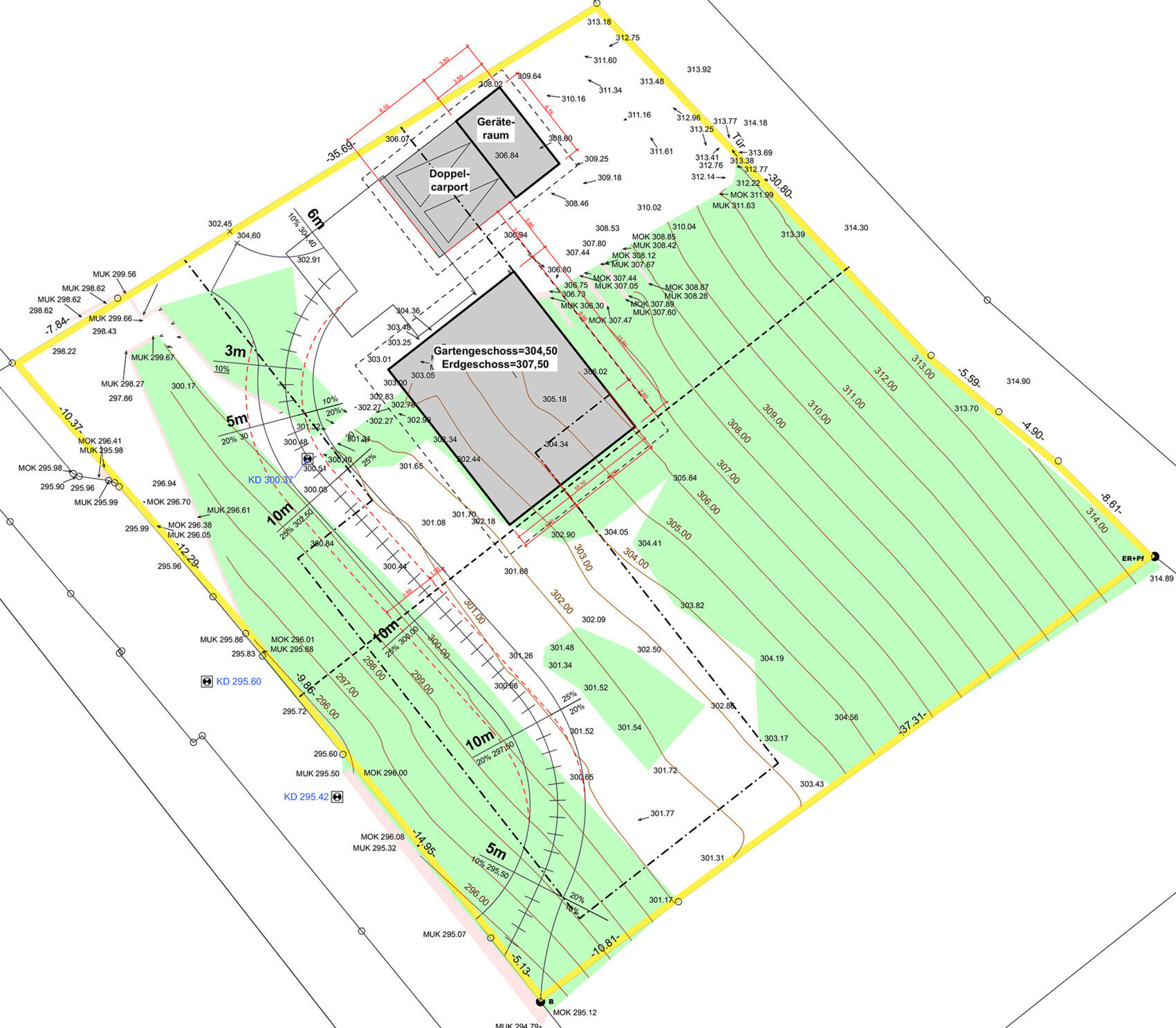
I have been trying for days to figure out how to route the driveway differently to reduce the steepness. If the start of the driveway is placed lower on the plot, more soil would have to be excavated, and the garden area would become smaller.
If the driveway is positioned higher up, closer to the road (no longer parallel to it), it would become longer, but significant fill and retaining measures would be needed there.
Maybe it would be enough to make the curves tighter and allow the driveway to rise more quickly? Or would that again cause problems for vehicle access?
The garage/carport could also be positioned somewhat lower, but it must be inside the building area (indicated by the dotted line). That would make access to the construction site or later deliveries to the house more difficult. In the future, climbing stairs will also be challenging for us as we get older if the driveway has more steps.
Does anyone have any good ideas or suggestions on what we could do?
We are now at the beginning of our planning process. The house design is already somewhat advanced, and we are currently gathering quotes for earthworks and landscaping.
About our plot: It is more than 2000 sqm (21,500 sq ft) in size and is located on a slope. The slope itself has an elevation difference of about 19 meters (62 feet) from the road to the forest path above the property. In the middle of the plot, there are already some terraces and a small existing building. This building is currently only accessible via a footpath and a few stairs.
The house will be positioned roughly in the center of the slope, at about 9 to 9.5 meters (30 to 31 feet) above street level.
During the house planning, our architect also included a driveway to the new building. However, at its steepest section, the driveway would have a 25% gradient.
Driving a car up it seems possible, but walking up might be difficult, right?
We also wonder about the driveway surface. Gravel with grid reinforcement might be challenging on a 25% slope, and even paving would likely need to be fully mortar-set. Snow and ice could cause additional issues.
The driveway is currently planned as follows:
Section – Gradient – Elevation (above sea level)
- 0 m – 0% – 295 m (967 ft)
- 5 m – 10% – 295.5 m (969 ft)
- 10 m – 20% – 297.5 m (976 ft)
- 10 m – 25% – 300 m (984 ft)
- 10 m – 25% – 302.5 m (993 ft)
- 5 m – 20% – 303.5 m (996 ft)
- 3 m – 10% – 303.8 m (997 ft)
- 6 m – 10% – 304.4 m (999 ft)
So the driveway is currently 49 meters (161 feet) long with an average linear gradient of 19.4%.
The current plan (simplified) is attached. It shows two versions, but neither changes the slope significantly.
I have been trying for days to figure out how to route the driveway differently to reduce the steepness. If the start of the driveway is placed lower on the plot, more soil would have to be excavated, and the garden area would become smaller.
If the driveway is positioned higher up, closer to the road (no longer parallel to it), it would become longer, but significant fill and retaining measures would be needed there.
Maybe it would be enough to make the curves tighter and allow the driveway to rise more quickly? Or would that again cause problems for vehicle access?
The garage/carport could also be positioned somewhat lower, but it must be inside the building area (indicated by the dotted line). That would make access to the construction site or later deliveries to the house more difficult. In the future, climbing stairs will also be challenging for us as we get older if the driveway has more steps.
Does anyone have any good ideas or suggestions on what we could do?
H
hampshire15 Oct 2020 21:36_pexed_ schrieb:
Does your driveway reach all the way to the house? How long is it, and what is the maximum steepness?
Would you build it the same way again? The driveway reaches up to the house level, which is 10.5m (34 feet) above the street. I don’t know the exact length at the moment; it’s somewhere between 80 and 110m (260 and 360 feet) depending on where you measure to. The slope is not linear; the steepest part is right at the beginning of the driveway and probably doesn’t exceed 20%. I haven’t measured it precisely.
At first, we planned to keep the slope gentler and intended to create the last section with stairs leading to the house. I’m really glad we had so much excavation material to build up the eastern slope and then rise with a slightly larger curve. Currently, the driveway is gravel, which doesn’t work well on the two steep sections. Guests and delivery drivers cannot manage to drive up without tire spin. So next year, we will revisit this and consider options. We don’t want to fully pave the entire area.
Climbee schrieb:
With the right earthworks, it can be done, but as mentioned, it will be costly. That shouldn’t be underestimated, but also shouldn’t be calculated separately since if you have excavation material from the house anyway and can reuse it, it positively affects another part of the budget, like transport and disposal. Besides the earthworks, retaining the slope is also not trivial – no matter what method you choose, it always costs a significant amount.
H
hampshire15 Oct 2020 21:38Escroda schrieb:
Is located outside the building envelope.You just have to ask if you can get approval for it. Sometimes you’re surprised by what is allowed and what isn’t.matte1987 schrieb:
How about a straight driveway with a turning area (red), a carport (black), and stairs (blue) leading up to the house?
The turning area would, of course, be level...
PS: The road could basically be cut into the slope. On the uphill side, it could be supported by a concrete wall or L-shaped retaining blocks, and the downhill side slightly sloped. The resulting triangle could then be planted.
PPS: You could then plant a hedge on the retaining blocks as a privacy screen towards the garden. The idea is quite similar to my last sketch:
Only that mine obviously has a curve and the garage is rotated within the building setback area. But that could really be a good idea, too.
Having the driveway go straight downhill is no problem either. The road is rarely used going north. There is a path going down in that direction, but I don’t think it is open to regular traffic.
hampshire schrieb:
The driveway reaches house level, which is 10.5m (34.4 ft) above the street. I don’t know the exact length at the moment; it’s somewhere between 80 and 110m (87 and 120 yards), depending on how it’s measured. The slope isn’t linear; the steepest section is right at the start of the driveway but shouldn’t exceed 20%. I haven’t measured it precisely.
At first, we planned to keep it less steep and use stairs for the last part leading to the house. I’m really glad we had so much excavation material to build up the slope on the east side and then approach the house with a slightly larger curve at a higher level. Currently, the driveway is gravel, which doesn’t work well on the two steep parts. Guests and delivery services have trouble driving up without tire spin. So, we are revisiting it next year to figure out a solution. We don’t want to fully pave the entire area.
This should not be underestimated, but also not considered in isolation. If you have building excavation on site and can reuse it, that’s positive for other budget items like transport and disposal. Besides earthworks, slope stabilization is no joke either—whatever method you choose, it always costs a considerable amount. That is already quite a stretch in your case. Over that distance, you can compensate a significant height difference.
Were you allowed to reuse the excavation material like that? I’ve heard that not every soil quality is suitable for building up (for example, under the driveway). Of course, it probably doesn’t matter in a normal, undeveloped garden, but if you need material for under the house or underneath the driveway, I understand it must meet certain quality standards, right?
Slope stabilization and geotechnical reports will be another interesting topic. We want to wait on that until it’s clear how the driveway will actually be constructed.
The neighbor on the undeveloped side has quite steep embankments (almost vertical) and about 3m (10 ft) high. They are densely overgrown with small trees and shrubs. That gives me hope the soil is pretty stable in terms of durability (if that’s the right term).
According to the geologists’ initial statement, it is probably sandstone overlain by mixed-grain slope sediments there… I hope that is good?
Depending on the location in Lower Franconia, winter maintenance should not be overlooked. Along the Main River, it is less of an issue, but in the Rhön and Spessart regions, it should be taken into account.
@hampshire try using grass pavers in that area or just paving the driveway track, as is often seen on rural paths.
@hampshire try using grass pavers in that area or just paving the driveway track, as is often seen on rural paths.
H
hampshire16 Oct 2020 08:00haydee schrieb:
Try paving the area with grass pavers or only the driving lane, as is often seen on farm tracks. I have thought about just preparing the driving lanes as well. We’ll just take a bit more time until we find the right solution. It also works fine as it is.
@_pexed_: We moved and used the stones and soil on the property, and no one questioned whether that was allowed. Considering the size of the plot, the excavation wasn’t very noticeable. It looks as if it has always been that way.
S
sichtbeton8216 Oct 2020 13:45Sorry, I misunderstood the slope. So obviously my picture doesn’t help here...
My dentist, who has since become a good friend, built his house earlier than ours. He then recommended the architect to us... For him, the slope is exactly the opposite to ours, like in your case. I can’t upload any pictures, but I’ll briefly describe it in words.
The street lies to the east. The driveway accesses the southernmost part of the plot (flat) up to about the middle. The driveway is approximately 3m (10 feet) wide. The lowest floor (basement) is set back about 6m (20 feet) compared to the ground floor above. You can park under the ground floor across nearly the whole width of the house (about 4 cars). Additionally, two more cars can park on the driveway in front of the house. The basement contains an entrance area (cloakroom) and access to the cellar room. There is also a service elevator there. The ground floor has the “main” entrance, three children’s rooms, a bedroom, bathrooms, and the utility room. On the upper floor is the open-plan living area (kitchen, living room, dining room) along with a toilet and a pantry. The service elevator has three stops: in the basement cellar room, the utility room on the ground floor (convenient for grilling in the garden), and the pantry on the upper floor.
I hope I managed to convey it reasonably well so you can get an idea.
My dentist, who has since become a good friend, built his house earlier than ours. He then recommended the architect to us... For him, the slope is exactly the opposite to ours, like in your case. I can’t upload any pictures, but I’ll briefly describe it in words.
The street lies to the east. The driveway accesses the southernmost part of the plot (flat) up to about the middle. The driveway is approximately 3m (10 feet) wide. The lowest floor (basement) is set back about 6m (20 feet) compared to the ground floor above. You can park under the ground floor across nearly the whole width of the house (about 4 cars). Additionally, two more cars can park on the driveway in front of the house. The basement contains an entrance area (cloakroom) and access to the cellar room. There is also a service elevator there. The ground floor has the “main” entrance, three children’s rooms, a bedroom, bathrooms, and the utility room. On the upper floor is the open-plan living area (kitchen, living room, dining room) along with a toilet and a pantry. The service elevator has three stops: in the basement cellar room, the utility room on the ground floor (convenient for grilling in the garden), and the pantry on the upper floor.
I hope I managed to convey it reasonably well so you can get an idea.
Similar topics