
Hello and thank you for reading my post!
We are now at the beginning of our planning process. The house design is already somewhat advanced, and we are currently gathering quotes for earthworks and landscaping.
About our plot: It is more than 2000 sqm (21,500 sq ft) in size and is located on a slope. The slope itself has an elevation difference of about 19 meters (62 feet) from the road to the forest path above the property. In the middle of the plot, there are already some terraces and a small existing building. This building is currently only accessible via a footpath and a few stairs.
The house will be positioned roughly in the center of the slope, at about 9 to 9.5 meters (30 to 31 feet) above street level.
During the house planning, our architect also included a driveway to the new building. However, at its steepest section, the driveway would have a 25% gradient.
Driving a car up it seems possible, but walking up might be difficult, right?
We also wonder about the driveway surface. Gravel with grid reinforcement might be challenging on a 25% slope, and even paving would likely need to be fully mortar-set. Snow and ice could cause additional issues.
The driveway is currently planned as follows:
Section – Gradient – Elevation (above sea level)
So the driveway is currently 49 meters (161 feet) long with an average linear gradient of 19.4%.
The current plan (simplified) is attached. It shows two versions, but neither changes the slope significantly.
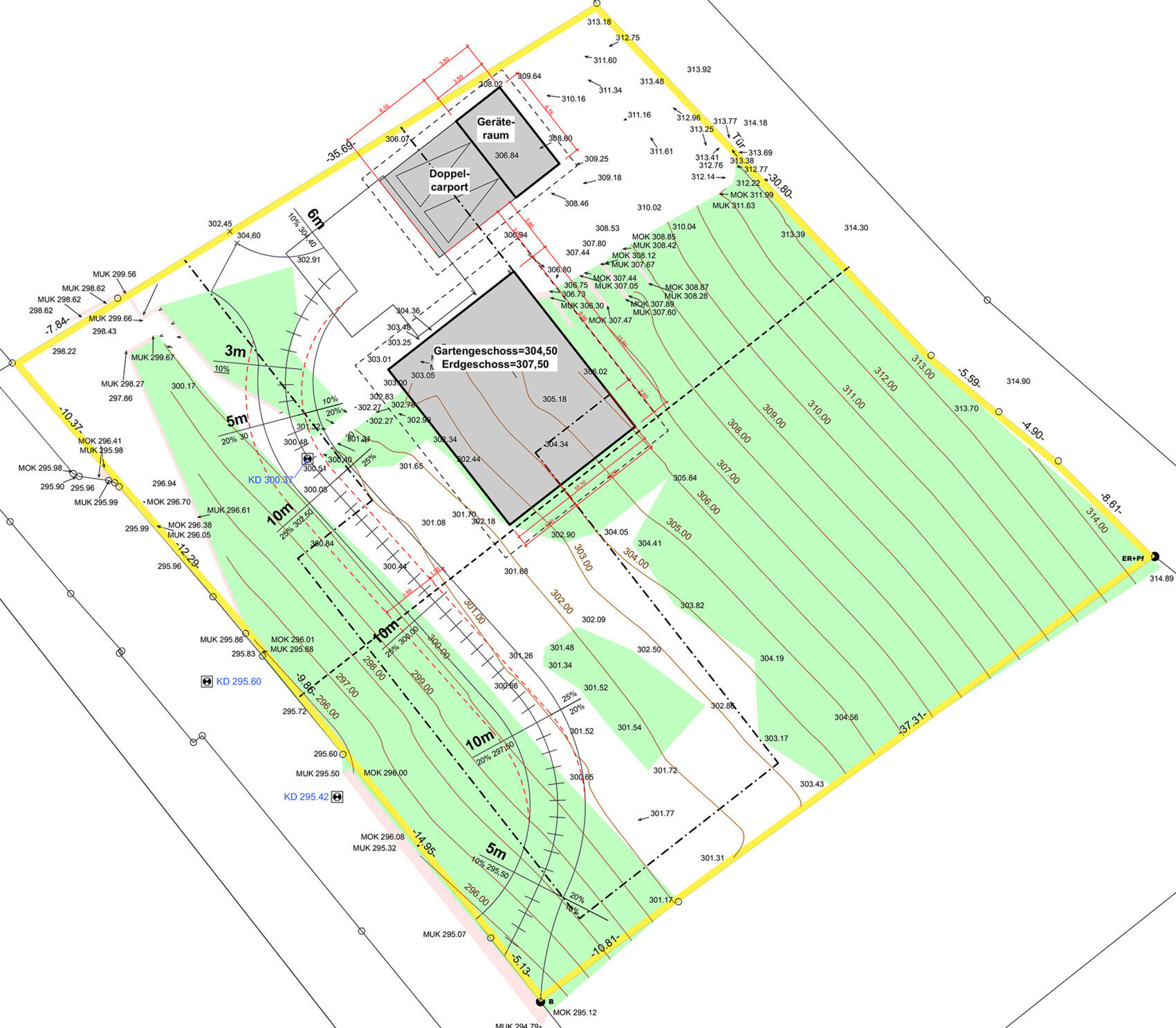
I have been trying for days to figure out how to route the driveway differently to reduce the steepness. If the start of the driveway is placed lower on the plot, more soil would have to be excavated, and the garden area would become smaller.
If the driveway is positioned higher up, closer to the road (no longer parallel to it), it would become longer, but significant fill and retaining measures would be needed there.
Maybe it would be enough to make the curves tighter and allow the driveway to rise more quickly? Or would that again cause problems for vehicle access?
The garage/carport could also be positioned somewhat lower, but it must be inside the building area (indicated by the dotted line). That would make access to the construction site or later deliveries to the house more difficult. In the future, climbing stairs will also be challenging for us as we get older if the driveway has more steps.
Does anyone have any good ideas or suggestions on what we could do?
We are now at the beginning of our planning process. The house design is already somewhat advanced, and we are currently gathering quotes for earthworks and landscaping.
About our plot: It is more than 2000 sqm (21,500 sq ft) in size and is located on a slope. The slope itself has an elevation difference of about 19 meters (62 feet) from the road to the forest path above the property. In the middle of the plot, there are already some terraces and a small existing building. This building is currently only accessible via a footpath and a few stairs.
The house will be positioned roughly in the center of the slope, at about 9 to 9.5 meters (30 to 31 feet) above street level.
During the house planning, our architect also included a driveway to the new building. However, at its steepest section, the driveway would have a 25% gradient.
Driving a car up it seems possible, but walking up might be difficult, right?
We also wonder about the driveway surface. Gravel with grid reinforcement might be challenging on a 25% slope, and even paving would likely need to be fully mortar-set. Snow and ice could cause additional issues.
The driveway is currently planned as follows:
Section – Gradient – Elevation (above sea level)
- 0 m – 0% – 295 m (967 ft)
- 5 m – 10% – 295.5 m (969 ft)
- 10 m – 20% – 297.5 m (976 ft)
- 10 m – 25% – 300 m (984 ft)
- 10 m – 25% – 302.5 m (993 ft)
- 5 m – 20% – 303.5 m (996 ft)
- 3 m – 10% – 303.8 m (997 ft)
- 6 m – 10% – 304.4 m (999 ft)
So the driveway is currently 49 meters (161 feet) long with an average linear gradient of 19.4%.
The current plan (simplified) is attached. It shows two versions, but neither changes the slope significantly.
I have been trying for days to figure out how to route the driveway differently to reduce the steepness. If the start of the driveway is placed lower on the plot, more soil would have to be excavated, and the garden area would become smaller.
If the driveway is positioned higher up, closer to the road (no longer parallel to it), it would become longer, but significant fill and retaining measures would be needed there.
Maybe it would be enough to make the curves tighter and allow the driveway to rise more quickly? Or would that again cause problems for vehicle access?
The garage/carport could also be positioned somewhat lower, but it must be inside the building area (indicated by the dotted line). That would make access to the construction site or later deliveries to the house more difficult. In the future, climbing stairs will also be challenging for us as we get older if the driveway has more steps.
Does anyone have any good ideas or suggestions on what we could do?
Detective @Escroda has struck again.
The issue with the "green strips" is a bit complicated. I will talk directly to the city to see what can be done. The development plan is still relatively recent, and I think they simply tried to fit the existing situation into a proper planning framework. Many of the regulations have also not been followed by (newer) houses. Hopefully, we will be able to get some exceptions.
@11ant is also right! The garage really doesn’t need to be on the summit cross, and the base camp should be sufficient. I just didn’t quite understand the part about the curve.
If the curve also has a gradient, does that make it less severe (in terms of the curve)?
Does anyone happen to know what radius or diameter such a curve with a gradient is allowed to have?
The issue with the "green strips" is a bit complicated. I will talk directly to the city to see what can be done. The development plan is still relatively recent, and I think they simply tried to fit the existing situation into a proper planning framework. Many of the regulations have also not been followed by (newer) houses. Hopefully, we will be able to get some exceptions.
@11ant is also right! The garage really doesn’t need to be on the summit cross, and the base camp should be sufficient. I just didn’t quite understand the part about the curve.
If the curve also has a gradient, does that make it less severe (in terms of the curve)?
Does anyone happen to know what radius or diameter such a curve with a gradient is allowed to have?

_pexed_ schrieb:
If the curve also has a slope at the same time, it’s not quite as extreme (meaning the curve), right?I didn’t think of it that way, but of course that’s true: "Pythagoras" also works in three dimensions, which naturally applies to curves just as much as to straight lines.https://www.instagram.com/11antgmxde/
https://www.linkedin.com/company/bauen-jetzt/
N
Nice-Nofret15 Oct 2020 19:41It depends on your car; the T-Roc has a turning circle of about 11 meters (36 feet), but there are also turning circles of 13 meters (43 feet) and more. A Smart car can manage with about 7 meters (23 feet).
The steeper the road and the tighter the curve, the more likely you are to end up in a ditch during winter when going downhill. When driving uphill, most people get stuck in steep curves... I often see people unfamiliar with mountain roads struggling to drive on narrow mountain roads.
If it becomes too steep, there should be a crash barrier in the curve.
The steeper the road and the tighter the curve, the more likely you are to end up in a ditch during winter when going downhill. When driving uphill, most people get stuck in steep curves... I often see people unfamiliar with mountain roads struggling to drive on narrow mountain roads.
If it becomes too steep, there should be a crash barrier in the curve.
How about a straight driveway with a turning area (red), a carport (black), and a staircase (blue) leading to the house?
The turning area would, of course, be level...
Note: The road could basically be cut into the slope. On the uphill side, it would be supported with a concrete wall or retaining blocks, and the slope side could be slightly graded. The resulting triangle could then be planted.
Note 2: On the retaining blocks, a hedge could be planted as a privacy screen toward the garden.
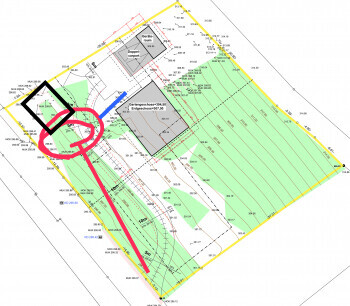
The turning area would, of course, be level...
Note: The road could basically be cut into the slope. On the uphill side, it would be supported with a concrete wall or retaining blocks, and the slope side could be slightly graded. The resulting triangle could then be planted.
Note 2: On the retaining blocks, a hedge could be planted as a privacy screen toward the garden.
_pexed_ schrieb:
Detective @Escroda has struck again. Yes, I am always so impatient. I just couldn’t wait until Christmas.
matte1987 schrieb:
How about a straight driveway? With a 6 m (20 feet) wide street, the property would hardly be accessible from the north. Well – it isn’t a main road – some maneuvering is certainly possible, but it would be quite inconvenient.
matte1987 schrieb:
Carport (black) It is located outside the building permit / planning permission area.
Similar topics