
Hello and thank you for reading my post!
We are now at the beginning of our planning process. The house design is already somewhat advanced, and we are currently gathering quotes for earthworks and landscaping.
About our plot: It is more than 2000 sqm (21,500 sq ft) in size and is located on a slope. The slope itself has an elevation difference of about 19 meters (62 feet) from the road to the forest path above the property. In the middle of the plot, there are already some terraces and a small existing building. This building is currently only accessible via a footpath and a few stairs.
The house will be positioned roughly in the center of the slope, at about 9 to 9.5 meters (30 to 31 feet) above street level.
During the house planning, our architect also included a driveway to the new building. However, at its steepest section, the driveway would have a 25% gradient.
Driving a car up it seems possible, but walking up might be difficult, right?
We also wonder about the driveway surface. Gravel with grid reinforcement might be challenging on a 25% slope, and even paving would likely need to be fully mortar-set. Snow and ice could cause additional issues.
The driveway is currently planned as follows:
Section – Gradient – Elevation (above sea level)
So the driveway is currently 49 meters (161 feet) long with an average linear gradient of 19.4%.
The current plan (simplified) is attached. It shows two versions, but neither changes the slope significantly.
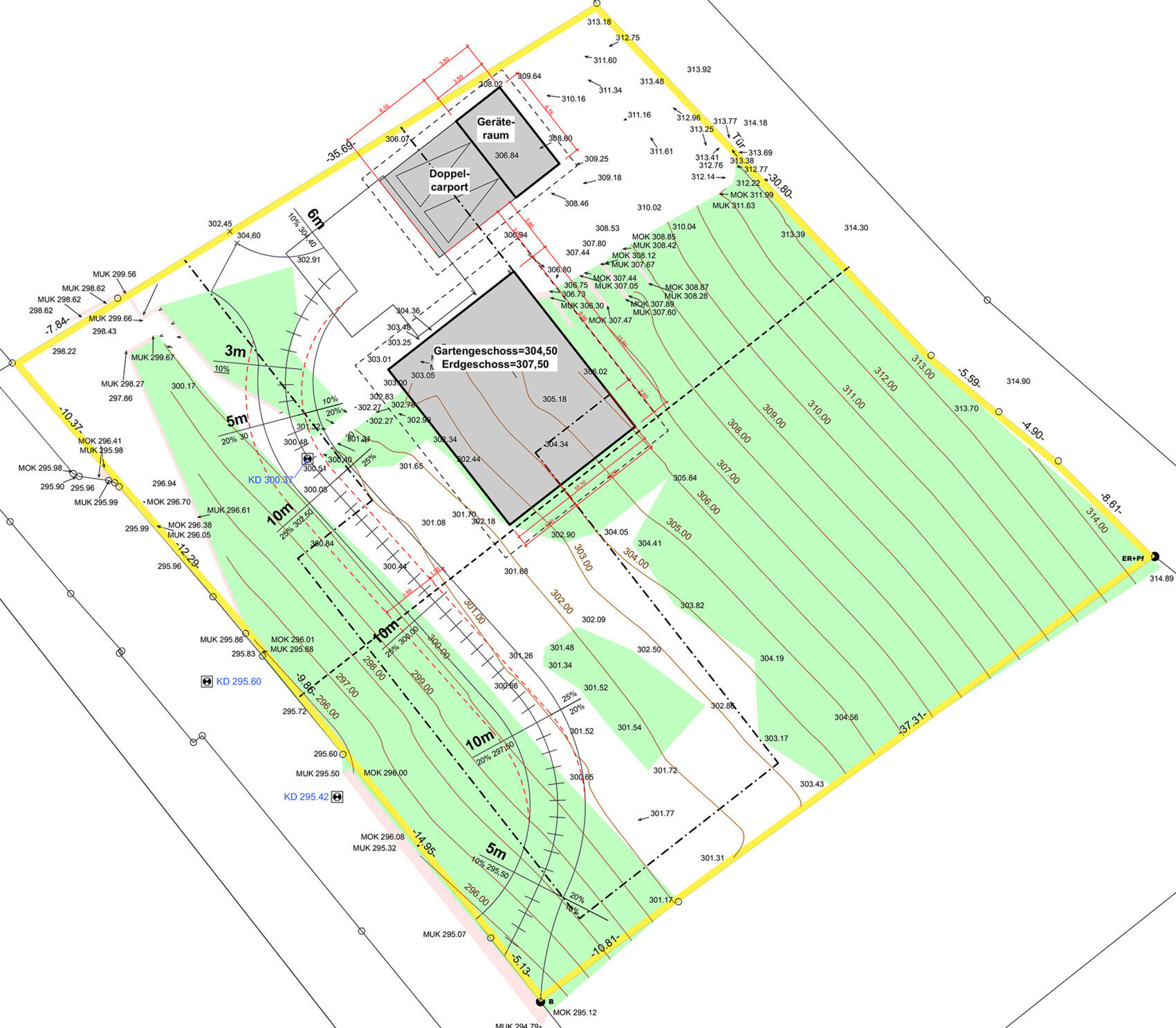
I have been trying for days to figure out how to route the driveway differently to reduce the steepness. If the start of the driveway is placed lower on the plot, more soil would have to be excavated, and the garden area would become smaller.
If the driveway is positioned higher up, closer to the road (no longer parallel to it), it would become longer, but significant fill and retaining measures would be needed there.
Maybe it would be enough to make the curves tighter and allow the driveway to rise more quickly? Or would that again cause problems for vehicle access?
The garage/carport could also be positioned somewhat lower, but it must be inside the building area (indicated by the dotted line). That would make access to the construction site or later deliveries to the house more difficult. In the future, climbing stairs will also be challenging for us as we get older if the driveway has more steps.
Does anyone have any good ideas or suggestions on what we could do?
We are now at the beginning of our planning process. The house design is already somewhat advanced, and we are currently gathering quotes for earthworks and landscaping.
About our plot: It is more than 2000 sqm (21,500 sq ft) in size and is located on a slope. The slope itself has an elevation difference of about 19 meters (62 feet) from the road to the forest path above the property. In the middle of the plot, there are already some terraces and a small existing building. This building is currently only accessible via a footpath and a few stairs.
The house will be positioned roughly in the center of the slope, at about 9 to 9.5 meters (30 to 31 feet) above street level.
During the house planning, our architect also included a driveway to the new building. However, at its steepest section, the driveway would have a 25% gradient.
Driving a car up it seems possible, but walking up might be difficult, right?
We also wonder about the driveway surface. Gravel with grid reinforcement might be challenging on a 25% slope, and even paving would likely need to be fully mortar-set. Snow and ice could cause additional issues.
The driveway is currently planned as follows:
Section – Gradient – Elevation (above sea level)
- 0 m – 0% – 295 m (967 ft)
- 5 m – 10% – 295.5 m (969 ft)
- 10 m – 20% – 297.5 m (976 ft)
- 10 m – 25% – 300 m (984 ft)
- 10 m – 25% – 302.5 m (993 ft)
- 5 m – 20% – 303.5 m (996 ft)
- 3 m – 10% – 303.8 m (997 ft)
- 6 m – 10% – 304.4 m (999 ft)
So the driveway is currently 49 meters (161 feet) long with an average linear gradient of 19.4%.
The current plan (simplified) is attached. It shows two versions, but neither changes the slope significantly.
I have been trying for days to figure out how to route the driveway differently to reduce the steepness. If the start of the driveway is placed lower on the plot, more soil would have to be excavated, and the garden area would become smaller.
If the driveway is positioned higher up, closer to the road (no longer parallel to it), it would become longer, but significant fill and retaining measures would be needed there.
Maybe it would be enough to make the curves tighter and allow the driveway to rise more quickly? Or would that again cause problems for vehicle access?
The garage/carport could also be positioned somewhat lower, but it must be inside the building area (indicated by the dotted line). That would make access to the construction site or later deliveries to the house more difficult. In the future, climbing stairs will also be challenging for us as we get older if the driveway has more steps.
Does anyone have any good ideas or suggestions on what we could do?
Hello,
I would keep the carport at the northwest property boundary but move it to the elevation line 302. Then make the driveway straight. Who wants to drive curves on icy roads? You will still have about 1 meter (3 feet) of height, which can be easily managed with a staircase. The driveway from the carport would then head southwest. The slope would be about 15%.
Enjoy working on it.
I would keep the carport at the northwest property boundary but move it to the elevation line 302. Then make the driveway straight. Who wants to drive curves on icy roads? You will still have about 1 meter (3 feet) of height, which can be easily managed with a staircase. The driveway from the carport would then head southwest. The slope would be about 15%.
Enjoy working on it.
Escroda schrieb:
Information is slowly coming in, but there are still some unclear points.
The site plan shows a garden level and a ground floor. I assume that the height measurements refer to the top edge of the finished floor. This means the garden level is already 2.30m (7.5 feet) above the existing ground on the valley side. Does the term “basement” refer to another floor, or how is this height difference supposed to be handled?
That would be more than four floor heights! What about the roof edge (eaves, ridge)? What exactly is specified in the zoning plan / building permit?
What does that mean in absolute terms? How deep can the finished floor level of the lowest floor be before the desired view is restricted?
So then:
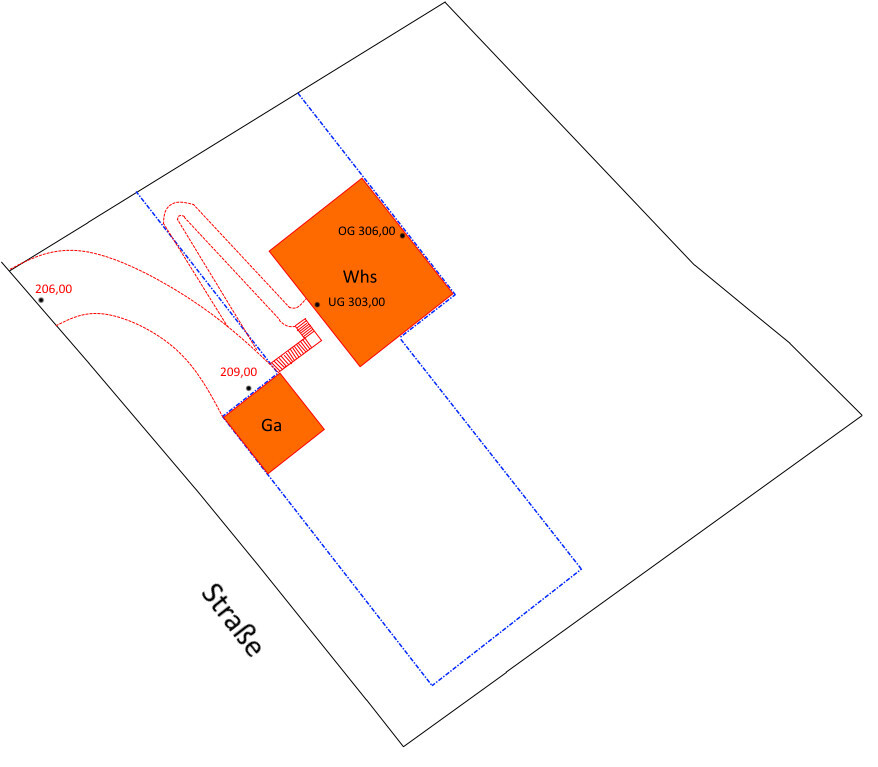
It’s not barrier-free, but my limit of 15% slope is maintained.
Well, the exaggeration might make it clearer, but in reality it would be a maximum of 2m (6.6 feet). With the new proposal, the garage fits nicely into the terrain, 1.5 sides underground and no overlapping anymore.
Floor plans and elevations would be helpful so we know where the entrance is supposed to be. Also, the street width to assess the driveway angle. And the date of the zoning plan / building permit to estimate exemption options. And the zoning plan drawing. And the written conditions. And the justification. And ... oh right, Christmas is still so far away?Thanks for the idea! That could be a good option!
Sorry for the missing information. I also assume the height measurements are as you say. Unfortunately, we don’t have any cross sections or finalized floor plans yet. However, the entrance will be on the northwest side—somewhat far back, roughly where the original plan shows the carport. There will be an additional exit on the upper floor on the northeast side and exits to the garden on the lower floor (southwest and southeast).
I just received a call confirming we’ll get the first proper drawings and visualization by the end of the month.
There will only be two floors. My terminology wasn’t very precise. There is a basement/garden level (i.e. “lower”) and a ground floor (“upper”). As already mentioned, the lower floor is at least partly against the slope on the entire backside.
Regarding the possible heights in the zoning plan / building permit: it allows a maximum of two floors plus an (expanded) attic:
1 full floor, 1 garden floor counted as a full floor, and 1 attic floor counted as a full floor as the upper limit. On the mountain side, 1 full floor is mandatory. Attic extensions per applicable building code. Wall heights: valley-side building lines, mountain side up to 4.0 m (13 feet) above the street, valley side up to 7.0 m (23 feet) above terrain; mountain-side building lines, mountain side up to 4.0 m (13 feet) above terrain, valley side up to 7.0 m (23 feet) above terrain. Terrain modifications are permitted according to regulations in order to comply with wall height limits.
If I understand this correctly, and judging by the houses that block our view, those shouldn’t be more than 10 meters (33 feet) high (4m floor + attic?).
If our house were to start about 9 meters (30 feet) above street level, you could still look over those houses from the garden level.
sichtbeton82 schrieb:
Sloping plots. By now, I love them . 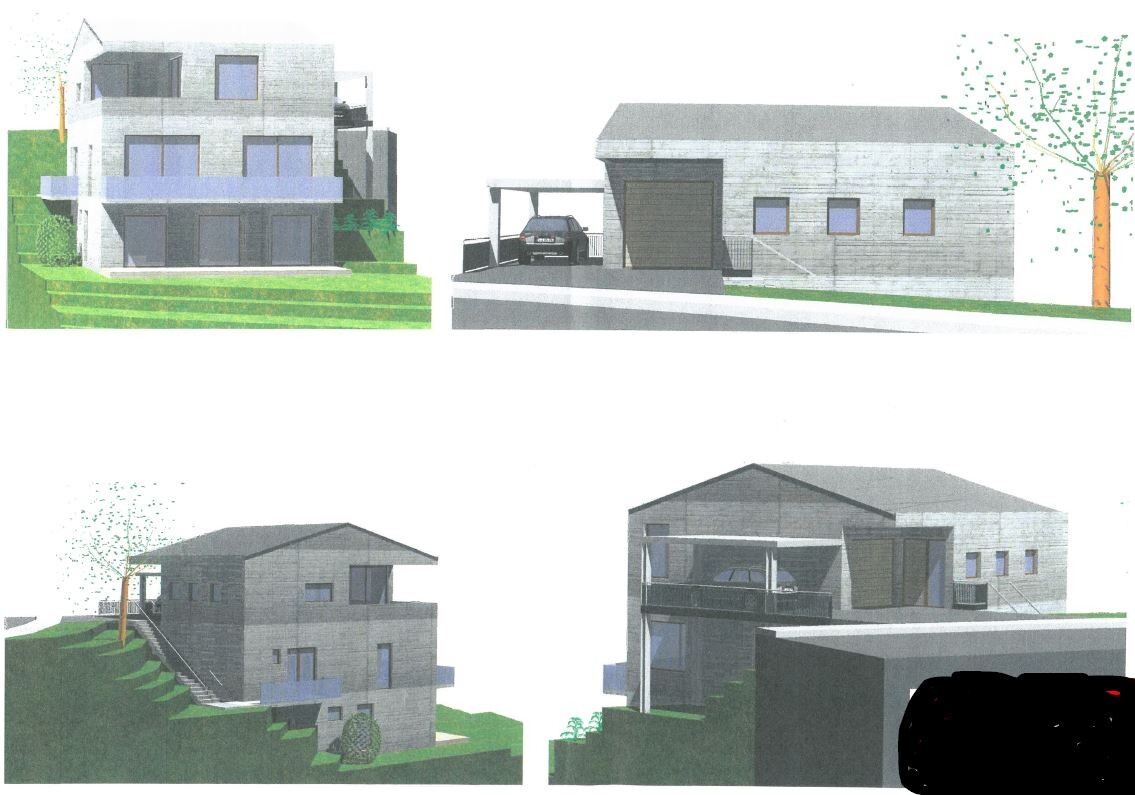 I’ll just throw this picture in. This was an alternative design from our side. It might be an option for you.
Thanks for the images. For us, the driveway issue is exactly the opposite. Our house is positioned above the road, on the mountain side. Otherwise, it’s quite similar (except we have one less floor).
I’ve also made a new plan showing how the driveway could look. With this design, the height of the garage with the driveway could be moved further down or up to better match the driveway slope. An additional path from the street, along the driveway, all the way to the house would also be possible.
A terrace or something similar could even be realized on top of the garage.
What do you think?
Somehow, this doesn’t quite add up for me.
Several tens of thousands of euros are planned for the driveway, just to park the cars in a carport — along with all the disadvantages that such a driveway brings. If you don’t want to relocate the house (why not have a garage in the basement?), I would rather place the carport more conveniently.
Put the carport at the edge with almost no driveway and no height difference. From there, create a nice path with stairs leading up to the house.
A sloped site requires solutions that work WITH the land, not against it. Garden + living/kitchen/dining + access path + car parking on the same level rarely go together...
We had to learn this during our planning phase as well.
We insisted on having the car and front door on the garden level, which would have meant a driveway about 15 m (50 feet) long with approximately 1.5–2 m (5–6.5 feet) height difference, and no turning space.
Now we enter the house at ground level from the car and have to go up half a story (split-level) via stairs to reach the kitchen.
But I prefer walking those stairs in dry conditions.
A nice side effect is that I don’t have to shovel a single square meter of snow.
So, I would focus more on the positioning of the house and especially the carport, rather than on the steep slope of this extreme driveway.
Side note: For the money saved by avoiding a monstrous driveway, you can afford snow removal service for life or simply build a garage.
Several tens of thousands of euros are planned for the driveway, just to park the cars in a carport — along with all the disadvantages that such a driveway brings. If you don’t want to relocate the house (why not have a garage in the basement?), I would rather place the carport more conveniently.
Put the carport at the edge with almost no driveway and no height difference. From there, create a nice path with stairs leading up to the house.
A sloped site requires solutions that work WITH the land, not against it. Garden + living/kitchen/dining + access path + car parking on the same level rarely go together...
We had to learn this during our planning phase as well.
We insisted on having the car and front door on the garden level, which would have meant a driveway about 15 m (50 feet) long with approximately 1.5–2 m (5–6.5 feet) height difference, and no turning space.
Now we enter the house at ground level from the car and have to go up half a story (split-level) via stairs to reach the kitchen.
But I prefer walking those stairs in dry conditions.
A nice side effect is that I don’t have to shovel a single square meter of snow.
So, I would focus more on the positioning of the house and especially the carport, rather than on the steep slope of this extreme driveway.
Side note: For the money saved by avoiding a monstrous driveway, you can afford snow removal service for life or simply build a garage.
Homeowner schrieb:
Hello,
I would keep the carport at the northwest property boundary but shift it to the elevation line 302. Then straighten the driveway. Who wants to drive curves on icy roads? Then you still have about 1 m (3 feet) of height difference, which can be easily managed with a staircase. The driveway from the carport would then head southwest. The slope would be about 15%.
Have fun tinkering. I think I’m a bit confused here. So you mean placing the carport directly next to the house (like in the first plan), but 2.5 m (8 feet) lower (which would be manageable with stairs), and then going straight down to the street?
That would be a 6 m (20 feet) difference (street at 296 and carport at 302) over about 25 m (82 feet) distance. That means a slope of over 25%.
Did I misunderstand your suggestion?
matte1987 schrieb:
This somehow doesn’t add up for me.
Several tens of thousands of euros are planned just for the driveway, only to park cars in a carport, along with all the disadvantages such a driveway brings. If you don’t want to move the house (why not have a garage in the basement?), I would rather place the carport more practically.
Carport at the edge with almost no driveway or height difference. From there a nice path with stairs leading up to the house.
Slopes require solutions that work WITH the land, not against it. Garden + living/kitchen/dining + access path + car parking on one level is rarely achievable...
We had to learn this in our own planning phase too.
We wanted to force the car and front door on garden level, which would have resulted in a driveway about 15 m (49 feet) long with a 1.5–2 m (5–6.5 feet) height difference and no turning space.
Now we enter the house from the car on a level surface but have half a story (split-level) and stairs to overcome to get to the kitchen.
I prefer that, especially since it means I don’t have to shovel any snow.
So I’d focus more on the positioning of the house and especially the carport, rather than on fixing that steep driveway.
Bonus: The money you save by avoiding a monstrous driveway could pay for lifelong snow removal service, or just building a garage outright. You’re really bringing up some good points. The all-in-one perfect solution probably doesn’t exist (especially in house building). The length of the driveway itself doesn’t bother me that much since we’ll need some sort of construction access anyway. Earthworks and a stable base have to be done either way.
Putting the garage in the basement (you mean under the garden level, right?) isn’t allowed by the development plan. Moving the garage to the garden level is not an option for us because we prefer living space there and an external carport or garage.
Placing the garage further down has been suggested before. The downside is that it would be quite deep below ground and you’d have a lot of stairs to climb up to the house. That’s not a problem for us (we currently live on the 4th floor without an elevator), but it’s inconvenient when delivering big items or after large shopping trips.
What do you think of my last suggestion? The driveway would still be fairly long, but earthworks would be somewhat reduced. It might not be so obvious on the original plan, but where the garage would be, there’s a slope, then a plateau (where the old house stands). In front of that is the current path upwards and another plateau about 1 m (3 feet) lower than the driveway.
Homeowner schrieb:
It doesn’t make sense to plan the first curve with a 30% gradient and then continue along the elevation line. Were you referring to my last sketch? Of course the driveway shouldn’t have a 30% grade and then continue straight. The 6 m (20 feet) height difference should be spread over about 40 m (131 feet), resulting in an average slope of around 15%.
_pexed_ schrieb:
I think I’m a bit confused here. So, place the carport directly next to the house (as on the first plan), but 2.5 meters (8 feet) lower (which is possible with stairs), and then go straight down to the street?
That would be a 6-meter (20 feet) difference in height (street at 296 and carport at 302), which would have to be managed over about 25 meters (82 feet). That would mean a slope of more than 25%.
Have I misunderstood the suggestion?
I guess the garden level confused me.
Were you referring to my last sketch? The driveway shouldn’t have a 30% slope and then be flat. The height difference (6 meters / 20 feet) should be spread out over about 40 meters (131 feet), resulting in an average slope of around 15%. The way the architect drew the first curve, or as you did in your sketch, it hardly works properly. You end up with at least a 30% slope or would need major cuttings. By adjusting the angle relative to the contour lines, this can be mitigated.
Similar topics