
Hello everyone,
The soil report has determined that 1 meter (3.3 feet) of topsoil within a 1 meter (3.3 feet) radius around the foundation slab must be removed and replaced. Additionally, a perimeter drainage system needs to be installed around and beneath the foundation slab.
Now the following questions arise:
The soil report has determined that 1 meter (3.3 feet) of topsoil within a 1 meter (3.3 feet) radius around the foundation slab must be removed and replaced. Additionally, a perimeter drainage system needs to be installed around and beneath the foundation slab.
Now the following questions arise:
- We want to build a double garage measuring 9 x 6 meters (30 x 20 feet) directly on the property boundary. On the neighboring property, right on the boundary, there is a prefabricated garage measuring 2.5 x 5 meters (8 x 16 feet). Excavation on the boundary side cannot be done within a 1 meter (3.3 feet) radius around the garage, but only up to the boundary itself. How is the 1 meter (3.3 feet) deep excavation supposed to be carried out directly on the boundary? A slope cannot be created due to the prefabricated garage.
- What is the purpose of the perimeter drainage system beneath the foundation slab? There can be no precipitation water there, and water coming from the sides is supposed to be drained through the ring drainage system.
O
Osnabruecker26 Dec 2019 16:17A few pieces of information and assessments are missing for proper, expert advice.
Why does the soil report recommend soil replacement and drainage? Is there perched water on the slope? Groundwater? Cautious expert ("belt and suspenders" approach), who commissioned or arranged for the report?
What does the expert say about the type of soil to be installed? ...
Tip:
Communication helps.
Talk to the expert – that’s what they were paid for.
Talk to another specialist (expert/earthworks contractor).
Also, speak with your future neighbors. They usually know the soil conditions best (water in the basement, etc.).
Why does the soil report recommend soil replacement and drainage? Is there perched water on the slope? Groundwater? Cautious expert ("belt and suspenders" approach), who commissioned or arranged for the report?
What does the expert say about the type of soil to be installed? ...
Tip:
Communication helps.
Talk to the expert – that’s what they were paid for.
Talk to another specialist (expert/earthworks contractor).
Also, speak with your future neighbors. They usually know the soil conditions best (water in the basement, etc.).
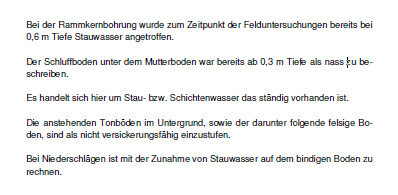
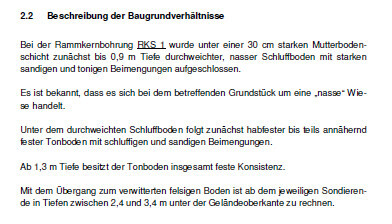
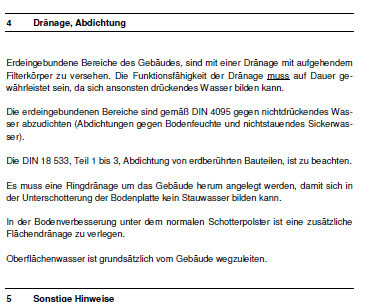
I have attached some excerpts from the expert report.
Of course, I have spoken with the surveyor several times, but he stands by his assessment. Whether he is a cautious surveyor, I cannot judge.
The plot is completely flat and not located on a slope.
The neighbors are unaware of anything.

Of course, I have spoken with the surveyor several times, but he stands by his assessment. Whether he is a cautious surveyor, I cannot judge.
The plot is completely flat and not located on a slope.
The neighbors are unaware of anything.
O
Osnabruecker26 Dec 2019 16:58According to the expert report, everything is logically consistent.
You don't want to build on clay or loose soil. Whether the gravel layer is 55 cm (22 inches) or 30 cm (12 inches) thick should ultimately depend on the structural engineer’s assumptions regarding the load for the foundations.
In my opinion, the drainage below the gravel is an additional, not unnecessary, safety measure. Even if you have perimeter drainage at gravel level on the outside, it is by no means a cure-all. Water always finds its way...
The 1 m (3 ft 3 in) wide continuous gravel bedding serves, among other things, to distribute the load but also as a working platform for scaffolding. The latter isn’t needed for building on a property boundary. The former is less significant for a garage, where strip foundations might be more appropriate than gravel.
Following my list above, the next step would be consulting the structural engineer. They should, of course, receive the soil report.
For your information: Structural engineer—make sure to point out the existing neighboring building on the property boundary. Otherwise, the “standard” structural calculations will be applied.
You don't want to build on clay or loose soil. Whether the gravel layer is 55 cm (22 inches) or 30 cm (12 inches) thick should ultimately depend on the structural engineer’s assumptions regarding the load for the foundations.
In my opinion, the drainage below the gravel is an additional, not unnecessary, safety measure. Even if you have perimeter drainage at gravel level on the outside, it is by no means a cure-all. Water always finds its way...
The 1 m (3 ft 3 in) wide continuous gravel bedding serves, among other things, to distribute the load but also as a working platform for scaffolding. The latter isn’t needed for building on a property boundary. The former is less significant for a garage, where strip foundations might be more appropriate than gravel.
Following my list above, the next step would be consulting the structural engineer. They should, of course, receive the soil report.
For your information: Structural engineer—make sure to point out the existing neighboring building on the property boundary. Otherwise, the “standard” structural calculations will be applied.
Similar topics