
ᐅ Drainpipe nominal diameter 32 mm sealed inside into nominal diameter 40 mm
Created on: 2 Feb 2024 21:39
M
Matthias_OM
Matthias_O2 Feb 2024 21:39Hello.
I have an existing floor drain (see sketch), it is an HL541. I want to seal an additional pipe, for example a DN32 pipe with an elbow, into the drain opening.
But how?
The inner diameter of the drain opening is about 36mm (1.4 inches), similar to a DN40 pipe, and the outer diameter of a DN32 pipe is 32mm (1.26 inches).
I would need a gasket between them.
Is there a suitable sleeve gasket for this? The sleeve gaskets I have seen and tested so far were all too thick, I couldn’t get them into the drain opening.
Or getting them in was possible, but then the DN32 pipe no longer fit inside. A standard 40/32 sleeve gasket is not meant for this, I know, since it has an outer diameter of at least 40mm (1.57 inches).
I would need a 36/32 sleeve gasket—does such a thing exist?
Does anyone have an idea how I can seal this properly? Also, it needs to be removable; I don’t want to glue it since it must be reversible.
PS: The pipe I want to seal into the floor drain does not necessarily have to be DN32. It can also be DN40 or something else.
Maybe someone has an idea for a different pipe solution?
Thanks, Matthias
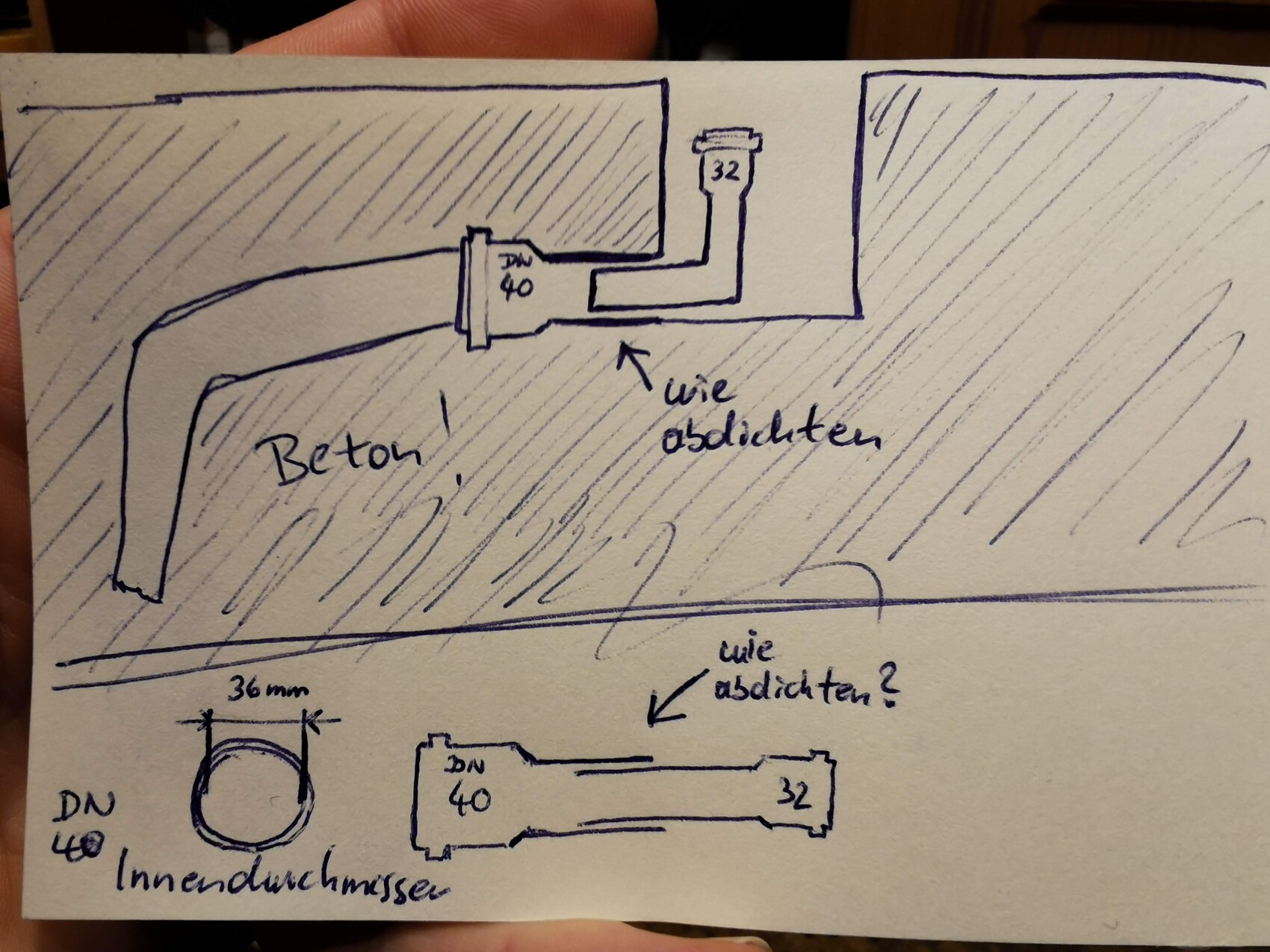
I have an existing floor drain (see sketch), it is an HL541. I want to seal an additional pipe, for example a DN32 pipe with an elbow, into the drain opening.
But how?
The inner diameter of the drain opening is about 36mm (1.4 inches), similar to a DN40 pipe, and the outer diameter of a DN32 pipe is 32mm (1.26 inches).
I would need a gasket between them.
Is there a suitable sleeve gasket for this? The sleeve gaskets I have seen and tested so far were all too thick, I couldn’t get them into the drain opening.
Or getting them in was possible, but then the DN32 pipe no longer fit inside. A standard 40/32 sleeve gasket is not meant for this, I know, since it has an outer diameter of at least 40mm (1.57 inches).
I would need a 36/32 sleeve gasket—does such a thing exist?
Does anyone have an idea how I can seal this properly? Also, it needs to be removable; I don’t want to glue it since it must be reversible.
PS: The pipe I want to seal into the floor drain does not necessarily have to be DN32. It can also be DN40 or something else.
Maybe someone has an idea for a different pipe solution?
Thanks, Matthias
A
Allthewayup2 Feb 2024 21:52Modify EPDM conical hollow plugs slightly, glue them onto the DN32 pipe, and then press them into the larger DN40 pipe. This should hold and is reversible.
Alternatively, use an EPDM rubber sleeve.
Just search online, as there are solutions available for these kinds of situations.
Alternatively, use an EPDM rubber sleeve.
Just search online, as there are solutions available for these kinds of situations.
M
Matthias_O3 Feb 2024 09:27Allthewayup schrieb:
Modify EPDM conical hollow plugs slightly, glue them onto the DN32 pipe, and then press them into the larger DN40 pipe. It should hold and is reversible.
Alternatively, use an EPDM rubber sleeve.
Just try searching online; there are solutions available for these kinds of situations. Thanks in advance, yes, that actually sounds quite promising.
M
Matthias_O3 Feb 2024 09:28My first sketch was just a simple diagram to help understand what I want to do more quickly.
It’s not really a standard 40mm (1.57 inch) pipe; it’s actually the outlet spigot of a floor drain, which is shaped like a 40mm (1.57 inch) pipe.
I need to somehow create a sealed connection for another pipe inside the outlet spigot of the floor drain.
The outlet spigot of the floor drain has an internal diameter of about 36mm (1.42 inch).
Ultimately, I want to connect a freestanding or semi-freestanding bathtub (wall bathtub) with a drain into the floor drain (which was originally meant as a shower drain).
Here is a new sketch with more details, showing how it really is...
I somehow need to connect the flexible hose coming from the bathtub trap into the floor drain.
I know it’s not correct as shown. I’m also aware that if I reduce from a 40mm (1.57 inch) pipe from the bathtub down to DN32 (about 32mm/1.26 inch), this creates a weak point that is prone to clogging.
But since it’s a semi-freestanding bathtub, I can still move it relatively easily to fix any potential clog.
What I am not allowed to do (because it’s a rental apartment) is break open the floor to install a new connection.
Thank you for your advice. Matthias.
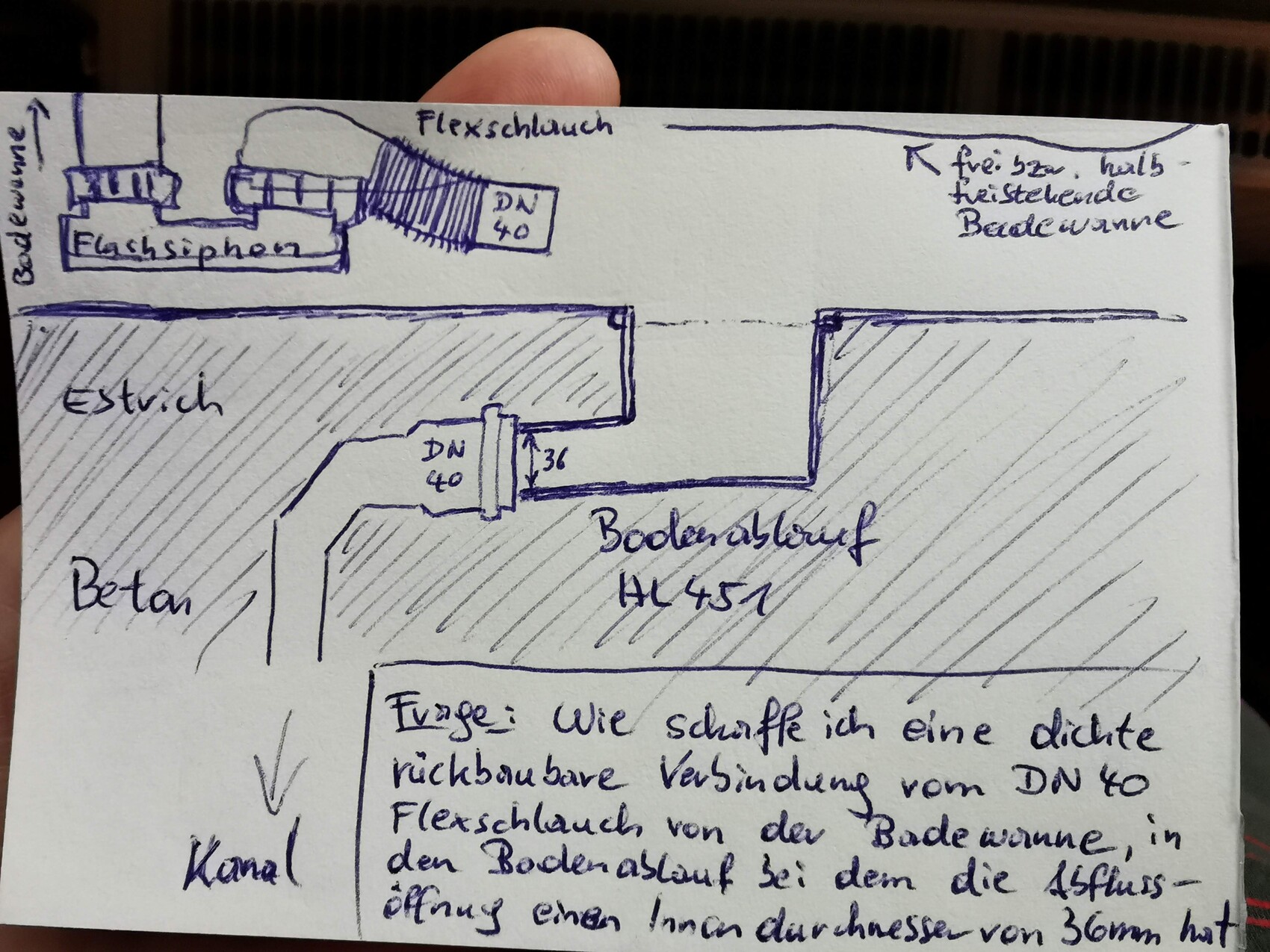
It’s not really a standard 40mm (1.57 inch) pipe; it’s actually the outlet spigot of a floor drain, which is shaped like a 40mm (1.57 inch) pipe.
I need to somehow create a sealed connection for another pipe inside the outlet spigot of the floor drain.
The outlet spigot of the floor drain has an internal diameter of about 36mm (1.42 inch).
Ultimately, I want to connect a freestanding or semi-freestanding bathtub (wall bathtub) with a drain into the floor drain (which was originally meant as a shower drain).
Here is a new sketch with more details, showing how it really is...
I somehow need to connect the flexible hose coming from the bathtub trap into the floor drain.
I know it’s not correct as shown. I’m also aware that if I reduce from a 40mm (1.57 inch) pipe from the bathtub down to DN32 (about 32mm/1.26 inch), this creates a weak point that is prone to clogging.
But since it’s a semi-freestanding bathtub, I can still move it relatively easily to fix any potential clog.
What I am not allowed to do (because it’s a rental apartment) is break open the floor to install a new connection.
Thank you for your advice. Matthias.
Similar topics