
ᐅ Single-family house design with garage/carport – request for feedback
Created on: 16 Apr 2015 14:06
E
elVincent
Hello,
I have been following the forum for a while and now want to become active myself. My wife (29) and I (32) have reserved a plot of land for which we have created a first draft to check if our ideas are feasible on this site. We have already gone into great detail, so by now there is an almost finished plan. I would like to present this today and ask for your evaluation/critique. Please feel free to be brutally honest ;-)
First, the list of questions:
Development plan/restrictions: Everything except flat roofs is allowed, max. building height 9.0m (30 feet), two stories, site coverage ratio 0.4, floor area ratio 0.6, 2 parking spaces, no requirement for ridge direction, border development with garage possible, building permit inquiry has already been submitted and approved positively.
Plot size: 830m² (8,930 sq ft), completely flat
Owners’ requirements:
Style, roof type, building type: somewhat modern look, gable roof (15°), single-family house with office (permanent home office)
Basement, floors: usable basement under main building, 2 full floors
Number of people, age: currently 2 people, 29 and 32 years old, two more planned :-)
Space requirements on ground and upper floor: approx. 160-180 m² (1,720-1,940 sq ft)
Office: home office
Overnight guests per year: about 5
Open or closed architecture: open style
Conservative or modern construction:
Open kitchen, kitchen island: open kitchen
Number of dining seats: permanently four, option to expand to 10-12
Balcony, roof terrace: no balcony, possibly the flat roof annex could be used as a roof terrace
Garage, carport: double garage
House design:
Who created the plan: self-drawn; the basic requirements were discussed with a friend who is an architect (though she does not have much experience with single-family houses yet!)
What do you like most? Exterior views, bright office with garden view
What do you dislike? Rooms on the upper floor are somewhat oversized
Cost estimate according to architect/planner: –
Personal budget limit for house including features: €330,000
Preferred heating system: wood pellets (condensing technology), underfloor heating
I hope the design is clear in all aspects. I am a mechanical engineer and created the entire design with SolidWorks, which is certainly not the standard software for this purpose. But in return, you get everything in 3D and nicely colored :-)
The main problem I currently see with the design is that because a certain amount of space program is assigned to the ground floor, the footprint becomes so large that the upper floor and basement end up hopelessly oversized. Perhaps the overall length could be slightly reduced by enlarging the annex (the guest room would then shift further into the office cube). But maybe a completely new arrangement would also be sensible.
A quick note on our life situation: I work for a small engineering office where everyone works full-time from home for flexibility reasons. Therefore, the boundary between living and working sometimes blurs for me. So I need a room where I am sufficiently secluded to have peace and quiet, but still close enough to participate in family life.
We want to have two children, but they should only be born after the homebuilding project is completed. The planned construction start is mid-2016.
If anything is unclear or if information is missing, please just ask. I look forward to criticism and hopefully a pleasant discussion. When you create the design yourself, there are certainly things you don’t notice because you can’t see the forest for the trees.
I have been following the forum for a while and now want to become active myself. My wife (29) and I (32) have reserved a plot of land for which we have created a first draft to check if our ideas are feasible on this site. We have already gone into great detail, so by now there is an almost finished plan. I would like to present this today and ask for your evaluation/critique. Please feel free to be brutally honest ;-)
First, the list of questions:
Development plan/restrictions: Everything except flat roofs is allowed, max. building height 9.0m (30 feet), two stories, site coverage ratio 0.4, floor area ratio 0.6, 2 parking spaces, no requirement for ridge direction, border development with garage possible, building permit inquiry has already been submitted and approved positively.
Plot size: 830m² (8,930 sq ft), completely flat
Owners’ requirements:
Style, roof type, building type: somewhat modern look, gable roof (15°), single-family house with office (permanent home office)
Basement, floors: usable basement under main building, 2 full floors
Number of people, age: currently 2 people, 29 and 32 years old, two more planned :-)
Space requirements on ground and upper floor: approx. 160-180 m² (1,720-1,940 sq ft)
Office: home office
Overnight guests per year: about 5
Open or closed architecture: open style
Conservative or modern construction:
Open kitchen, kitchen island: open kitchen
Number of dining seats: permanently four, option to expand to 10-12
Balcony, roof terrace: no balcony, possibly the flat roof annex could be used as a roof terrace
Garage, carport: double garage
House design:
Who created the plan: self-drawn; the basic requirements were discussed with a friend who is an architect (though she does not have much experience with single-family houses yet!)
What do you like most? Exterior views, bright office with garden view
What do you dislike? Rooms on the upper floor are somewhat oversized
Cost estimate according to architect/planner: –
Personal budget limit for house including features: €330,000
Preferred heating system: wood pellets (condensing technology), underfloor heating
I hope the design is clear in all aspects. I am a mechanical engineer and created the entire design with SolidWorks, which is certainly not the standard software for this purpose. But in return, you get everything in 3D and nicely colored :-)
The main problem I currently see with the design is that because a certain amount of space program is assigned to the ground floor, the footprint becomes so large that the upper floor and basement end up hopelessly oversized. Perhaps the overall length could be slightly reduced by enlarging the annex (the guest room would then shift further into the office cube). But maybe a completely new arrangement would also be sensible.
A quick note on our life situation: I work for a small engineering office where everyone works full-time from home for flexibility reasons. Therefore, the boundary between living and working sometimes blurs for me. So I need a room where I am sufficiently secluded to have peace and quiet, but still close enough to participate in family life.
We want to have two children, but they should only be born after the homebuilding project is completed. The planned construction start is mid-2016.
If anything is unclear or if information is missing, please just ask. I look forward to criticism and hopefully a pleasant discussion. When you create the design yourself, there are certainly things you don’t notice because you can’t see the forest for the trees.
First, the positive: I quite like the floor plan except for a few minor details. Now to those details:
No door between the living room and hallway? I don’t find that very practical. Noise from the living room will spread throughout the house and can always be heard upstairs. Not ideal with children. Also, the view from the dining table directly onto the bathroom door. This could cause unpleasant odors. I would suggest installing a nice glass door.
The upper floor looks good overall. I would move the children’s bedroom doors about 70/75 cm (28/30 inches) away from the wall so that you can place a wardrobe behind them. For a small storage room, you don’t even need to reduce the bathroom size. Just add a wall between the staircase and the bathroom at the top — the corner there is usually unused anyway.
I’m not a fan of a window above the bed. It can cause uncomfortable drafts because glass surfaces are generally cooler than walls and lead to slight air circulation.
I don’t like the basement at all. It seems very fragmented. If you want to exit from the laundry room, I would turn the storage room at the light well into part of the laundry area and straighten the wall there. I would combine the laundry room and workshop into one larger storage space.
No door between the living room and hallway? I don’t find that very practical. Noise from the living room will spread throughout the house and can always be heard upstairs. Not ideal with children. Also, the view from the dining table directly onto the bathroom door. This could cause unpleasant odors. I would suggest installing a nice glass door.
The upper floor looks good overall. I would move the children’s bedroom doors about 70/75 cm (28/30 inches) away from the wall so that you can place a wardrobe behind them. For a small storage room, you don’t even need to reduce the bathroom size. Just add a wall between the staircase and the bathroom at the top — the corner there is usually unused anyway.
I’m not a fan of a window above the bed. It can cause uncomfortable drafts because glass surfaces are generally cooler than walls and lead to slight air circulation.
I don’t like the basement at all. It seems very fragmented. If you want to exit from the laundry room, I would turn the storage room at the light well into part of the laundry area and straighten the wall there. I would combine the laundry room and workshop into one larger storage space.
E
elVincent5 May 2015 14:20Thank you all for your responses. Here are our thoughts:
Regarding the hallway on the ground floor: The design aims to keep the staircase as open as possible so that the hallway can receive natural light from the vestibule/stairwell on one side towards the bathroom, and otherwise be lit by natural light from the kitchen/dining area. We don’t expect it to feel like a narrow corridor this way. Hopefully, we aren’t too far off with that assumption. Attached is a 3D view for reference.
We still need to furnish the vestibule to see if the space is sufficient. If necessary, we might have to create some additional room there.
Rotating the bed upstairs by 90° seems much more practical than the current arrangement. The dressing room is 2.10m (7 feet) wide and will be properly furnished by my father-in-law, who is a master carpenter. We are thinking of mostly open shelves, 45cm (18 inches) deep along the lengthwise sides and 60cm (24 inches) deep on the end wall, where wider garments such as jackets, suits, etc., can be hung. This should hopefully leave about 1.20m (4 feet) of free movement space.
We are aware of the open floor plan on the ground floor and have already considered options for partially closing it off. Since the pantry and living room walls align, sliding doors could be a possibility here, allowing for changes to be made later if needed.
We are considering moving the children’s room doors upstairs, but we don’t see a strong reason for it. After all, it would reduce continuous wall space, which could be used, for example, for placing a dresser.
A storage room in front of the stairs upstairs is not possible because it would block natural light. Currently, the stairs are oriented the other way, so you reach the top at the exterior wall side. I probably should have added an arrow on the plan to show this.
As mentioned, the basement is not yet finished. However, I wonder if the laundry room shouldn’t be closer to the stairs since the path between stairs and laundry is likely used more often than between the laundry and the light well. The storage room by the light well is intended for bulky items like garden tables, grills, etc., which can be stored over the winter without having to maneuver them around a tight corner—just straight from the light well into the storage room.
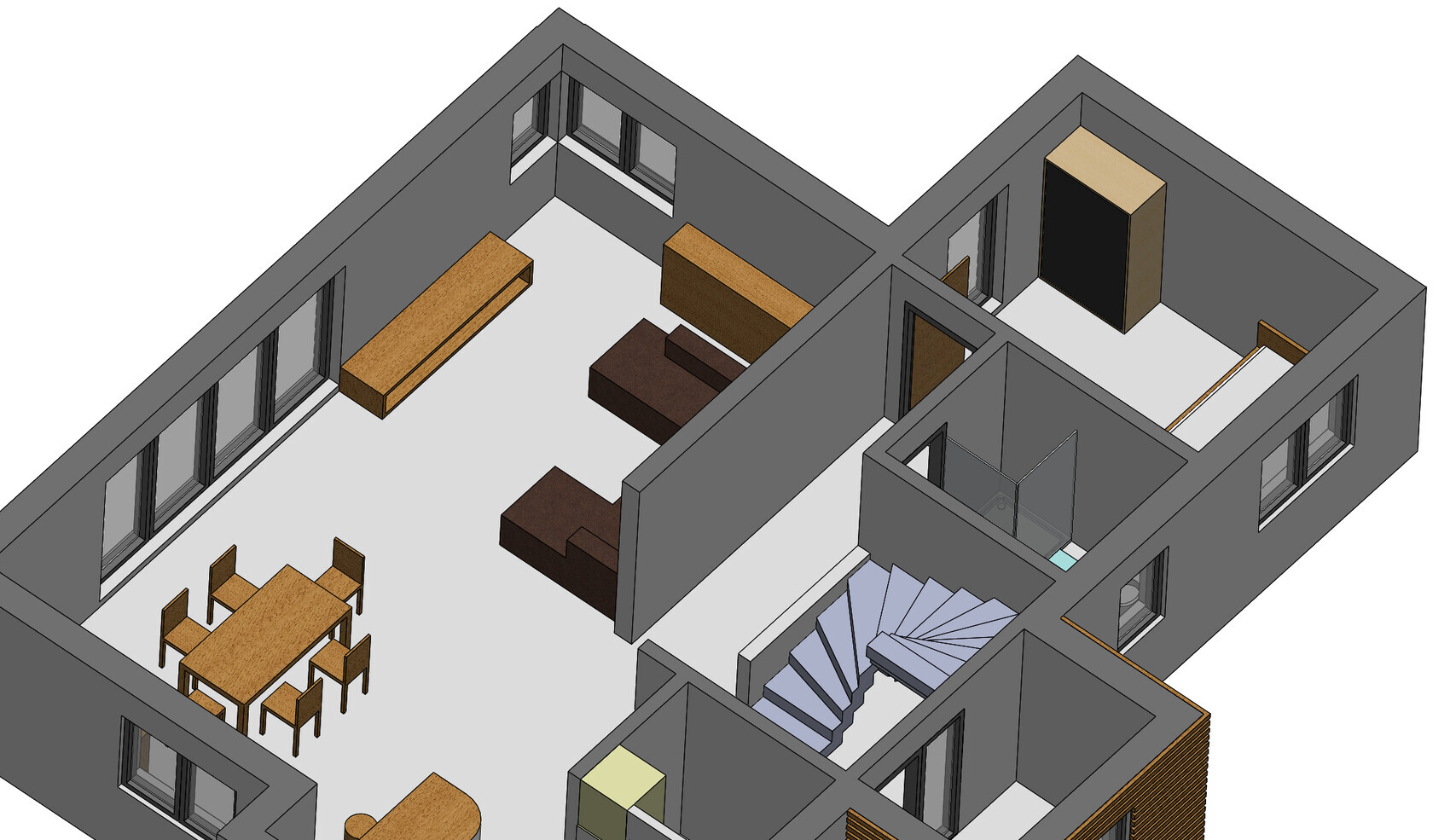
Regarding the hallway on the ground floor: The design aims to keep the staircase as open as possible so that the hallway can receive natural light from the vestibule/stairwell on one side towards the bathroom, and otherwise be lit by natural light from the kitchen/dining area. We don’t expect it to feel like a narrow corridor this way. Hopefully, we aren’t too far off with that assumption. Attached is a 3D view for reference.
We still need to furnish the vestibule to see if the space is sufficient. If necessary, we might have to create some additional room there.
Rotating the bed upstairs by 90° seems much more practical than the current arrangement. The dressing room is 2.10m (7 feet) wide and will be properly furnished by my father-in-law, who is a master carpenter. We are thinking of mostly open shelves, 45cm (18 inches) deep along the lengthwise sides and 60cm (24 inches) deep on the end wall, where wider garments such as jackets, suits, etc., can be hung. This should hopefully leave about 1.20m (4 feet) of free movement space.
We are aware of the open floor plan on the ground floor and have already considered options for partially closing it off. Since the pantry and living room walls align, sliding doors could be a possibility here, allowing for changes to be made later if needed.
We are considering moving the children’s room doors upstairs, but we don’t see a strong reason for it. After all, it would reduce continuous wall space, which could be used, for example, for placing a dresser.
A storage room in front of the stairs upstairs is not possible because it would block natural light. Currently, the stairs are oriented the other way, so you reach the top at the exterior wall side. I probably should have added an arrow on the plan to show this.
As mentioned, the basement is not yet finished. However, I wonder if the laundry room shouldn’t be closer to the stairs since the path between stairs and laundry is likely used more often than between the laundry and the light well. The storage room by the light well is intended for bulky items like garden tables, grills, etc., which can be stored over the winter without having to maneuver them around a tight corner—just straight from the light well into the storage room.
I also designed a walk-in closet. I have cabinets that are 58 cm deep (23 inches), as I now hang everything—T-shirts, blouses, pants, dresses, jackets, and so on. This is much more practical than constantly folding and stacking everything. The only alternative is when cabinets are only 45 cm deep (18 inches).
elVincent schrieb:
The walk-in closet is 2.10 m wide (7 feet) and will be fitted with custom furniture by my father-in-law, who is a master carpenter. We are thinking mostly open shelves,...
We are still considering relocating the children's bedroom doors on the upper floor, but I don’t see a really convincing reason to do so. After all, you lose continuous wall space where you could, for example, place a dresser.If the walk-in closet is furnished with open shelving, I would consider a partition (sliding door) to the bedroom. Dust gets stirred up in the bedroom when shaking out duvets and changing bedding, so I would want to protect the clothes from that.
As for moving the children's bedroom doors, wardrobes are usually placed or hidden behind doors since they tend to look quite bulky. There is still plenty of space for a dresser in the rooms. I also don’t think this is the final layout for the furniture—do children’s or teenagers’ rooms ever really have a final furnishing plan? 😉
Other than that, I like it.
B
Bauexperte5 May 2015 16:49milkie schrieb:
Really? You even hang T-shirts? Tank tops? Jeans? Etc... I’d like to see that sometime 🙂 Me too; I have other hobbies besides ironing 😉
Best regards, Bauexperte
Similar topics