
ᐅ Design of a single-family house, 2 full stories, gable roof, no basement, double garage
Created on: 28 Mar 2025 14:34
S
schrauberlouis
Hello dear forum members,
Over 1.5 years ago, we were lucky to secure a 500m² (5,382 sq ft) plot in our highly sought-after hometown and now want to upgrade from our terraced house to a great single-family home. To achieve the best possible improvement, I am hoping for your experience and suggestions for improvement.
I have been enthusiastically following this forum for months and have already learned a lot. We have spent the time that has passed in a kind of “self-discovery” process and, for example, took a long time to come to terms with the idea of “no basement” due to cost/benefit considerations. (Unfortunately, this is still a prejudice in the area and among acquaintances.)
We have already visited two general contractors and were relatively disappointed with their designs because a lot of information and wishes were overlooked. Since it is also very difficult to find an architect who suits us, I have spent the past year reviewing and adapting numerous prefab house designs, designs from here, etc., or drawing my own. Of course, we will then go to a planner or architect. This approach is obviously not the right one, but I don’t want to waste any more time on countless meetings where the key points get lost again.
DIY designs are often harshly criticized here and in other forums 🙂 I hope to be spared and am curious what you think about this. Many thanks in advance!
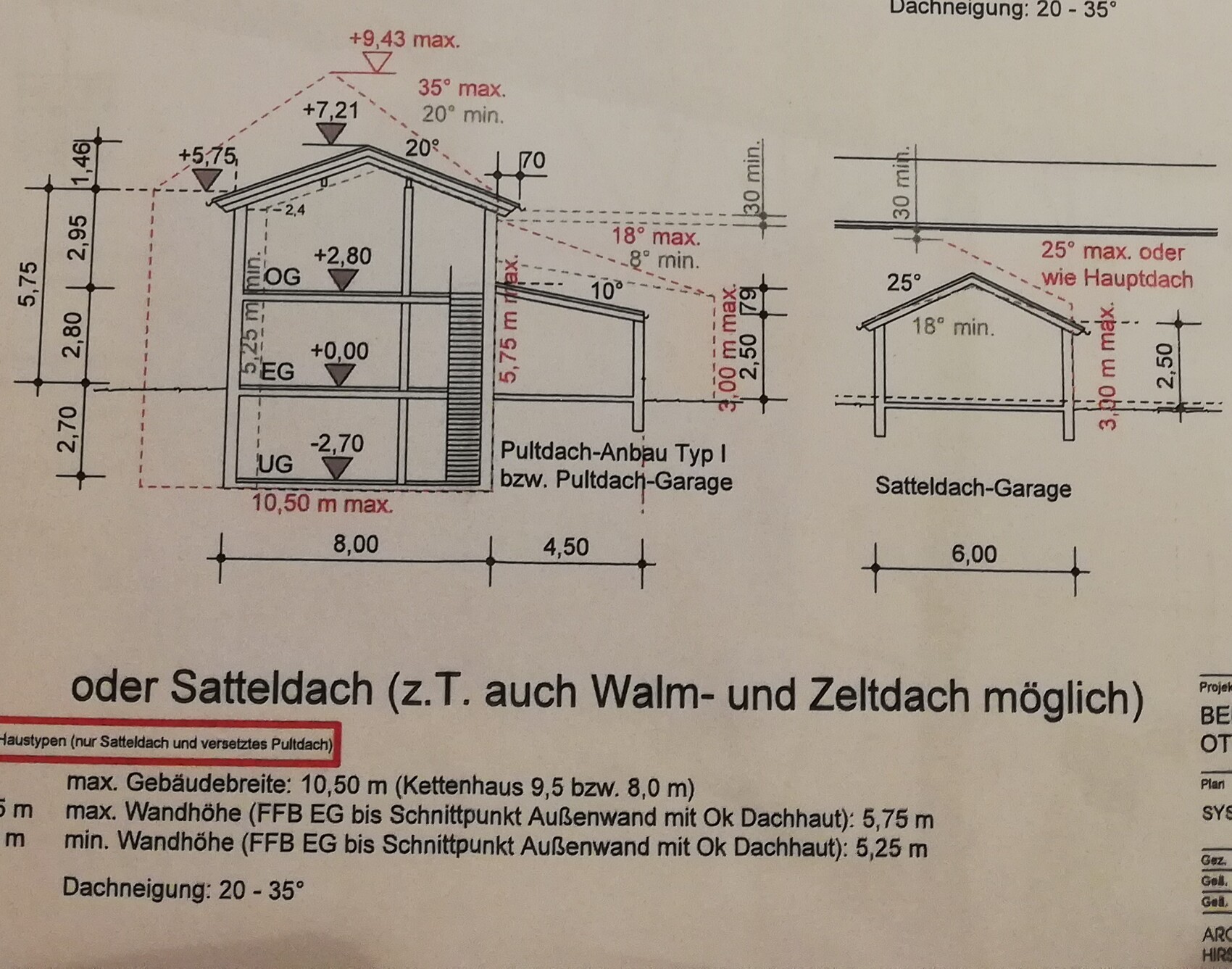
Development Plan / Restrictions
Plot size 500m² , ridge direction predetermined from east to west
Slope no, very flat
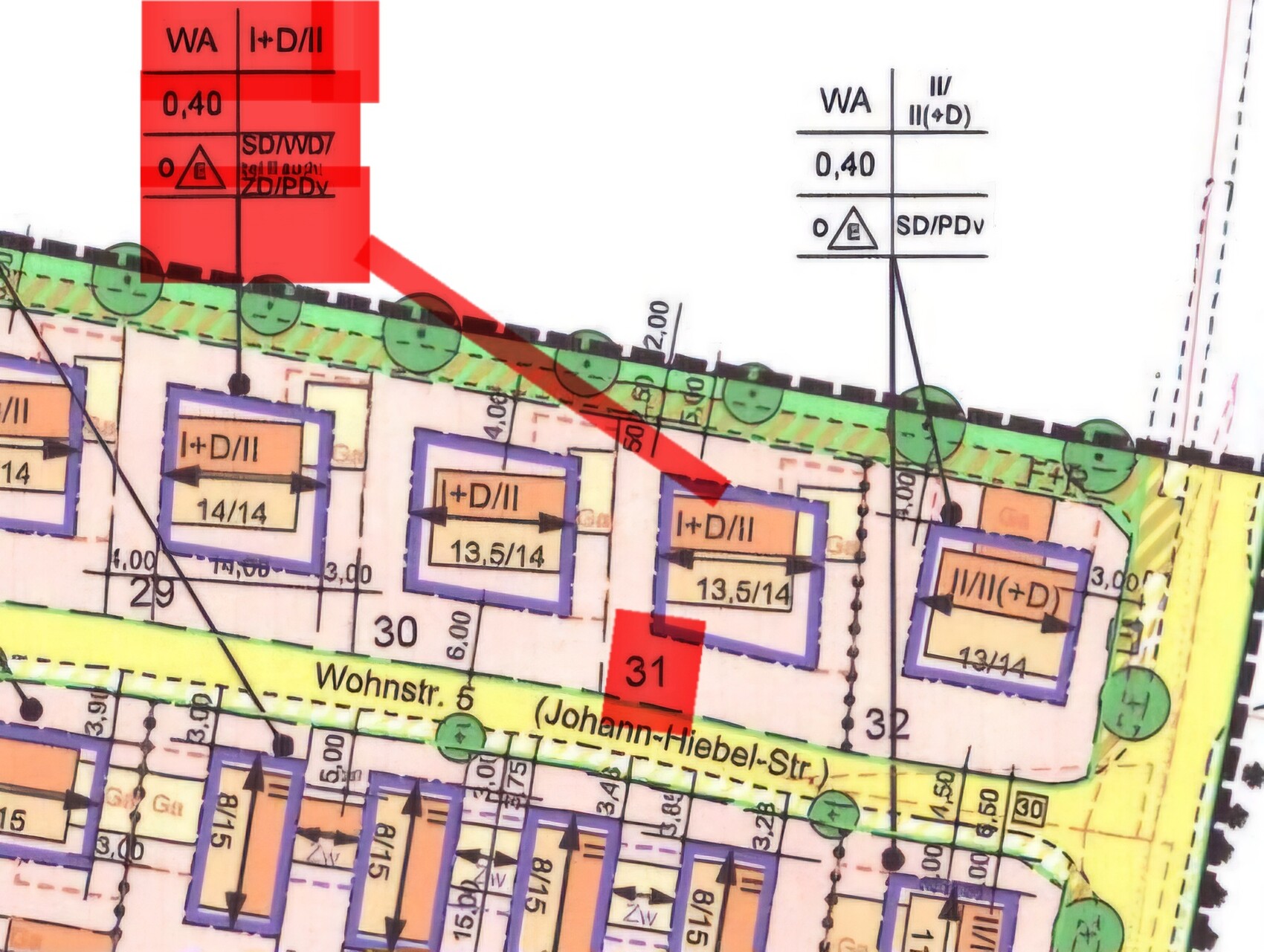
Floor area ratio 0.4 (may be exceeded by 50% by counting garages, etc., but the municipality is not very strict about it)
Edge development boundary garage
Number of parking spaces 1.5 per residential unit
Number of storeys I + attic or II
Roof type gable, hip, tent, and staggered shed roofs allowed
Orientation south
Maximum heights / limits
I + attic:
Eaves height from finished ground level on ground floor max. 4.3m (14 ft)
Roof pitch 35 - 42 degrees
II:
Eaves height min. 5.25m (17 ft)/max. 5.75m (19 ft)
Roof pitch 20 - 35 degrees
Garages:
gable roof 18 - 25 degrees or matching main building
shed roof 8 - 18 degrees
flat roof with green roofing
Client Requirements
Style, roof shape, building type single-family home, gable roof
Basement, storeys
no basement due to high groundwater, flat site, and cost/benefit considerations, 2 storeys + attic storage (possibly above garage)
Number of people 4, ages 34, 32, 2, 0
Space requirements ground floor, upper floor approx. 170m² (1,830 sq ft) total
Office: home office (possibly bedroom later in life or for health reasons)
Overnight guests per year almost none, but 3rd children’s/guest room upstairs as a spare room or due to lack of basement for children’s hobbies etc.
Open or closed layout living room can be closed off as a retreat, cooking + dining open
Conservative or modern design both
Open kitchen, kitchen island yes
Number of dining seats at least 6, expandable for birthdays etc.
Fireplace no
Music/stereo wall no
Balcony, roof terrace no
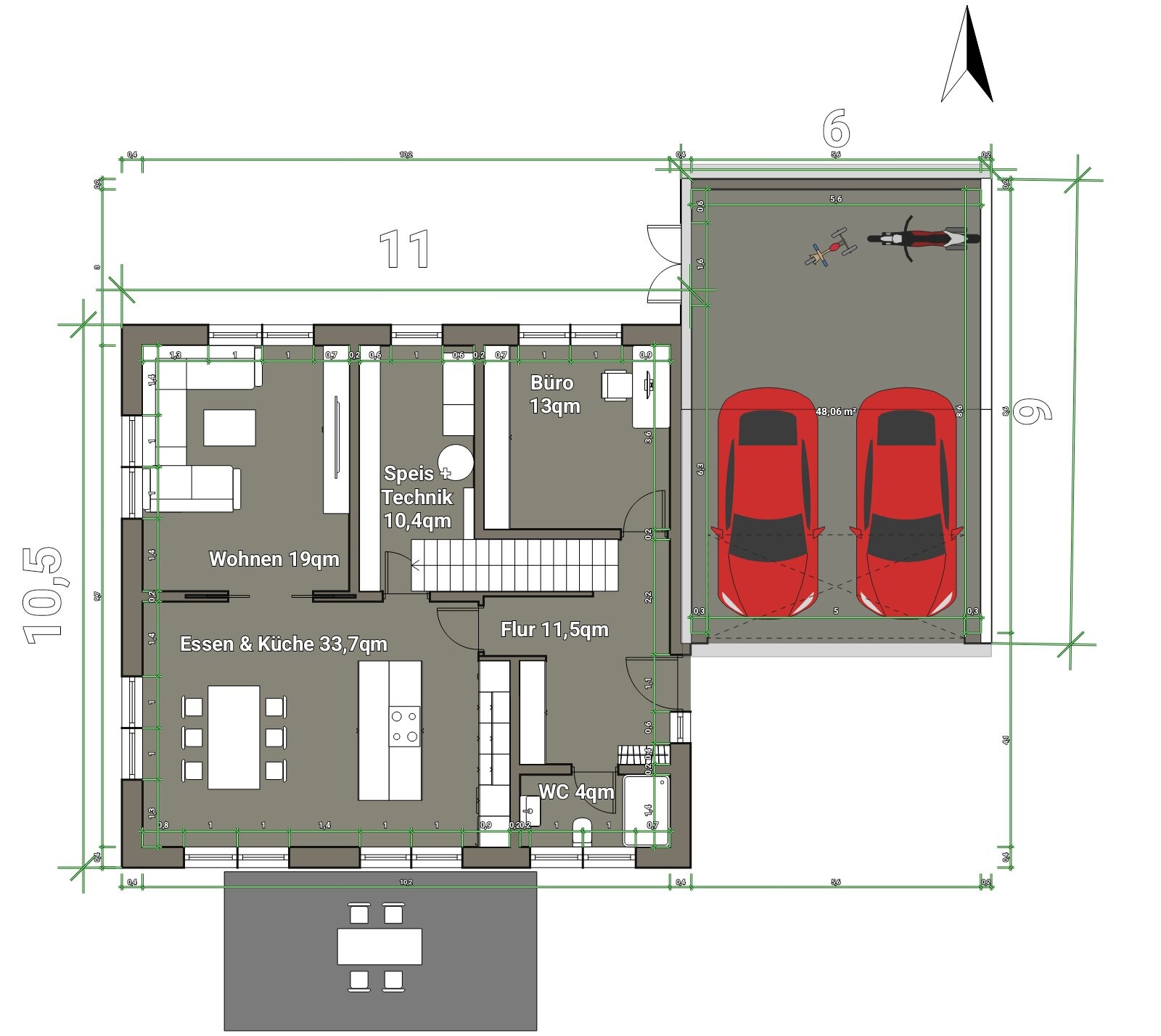
Garage double garage with 9m (30 ft) length (max boundary development) for 2 cars + motorcycle, workshop for DIY maintenance or woodworking, bicycles, etc. (currently mostly stored at parents or elsewhere)
Utility garden, greenhouse no
Other wishes/features/daily routine, also reasons why some things should or should not be included
- since gable roofs on a garage on the boundary are allowed in Bavaria, I also considered putting the technical room + laundry room in the attic of the garage (accessible from the upper floor, but difficult to implement and 35-degree roof partly too shallow). Instead, we now plan a “cold roof” with an intermediate floor (access e.g. by freight elevator from the garage) to create some basement replacement, e.g., for winter tires and more.
- staircase separated from living area because children are noise-sensitive
- functional and relatively large cloakroom (only 2m (6.5 ft) closet here, but we see the office as a backup cloakroom for seasonal jackets etc.)
- straight or half-landing staircase
- shower on ground floor desirable, not a must. Large shower upstairs without glass wall
- kitchen and dining open, living room separable
- space in living room for U-shaped sofa + play area
- ground floor office also as multifunctional room for home office, additional cloakroom, guest, or elderly bedroom
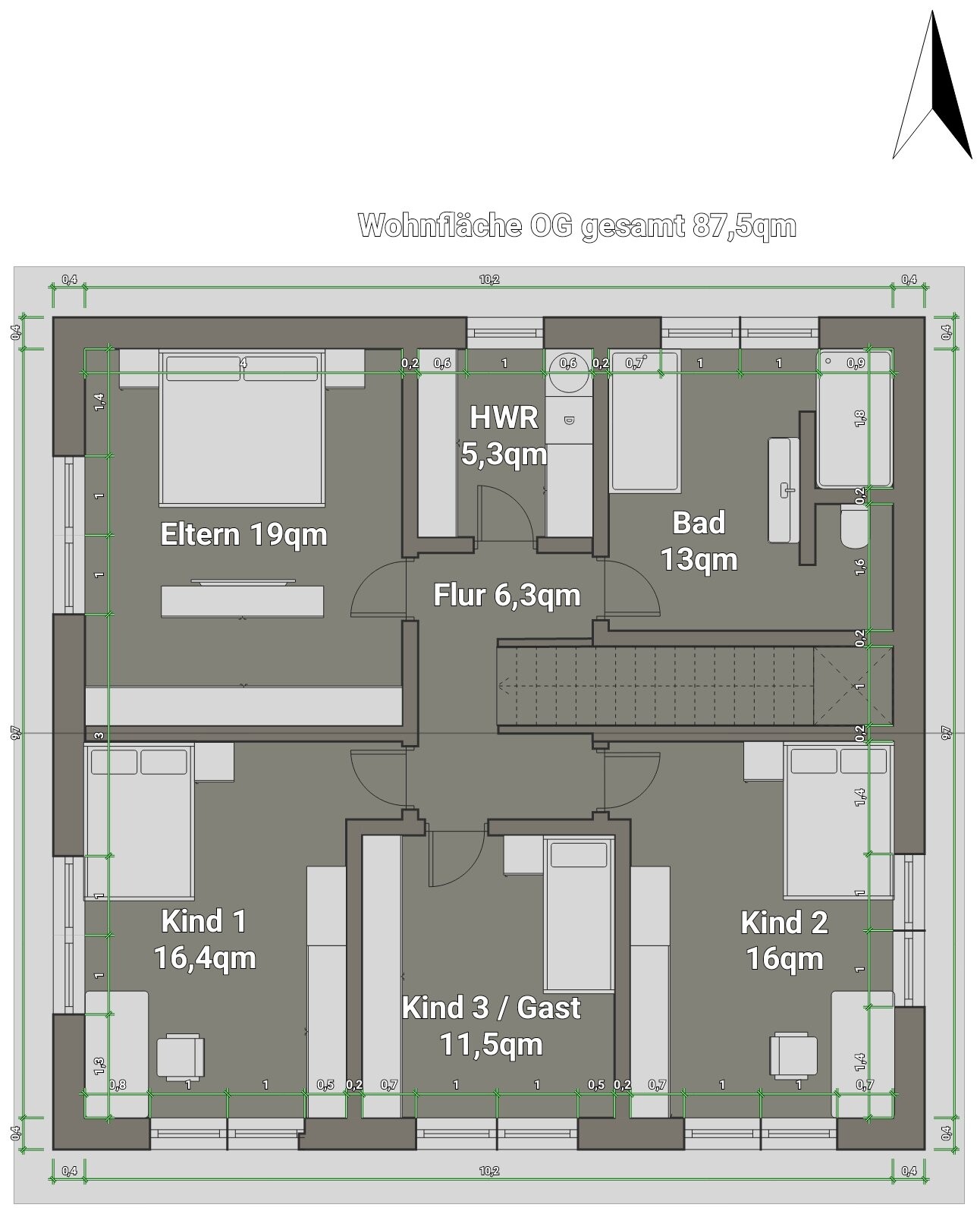
- upstairs 2 children’s rooms and a third (smaller) children’s room initially and possibly permanently for laundry, hobbies, additional children’s play area, spare bedroom, or occasional second home office (after mother’s parental leave).
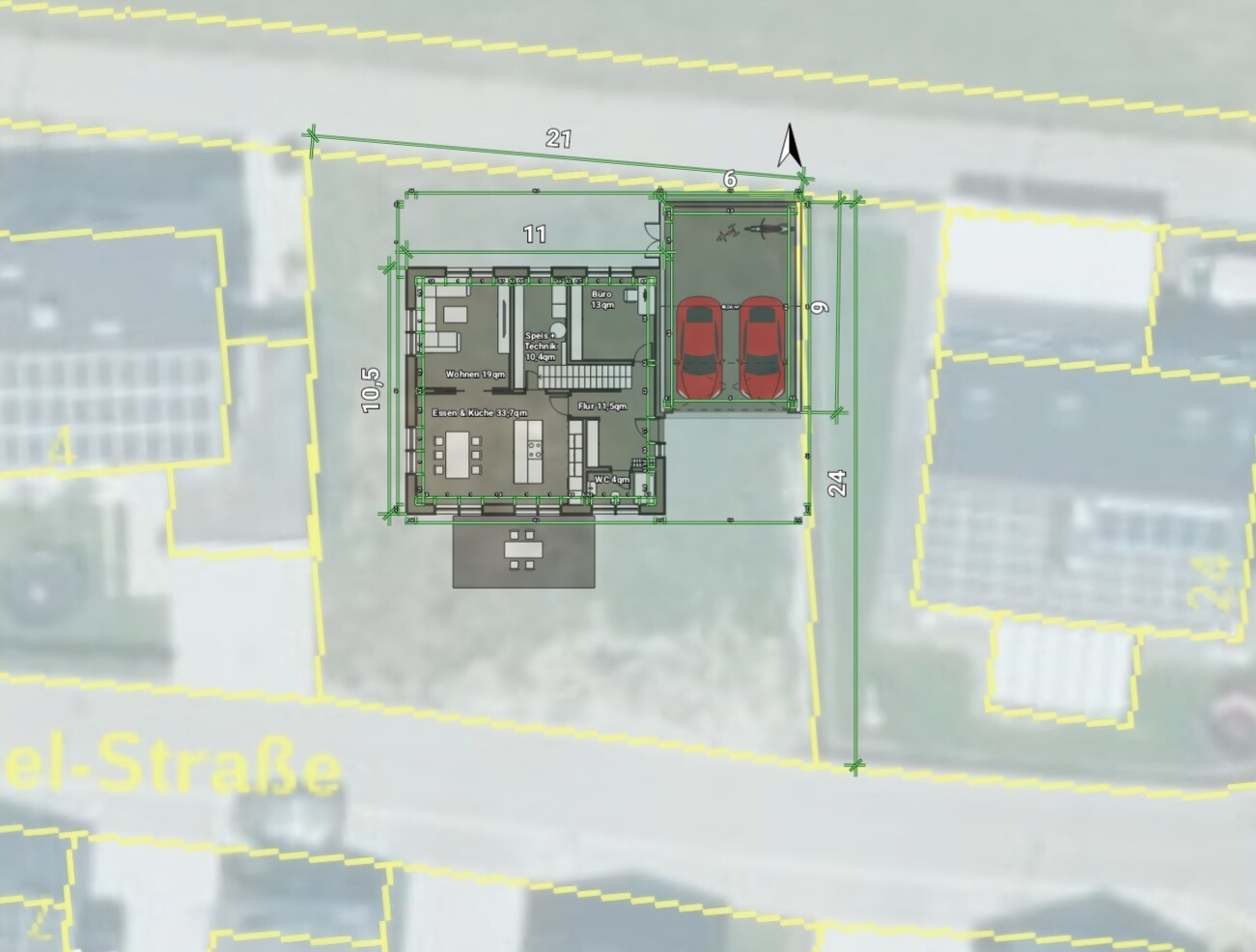
- as much south-facing garden as possible towards the quiet residential street, resulting in the disadvantage of a “long driveway,” but we see this as practical space for playing, parking, etc.
House Design
Designer:
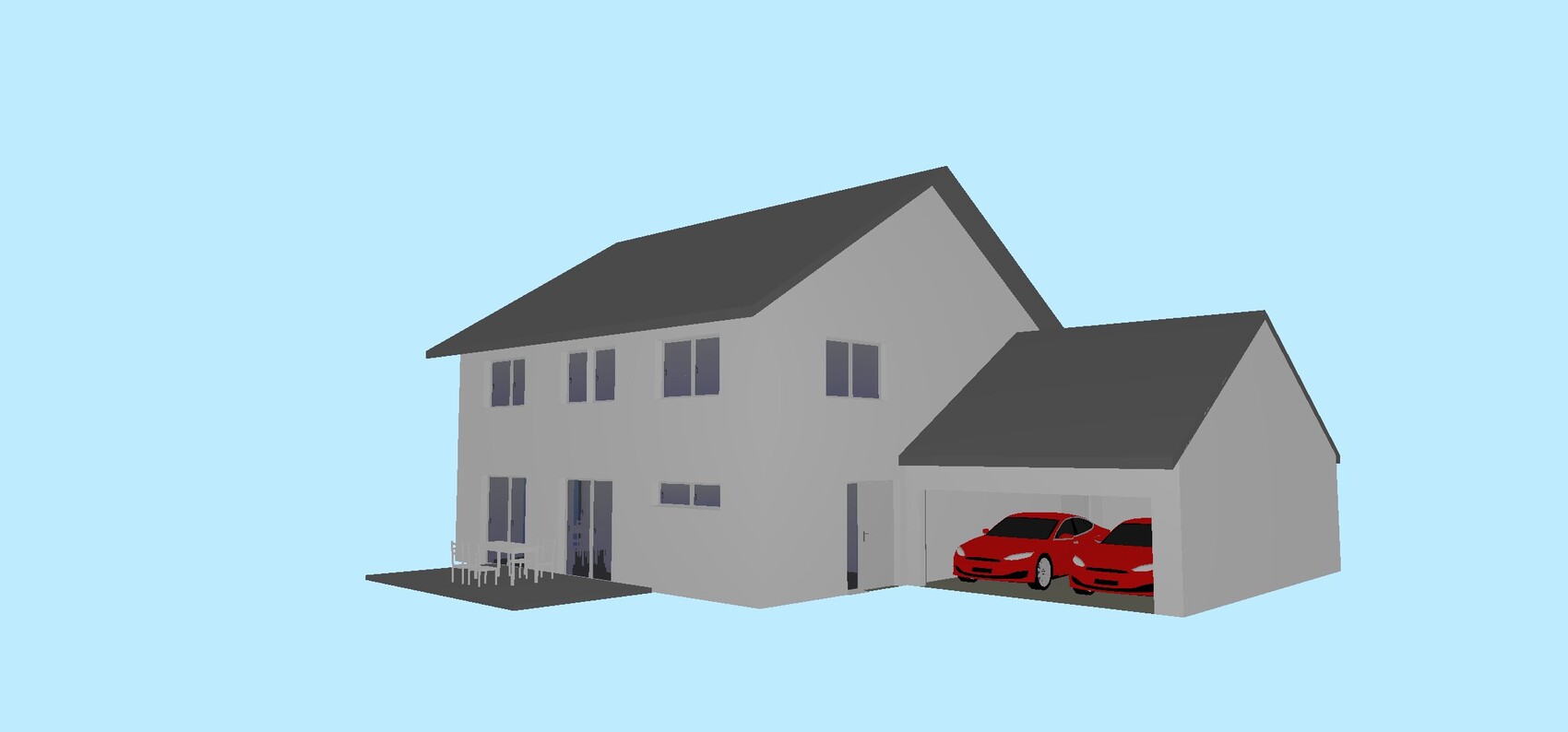
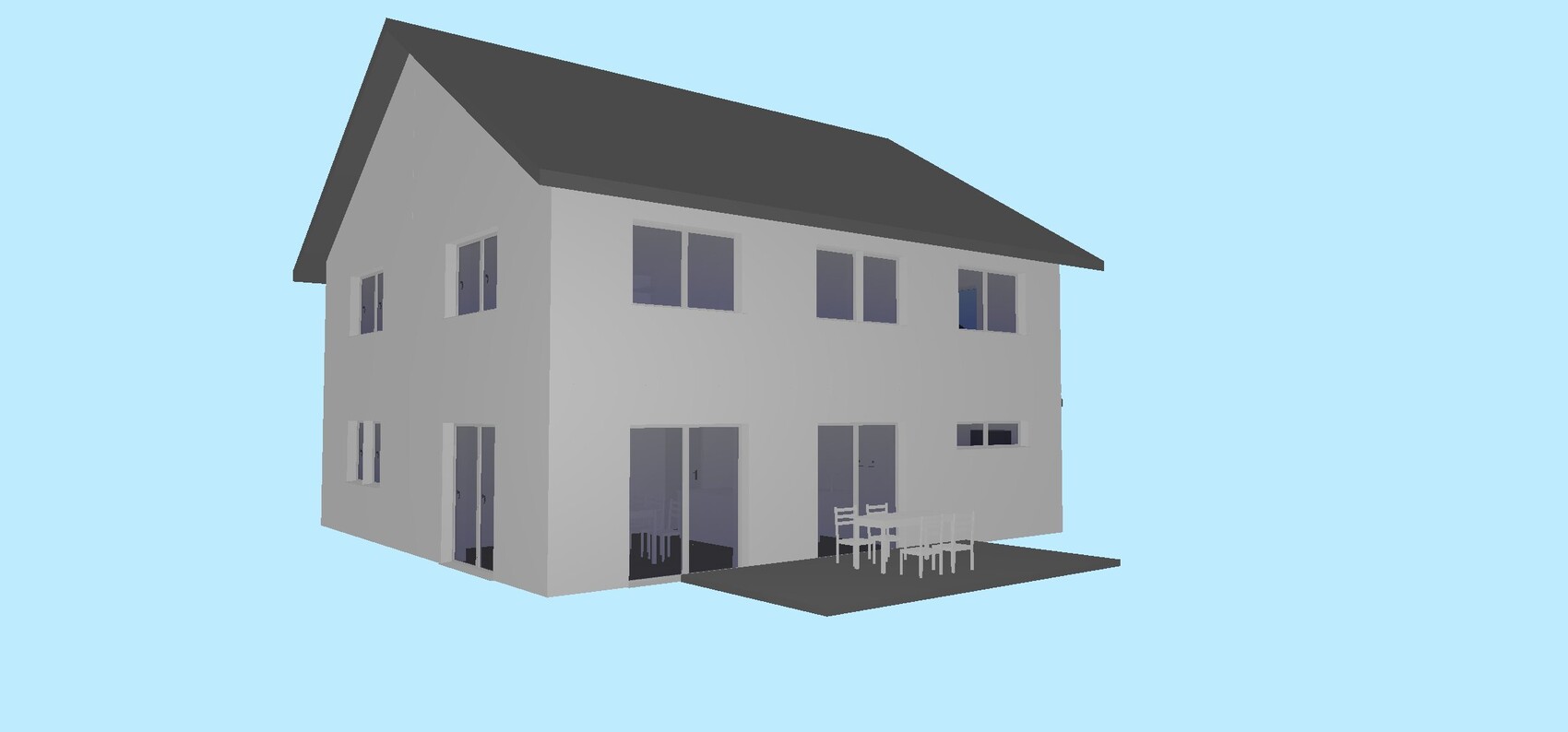
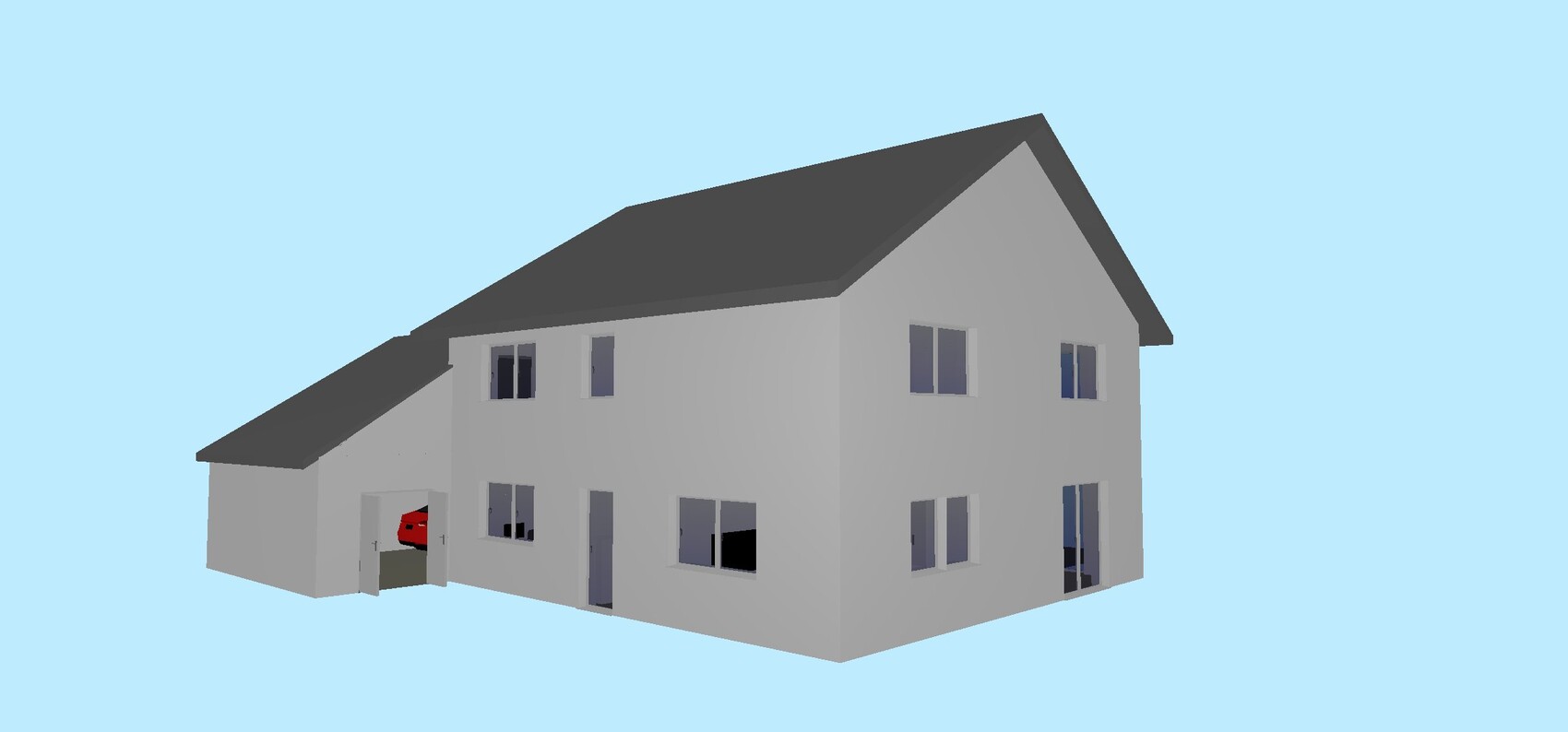
- own design (wall thicknesses roughly assumed: exterior 40cm (16 in), interior 20cm (8 in))
What do you especially like? Why?
- fits all wishes
- large garage with storage room above
- open kitchen with island and direct access to the main terrace
- adjacent pantry with more than 4m (13 ft) of shelves
What do you dislike? Why?
- location of bathroom upstairs is above ground floor office → drainage difficult & noise issue if used as a bedroom later.
- kitchen relatively small, but acceptable compromise due to the long shelf wall in the utility room as backup for fryer, pantry, etc.
- bathroom with T-layout at 3.6m x 3.6m (12 ft x 12 ft) almost too tight
- technical room only along a 3.6m (12 ft) long wall and in the middle of the house (long supply routes regarding connections) → questionable if feasible
- entrance is right at driveway without a landing, but unavoidable due to only 17m (56 ft) wide building zone and urgent desire for a double garage
- generally, we would like to have the option to separate the upper floor as a separate living unit later in life, which is not possible here. An external staircase would be required in that case.
- house size & living area of about 180m² (1,940 sq ft) feels large at first, but we find it hard to do without the usual basement and have therefore planned a reserve.
Price estimate according to architect/planner: own estimate approx. €650,000 - 700,000
Personal price limit including equipment: we have not set a fixed price limit; we want to build the optimal, efficient house that suits us (as expensive as necessary and as inexpensive as possible…). The land (standard land value €440/m²) is paid for, we live in a paid-off terraced house with 136m² and have some equity available.
Preferred heating technology : heat pump (air or ring trench)
If you have to give up something, which features / expansions
- can give up if necessary: pantry, large office on ground floor, third room upstairs
- cannot give up: everything else
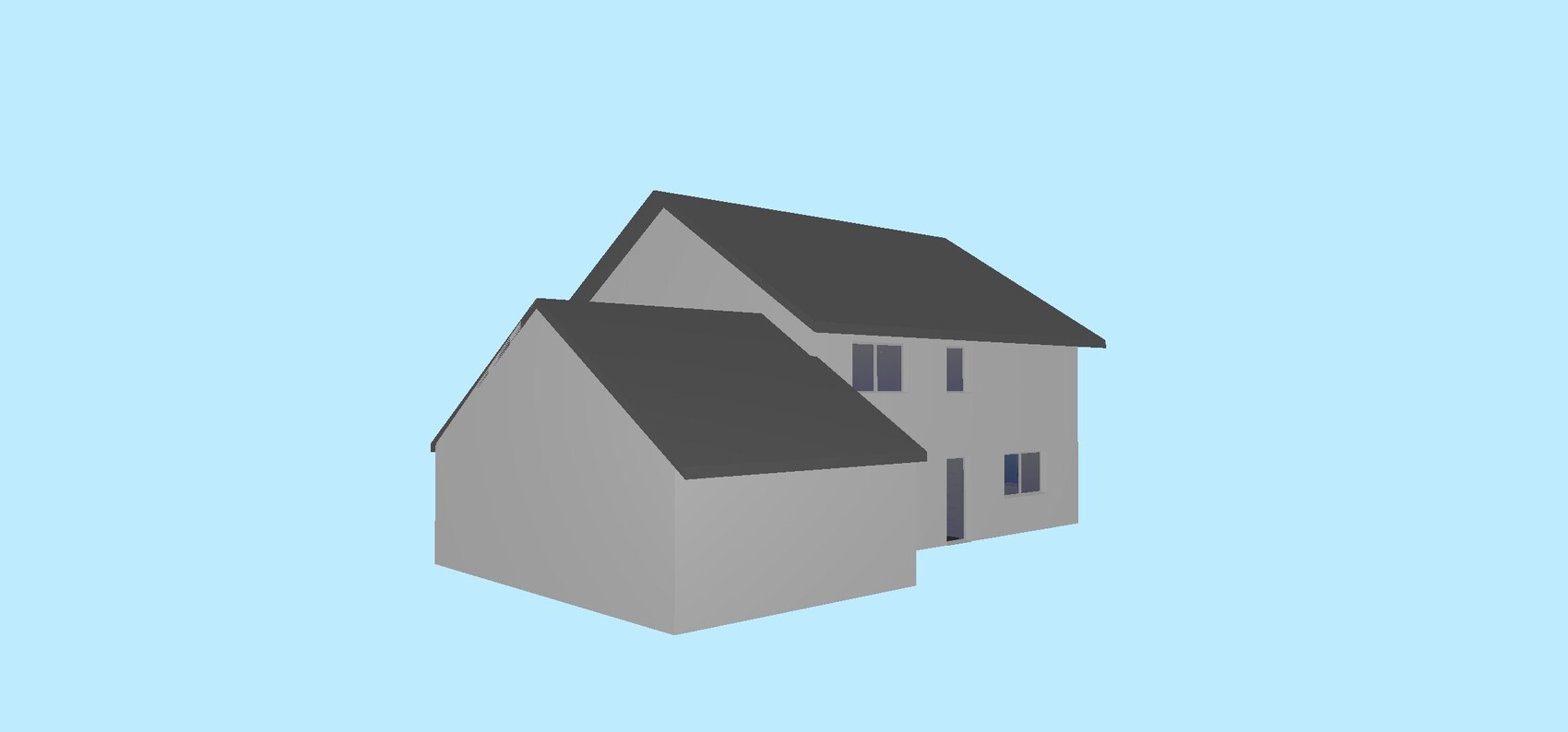
Over 1.5 years ago, we were lucky to secure a 500m² (5,382 sq ft) plot in our highly sought-after hometown and now want to upgrade from our terraced house to a great single-family home. To achieve the best possible improvement, I am hoping for your experience and suggestions for improvement.
I have been enthusiastically following this forum for months and have already learned a lot. We have spent the time that has passed in a kind of “self-discovery” process and, for example, took a long time to come to terms with the idea of “no basement” due to cost/benefit considerations. (Unfortunately, this is still a prejudice in the area and among acquaintances.)
We have already visited two general contractors and were relatively disappointed with their designs because a lot of information and wishes were overlooked. Since it is also very difficult to find an architect who suits us, I have spent the past year reviewing and adapting numerous prefab house designs, designs from here, etc., or drawing my own. Of course, we will then go to a planner or architect. This approach is obviously not the right one, but I don’t want to waste any more time on countless meetings where the key points get lost again.
DIY designs are often harshly criticized here and in other forums 🙂 I hope to be spared and am curious what you think about this. Many thanks in advance!
Development Plan / Restrictions
Plot size 500m² , ridge direction predetermined from east to west
Slope no, very flat
Floor area ratio 0.4 (may be exceeded by 50% by counting garages, etc., but the municipality is not very strict about it)
Edge development boundary garage
Number of parking spaces 1.5 per residential unit
Number of storeys I + attic or II
Roof type gable, hip, tent, and staggered shed roofs allowed
Orientation south
Maximum heights / limits
I + attic:
Eaves height from finished ground level on ground floor max. 4.3m (14 ft)
Roof pitch 35 - 42 degrees
II:
Eaves height min. 5.25m (17 ft)/max. 5.75m (19 ft)
Roof pitch 20 - 35 degrees
Garages:
gable roof 18 - 25 degrees or matching main building
shed roof 8 - 18 degrees
flat roof with green roofing
Client Requirements
Style, roof shape, building type single-family home, gable roof
Basement, storeys
no basement due to high groundwater, flat site, and cost/benefit considerations, 2 storeys + attic storage (possibly above garage)
Number of people 4, ages 34, 32, 2, 0
Space requirements ground floor, upper floor approx. 170m² (1,830 sq ft) total
Office: home office (possibly bedroom later in life or for health reasons)
Overnight guests per year almost none, but 3rd children’s/guest room upstairs as a spare room or due to lack of basement for children’s hobbies etc.
Open or closed layout living room can be closed off as a retreat, cooking + dining open
Conservative or modern design both
Open kitchen, kitchen island yes
Number of dining seats at least 6, expandable for birthdays etc.
Fireplace no
Music/stereo wall no
Balcony, roof terrace no
Garage double garage with 9m (30 ft) length (max boundary development) for 2 cars + motorcycle, workshop for DIY maintenance or woodworking, bicycles, etc. (currently mostly stored at parents or elsewhere)
Utility garden, greenhouse no
Other wishes/features/daily routine, also reasons why some things should or should not be included
- since gable roofs on a garage on the boundary are allowed in Bavaria, I also considered putting the technical room + laundry room in the attic of the garage (accessible from the upper floor, but difficult to implement and 35-degree roof partly too shallow). Instead, we now plan a “cold roof” with an intermediate floor (access e.g. by freight elevator from the garage) to create some basement replacement, e.g., for winter tires and more.
- staircase separated from living area because children are noise-sensitive
- functional and relatively large cloakroom (only 2m (6.5 ft) closet here, but we see the office as a backup cloakroom for seasonal jackets etc.)
- straight or half-landing staircase
- shower on ground floor desirable, not a must. Large shower upstairs without glass wall
- kitchen and dining open, living room separable
- space in living room for U-shaped sofa + play area
- ground floor office also as multifunctional room for home office, additional cloakroom, guest, or elderly bedroom
- upstairs 2 children’s rooms and a third (smaller) children’s room initially and possibly permanently for laundry, hobbies, additional children’s play area, spare bedroom, or occasional second home office (after mother’s parental leave).
- as much south-facing garden as possible towards the quiet residential street, resulting in the disadvantage of a “long driveway,” but we see this as practical space for playing, parking, etc.
House Design
Designer:
- own design (wall thicknesses roughly assumed: exterior 40cm (16 in), interior 20cm (8 in))
What do you especially like? Why?
- fits all wishes
- large garage with storage room above
- open kitchen with island and direct access to the main terrace
- adjacent pantry with more than 4m (13 ft) of shelves
What do you dislike? Why?
- location of bathroom upstairs is above ground floor office → drainage difficult & noise issue if used as a bedroom later.
- kitchen relatively small, but acceptable compromise due to the long shelf wall in the utility room as backup for fryer, pantry, etc.
- bathroom with T-layout at 3.6m x 3.6m (12 ft x 12 ft) almost too tight
- technical room only along a 3.6m (12 ft) long wall and in the middle of the house (long supply routes regarding connections) → questionable if feasible
- entrance is right at driveway without a landing, but unavoidable due to only 17m (56 ft) wide building zone and urgent desire for a double garage
- generally, we would like to have the option to separate the upper floor as a separate living unit later in life, which is not possible here. An external staircase would be required in that case.
- house size & living area of about 180m² (1,940 sq ft) feels large at first, but we find it hard to do without the usual basement and have therefore planned a reserve.
Price estimate according to architect/planner: own estimate approx. €650,000 - 700,000
Personal price limit including equipment: we have not set a fixed price limit; we want to build the optimal, efficient house that suits us (as expensive as necessary and as inexpensive as possible…). The land (standard land value €440/m²) is paid for, we live in a paid-off terraced house with 136m² and have some equity available.
Preferred heating technology : heat pump (air or ring trench)
If you have to give up something, which features / expansions
- can give up if necessary: pantry, large office on ground floor, third room upstairs
- cannot give up: everything else

Whether wearing a checkered shirt truly makes a man a lumberjack is, I would recommend, best approached with a bold question mark. For me, the statements about a flat but groundwater problem-prone plot were sufficient to not put the cellar question at the forefront of the initial step. Generally, from my perspective, there are two basic types of child accommodations. Here, children aged two and zero were mentioned. Therefore, I would consider them as users of the dynamic room group KGB (Child / Guest / Office). Teenagers from the age of confirmation / second communion / youth initiation onwards, I see as ready to leave the nest, and accordingly accommodated in a separate apartment (with only an unsealed passage). This also affects the “children’s bathroom,” which in my opinion only makes sense when paired with their own cleaning responsibilities.
This is unfortunately very popular—probably because it sounds logically plausible—but it is the surest path to frustration with botched results.
Even a freelance architect can be part of the CAD generation. They don’t sketch; they don’t erase; they don’t conceptualize. They start immediately like playing Pictionary (dog, cat, mouse, car dealership...) and refuse to draw a design at any stage of development, instead producing only a basic draft, then removing points that don’t please them, and during further planning only scaling it at presentation scale. Therefore, they include all details right away, which, according to traditional master craftsmanship, have no place in a preliminary draft. But a preliminary draft has a function in the design maturation process and must be seriously developed on its own terms. Labeling a careless “ready-to-go” draft (started in third gear) as a preliminary draft only because one believes, as a digital native, to have all knowledge spoon-fed and no longer needs a real preliminary draft, is a big mistake at the expense of the clients. An unrefined, not-yet-finalized draft is useless and cannot replace a proper preliminary draft. For this reason, a layperson should never bring a “detailed preliminary draft” (which is in itself a contradiction and shows a lack of understanding of design maturation) to a meeting with an architect. If you do, and happen to work with a CAD-generation architect, you will get exactly the kind of disappointing result that makes you wonder why you bothered going to a (inexperienced) professional at all: a symmetrical finish then becomes the absolute limit of what you can expect. You can perfect this mistake by going to an “architect from design phases 1 to 4” who never supervises the design or its budget-compliant realization. Then the mess also becomes nicely expensive. I don’t do hundreds of iterations, but unfortunately, my service of “finding the right architect” cannot be offered with a fixed price example as the effort varies individual case by case. That is the downside of the coin, as I operate nationwide. Then the approach “one out of twelve will fit” clearly does not work.
https://www.instagram.com/11antgmxde/
https://www.linkedin.com/company/bauen-jetzt/
Arauki11 schrieb:
I once mentioned that my wife probably drew 100 DIN A4 pages, changing them repeatedly. She copied a ground plan template several times and then kept piecing it together. If you want to do it yourself at that level (which was our case), it takes a lot of energy and accuracy, or you go to an architect and let their creativity work. We had a very weak general contractor but at least he kept implementing our ideas in his software so we could continue.
This is unfortunately very popular—probably because it sounds logically plausible—but it is the surest path to frustration with botched results.
schrauberlouis schrieb:
When I look at houses or floor plans from freelance architects within my circle, I often wonder what they were actually thinking. It is extremely difficult to find one suitable for us. To avoid hundreds of iterations and wasting huge amounts of money and time, I then took this approach. By the way, we also had a detailed preliminary discussion with a freelance architect, but even there the initial ideas were disappointing. [...]
But here I have drifted too far into the details again... Please consider this a somewhat more detailed "preliminary draft".
Even a freelance architect can be part of the CAD generation. They don’t sketch; they don’t erase; they don’t conceptualize. They start immediately like playing Pictionary (dog, cat, mouse, car dealership...) and refuse to draw a design at any stage of development, instead producing only a basic draft, then removing points that don’t please them, and during further planning only scaling it at presentation scale. Therefore, they include all details right away, which, according to traditional master craftsmanship, have no place in a preliminary draft. But a preliminary draft has a function in the design maturation process and must be seriously developed on its own terms. Labeling a careless “ready-to-go” draft (started in third gear) as a preliminary draft only because one believes, as a digital native, to have all knowledge spoon-fed and no longer needs a real preliminary draft, is a big mistake at the expense of the clients. An unrefined, not-yet-finalized draft is useless and cannot replace a proper preliminary draft. For this reason, a layperson should never bring a “detailed preliminary draft” (which is in itself a contradiction and shows a lack of understanding of design maturation) to a meeting with an architect. If you do, and happen to work with a CAD-generation architect, you will get exactly the kind of disappointing result that makes you wonder why you bothered going to a (inexperienced) professional at all: a symmetrical finish then becomes the absolute limit of what you can expect. You can perfect this mistake by going to an “architect from design phases 1 to 4” who never supervises the design or its budget-compliant realization. Then the mess also becomes nicely expensive. I don’t do hundreds of iterations, but unfortunately, my service of “finding the right architect” cannot be offered with a fixed price example as the effort varies individual case by case. That is the downside of the coin, as I operate nationwide. Then the approach “one out of twelve will fit” clearly does not work.
https://www.instagram.com/11antgmxde/
https://www.linkedin.com/company/bauen-jetzt/
schrauberlouis schrieb:
But when I look at houses or floor plans from independent architects among acquaintances, I often wonder what they were actually thinking. After all, the wishes they communicated were implemented.
schrauberlouis schrieb:
So it is extremely difficult to find one that suits us. In that respect, you can also work with such an architect. Whether you burden the architect with contradictory wishes, resulting in a design that doesn't make sense, is up to you.
But in the end, everyone has their own preferences. What matters is that the design works. And you probably paid less attention to that because your perspective was somewhat different.
Similar topics