
ᐅ Does it make sense to install an air conditioning system as a retrofit?
Created on: 25 Mar 2020 18:19
A
andimann
Hello everyone,
We have been living in the house since December 2016, and during the planning and construction phase, I never even considered installing an air conditioning system.
Basically, we manage without one. During the extreme summer of 2018, the upstairs temperature peaked at 25.5-26°C (78-79°F). That was just barely acceptable, but personally, it was borderline for sleeping. Summers like that will probably become more frequent in the future. In summer 2019, temperatures never rose above 25°C (77°F), but unfortunately there were times of very high humidity, which made it uncomfortable. Morning ventilation didn't help much then; it actually made things worse. Ventilation only works effectively if the shutters are open, but we prefer to sleep in the dark...
Since I've learned that air conditioning systems are much more affordable both in initial cost and electricity consumption than I originally thought, I now realize I should have planned for one back then. Hindsight is always 20/20...
Now I'm considering whether it would be possible to retrofit an air conditioner, at least with minimal functionality.
The requirements would be:
We have a stairwell with a half-landing and an adjacent wide hallway upstairs.
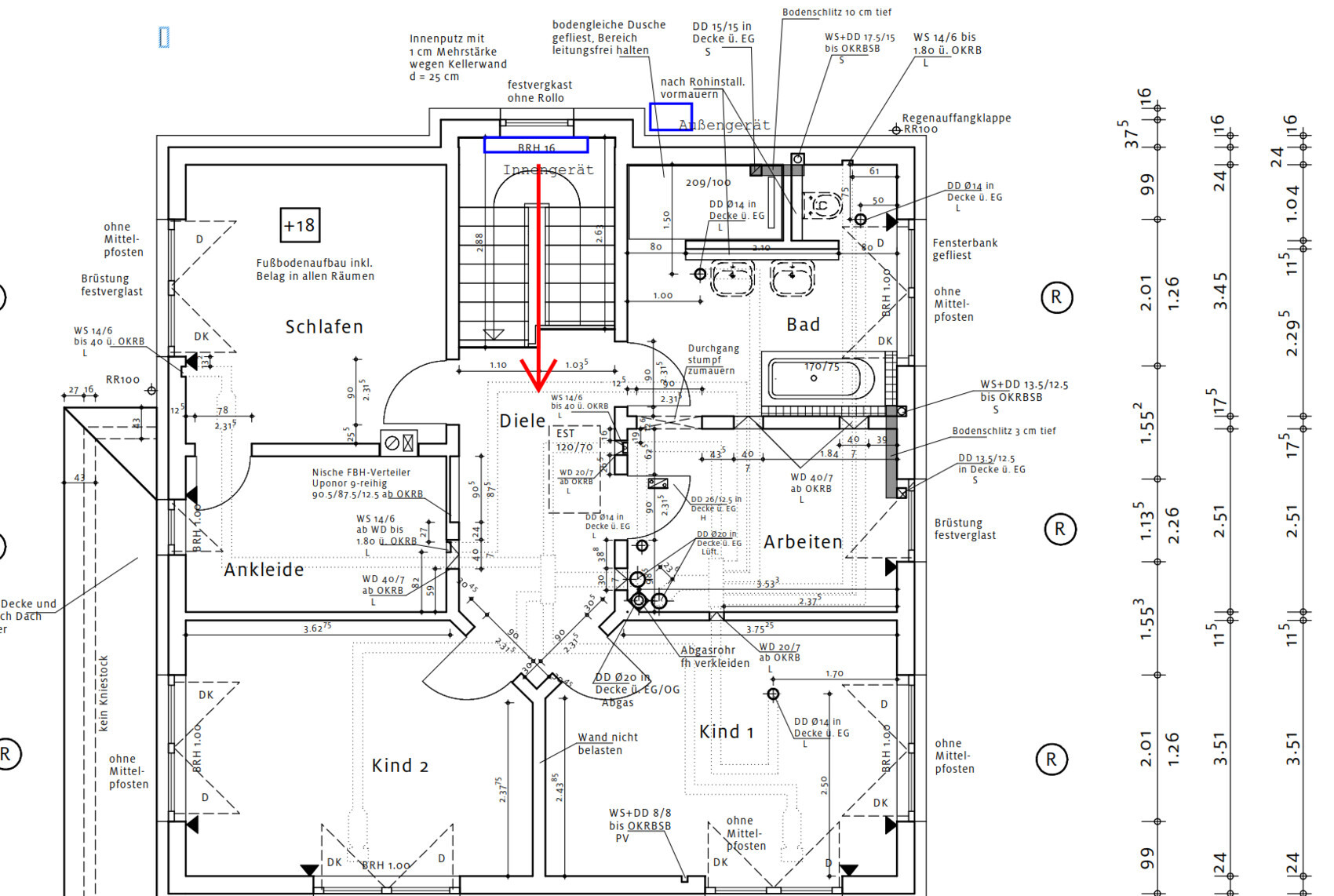
The idea is to install an indoor unit in the stairwell, above the window, directly below the upstairs ceiling. From there, the unit could blow air along the hallway and, with doors open to Child 1 / Child 2 and the bedroom, at least some cooled air would reach those rooms. Possibly supported by a oscillating fan placed in the hallway. The system would run in the morning until just after noon, when no one is home anyway. This way, the house would be pre-cooled during that time and wouldn’t keep heating up continuously. As mentioned, the goal is just to lower the temperature by about 2°C (4°F), not to cool all rooms evenly and draft-free down to 18°C (64°F).
The outdoor unit could be placed next to the ledge, and the piping routed straight up in the corner, even though that is on the north side, where our trash bins and firewood are stored. So it’s not exactly the most attractive spot...
Questions (I understand that precise predictions are difficult):
Best regards,
Andreas
We have been living in the house since December 2016, and during the planning and construction phase, I never even considered installing an air conditioning system.
Basically, we manage without one. During the extreme summer of 2018, the upstairs temperature peaked at 25.5-26°C (78-79°F). That was just barely acceptable, but personally, it was borderline for sleeping. Summers like that will probably become more frequent in the future. In summer 2019, temperatures never rose above 25°C (77°F), but unfortunately there were times of very high humidity, which made it uncomfortable. Morning ventilation didn't help much then; it actually made things worse. Ventilation only works effectively if the shutters are open, but we prefer to sleep in the dark...
Since I've learned that air conditioning systems are much more affordable both in initial cost and electricity consumption than I originally thought, I now realize I should have planned for one back then. Hindsight is always 20/20...
Now I'm considering whether it would be possible to retrofit an air conditioner, at least with minimal functionality.
The requirements would be:
- Cooling the air temperature upstairs by a maximum of 2-3°C (4-5°F). Keeping it under 24°C (75°F) would be perfectly fine. We don’t want it colder than that.
- Dehumidification of the air.
We have a stairwell with a half-landing and an adjacent wide hallway upstairs.
The idea is to install an indoor unit in the stairwell, above the window, directly below the upstairs ceiling. From there, the unit could blow air along the hallway and, with doors open to Child 1 / Child 2 and the bedroom, at least some cooled air would reach those rooms. Possibly supported by a oscillating fan placed in the hallway. The system would run in the morning until just after noon, when no one is home anyway. This way, the house would be pre-cooled during that time and wouldn’t keep heating up continuously. As mentioned, the goal is just to lower the temperature by about 2°C (4°F), not to cool all rooms evenly and draft-free down to 18°C (64°F).
The outdoor unit could be placed next to the ledge, and the piping routed straight up in the corner, even though that is on the north side, where our trash bins and firewood are stored. So it’s not exactly the most attractive spot...
Questions (I understand that precise predictions are difficult):
- Would such a setup be effective, or is it a bad idea that would just result in a cold hallway and rooms that are as warm as before? I think I've seen a similar configuration in a thread here, but I can’t find it anymore.
- What cooling capacity should I expect to need? The bedroom, hallway, and both children’s rooms together are about 65 m² (700 sq ft). I’ve seen recommendations between 4 and 6 kW (14,000 to 21,000 BTU), but since we don’t want to cool down to 19°C (66°F), just reduce the temperature slightly, should it be less?
- Are there devices or brands known for having stronger fans? We need a unit that can blow its airflow further...
- How is condensate handled in such a setup? Would we likely need to run another drain hose through the exterior wall?
Best regards,
Andreas

A device installed in the hallway at the highest point, circulating the air to cool it by a few degrees, is sufficient. Naturally, this will result in a very cold hallway. But if all the doors are open on the upper floor, a comfortable temperature will be established as the air mixes, and the ground floor will also benefit to some extent.
Certainly, you will use more energy and need a larger system because you are cooling the entire house, not just specific zones as is possible with multiple indoor units located in each room.
However, the investment is worthwhile. I personally faced the same issues one year after moving in and then retrofitted an air conditioning system in the house, which I have since upgraded to a more powerful one due to more people living in the house.
Mobile air conditioners are impractical. They are more suitable for a shed or a garden house.
Certainly, you will use more energy and need a larger system because you are cooling the entire house, not just specific zones as is possible with multiple indoor units located in each room.
However, the investment is worthwhile. I personally faced the same issues one year after moving in and then retrofitted an air conditioning system in the house, which I have since upgraded to a more powerful one due to more people living in the house.
Mobile air conditioners are impractical. They are more suitable for a shed or a garden house.
First of all, when using mobile units, it is important to consider that—even if the warm exhaust air is vented outside through a duct—air still needs to flow back in somewhere to balance the negative pressure created inside the house. This means that warm outdoor air, which also contains a significant amount of moisture, is drawn inside. When this air cools down, the relative humidity increases even further.
If using an air conditioner, then a split system is recommended, unless there is absolutely no other option.
If using an air conditioner, then a split system is recommended, unless there is absolutely no other option.
H
hampshire26 Mar 2020 17:58Crossy schrieb:
I really have no idea about this topic, but couldn’t the same effect be achieved with portable units in the bedrooms? I tried it once back in the summer of 2006 on a whim, using an offer from Metro, since our bedroom was under the roof in our townhouse and my dear wife wasn’t happy with the heat. It was exactly as Rick described. I then gave the device to my tire dealer—his office was in a baking hot container at the time. If you’re going for it, make it a fixed installation, carefully matched to strictly sealed room volumes.
Just as a side note:
Our Mitsubishi air conditioning system is broken. It’s a bit older than 2 years, and last week, during the first use of the new year, we noticed it stopped working.
The fault analysis showed that the outdoor unit is damaged; both the compressor and the inverter likely need to be replaced. Warranty is initially being refused because we are 4 weeks (!) past the 2-year period.
I honestly thought that by choosing a well-known manufacturer, I could avoid such problems.
I’m going to try contacting Mitsubishi directly now; I’m really frustrated...
Our Mitsubishi air conditioning system is broken. It’s a bit older than 2 years, and last week, during the first use of the new year, we noticed it stopped working.
The fault analysis showed that the outdoor unit is damaged; both the compressor and the inverter likely need to be replaced. Warranty is initially being refused because we are 4 weeks (!) past the 2-year period.
I honestly thought that by choosing a well-known manufacturer, I could avoid such problems.
I’m going to try contacting Mitsubishi directly now; I’m really frustrated...
Similar topics