
I want to enlarge an existing terrace (width 9.6m (32 feet), depth 1.9m (6 feet), height approx. 70cm (28 inches), blue color).
The planned size is: width 14.6m (48 feet), depth 3.0m (10 feet), height approx. 70cm (28 inches), green color.
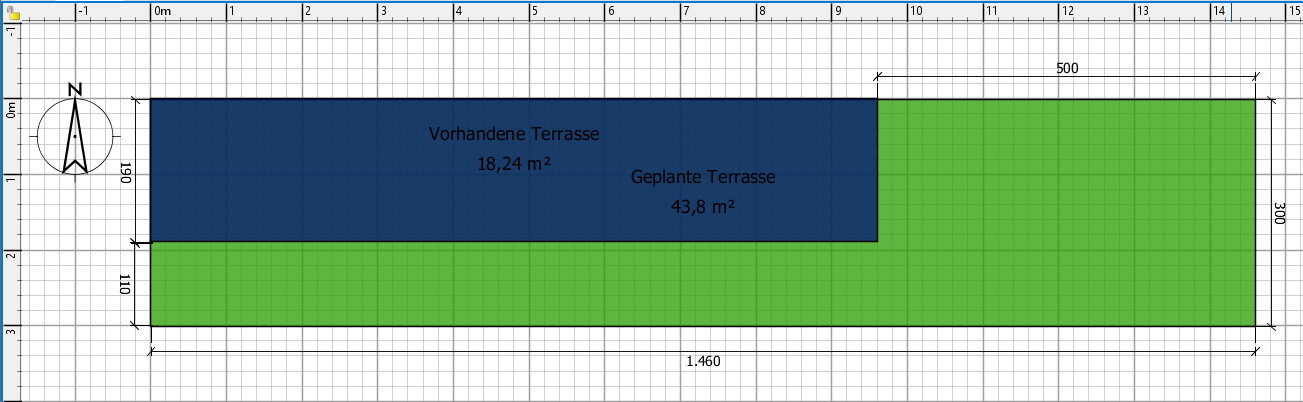
The base of the additional terrace area is concrete with slight unevenness (approx. 10cm (4 inches)).
I am considering pouring several concrete columns under the new terrace and mounting a framework of beams arranged east-west and north-south on top of them. The floor covering (probably exposed aggregate concrete slabs or wooden decking) would then be installed on this structure.
The terrace extension should be as cost-effective as possible, using existing materials where applicable, and built entirely as a DIY project.
There are several precast concrete slatted floor elements from a former barn (lengths of 1.8m (6 feet), 2.6m (8.5 feet), and 3.5m (11.5 feet), thickness about 15cm (6 inches)) available. I would like to use these as the basic framework.
My questions are:
1) How do I calculate the necessary spacing between the beams of the substructure to ensure sufficient load-bearing capacity?
2) Are there ready-made (height-adjustable?) alternatives available for the supporting columns?
The planned size is: width 14.6m (48 feet), depth 3.0m (10 feet), height approx. 70cm (28 inches), green color.
The base of the additional terrace area is concrete with slight unevenness (approx. 10cm (4 inches)).
I am considering pouring several concrete columns under the new terrace and mounting a framework of beams arranged east-west and north-south on top of them. The floor covering (probably exposed aggregate concrete slabs or wooden decking) would then be installed on this structure.
The terrace extension should be as cost-effective as possible, using existing materials where applicable, and built entirely as a DIY project.
There are several precast concrete slatted floor elements from a former barn (lengths of 1.8m (6 feet), 2.6m (8.5 feet), and 3.5m (11.5 feet), thickness about 15cm (6 inches)) available. I would like to use these as the basic framework.
My questions are:
1) How do I calculate the necessary spacing between the beams of the substructure to ensure sufficient load-bearing capacity?
2) Are there ready-made (height-adjustable?) alternatives available for the supporting columns?
B
boxandroof25 Dec 2019 21:351) It depends on the material of the substructure. I’m not sure how to calculate it exactly, but there are various guidelines for wooden substructures that specify spacing, which I would use as a reference. You can space them further apart with aluminum.
2) Search online for plastic pedestal supports that are height-adjustable. Some have self-leveling heads and a fairly high load capacity. I believe they cost around 5€ each depending on the height. Overall, it adds up, but it allows for more tolerance in leveling.
I built my substructure from aluminum square tubes up to 6m (20 feet) long, placed on pedestals adjustable between 2-15cm (1-6 inches) in height. Where the height wasn’t sufficient, I placed bricks under the pedestals. The substructure has two layers to bridge the height and provide stability. Vertically oriented 60x40x4mm (2.4x1.6x0.16 inches) profiles spanned up to 150cm (59 inches) for the lower level, minimizing the number of point foundations. The upper layer is 2mm (0.08 inches) thick with spacing up to 50cm (20 inches). Aluminum, however, is more expensive than wood. With only one layer of substructure, you need more support points because the terrace surface generally cannot allow large spans. You’ll need to calculate what is most cost-effective for you. For me, minimizing work was most important since my site was completely unprepared, so I preferred fewer point foundations on the ground.
2) Search online for plastic pedestal supports that are height-adjustable. Some have self-leveling heads and a fairly high load capacity. I believe they cost around 5€ each depending on the height. Overall, it adds up, but it allows for more tolerance in leveling.
I built my substructure from aluminum square tubes up to 6m (20 feet) long, placed on pedestals adjustable between 2-15cm (1-6 inches) in height. Where the height wasn’t sufficient, I placed bricks under the pedestals. The substructure has two layers to bridge the height and provide stability. Vertically oriented 60x40x4mm (2.4x1.6x0.16 inches) profiles spanned up to 150cm (59 inches) for the lower level, minimizing the number of point foundations. The upper layer is 2mm (0.08 inches) thick with spacing up to 50cm (20 inches). Aluminum, however, is more expensive than wood. With only one layer of substructure, you need more support points because the terrace surface generally cannot allow large spans. You’ll need to calculate what is most cost-effective for you. For me, minimizing work was most important since my site was completely unprepared, so I preferred fewer point foundations on the ground.
First of all, thank you for the detailed response.
I plan to use the existing precast concrete slatted floor elements I have here for the substructure. Has anyone had experience with this, especially regarding stability compared to wood?
Adjustable pedestals sound interesting. However, I need to bridge a height of about 40cm (total height approximately 70cm (27.5 inches) minus 2 times 15cm (6 inches) concrete element thickness). Are adjustable pedestals available for this height?
I plan to use the existing precast concrete slatted floor elements I have here for the substructure. Has anyone had experience with this, especially regarding stability compared to wood?
Adjustable pedestals sound interesting. However, I need to bridge a height of about 40cm (total height approximately 70cm (27.5 inches) minus 2 times 15cm (6 inches) concrete element thickness). Are adjustable pedestals available for this height?
B
boxandroof25 Dec 2019 21:57Since your ground is solid, you can place something underneath to bridge the gap, like stone slabs or similar.
G
Gartenfreund27 Dec 2019 06:59I'm not sure if I understood you correctly.
But as I understand it, I would lay the gap floor elements on the concrete slab, then place a garden weed barrier fabric on top. After that, add gravel or sand, and then lay the paving slabs.
You should also ensure that water drains off the concrete slab quickly and efficiently.
But as I understand it, I would lay the gap floor elements on the concrete slab, then place a garden weed barrier fabric on top. After that, add gravel or sand, and then lay the paving slabs.
You should also ensure that water drains off the concrete slab quickly and efficiently.
Similar topics