
ᐅ DIY Solar Power System Based on 48V: Tips on Inverters, Charge Controllers, and Energy Storage
Created on: 10 Dec 2025 15:24
P
PurePowerP
PurePower10 Dec 2025 15:24Hello.
I would like to share my project here and would appreciate any tips and comments:
About the project:
I currently have 2 Hoymiles HM-600 inverters (both running at 400 watts). The first is connected to its own circuit on L1 (3x 2.5mm²), and the second is also on its own circuit on L2 (2.5mm²).
Until recently, I was able to monitor and control the inverters with an OpenDTU, but unfortunately, it broke.
As I had already been considering adding a battery storage system, independent of the failure, I now want to move forward with this and have done some initial planning and extensive research.
I want a DIY solution based on 48V. Please refrain from suggesting ready-made systems like Ecoflow, Anker, or similar.
After thorough research, the Lumeentree featuring Trucki combination appeals to me the most, and I would like to build on that. I am particularly interested in the possibility of eventually expanding this into a cascaded photovoltaic system. [It is known that this then needs to be inspected and registered by an electrician.]
From my existing setup, I would like to keep my 4 currently installed panels for now. They consist of 2 x 410 Wp panels and 2 x 430 Wp heat pump panels. All panels are bifacial and are mounted at a 15° angle on my garage, facing southwest. Self-consumption is around 40%. Currently, I am losing nearly 200 EUR per year due to non-compensated export feed-in.
From an electrical upgrade in my house, I still have a 2-row IP65-rated fuse box available, which I also want to reuse and possibly include for some components. A Shelly Pro 3EM is already installed and in use here.
I have worked out two potential setups:
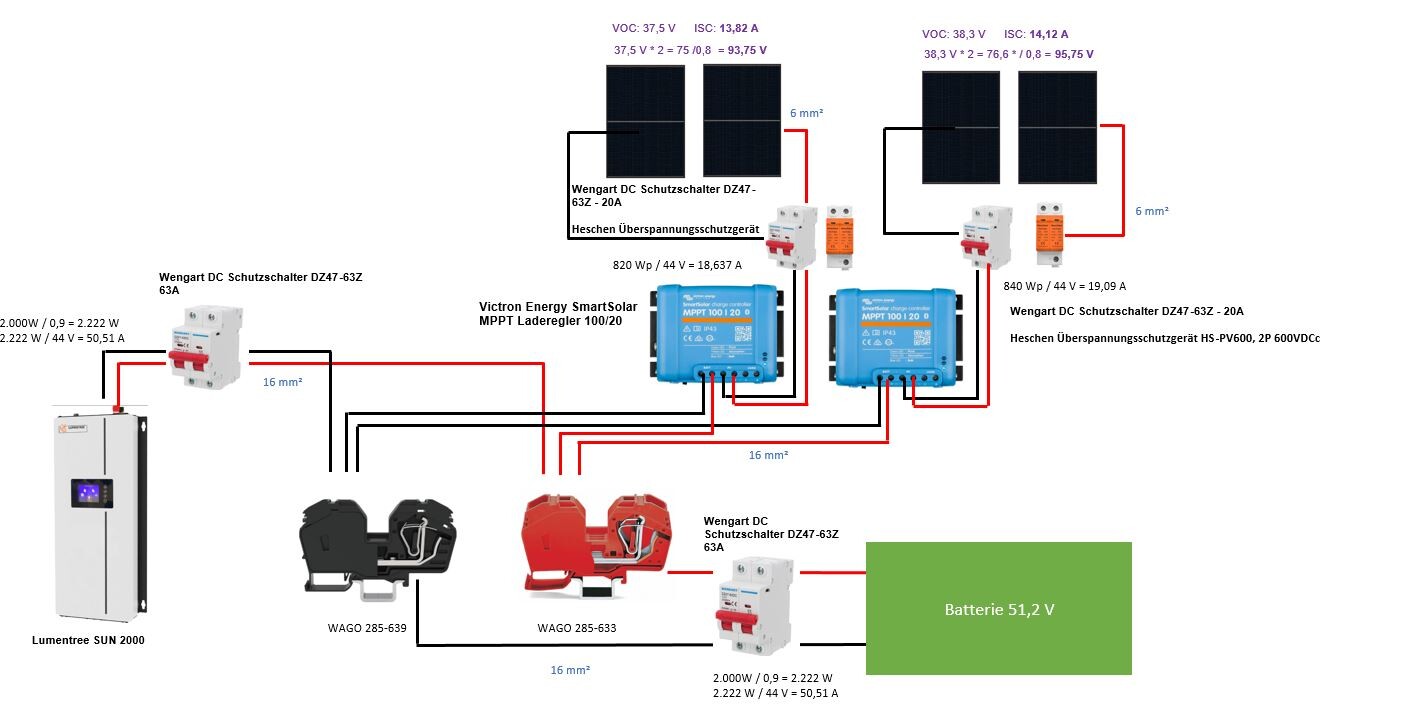
Option 1 uses 2 strings, each connected to its own Victron Energy SmartSolar MPPT charge controller 100/20.
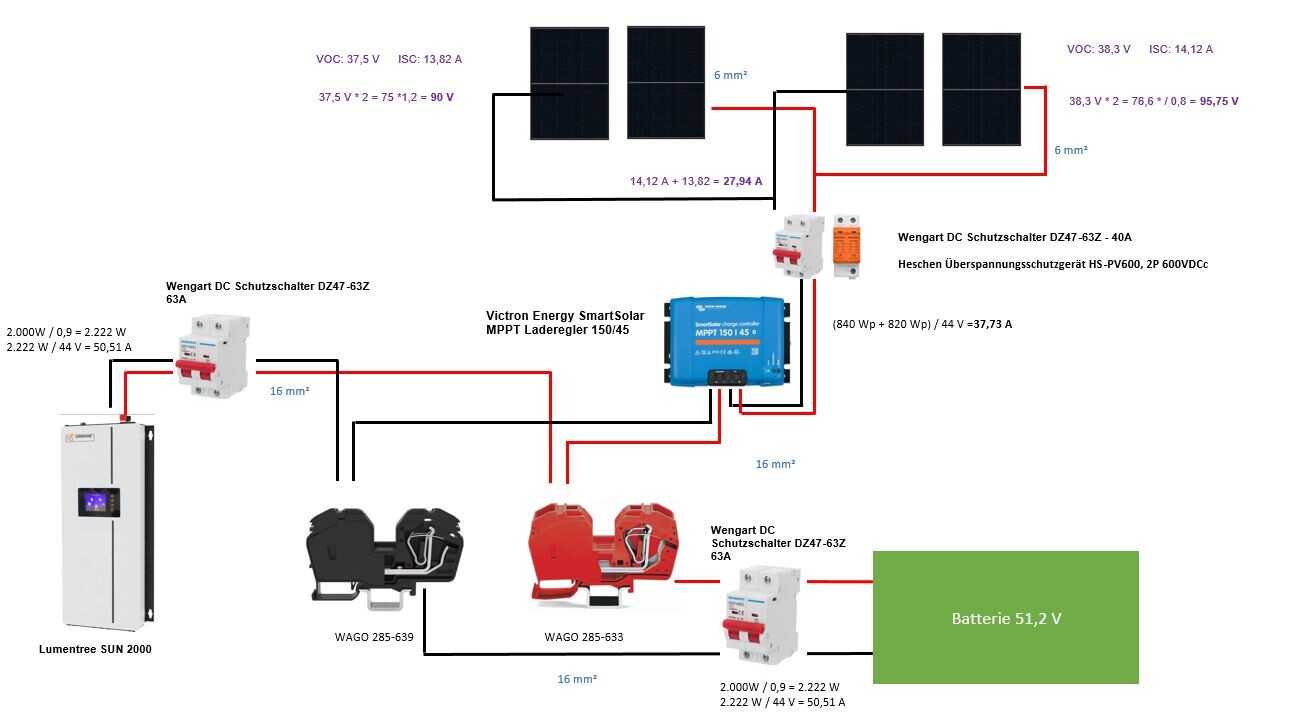
Option 2 uses 2 strings, both connected to one Victron Energy SmartSolar MPPT charge controller 150/45.
The cable length from the photovoltaic strings is 6 and 8 meters (approx. 20 and 26 feet) in both cases.
The cable length from the battery to the busbar and from the inverter to the busbar would be calculated at a maximum of 50 to 70 centimeters (approx. 20 to 28 inches) each. The length from the solar charge controllers to the busbar would be about 40 centimeters (approx. 16 inches).
My questions are:
- Which option would you recommend?
- Are the cable cross-sections sized sufficiently? There are two houses nearby, about three times as tall as mine. Is surge protection necessary, and does it make sense for such a small system? My current balcony solar system is not grounded. However, a Type 2 surge protector is installed in the sub-distribution board in the garage.
- What about fusing around the solar charge controller? I have found differing opinions, some recommend fuses between the PV panels and the charge controller, while others recommend fusing between the charge controller and the busbar.
- I have currently placed fuses before the battery and the inverter. In my view, fuses only make sense between the panels and the charge controller, since the busbar can be disconnected from all sides. The charge controller does not operate without voltage from the panels.
- Which battery storage would you recommend? I do not want to build the battery myself. I am interested in the following products:
- Volksspeicher from the Lumentree site (approx. 800 EUR)
- Power Queen 48V 100Ah 4U server rack LiFePO4 battery (approx. 1,160 EUR)
- Felicity LPBA48100-02 51.2V 5.12 kWh LiFePO4 (approx. 725 EUR)
All products are LiFePO4 100Ah batteries with BMS. However, the price difference is quite significant. The datasheets provide limited information. Could someone explain the differences, or suggest another battery I should consider?
Thank you all in advance for your support. I will respond promptly to any questions.
I would like to share my project here and would appreciate any tips and comments:
About the project:
I currently have 2 Hoymiles HM-600 inverters (both running at 400 watts). The first is connected to its own circuit on L1 (3x 2.5mm²), and the second is also on its own circuit on L2 (2.5mm²).
Until recently, I was able to monitor and control the inverters with an OpenDTU, but unfortunately, it broke.
As I had already been considering adding a battery storage system, independent of the failure, I now want to move forward with this and have done some initial planning and extensive research.
I want a DIY solution based on 48V. Please refrain from suggesting ready-made systems like Ecoflow, Anker, or similar.
After thorough research, the Lumeentree featuring Trucki combination appeals to me the most, and I would like to build on that. I am particularly interested in the possibility of eventually expanding this into a cascaded photovoltaic system. [It is known that this then needs to be inspected and registered by an electrician.]
From my existing setup, I would like to keep my 4 currently installed panels for now. They consist of 2 x 410 Wp panels and 2 x 430 Wp heat pump panels. All panels are bifacial and are mounted at a 15° angle on my garage, facing southwest. Self-consumption is around 40%. Currently, I am losing nearly 200 EUR per year due to non-compensated export feed-in.
From an electrical upgrade in my house, I still have a 2-row IP65-rated fuse box available, which I also want to reuse and possibly include for some components. A Shelly Pro 3EM is already installed and in use here.
I have worked out two potential setups:
Option 1 uses 2 strings, each connected to its own Victron Energy SmartSolar MPPT charge controller 100/20.
Option 2 uses 2 strings, both connected to one Victron Energy SmartSolar MPPT charge controller 150/45.
The cable length from the photovoltaic strings is 6 and 8 meters (approx. 20 and 26 feet) in both cases.
The cable length from the battery to the busbar and from the inverter to the busbar would be calculated at a maximum of 50 to 70 centimeters (approx. 20 to 28 inches) each. The length from the solar charge controllers to the busbar would be about 40 centimeters (approx. 16 inches).
My questions are:
- Which option would you recommend?
- Are the cable cross-sections sized sufficiently? There are two houses nearby, about three times as tall as mine. Is surge protection necessary, and does it make sense for such a small system? My current balcony solar system is not grounded. However, a Type 2 surge protector is installed in the sub-distribution board in the garage.
- What about fusing around the solar charge controller? I have found differing opinions, some recommend fuses between the PV panels and the charge controller, while others recommend fusing between the charge controller and the busbar.
- I have currently placed fuses before the battery and the inverter. In my view, fuses only make sense between the panels and the charge controller, since the busbar can be disconnected from all sides. The charge controller does not operate without voltage from the panels.
- Which battery storage would you recommend? I do not want to build the battery myself. I am interested in the following products:
- Volksspeicher from the Lumentree site (approx. 800 EUR)
- Power Queen 48V 100Ah 4U server rack LiFePO4 battery (approx. 1,160 EUR)
- Felicity LPBA48100-02 51.2V 5.12 kWh LiFePO4 (approx. 725 EUR)
All products are LiFePO4 100Ah batteries with BMS. However, the price difference is quite significant. The datasheets provide limited information. Could someone explain the differences, or suggest another battery I should consider?
Thank you all in advance for your support. I will respond promptly to any questions.
0
007sascha12 Dec 2025 06:57Hello, interesting project, I had roughly considered something similar myself. However, the problem is that a balcony power system and DIY usually exclude each other. Everything has to be plug-and-play with prefabricated components, which rules out Victron components as well as any batteries for self-connection. Sad but true.
So this won’t work as a balcony power system.
So this won’t work as a balcony power system.
P
PurePower12 Dec 2025 10:11@007sascha: Where exactly is that stated? In my opinion, the inverter only needs to be plug-and-play, and that is the Lumentree. Furthermore, the VDE standards are recommendations, not laws. If I can justify it, I am allowed to deviate from these standards.
0
007sascha12 Dec 2025 10:37Where exactly does it say that? DIN VDE V 0126-95
“This preliminary standard applies to plug-in solar devices that are marketed as products operable by laypersons.”
I believe that “products operable by laypersons” always refers to the entire system, not just the inverter. However, I’m happy to be corrected. Where does it say that the requirements apply only to the inverter? 😉
Of course, the VDE is only a guideline and not a law, but few will likely succeed in defending their own measures in court if necessary.
Similar topics