
Hello community,
this year we built a Flair 125 with the company Town & Country.
In addition to the intermediate ceiling (attic floor and roof space), we insulated the attic from the OSB floor to the peak. There is a vapor barrier in the intermediate ceiling as well as in the attic.
The attic has an insulated window and a ventilation pipe valve for the sanitary system. The humidity in the attic is quite high; small droplets form on the vapor barrier.
Now we want to build a partition wall in the attic to divide it. Access should be possible via an insulated attic stair (mostly closed) as well as through a room. The access through the room is via a space-saving staircase. We have installed a Lunos ventilation system in all rooms except the attic. My question is, is the air circulation in the attic sufficient?
Through the room access via the space-saving staircase, "fresh" air is always coming up from below...!
this year we built a Flair 125 with the company Town & Country.
In addition to the intermediate ceiling (attic floor and roof space), we insulated the attic from the OSB floor to the peak. There is a vapor barrier in the intermediate ceiling as well as in the attic.
The attic has an insulated window and a ventilation pipe valve for the sanitary system. The humidity in the attic is quite high; small droplets form on the vapor barrier.
Now we want to build a partition wall in the attic to divide it. Access should be possible via an insulated attic stair (mostly closed) as well as through a room. The access through the room is via a space-saving staircase. We have installed a Lunos ventilation system in all rooms except the attic. My question is, is the air circulation in the attic sufficient?
Through the room access via the space-saving staircase, "fresh" air is always coming up from below...!
H
hemali200318 Jan 2018 14:39To my knowledge, when insulating an attic space, heating and ventilation should also be installed; otherwise, problems with moisture and condensation are inevitable. This was the advice we received from Town & Country, so we decided not to insulate the attic (ventilated roof).
Regarding ventilation: We have a tiny pantry without any ventilation (the only room like this), and the humidity rises above 80% when the door is closed. It is said that this should stabilize over time (residual moisture). If not, we will need to install ventilation.
Attic: Warm air, along with moisture, rises and condenses as water in the unheated (?) attic space. I find it hard to believe that the air exchanges sufficiently on its own...
Regarding ventilation: We have a tiny pantry without any ventilation (the only room like this), and the humidity rises above 80% when the door is closed. It is said that this should stabilize over time (residual moisture). If not, we will need to install ventilation.
Attic: Warm air, along with moisture, rises and condenses as water in the unheated (?) attic space. I find it hard to believe that the air exchanges sufficiently on its own...
K
Knallkörper19 Jan 2018 09:47Is the vapor barrier of the attic properly connected to the vapor barrier of the ceiling below? Is the attic not insulated, or is there another reason why condensation is forming there?
The attic is insulated, and the vapor barrier is sealed to the exterior wall and the OSB floor in the attic. On the upper floor, the vapor barrier is also sealed to the exterior wall. Between the upper floor and the OSB attic floor, 200mm (8 inches) of insulation has been installed. I believe the condensation in the attic is caused by the pipe ventilation valve.
Hello community,
we have implemented the following solution:
We insulated the attic space and professionally sealed the vapor barrier to the OSB board of the intermediate ceiling.
Furthermore, we installed a partition wall in the attic. The side used for storage was fitted with a window that is opened daily for several minutes. Additionally, a ventilation brick was installed on that side. The pipe ventilation was moved from the attic to the roof.
On the “living” side, a roof window was also installed, which is usually set to the “ventilation” position. The wall in the attic between the “storage” and “living” areas is insulated and has a small ventilation grille.
Access from the living room to the attic is possible via a staircase and is always open.
Do you think this solution is sufficient?
Green insulation
Red vapor barrier.
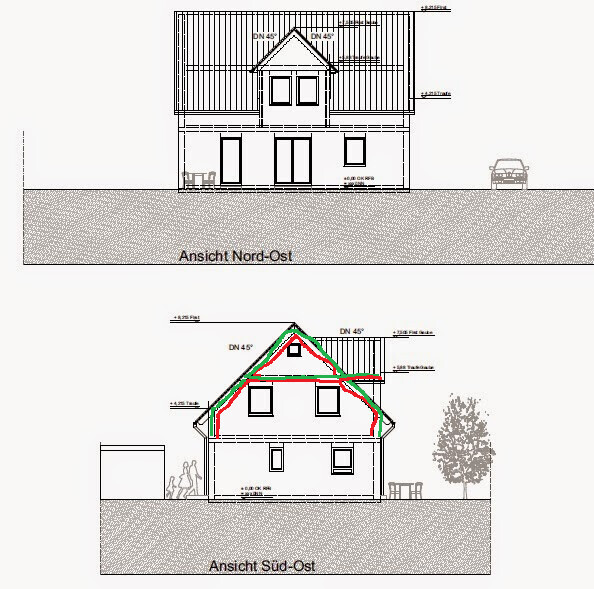
we have implemented the following solution:
We insulated the attic space and professionally sealed the vapor barrier to the OSB board of the intermediate ceiling.
Furthermore, we installed a partition wall in the attic. The side used for storage was fitted with a window that is opened daily for several minutes. Additionally, a ventilation brick was installed on that side. The pipe ventilation was moved from the attic to the roof.
On the “living” side, a roof window was also installed, which is usually set to the “ventilation” position. The wall in the attic between the “storage” and “living” areas is insulated and has a small ventilation grille.
Access from the living room to the attic is possible via a staircase and is always open.
Do you think this solution is sufficient?
Green insulation
Red vapor barrier.
Similar topics