
ᐅ District heating – domestic hot water via storage tank or instantaneous heater?
Created on: 24 Sep 2020 09:45
D
Deraggi2
Hello everyone,
we are currently planning a complete renovation of a house (4-person household), including the installation work. The house has a district heating connection, which is currently used only for heating. In the two bathrooms, old, large electric instantaneous water heaters are installed.
We are now considering how to implement the new installation. Since everything will be opened up, installing new domestic hot water pipes is expected to be no problem.
I am not up to date on instantaneous water heaters, so here are my questions – maybe someone can help:
we are currently planning a complete renovation of a house (4-person household), including the installation work. The house has a district heating connection, which is currently used only for heating. In the two bathrooms, old, large electric instantaneous water heaters are installed.
We are now considering how to implement the new installation. Since everything will be opened up, installing new domestic hot water pipes is expected to be no problem.
I am not up to date on instantaneous water heaters, so here are my questions – maybe someone can help:
- Does it make sense to stick with instantaneous water heaters for the bathrooms? I see the advantage of having "more" water available for morning showers. However, the heaters should be compact and not an eyesore. Are there any other advantages to instantaneous water heaters?
- In the kitchen, I am considering a small instantaneous water heater under the sink. Advantage: I would get warm, drinkable water faster, for example, for cooking pasta. Does anyone have experience with this? I am especially interested in how quickly warm water arrives and whether it gets warm enough.
 LordNibbler24 Sep 2020 17:39
What is the current state of the transfer station? Is it even installed, or is there an old direct connection? So, a new one might be necessary.
There are various concepts for connecting heating and hot water systems (number of heat exchangers and buffer tanks). This also partly depends on the supply temperature required for the heating system in the future (standard radiators or underfloor heating).
If you currently have large devices for water heating in the bathroom, these are probably boilers. They consume low power and keep water warm, but once the hot water supply is used up after a hot bath, it may take a few hours to replenish.
An instantaneous water heater is very compact (more like a shoebox). Since it heats water on demand, it requires much more power. Because this power is needed suddenly, approval from the grid operator is usually required above a certain power level for the connection.
I currently still have an instantaneous water heater myself but plan to switch from district heating with a direct connection to a compact station for central hot water generation via district heating. If you decide on an instantaneous water heater, make sure to choose one with electronic control rather than hydraulic. The latter are very sensitive to pressure fluctuations and may not work well with every faucet.
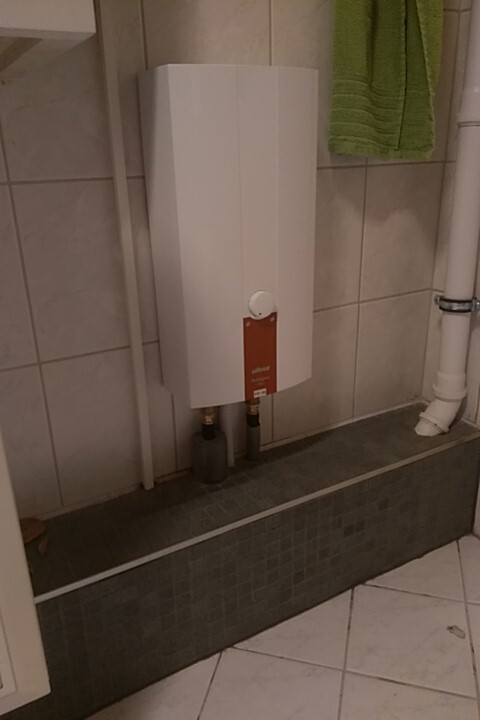
P.S.: this is an 18 kW (18 kW) instantaneous water heater.
There are various concepts for connecting heating and hot water systems (number of heat exchangers and buffer tanks). This also partly depends on the supply temperature required for the heating system in the future (standard radiators or underfloor heating).
If you currently have large devices for water heating in the bathroom, these are probably boilers. They consume low power and keep water warm, but once the hot water supply is used up after a hot bath, it may take a few hours to replenish.
An instantaneous water heater is very compact (more like a shoebox). Since it heats water on demand, it requires much more power. Because this power is needed suddenly, approval from the grid operator is usually required above a certain power level for the connection.
I currently still have an instantaneous water heater myself but plan to switch from district heating with a direct connection to a compact station for central hot water generation via district heating. If you decide on an instantaneous water heater, make sure to choose one with electronic control rather than hydraulic. The latter are very sensitive to pressure fluctuations and may not work well with every faucet.
P.S.: this is an 18 kW (18 kW) instantaneous water heater.
LordNibbler schrieb:
How is the heat transfer station set up so far? Is there even one, or is it an old direct connection? So, a new one will likely be necessary.
There are various concepts for connecting heating and domestic hot water (number of heat exchangers and buffer tanks). It also depends somewhat on the supply temperature needed in the future for the heating system (standard radiators or underfloor heating).
If you currently have large devices in the bathroom for heating water, those are probably boilers. They consume little power and keep water warm, but after a hot bath, if all the hot water is used up, it can take a few hours to heat up more.
An instantaneous water heater (tankless water heater) is very compact (more like the size of a shoebox). Since it heats water on demand as it flows, it requires much more power. Because this power is needed quite suddenly, obtaining approval from the utility provider is usually necessary above a certain power level.
I myself currently still have an instantaneous water heater but will switch from district heating with a direct connection to a compact station with central hot water generation via district heating. If you decide on an instantaneous water heater, make sure to choose one with electronic control rather than hydraulic. Hydraulic models are very sensitive to pressure fluctuations and may not be compatible with every faucet.
P.S.: this is an 18 kW (18 kW) instantaneous water heater
[ATTACH alt="IMG_20200924_174107.jpg"]51619[/ATTACH] Thank you very much for your reply. It is an old direct connection, so we will need to get a heat transfer station anyway. We would also need the hot water storage tank.
Thanks to everyone for the many helpful details. I think I will discuss the specifics in detail with my specialist company – I just like to have a basic understanding in situations like this.
Thanks!
LordNibbler25 Sep 2020 12:52In Wolfsburg, the municipal utilities specify which models (currently from Pewo) of the compact station can be used. These are also installed by a company designated by them.
Only after installation, including the storage system if applicable, can any heating engineer work on it, as this is the low-pressure side. However, on the connection side, due to the high pressure (10 bar, 100°C (212°F)), only companies certified by them are allowed to work.
Only after installation, including the storage system if applicable, can any heating engineer work on it, as this is the low-pressure side. However, on the connection side, due to the high pressure (10 bar, 100°C (212°F)), only companies certified by them are allowed to work.
Similar topics