
ᐅ Challenging Floor Plan, Plot, and Historic Building – Section 34
Created on: 11 Feb 2025 21:44
B
buttyhome
Dear Forum,
First of all, we would like to introduce ourselves. We are a family of four and have now found a nice sloped plot in NRW. We are aware that it is considered a "challenging plot" in terms of buildability, but we have fallen in love with the location and the view. It is a total of 390 m² (4200 sq ft) of building land, with green space extending behind the plot. Currently, it is occupied by two buildings, the front one of which is a listed monument requiring renovation. The rear building is in such poor condition that it must be demolished. Of course, the monument must not be significantly disturbed within its ensemble, so a modern flat roof is unfortunately not possible. However, I am hopeful that we can connect the monument with our planned new building by a joint or gap.
First, the current situation: the front house is the monument, which I intend to renovate and use as a home office/guest room.
The front house currently has two floors, but ceiling heights no longer meet our needs due to our height, so we plan, as far as possible, to remove some walls and the ceiling between floors to expose the beams.
Now to our planned new build. We are working with an architect we really trust, who has designed and renovated some truly excellent houses within our circle of friends.
Development plan / restrictions
Plot size: buildable - 390 m² (4200 sq ft), with green space behind
Slope: yes, ascending towards the rear, with an incline between 8 and 12 %, so the house will sit at the lower part of the slope. Unfortunately, the view into the valley can only be enjoyed from the upper floor due to buildings on the opposite side of the street.
§34 construction: “mixed neighborhood”, single and two-story buildings with flat and pitched roofs, some 2.5-story pitched roofs
Edge development: apparently quite common in the neighborhood. My architect is more optimistic than I am that edge development will be allowed.
Number of parking spaces: 1
Number of stories: two full floors + pitched roof
Roof type: pitched roof
Style: must integrate with the half-timbered monument for an overall harmony (please no historicism, I prefer modern architecture, perhaps with wooden cladding)
Orientation: The architect insists on building the eaves side facing the street because of window areas. I am unsure if this is possible due to boundary constraints, so I suggest a gable orientation as an alternative. I am particularly interested in your ideas here! We are still in the very first planning phase.
Maximum height / limits: 2.5 stories
Client requirements
Number of occupants: 2 adults + 2 children
Ground floor space needs: master bedroom, 2 children's bedrooms, 2 bathrooms, separate cloakroom, either at the rear (slope) or in the basement: laundry room, storage, building services
Upper floor: large open-plan kitchen and living area with garden access, fireplace, guest toilet
Office: combined with guest room
Occasional overnight guests per year
Open or closed architecture: open plan
Traditional or modern design: modern
Open kitchen with island
Minimum dining seats: 8
Fireplace: yes
Music/speaker wall: no
Balcony, roof terrace: no
Carport
House design
Not yet available, we are still assessing the basic buildability
Designer: architect versus own ideas
Personal budget for house including fittings: initially open, we want to see what is possible
Preferred heating system: heat pump
If you had to give up something, which details or features
- can you do without: -
- cannot do without: large window front facing the garden with direct garden/terrace access
Here is the architect’s first concept. She assumes basic buildability including edge development and therefore wants to place the new build with the eaves side directly adjacent to the neighbor. I would prefer a longer joint/gap, but that would make the edge building length disproportionate. I find that unfortunate as I would like the new building positioned further back in the plot to create a larger front courtyard. This is the first idea currently being checked for feasibility by the building and monument authorities:
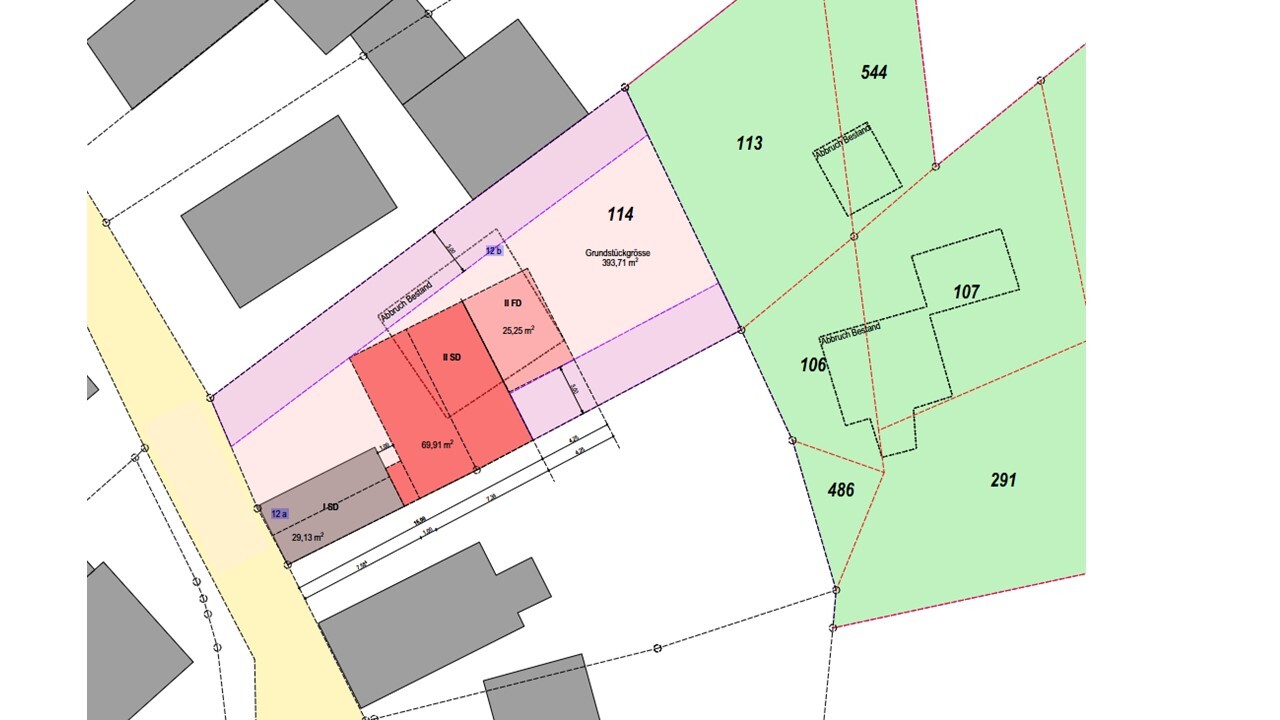
The extension toward the garden is optional and designed with a flat roof.
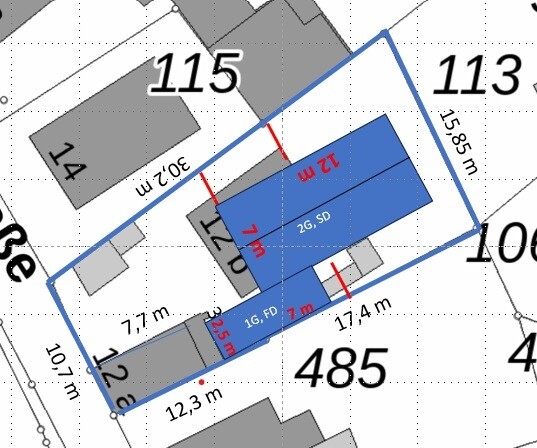
My idea would be to extend the building joint further, placing the entrance and cloakroom there, with the new building accessed above. This new building would be rotated to face with its gable. Because it would extend far into the slope, the ground floor would effectively become a basement, and the upper floor would have direct garden access at ground level. I would also need to encroach on the neighboring boundary, but I imagine this might be simpler as I am only planning a single story there. Would the house then have enough windows? You don’t want to orient large window fronts too much towards neighbors, but at least toward the garden I would like to have a large gable window area.
Thank you very much for your suggestions! What do you think is feasible? What are the pros and cons?
I am also still looking for a contour map. All the maps I find online are somewhat coarse. Is there an online resource for NRW? What options should I select in the NRW geoportal to get a good detailed representation?
First of all, we would like to introduce ourselves. We are a family of four and have now found a nice sloped plot in NRW. We are aware that it is considered a "challenging plot" in terms of buildability, but we have fallen in love with the location and the view. It is a total of 390 m² (4200 sq ft) of building land, with green space extending behind the plot. Currently, it is occupied by two buildings, the front one of which is a listed monument requiring renovation. The rear building is in such poor condition that it must be demolished. Of course, the monument must not be significantly disturbed within its ensemble, so a modern flat roof is unfortunately not possible. However, I am hopeful that we can connect the monument with our planned new building by a joint or gap.
First, the current situation: the front house is the monument, which I intend to renovate and use as a home office/guest room.
The front house currently has two floors, but ceiling heights no longer meet our needs due to our height, so we plan, as far as possible, to remove some walls and the ceiling between floors to expose the beams.
Now to our planned new build. We are working with an architect we really trust, who has designed and renovated some truly excellent houses within our circle of friends.
Development plan / restrictions
Plot size: buildable - 390 m² (4200 sq ft), with green space behind
Slope: yes, ascending towards the rear, with an incline between 8 and 12 %, so the house will sit at the lower part of the slope. Unfortunately, the view into the valley can only be enjoyed from the upper floor due to buildings on the opposite side of the street.
§34 construction: “mixed neighborhood”, single and two-story buildings with flat and pitched roofs, some 2.5-story pitched roofs
Edge development: apparently quite common in the neighborhood. My architect is more optimistic than I am that edge development will be allowed.
Number of parking spaces: 1
Number of stories: two full floors + pitched roof
Roof type: pitched roof
Style: must integrate with the half-timbered monument for an overall harmony (please no historicism, I prefer modern architecture, perhaps with wooden cladding)
Orientation: The architect insists on building the eaves side facing the street because of window areas. I am unsure if this is possible due to boundary constraints, so I suggest a gable orientation as an alternative. I am particularly interested in your ideas here! We are still in the very first planning phase.
Maximum height / limits: 2.5 stories
Client requirements
Number of occupants: 2 adults + 2 children
Ground floor space needs: master bedroom, 2 children's bedrooms, 2 bathrooms, separate cloakroom, either at the rear (slope) or in the basement: laundry room, storage, building services
Upper floor: large open-plan kitchen and living area with garden access, fireplace, guest toilet
Office: combined with guest room
Occasional overnight guests per year
Open or closed architecture: open plan
Traditional or modern design: modern
Open kitchen with island
Minimum dining seats: 8
Fireplace: yes
Music/speaker wall: no
Balcony, roof terrace: no
Carport
House design
Not yet available, we are still assessing the basic buildability
Designer: architect versus own ideas
Personal budget for house including fittings: initially open, we want to see what is possible
Preferred heating system: heat pump
If you had to give up something, which details or features
- can you do without: -
- cannot do without: large window front facing the garden with direct garden/terrace access
Here is the architect’s first concept. She assumes basic buildability including edge development and therefore wants to place the new build with the eaves side directly adjacent to the neighbor. I would prefer a longer joint/gap, but that would make the edge building length disproportionate. I find that unfortunate as I would like the new building positioned further back in the plot to create a larger front courtyard. This is the first idea currently being checked for feasibility by the building and monument authorities:
The extension toward the garden is optional and designed with a flat roof.
My idea would be to extend the building joint further, placing the entrance and cloakroom there, with the new building accessed above. This new building would be rotated to face with its gable. Because it would extend far into the slope, the ground floor would effectively become a basement, and the upper floor would have direct garden access at ground level. I would also need to encroach on the neighboring boundary, but I imagine this might be simpler as I am only planning a single story there. Would the house then have enough windows? You don’t want to orient large window fronts too much towards neighbors, but at least toward the garden I would like to have a large gable window area.
Thank you very much for your suggestions! What do you think is feasible? What are the pros and cons?
I am also still looking for a contour map. All the maps I find online are somewhat coarse. Is there an online resource for NRW? What options should I select in the NRW geoportal to get a good detailed representation?
B
buttyhome12 Feb 2025 11:28ypg schrieb:
By the way, I wouldn’t call it a problematic plot, but rather a plot for enthusiasts. After a night’s sleep, you have me convinced. Is it possible to change the title? I can’t find any edit function. Otherwise, I would call it:
“Enthusiast’s Plot with Timber-Frame Monument and Section 34 Development – Initial Ideas”
I want to create enthusiasm for the project.
I generally think building within an existing structure is a great idea; you like the property you found and you have a reliable architect with appropriate references. So, in this part of the forum, you’re already ahead of the curve, because the architect will enjoy creating another reference project and overcoming the existing challenges.
Such a project is not comparable to typical new builds of a single-family house on open land through a general contractor or a prefab home company at all.
Disadvantages can always be financial or practical. Often, beautiful things are not practical but beautiful, and with a property like this, there will (hopefully) be many beautiful and unique features that ultimately won’t always be as practical as they might be in a typical single-family home. However, it can (and should) carry your very personal signature, and that applies equally to split-level layouts as well as exposed beams, for example. Such a house, especially inside, should receive detailed planning and design—then it will become a real gem.
You’re missing further input here, but that’s currently hardly possible since you’re still dealing with a blank slate until the first draft or at least a rough sketch is available regarding the possible construction approach.
If you want to refine such a property, you will have to be comfortable with and adapt to the fact that not all your desired “standards” can be realized. I would suggest discussing basic concepts with the architect and having their feasibility checked with the local authorities (building permit / planning permission); then perhaps a new discussion can be started or the discussion will become more active on its own as things become more concrete.
In this respect, I also believe that aspects such as covered parking, terraces, storage rooms, access routes, etc., will only be implementable as a whole and perhaps in somewhat unusual ways in order to create a beautiful overall result.
I am very curious and would be pleased if someone once again shared their project here with an open outcome and, in return, received the often important experiences from participants.
It’s not the thread name that’s the issue.
Such a project is not comparable to typical new builds of a single-family house on open land through a general contractor or a prefab home company at all.
buttyhome schrieb:
P.S: I also really like split-level houses. With my elongated floor plan, that would probably make more sense, so the staircase would have to be in the middle.
What are the pros and cons?
Disadvantages can always be financial or practical. Often, beautiful things are not practical but beautiful, and with a property like this, there will (hopefully) be many beautiful and unique features that ultimately won’t always be as practical as they might be in a typical single-family home. However, it can (and should) carry your very personal signature, and that applies equally to split-level layouts as well as exposed beams, for example. Such a house, especially inside, should receive detailed planning and design—then it will become a real gem.
You’re missing further input here, but that’s currently hardly possible since you’re still dealing with a blank slate until the first draft or at least a rough sketch is available regarding the possible construction approach.
If you want to refine such a property, you will have to be comfortable with and adapt to the fact that not all your desired “standards” can be realized. I would suggest discussing basic concepts with the architect and having their feasibility checked with the local authorities (building permit / planning permission); then perhaps a new discussion can be started or the discussion will become more active on its own as things become more concrete.
In this respect, I also believe that aspects such as covered parking, terraces, storage rooms, access routes, etc., will only be implementable as a whole and perhaps in somewhat unusual ways in order to create a beautiful overall result.
I am very curious and would be pleased if someone once again shared their project here with an open outcome and, in return, received the often important experiences from participants.
It’s not the thread name that’s the issue.
B
buttyhome12 Feb 2025 12:24Arauki11 schrieb:
I think the idea of building within an existing structure is fundamentally great; you like the property you found, and you have a trustworthy architect with relevant references, so you’re already ahead of the game in this area here on the forum. The architect will also enjoy creating another reference project and solving the existing challenges.
Such a project isn’t comparable to the usual single-family home builds on open land through a general contractor or a prefab house company.
...Thank you for your kind words! You’re right—what can you do at this point? My impatience comes from the uncertainty about what’s actually possible to build. How are you supposed to take action when you have even less information than I do?
The architect’s plan with the very rough outer shell is already with the building authority and the local heritage preservation office. We agreed to just see what’s feasible and then make the best of the given conditions. I’m also keeping the construction budget deliberately open because we simply want to realize the dream of our lives (family takes priority for now). That doesn’t mean we need a huge amount of space; we just want something unique and fitting for us. Everyone involved is incredibly excited about the project—our architect is already enthusiastic about emphasizing the front courtyard character with a wooden façade.
For me, the rational alarm bells keep ringing—wondering what the building authority will say. For example, I couldn’t sleep last night thinking about the northern neighbor who built directly on the boundary line. If the building authority now requires a 2 x 3 meter (6.5 x 10 feet) setback from the boundary, our lot would be unbuildable. I hope situations like that don’t actually happen...
Haha, your imagination will have you designing all kinds of different houses, only to have them stopped by the building authority, neighbors, or some other obstacle.
With an architect that committed and genuinely enjoying the process, it will become a beautiful home, probably very different from what you can imagine right now. For some, this might cause stress, but I can relate and understand your excitement.
If something doesn’t go as planned—whether due to neighbors or the building authority—you shouldn’t despair or feel discouraged, because it opens up new possibilities that you hadn’t considered before (or needed to consider).
A friend of ours renovated a three-sided farmstead and got stuck or had to let go of some original “dreams” along the way. However, I see him as very satisfied with his project and with his awareness of creating something unique. People lived differently there in the past, so how could it be possible today to have a “modern” life without any compromises? That’s just not realistic.
I always find it inspiring when people live differently than what is generally considered the norm. A building that is part historic monument and part modern is something special, and consciously choosing building materials for it would also appeal to me.
Looking forward to your first draft.
With an architect that committed and genuinely enjoying the process, it will become a beautiful home, probably very different from what you can imagine right now. For some, this might cause stress, but I can relate and understand your excitement.
If something doesn’t go as planned—whether due to neighbors or the building authority—you shouldn’t despair or feel discouraged, because it opens up new possibilities that you hadn’t considered before (or needed to consider).
A friend of ours renovated a three-sided farmstead and got stuck or had to let go of some original “dreams” along the way. However, I see him as very satisfied with his project and with his awareness of creating something unique. People lived differently there in the past, so how could it be possible today to have a “modern” life without any compromises? That’s just not realistic.
I always find it inspiring when people live differently than what is generally considered the norm. A building that is part historic monument and part modern is something special, and consciously choosing building materials for it would also appeal to me.
Looking forward to your first draft.

buttyhome schrieb:
We are a family of four and have now found a nice hillside plot in NRW. [...] We are planning together with an architect whom we trust very much because she has really built and renovated some fantastic houses within our circle of acquaintances. Building within an existing structure is a whole different level of challenges, and working on a half-timbered historic building is a completely different matter compared to transforming a sixty-year-old house from an oil heating system to heat pumps. NRW is large; in Münstereifel, there is @wpic, and in Meschede, Mrs. Kohnen ("Kittybob") also lives in a listed building herself. I gladly recommend both of them.
Arauki11 schrieb:
You feel a lack of further participation here, but that is currently hardly possible, ... in my case, I also lack a clear overview: the house to be demolished shown in the opening post looks like it has a gable-end orientation in the photo, but the property excerpt/site plan shows more of a side-wall orientation. I’m also missing an aerial photo or property excerpt with about a 100m (330 ft) diagonal and photos of the situation regarding the garden floor, which is described as level with the hillside. I could imagine leaving the guest and study cottage as a standalone building, so not necessarily connecting it to a shared hallway area. That might even have the charm of considering it an independent structure and potentially treating it separately regarding energy-efficient renovation requirements under different conditions. Shared connections, heating supply, etc., wouldn’t necessarily prevent that. But as I said, these are all aspects where expertise in “old” or “very old” buildings is an entirely different matter.
https://www.instagram.com/11antgmxde/
https://www.linkedin.com/company/bauen-jetzt/
B
buttyhome12 Feb 2025 15:1411ant schrieb:
Building within an existing structure presents its own set of challenges, and working with a half-timbered historic building is a whole different level compared to updating a sixty-year-old house from an oil heating system to a heat pump. NRW is large; in Bad Münstereifel there is @wpic, and in Meschede, Ms. Kohnen ("Kittybob") also lives in a listed building herself. I recommend both of them. Thanks for the suggestions. Bad Münstereifel is really not far away.
11ant schrieb:
... in my case, I don’t have a clear picture either: the house marked for demolition in the opening post appears to be positioned along the eaves side in the photo, but on the official cadastral extract/site plan it looks more like it’s oriented along the gable side. I’m also missing an aerial photo or cadastral extract with an approximate 100 m (330 ft) diagonal view and photos showing the situation of the garden-level floor described as being level on the hillside side. I could imagine leaving the guest and workroom cottage standing alone, so not necessarily connecting it to a shared hallway area. That could also have the advantage of treating it as a separate building and dealing with energy retrofit requirements independently and under different conditions. Shared connections, heating supply, etc., wouldn’t necessarily prevent that. But as I said, these are all aspects where expertise in "old" or "very old" houses is a completely different matter. I’m attaching an aerial photo. The house to be demolished is, as in the photo, located along the eaves side. However, it was extended by an addition, which is why it appears gable-oriented on the cadastral plan.
Leaving the cottage as a standalone structure would only be a last resort if the heritage authorities require it. I definitely want to integrate it into the new building, as it would then be used much more frequently. Also, guest toilets would need to be installed there; otherwise, the guests won’t be happy ;-)
Similar topics