
ᐅ Challenging Floor Plan, Plot, and Historic Building – Section 34
Created on: 11 Feb 2025 21:44
B
buttyhome
Dear Forum,
First of all, we would like to introduce ourselves. We are a family of four and have now found a nice sloped plot in NRW. We are aware that it is considered a "challenging plot" in terms of buildability, but we have fallen in love with the location and the view. It is a total of 390 m² (4200 sq ft) of building land, with green space extending behind the plot. Currently, it is occupied by two buildings, the front one of which is a listed monument requiring renovation. The rear building is in such poor condition that it must be demolished. Of course, the monument must not be significantly disturbed within its ensemble, so a modern flat roof is unfortunately not possible. However, I am hopeful that we can connect the monument with our planned new building by a joint or gap.
First, the current situation: the front house is the monument, which I intend to renovate and use as a home office/guest room.
The front house currently has two floors, but ceiling heights no longer meet our needs due to our height, so we plan, as far as possible, to remove some walls and the ceiling between floors to expose the beams.
Now to our planned new build. We are working with an architect we really trust, who has designed and renovated some truly excellent houses within our circle of friends.
Development plan / restrictions
Plot size: buildable - 390 m² (4200 sq ft), with green space behind
Slope: yes, ascending towards the rear, with an incline between 8 and 12 %, so the house will sit at the lower part of the slope. Unfortunately, the view into the valley can only be enjoyed from the upper floor due to buildings on the opposite side of the street.
§34 construction: “mixed neighborhood”, single and two-story buildings with flat and pitched roofs, some 2.5-story pitched roofs
Edge development: apparently quite common in the neighborhood. My architect is more optimistic than I am that edge development will be allowed.
Number of parking spaces: 1
Number of stories: two full floors + pitched roof
Roof type: pitched roof
Style: must integrate with the half-timbered monument for an overall harmony (please no historicism, I prefer modern architecture, perhaps with wooden cladding)
Orientation: The architect insists on building the eaves side facing the street because of window areas. I am unsure if this is possible due to boundary constraints, so I suggest a gable orientation as an alternative. I am particularly interested in your ideas here! We are still in the very first planning phase.
Maximum height / limits: 2.5 stories
Client requirements
Number of occupants: 2 adults + 2 children
Ground floor space needs: master bedroom, 2 children's bedrooms, 2 bathrooms, separate cloakroom, either at the rear (slope) or in the basement: laundry room, storage, building services
Upper floor: large open-plan kitchen and living area with garden access, fireplace, guest toilet
Office: combined with guest room
Occasional overnight guests per year
Open or closed architecture: open plan
Traditional or modern design: modern
Open kitchen with island
Minimum dining seats: 8
Fireplace: yes
Music/speaker wall: no
Balcony, roof terrace: no
Carport
House design
Not yet available, we are still assessing the basic buildability
Designer: architect versus own ideas
Personal budget for house including fittings: initially open, we want to see what is possible
Preferred heating system: heat pump
If you had to give up something, which details or features
- can you do without: -
- cannot do without: large window front facing the garden with direct garden/terrace access
Here is the architect’s first concept. She assumes basic buildability including edge development and therefore wants to place the new build with the eaves side directly adjacent to the neighbor. I would prefer a longer joint/gap, but that would make the edge building length disproportionate. I find that unfortunate as I would like the new building positioned further back in the plot to create a larger front courtyard. This is the first idea currently being checked for feasibility by the building and monument authorities:
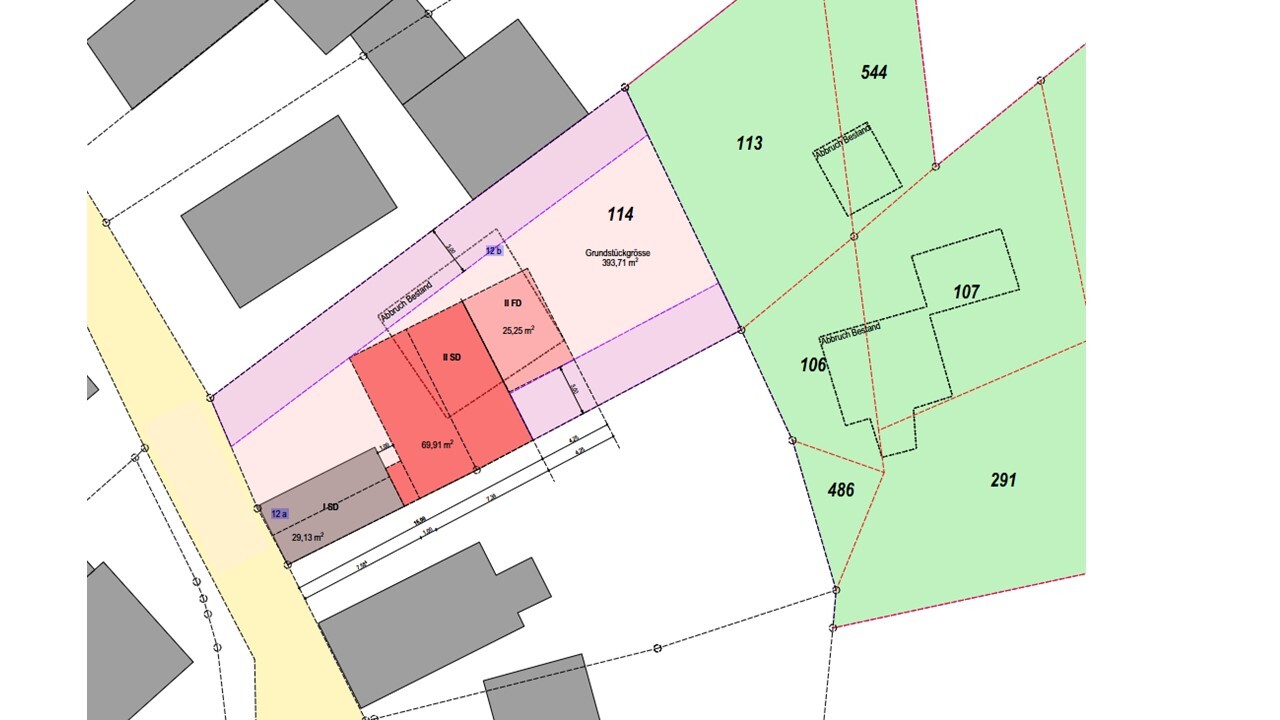
The extension toward the garden is optional and designed with a flat roof.
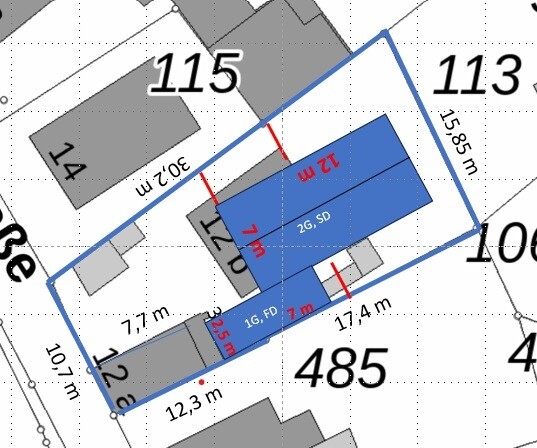
My idea would be to extend the building joint further, placing the entrance and cloakroom there, with the new building accessed above. This new building would be rotated to face with its gable. Because it would extend far into the slope, the ground floor would effectively become a basement, and the upper floor would have direct garden access at ground level. I would also need to encroach on the neighboring boundary, but I imagine this might be simpler as I am only planning a single story there. Would the house then have enough windows? You don’t want to orient large window fronts too much towards neighbors, but at least toward the garden I would like to have a large gable window area.
Thank you very much for your suggestions! What do you think is feasible? What are the pros and cons?
I am also still looking for a contour map. All the maps I find online are somewhat coarse. Is there an online resource for NRW? What options should I select in the NRW geoportal to get a good detailed representation?
First of all, we would like to introduce ourselves. We are a family of four and have now found a nice sloped plot in NRW. We are aware that it is considered a "challenging plot" in terms of buildability, but we have fallen in love with the location and the view. It is a total of 390 m² (4200 sq ft) of building land, with green space extending behind the plot. Currently, it is occupied by two buildings, the front one of which is a listed monument requiring renovation. The rear building is in such poor condition that it must be demolished. Of course, the monument must not be significantly disturbed within its ensemble, so a modern flat roof is unfortunately not possible. However, I am hopeful that we can connect the monument with our planned new building by a joint or gap.
First, the current situation: the front house is the monument, which I intend to renovate and use as a home office/guest room.
The front house currently has two floors, but ceiling heights no longer meet our needs due to our height, so we plan, as far as possible, to remove some walls and the ceiling between floors to expose the beams.
Now to our planned new build. We are working with an architect we really trust, who has designed and renovated some truly excellent houses within our circle of friends.
Development plan / restrictions
Plot size: buildable - 390 m² (4200 sq ft), with green space behind
Slope: yes, ascending towards the rear, with an incline between 8 and 12 %, so the house will sit at the lower part of the slope. Unfortunately, the view into the valley can only be enjoyed from the upper floor due to buildings on the opposite side of the street.
§34 construction: “mixed neighborhood”, single and two-story buildings with flat and pitched roofs, some 2.5-story pitched roofs
Edge development: apparently quite common in the neighborhood. My architect is more optimistic than I am that edge development will be allowed.
Number of parking spaces: 1
Number of stories: two full floors + pitched roof
Roof type: pitched roof
Style: must integrate with the half-timbered monument for an overall harmony (please no historicism, I prefer modern architecture, perhaps with wooden cladding)
Orientation: The architect insists on building the eaves side facing the street because of window areas. I am unsure if this is possible due to boundary constraints, so I suggest a gable orientation as an alternative. I am particularly interested in your ideas here! We are still in the very first planning phase.
Maximum height / limits: 2.5 stories
Client requirements
Number of occupants: 2 adults + 2 children
Ground floor space needs: master bedroom, 2 children's bedrooms, 2 bathrooms, separate cloakroom, either at the rear (slope) or in the basement: laundry room, storage, building services
Upper floor: large open-plan kitchen and living area with garden access, fireplace, guest toilet
Office: combined with guest room
Occasional overnight guests per year
Open or closed architecture: open plan
Traditional or modern design: modern
Open kitchen with island
Minimum dining seats: 8
Fireplace: yes
Music/speaker wall: no
Balcony, roof terrace: no
Carport
House design
Not yet available, we are still assessing the basic buildability
Designer: architect versus own ideas
Personal budget for house including fittings: initially open, we want to see what is possible
Preferred heating system: heat pump
If you had to give up something, which details or features
- can you do without: -
- cannot do without: large window front facing the garden with direct garden/terrace access
Here is the architect’s first concept. She assumes basic buildability including edge development and therefore wants to place the new build with the eaves side directly adjacent to the neighbor. I would prefer a longer joint/gap, but that would make the edge building length disproportionate. I find that unfortunate as I would like the new building positioned further back in the plot to create a larger front courtyard. This is the first idea currently being checked for feasibility by the building and monument authorities:
The extension toward the garden is optional and designed with a flat roof.
My idea would be to extend the building joint further, placing the entrance and cloakroom there, with the new building accessed above. This new building would be rotated to face with its gable. Because it would extend far into the slope, the ground floor would effectively become a basement, and the upper floor would have direct garden access at ground level. I would also need to encroach on the neighboring boundary, but I imagine this might be simpler as I am only planning a single story there. Would the house then have enough windows? You don’t want to orient large window fronts too much towards neighbors, but at least toward the garden I would like to have a large gable window area.
Thank you very much for your suggestions! What do you think is feasible? What are the pros and cons?
I am also still looking for a contour map. All the maps I find online are somewhat coarse. Is there an online resource for NRW? What options should I select in the NRW geoportal to get a good detailed representation?
11ant schrieb:
I would suggest talking to the mayor and, as a precaution, contacting my lawyer to get in touch with the head of the heritage office. I don’t understand this either. In today’s world, it’s understandable on the outside. Every village could use small historical highlights like that. But what is supposed to be preserved inside now for future generations???


11ant schrieb:
Sometimes you wonder if they’re just spinning asbestos joints in an ivory tower. You really don’t seem to be familiar with heritage conservation authorities. I’ve had my share of fun with them too – for example, with plain (no patterns or ornaments) reddish-brown tiles, about 15cm x 15cm (6 inches x 6 inches). They’re original and have to be preserved. Because of that, the underfloor heating in that room was lost, and a ceiling heating system had to be installed instead… which is tricky, considering the physics of warm air and all that… (no worries, the house is finished :-) )

buttyhome schrieb:
How much I would like to send this post as a reply to the heritage authority. Made my day! Possibly, after that, working constructively with them wouldn't be quite so smooth anymore. That's why I say the lawyer should call the head official. "Proportionality" is indeed a powerful magic word because at that point, the bureaucratic gymnastics of officialdom have their limits. For example,
RomeoZwo schrieb:
You really seem to know heritage offices poorly. I had my own fun there – including with ordinary (no patterns or ornaments) reddish-brown tiles, about 15cm x 15cm (6in x 6in). They are original and must be preserved. Because of that, the underfloor heating in that room was lost, and a ceiling heating system had to be installed... just not great with physics and warm air and so on... (no worries, the house is finished) is probably utter nonsense – also because ceiling heating systems did not exist in the original year of construction – but in the balance between "preserving original tiles" vs. "modern technical renovation," proportionality is still a matter of opinion. On the other hand,
ypg schrieb:
I can’t understand this either. In today’s times. It’s understandable on the outside. Every village can use such small historical magnets. But what is now supposed to be preserved inside for future generations??? preserving the interior "for future generations" just because there is no donor to finance dismantling and reconstruction in an open-air museum, and then telling the property owner, "well, then you just play museum on your own land," goes beyond tolerable absurdity. I dare to doubt that precisely the proto-version of the original Niederfinsdorf dwarf hut floor plan illustrates a cultural turning point that must be presented to the curious Martian upon landing on Earth. If it does, the Ministry of Culture should secure funds from the UN to lease this outbuilding for that purpose. But without such cultural uses, simply forbidding the relocation of the wall between the sewing room and the snuff box chamber is arbitrary and close to expropriation. Not everyone who’s crazy is Roman.
https://www.instagram.com/11antgmxde/
https://www.linkedin.com/company/bauen-jetzt/
11ant schrieb:
should call the head manager I even had a conference call with the head manager, both from the municipal heritage office and the state monument authority. However, this was about "original single-pane windows vs. energy-efficient renovation." The final explanation was: "It's not about the appearance but about preserving originality." When I asked if the old windows were “gone,” they said they (almost) do not mind whether the new ones are cheap plastic windows or wooden windows designed like the originals. The tiles were the icing on the cake because the heating calculation and all legal requirements demanded a heater in the hallway. Only the tiles were not allowed to be touched.
If I were to renovate a heritage building again, I would probably go through the house once with a sledgehammer before the inspection by the heritage office. Or warn the junk removal workers to be extra careless. I believe this is basic knowledge that heritage-specialized contractors have, but is lacking for amateurs doing this for the first time.
RomeoZwo schrieb:
If I were to renovate a historic building again, I would probably walk through the house with a sledgehammer before the inspection by the heritage preservation office. Or warn the junk removal service against being too careful. I believe this is basic knowledge that developers specializing in historic buildings have, but amateurs doing this for the first time lack. Among contractors, there's a saying "let bygones be bygones," meaning that when it comes to judging whether a building structure is worth preserving, dry rot ranks even above the state heritage officer in the hierarchy. At some point, reality reaches a level where even a president like Donald the First could no longer ignore the verdict.
https://www.instagram.com/11antgmxde/
https://www.linkedin.com/company/bauen-jetzt/
Similar topics