
Hello everyone,
Could someone please give me a tip on how to distinguish a masonry heater from a fireplace? I am currently visiting several houses, and often the owners themselves have no idea when I ask what type of stove it is. I’m particularly interested in one case (without having to ask a chimney sweep or expert every time). It’s located in the middle of an open room, built from floor to ceiling. I’m attaching a section from the listing. Do you see anything from that? The heating is done on the base/floor; there is no grate on which the wood is placed.
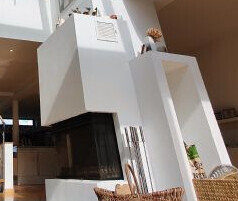
My question usually focuses on whether I will be allowed to operate the stove from next year without costly upgrades. Masonry heaters generally have fewer restrictions.
Best regards and thanks!
Could someone please give me a tip on how to distinguish a masonry heater from a fireplace? I am currently visiting several houses, and often the owners themselves have no idea when I ask what type of stove it is. I’m particularly interested in one case (without having to ask a chimney sweep or expert every time). It’s located in the middle of an open room, built from floor to ceiling. I’m attaching a section from the listing. Do you see anything from that? The heating is done on the base/floor; there is no grate on which the wood is placed.
My question usually focuses on whether I will be allowed to operate the stove from next year without costly upgrades. Masonry heaters generally have fewer restrictions.
Best regards and thanks!
H
hampshire24 May 2020 16:58A masonry heater is characterized by the fact that it is fired only with wood and does not have air supply from below. The wood rests on the base of the stove, ideally in a bed of ash. Modern masonry heaters with combustion control achieve an extremely clean burn. Typically, masonry heaters are built with a large thermal mass, for example from fireclay bricks. Flue gases pass through the thermal mass. In this way, energy is released over several hours as radiant heat into the room. The heating curve is long and gentle.
Wood stoves usually have a grate and a significantly faster burn rate. The heating curve is rather short and intense. Wood stoves can also be equipped with thermal mass to extend the heating curve somewhat.
In our living space (over 300 cubic meters (10,600 cubic feet) in volume), we use a masonry heater with Ortner technology as the sole heat source. In winter, a 11-13kg (24-29 lbs) load of good firewood provided comfortable warmth for 24 hours.
Our boys each have a Hase wood stove in their apartments as an alternative to infrared heating. The room heats up very quickly, but the stove starts to cool down after only 2-3 hours.
Fun fact: The heat output of wood-burning stoves is stated in kilowatts (kW). This measures the maximum residual heat. A masonry heater appears less efficient on paper than a wood stove because the time over which the output is measured is relatively short.
Wood stoves usually have a grate and a significantly faster burn rate. The heating curve is rather short and intense. Wood stoves can also be equipped with thermal mass to extend the heating curve somewhat.
In our living space (over 300 cubic meters (10,600 cubic feet) in volume), we use a masonry heater with Ortner technology as the sole heat source. In winter, a 11-13kg (24-29 lbs) load of good firewood provided comfortable warmth for 24 hours.
Our boys each have a Hase wood stove in their apartments as an alternative to infrared heating. The room heats up very quickly, but the stove starts to cool down after only 2-3 hours.
Fun fact: The heat output of wood-burning stoves is stated in kilowatts (kW). This measures the maximum residual heat. A masonry heater appears less efficient on paper than a wood stove because the time over which the output is measured is relatively short.
Cool, thanks for the clarifying answer. What do you think about the chimney in the picture? I couldn’t spot any ventilation slots at the bottom. However, the ventilation slots at the top seem more like a sign of a traditional convection stove, so a regular chimney rather than a masonry heater, right?
A masonry heater (in terms of the energy-saving regulations, meaning I am allowed to operate the stove from 2020 onwards) is not the same as a storage stove, but rather means that combustion happens directly on the base, resulting in higher temperatures and cleaner burning, correct?
A masonry heater (in terms of the energy-saving regulations, meaning I am allowed to operate the stove from 2020 onwards) is not the same as a storage stove, but rather means that combustion happens directly on the base, resulting in higher temperatures and cleaner burning, correct?
Similar topics