
S
schwerinbaut26 Jan 2020 20:43Hello Forum,
We are interested in a plot of land in a future residential development area. Our idea is a typical one-and-a-half-story single-family home with a pitched roof.
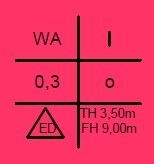
The development plan limits the eaves height to 3.50 meters (11 ft 6 in), defined as the distance between the top of the ground floor structural ceiling and the eaves.
In my understanding, the eaves are defined as the drip edge where the gutter is located.
Do you have any different interpretations of this point, and are one-and-a-half-story houses with knee walls not possible at all, with only bungalows allowed?
Extracts from the development plan are attached.

We are interested in a plot of land in a future residential development area. Our idea is a typical one-and-a-half-story single-family home with a pitched roof.
The development plan limits the eaves height to 3.50 meters (11 ft 6 in), defined as the distance between the top of the ground floor structural ceiling and the eaves.
In my understanding, the eaves are defined as the drip edge where the gutter is located.
Do you have any different interpretations of this point, and are one-and-a-half-story houses with knee walls not possible at all, with only bungalows allowed?
Extracts from the development plan are attached.
S
schwerinbaut26 Jan 2020 22:39Well, usually a point of the specified eave height is either the upper or lower edge of the roof covering. In that case, 3.50m (11.5 feet) would be rather low for a 1.5-story house...
I wonder whether I am reading this "to my advantage" or if the drip edge is actually meant.
I wonder whether I am reading this "to my advantage" or if the drip edge is actually meant.

Nordlys schrieb:
What is your problem?The knee wall height ends up somewhere around 50cm (20 inches). That seems to be the issue.But it doesn't have to be, because in this case you can simply plan the ground floor slightly larger and build down the upper floor at about 1.30m (4 ft 3 inches) or so, creating a knee wall.
Wiki:
The eaves point (also eaves line) is the intersection between the vertical exterior surface (surface of the outer wall) and the roof covering.
The height between the eaves point and the ground level is called the eaves height.

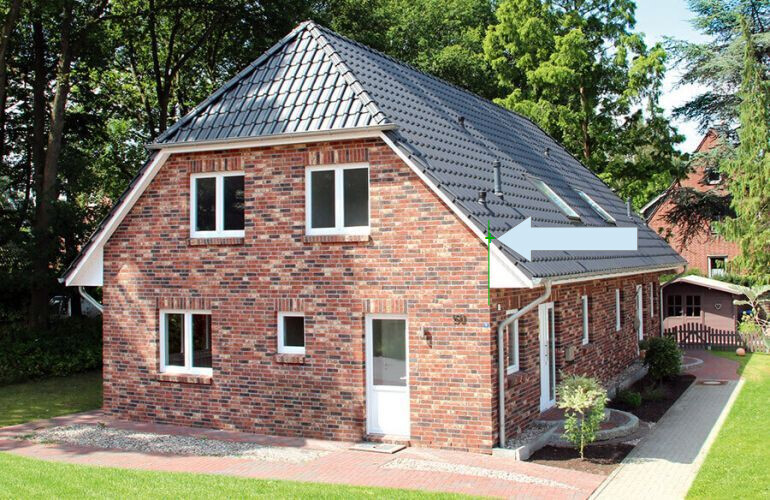
I have never come across this definition before, and it appears to be incorrectly formulated, meaning the terms are used inaccurately. What is apparently meant here is to use the top edge of the unfinished basement ceiling (which is practically referred to as the floor in the ground floor) as the reference point. It is more common to use the finished state of the same as a reference. The condition that this reference point should not be more than half a meter above the street surface is also standard practice. The same reference point in the attic is usually about 2.85 m (9 feet 4 inches) higher. Counting from there, there are practically still 65 cm (26 inches) of knee wall remaining up to the upper measuring point of the eave height. This point is always located where you would imagine the roof covering would exactly end at the intersection with the exterior wall surface. The gutter is only a romantic term in this context. In the picture posted by Karsten, I have marked this point; it is approximately at parapet height there, which is too high.
https://www.instagram.com/11antgmxde/
https://www.linkedin.com/company/bauen-jetzt/
https://www.instagram.com/11antgmxde/
https://www.linkedin.com/company/bauen-jetzt/
Similar topics