
Hello everyone,
We are planning to build a new house and now have some questions regarding the zoning plan.
Maybe you can provide some concrete answers or estimates about the situation.
I will probably visit the local authority again on Friday to clarify some details more specifically.
A brief background and framework:
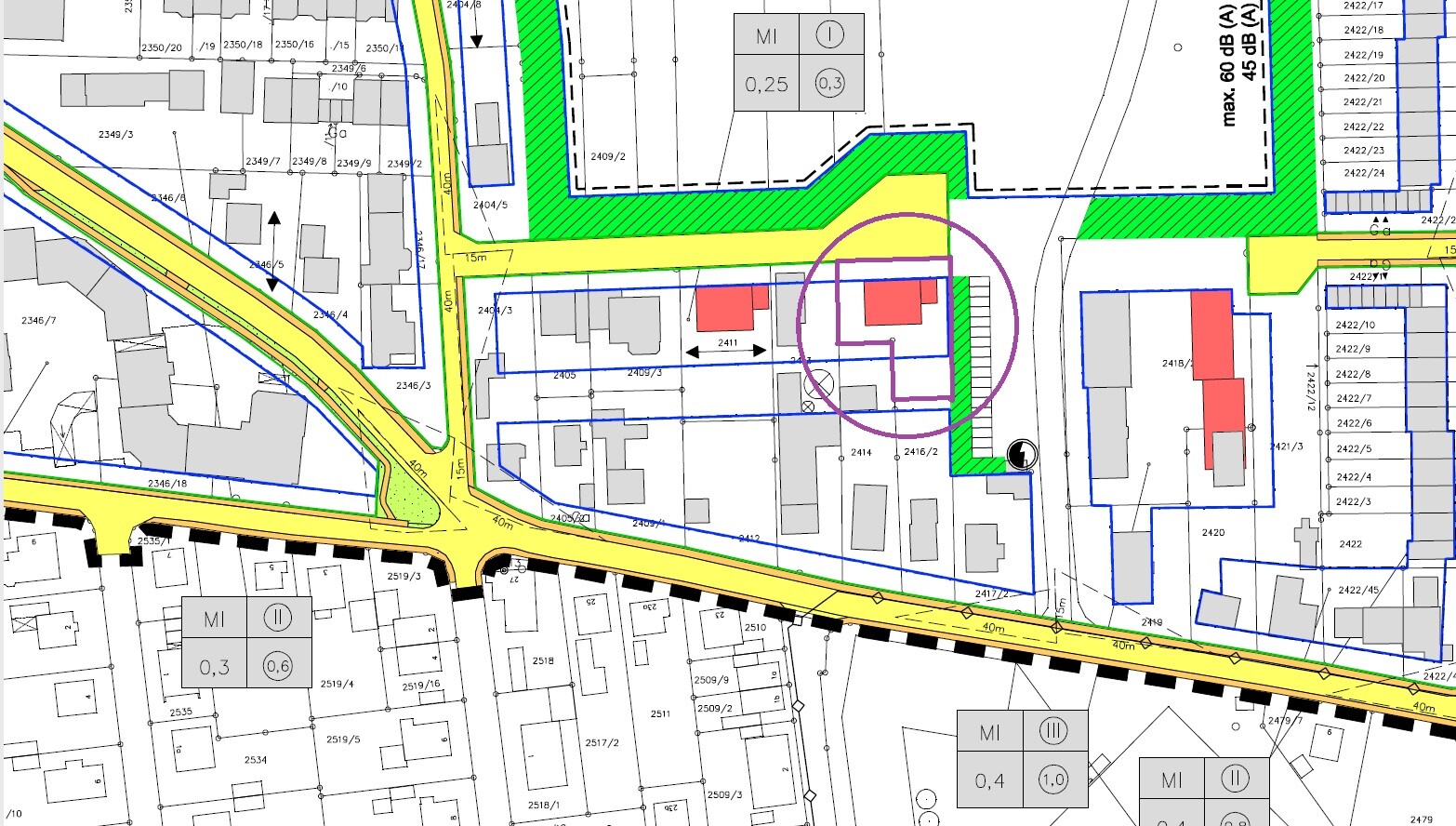
We own parcel number 2414 and the adjacent plot at the back, which is outlined in purple and marked with a circle for better identification.
The total plot area is approximately 750 sqm (8079 sq ft).
We currently live in the front house on parcel number 2414 and use the rear plot as a large garden.
The street to the north is not yet constructed but was planned for 2020.
Since the current house is an older building from the 1970s with two apartments, we would prefer to build new at the rear. Currently, with two children, we live in only 95 sqm (1023 sq ft). As my wife is self-employed and has a home office, the kids only have one shared bedroom, so it is quite cramped.
The street has been planned for many years; now the city has finally acquired the last parcel to enable its construction. According to the municipality, it is expected to be built next year.
So, we took a closer look at the zoning plan. Unfortunately, I am not very pleased with it.
I will try to organize the individual points and questions a bit.
Let’s see how far we get with this thread.
Attached is the relevant excerpt from the plan.
1. It is a mixed-use zone.
2. The maximum number of full stories is set to 1 (mandatory). This means I can only build one full story, and the attic floor may have a ceiling height of 2.2 m (7.2 ft) or more only on up to two-thirds of the area.
3. Roof pitch is specified as 22° - 28° according to the zoning regulations.
4. The important regulation states: “The height of knee walls, measured from the top of the ceiling to the intersection of the outer edge of the masonry with the top of the rafter, must not exceed 0.5 m (20 inches).”
So there is no much leeway here either. This means that the usable attic space will be significantly smaller than the ground floor.
5. Floor area ratio (FAR) = 0.25; I see this as uncritical for our project.
6. Plot ratio = 0.3; also uncritical for us.
7. According to the regulation: “Dormer extensions on main buildings are only permitted with flush-mounted windows.” For me, this means dormers are not allowed, only roof windows.
We had considered building a house with a ground floor plus upper floor. Also with some knee wall upstairs, but 0.5 m (20 inches) is quite tight. This causes a significant loss of usable area in the upper floor, so I would need to make the ground floor larger.
We are planning a house of about 130 sqm (1399 sq ft) for a family of four, including a home office.
Currently, we have three rough ideas:
1. Ground floor + upper floor with reduced area. So ground floor slightly larger and upper floor with knee wall. Ground floor maybe about 75 sqm (807 sq ft), upper floor about 60 sqm (646 sq ft). Roof pitch as steep as possible at 28°.
2. Alternatively, basement + ground floor with about 75 sqm (807 sq ft) each and possibly a “cold” attic and gable roof with 22°. In this case, the basement would need living rooms (children’s rooms/home office). Therefore, a basement with good insulation and large basement windows would be required.
3. Or a bungalow with about 125 sqm (1345 sq ft). Advantage: the total living space is slightly smaller as no stairs are needed and one bathroom is sufficient. No intermediate floor. Space under the roof can be used as storage. Disadvantage: large foundation slab and roof, so more plot area is lost.
How would you assess the three options in terms of cost?
We want to build as cost-effectively as possible, without unnecessary extras.
Additional relevant info: the house is planned to meet KFW40 energy standards. Either a controlled mechanical ventilation system or decentralized ventilation system will be installed.
We will definitely do some DIY work: plastering, flooring, electrical installations.
Do you have any other suggestions? Pros and cons?
We also once considered a multi-family house with 3 or 5 units, but after reviewing the zoning plan, this seems definitely off the table.
I expect there will be more threads later as our planning progresses in detail. This is just the initial starting point.
Thanks in advance for your help.
Regards,
Specki
We are planning to build a new house and now have some questions regarding the zoning plan.
Maybe you can provide some concrete answers or estimates about the situation.
I will probably visit the local authority again on Friday to clarify some details more specifically.
A brief background and framework:
We own parcel number 2414 and the adjacent plot at the back, which is outlined in purple and marked with a circle for better identification.
The total plot area is approximately 750 sqm (8079 sq ft).
We currently live in the front house on parcel number 2414 and use the rear plot as a large garden.
The street to the north is not yet constructed but was planned for 2020.
Since the current house is an older building from the 1970s with two apartments, we would prefer to build new at the rear. Currently, with two children, we live in only 95 sqm (1023 sq ft). As my wife is self-employed and has a home office, the kids only have one shared bedroom, so it is quite cramped.
The street has been planned for many years; now the city has finally acquired the last parcel to enable its construction. According to the municipality, it is expected to be built next year.
So, we took a closer look at the zoning plan. Unfortunately, I am not very pleased with it.
I will try to organize the individual points and questions a bit.
Let’s see how far we get with this thread.
Attached is the relevant excerpt from the plan.
1. It is a mixed-use zone.
2. The maximum number of full stories is set to 1 (mandatory). This means I can only build one full story, and the attic floor may have a ceiling height of 2.2 m (7.2 ft) or more only on up to two-thirds of the area.
3. Roof pitch is specified as 22° - 28° according to the zoning regulations.
4. The important regulation states: “The height of knee walls, measured from the top of the ceiling to the intersection of the outer edge of the masonry with the top of the rafter, must not exceed 0.5 m (20 inches).”
So there is no much leeway here either. This means that the usable attic space will be significantly smaller than the ground floor.
5. Floor area ratio (FAR) = 0.25; I see this as uncritical for our project.
6. Plot ratio = 0.3; also uncritical for us.
7. According to the regulation: “Dormer extensions on main buildings are only permitted with flush-mounted windows.” For me, this means dormers are not allowed, only roof windows.
We had considered building a house with a ground floor plus upper floor. Also with some knee wall upstairs, but 0.5 m (20 inches) is quite tight. This causes a significant loss of usable area in the upper floor, so I would need to make the ground floor larger.
We are planning a house of about 130 sqm (1399 sq ft) for a family of four, including a home office.
Currently, we have three rough ideas:
1. Ground floor + upper floor with reduced area. So ground floor slightly larger and upper floor with knee wall. Ground floor maybe about 75 sqm (807 sq ft), upper floor about 60 sqm (646 sq ft). Roof pitch as steep as possible at 28°.
2. Alternatively, basement + ground floor with about 75 sqm (807 sq ft) each and possibly a “cold” attic and gable roof with 22°. In this case, the basement would need living rooms (children’s rooms/home office). Therefore, a basement with good insulation and large basement windows would be required.
3. Or a bungalow with about 125 sqm (1345 sq ft). Advantage: the total living space is slightly smaller as no stairs are needed and one bathroom is sufficient. No intermediate floor. Space under the roof can be used as storage. Disadvantage: large foundation slab and roof, so more plot area is lost.
How would you assess the three options in terms of cost?
We want to build as cost-effectively as possible, without unnecessary extras.
Additional relevant info: the house is planned to meet KFW40 energy standards. Either a controlled mechanical ventilation system or decentralized ventilation system will be installed.
We will definitely do some DIY work: plastering, flooring, electrical installations.
Do you have any other suggestions? Pros and cons?
We also once considered a multi-family house with 3 or 5 units, but after reviewing the zoning plan, this seems definitely off the table.
I expect there will be more threads later as our planning progresses in detail. This is just the initial starting point.
Thanks in advance for your help.
Regards,
Specki
H
hampshire20 Dec 2019 11:10You can build a gable roof with one very short and one very long roof side. This then resembles a shed roof sloping from the higher side. The gables don’t have to be the same length. This results in two ridge beams at different heights. Consult with the building authority which ridge beam should be used for the roof height regulation (preferably the higher one on the short gable side). This way, you can gain a very usable upper floor.
Building very economically and meeting KFW40 standards don’t really go well together.
Building very economically and meeting KFW40 standards don’t really go well together.

hampshire schrieb:
Talk to the building authority to find out which purlin should be used for regulating the roof heights. Specki schrieb:
"The height of knee walls, measured from the top edge of the ceiling to the intersection of the outer edge of the masonry with the top edge of the purlin, must not exceed 0.5 m (1.6 ft)." I don’t see any mention of "a purlin of your choice," so I interpret that both knee walls are height-limited symmetrically. At most, one eaves side could be set back along part of its length, but within this context, I don’t think that would make much difference. The only exception might be a batten dormer, which could be argued as "not adding to the roof structure." However, the intention here seems clear, which means there is a corresponding risk of rejection for any attempts to circumvent the rules.
https://www.instagram.com/11antgmxde/
https://www.linkedin.com/company/bauen-jetzt/
H
hampshire20 Dec 2019 13:3111ant schrieb:
I don’t see anything about “a purlin of your choice,” so I also see both knee walls height-limited asymmetrically.With the proposed solution, it is possible to work with only one knee wall. The issue concerns the reference purlin in an asymmetrical design of the gable roof. This is certainly something that can be discussed.So, I visited the local authority earlier:
- I’ve correctly interpreted everything from the development plan and the regulations.
- It will probably be a bungalow with a partially expandable attic, which will provide significantly less space than the ground floor.
- If I want to deviate from the development plan, I can submit a free preliminary building inquiry. If it’s just about minor deviations, she said I might have a chance; for larger ones, probably not. They also consider whether there are already other deviations from the plan within the building plot. So, maybe I could get permission to raise the knee wall slightly or to add a dormer, etc. But a large knee wall of 1 to 1.5 meters (3 to 5 feet) is probably not going to be allowed.
Now I have a clearer idea of where I stand.
The next step will be to experiment a bit (with Sweet Home 3D) and see how much usable space can be created in the attic based on the footprint.
At the moment, I’m leaning towards having full living rooms on the ground floor and then using the attic for an office, utility room, and storage. This seems like a good compromise between efficient use of space and not requiring too large a footprint.
I still need to decide on the roof pitch. A steeper roof offers more room inside the house, while a lower pitch allows for a larger photovoltaic system, since panels can also be installed on the north side.
So now it’s time for some experimentation.
Once we have a few drafts, we’ll report back here
The next step after that will be choosing the building material: solid construction, timber frame, or maybe even a straw bale house ^^
Oh, and although almost everyone here might disagree, KFW40 standard is the only option for me. I believe the extra cost won’t be too high, since only slightly thicker insulation is needed compared to KFW55, but there’s an additional €5,000 [5000€] in subsidies. But I know most people here see it differently
Thanks already for all your advice
Best regards,
Specki
- I’ve correctly interpreted everything from the development plan and the regulations.
- It will probably be a bungalow with a partially expandable attic, which will provide significantly less space than the ground floor.
- If I want to deviate from the development plan, I can submit a free preliminary building inquiry. If it’s just about minor deviations, she said I might have a chance; for larger ones, probably not. They also consider whether there are already other deviations from the plan within the building plot. So, maybe I could get permission to raise the knee wall slightly or to add a dormer, etc. But a large knee wall of 1 to 1.5 meters (3 to 5 feet) is probably not going to be allowed.
Now I have a clearer idea of where I stand.
The next step will be to experiment a bit (with Sweet Home 3D) and see how much usable space can be created in the attic based on the footprint.
At the moment, I’m leaning towards having full living rooms on the ground floor and then using the attic for an office, utility room, and storage. This seems like a good compromise between efficient use of space and not requiring too large a footprint.
I still need to decide on the roof pitch. A steeper roof offers more room inside the house, while a lower pitch allows for a larger photovoltaic system, since panels can also be installed on the north side.
So now it’s time for some experimentation.
Once we have a few drafts, we’ll report back here
The next step after that will be choosing the building material: solid construction, timber frame, or maybe even a straw bale house ^^
Oh, and although almost everyone here might disagree, KFW40 standard is the only option for me. I believe the extra cost won’t be too high, since only slightly thicker insulation is needed compared to KFW55, but there’s an additional €5,000 [5000€] in subsidies. But I know most people here see it differently
Thanks already for all your advice
Best regards,
Specki
H
hampshire20 Dec 2019 14:08Thank you for the feedback and best wishes for successful next steps.
hampshire schrieb:
This concerns the reference purlin in an asymmetrical design of a pitched roof. There is no reference purlin here; all purlins must conform to the requirement not to exceed the batten’s top edge by 50cm (20 inches). You can’t have a situation like “because Christmas is approaching and one side meets the limit, the other side can ignore it as a reward.”
hampshire schrieb:
The proposed solution allows working with only one knee wall. Yes, of course that’s possible. But: what advantage is there in having a 50cm (20 inches) knee wall on one side and none on the other, compared to fully utilizing a 50cm (20 inches) knee wall on both sides?
Specki schrieb:
If it’s only about minor deviations, she said I might have a chance, If that’s the only deviation on the wishlist, then a maximum roof pitch of 35° should be achievable. I would suggest reviewing the existing buildings within the same zoning area and comparing them with the regulations: the larger the discrepancies, the more likely it was that problematic excesses requiring containment were found in these spots. Other residential areas in the same municipality can also give clues: restrictions might also apply there, for example because they were somewhat excessive and the neighborhood is now colloquially called “stepped-story houses.”
https://www.instagram.com/11antgmxde/
https://www.linkedin.com/company/bauen-jetzt/
Similar topics