
Hello dear forum community!
Since I have already received so much great help here during our house construction, I would like to use your expertise again for my personal nightmare project.
Current status: The house is built, and we are happily living in it. The garden is showing its best greenery. Weeds of all kinds (nettles, thistles, grasses, etc.) are spreading over more than 600sqm (about 6,460 sq ft). Fortunately, so are my dahlias. The garden still needs to be raised by roughly 100 cubic meters (about 3,530 cubic feet) in total. The soil will be delivered from another construction site in the next days/weeks. It is good topsoil on which the lawn has been growing (and maintained).
What I am planning: I want to start by pulling out as many weeds as possible from the weed-covered area. Once the new soil arrives, it will be spread on top and hopefully smother the rest.
Problem: But since I’m not relying on luck, quite a lot of weeds will probably regrow or be brought in again. Since most of the area is meant to become lawn, I want to leave as little weed as possible there. I’m relaxed about the flower beds—I will just keep pulling weeds there. But for the lawn... I would like to significantly reduce the weeds beforehand to ensure a good base.
But how do I do this? We have already considered chemical weed control. However, we have three tigers and a toddler. I would rather not poison my whole crew. The neighbor’s cat should also remain unharmed. Covering the entire 600 sqm (about 6,460 sq ft) is not really an option either.
Help!!!
Since I have already received so much great help here during our house construction, I would like to use your expertise again for my personal nightmare project.
Current status: The house is built, and we are happily living in it. The garden is showing its best greenery. Weeds of all kinds (nettles, thistles, grasses, etc.) are spreading over more than 600sqm (about 6,460 sq ft). Fortunately, so are my dahlias. The garden still needs to be raised by roughly 100 cubic meters (about 3,530 cubic feet) in total. The soil will be delivered from another construction site in the next days/weeks. It is good topsoil on which the lawn has been growing (and maintained).
What I am planning: I want to start by pulling out as many weeds as possible from the weed-covered area. Once the new soil arrives, it will be spread on top and hopefully smother the rest.
Problem: But since I’m not relying on luck, quite a lot of weeds will probably regrow or be brought in again. Since most of the area is meant to become lawn, I want to leave as little weed as possible there. I’m relaxed about the flower beds—I will just keep pulling weeds there. But for the lawn... I would like to significantly reduce the weeds beforehand to ensure a good base.
But how do I do this? We have already considered chemical weed control. However, we have three tigers and a toddler. I would rather not poison my whole crew. The neighbor’s cat should also remain unharmed. Covering the entire 600 sqm (about 6,460 sq ft) is not really an option either.
Help!!!

That interests me as well.
Bieber0815 schrieb:We also need to start thinking about this exact issue. The excavator will be back in two weeks for backfilling, and we want to roughly shape the garden and add topsoil then. But what should we do about all the weeds and grass?
@Evolith How does it look outside now? What have you done so far?
We mowed everything down with the trimmer and then used a small (second-hand) rototiller to work through the weed layer. It was quite a job, but this way it shredded everything and loosened the soil a bit. Then we simply raked out the rough debris. After that, almost one meter (3 feet) of topsoil was added, which settled to between 20 and 50 cm (8 to 20 inches) after the winter. Now the beds are established, the lawn has grown, and the weeds are under control. I’m really impressed.
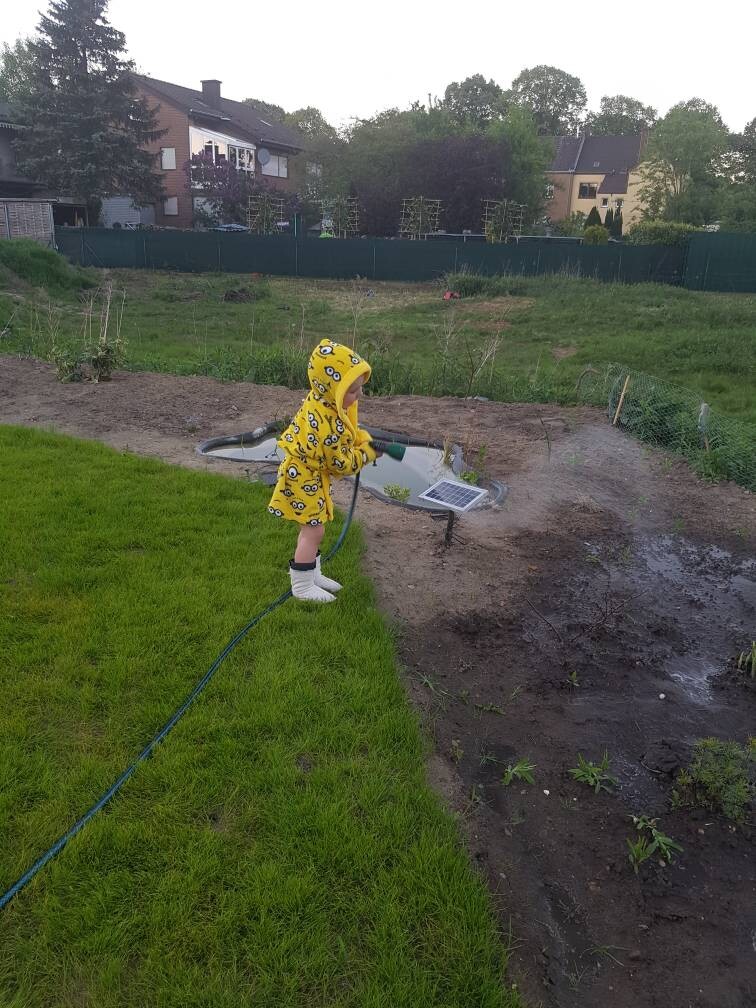
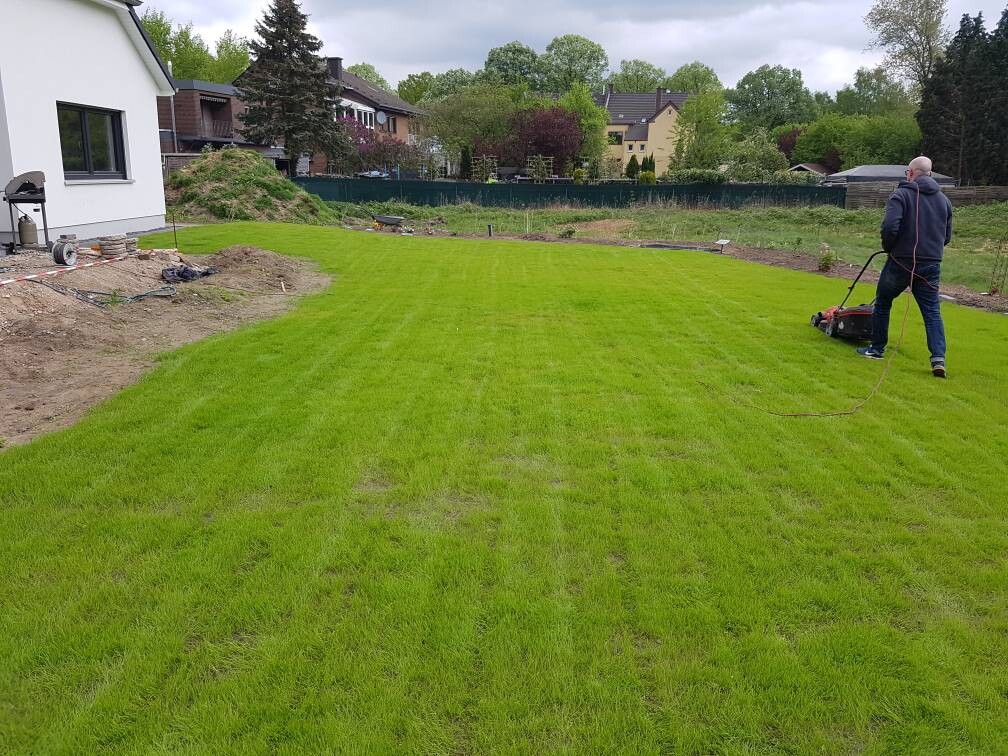
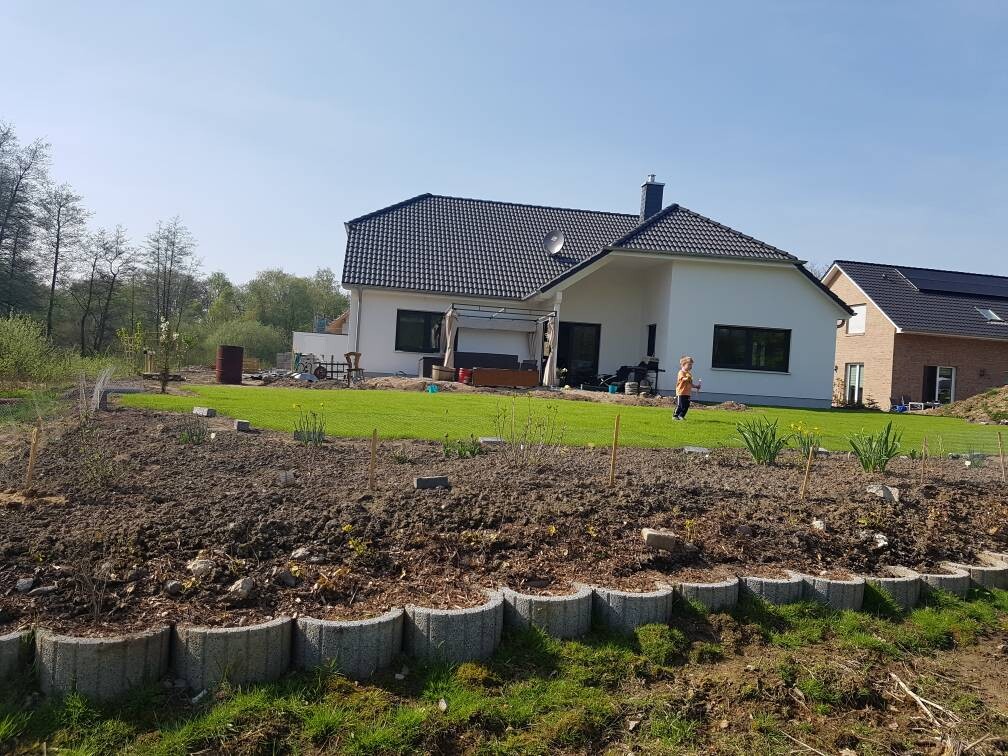
 markus27037 May 2018 07:54
The real question is, how much soil is being applied? With a depth of one meter (3 feet 3 inches), like with Evolith, weeds obviously have a hard time growing back through. However, at over 20 cm (8 inches), they can easily break through and many will regrow.
In general, it is recommended to sow the grass seed immediately and in quantities greater than those stated in the instructions as soon as the soil is spread. This reduces the time and space available for existing weeds.
In general, it is recommended to sow the grass seed immediately and in quantities greater than those stated in the instructions as soon as the soil is spread. This reduces the time and space available for existing weeds.

HAL06120 schrieb:
Or you could have someone run over it with a reverse tiller.Unfortunately, there is only one thread here in the forum about "reverse tillers." They are often recommended online and in YouTube videos for garden renovation or redoing lawns.
When I look for rental equipment, I only find places more than 100 km (62 miles) away. Are these machines really that rare?
Standard garden tillers are widely available in various widths and power levels for rent. But not reverse tillers. Has anyone here actually seen such a machine in person, or is it more of a myth, like the Yeti?
Background: the soil that was compacted has settled quite a bit, and we want to redo the entire lawn.

Why do you think you need a rotary tiller with reverse function instead of a standard rototiller?
As I understand it, a rotary tiller with reverse is meant to push existing stones and roots deeper into the soil, while leaving loosened finer soil particles on top. So, would using a regular rototiller followed by manually removing all unwanted debris also be an option?
As I understand it, a rotary tiller with reverse is meant to push existing stones and roots deeper into the soil, while leaving loosened finer soil particles on top. So, would using a regular rototiller followed by manually removing all unwanted debris also be an option?
Similar topics