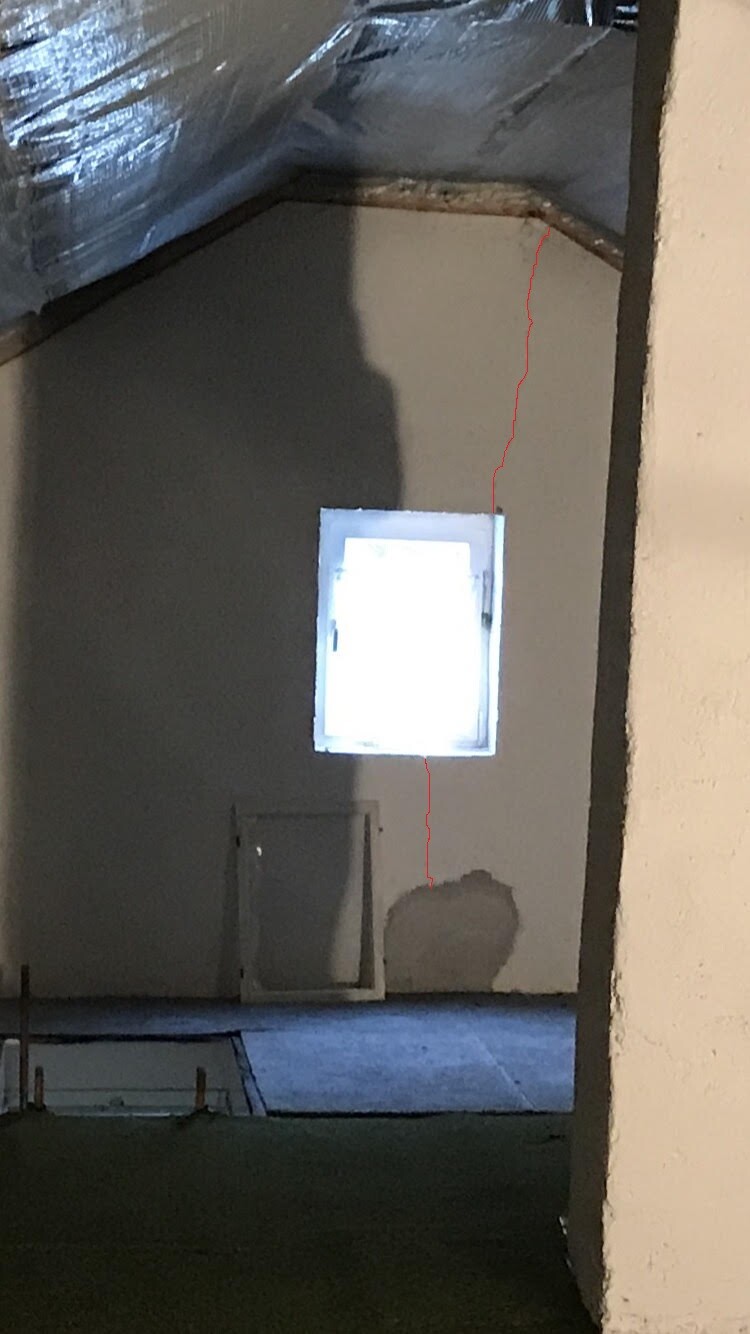
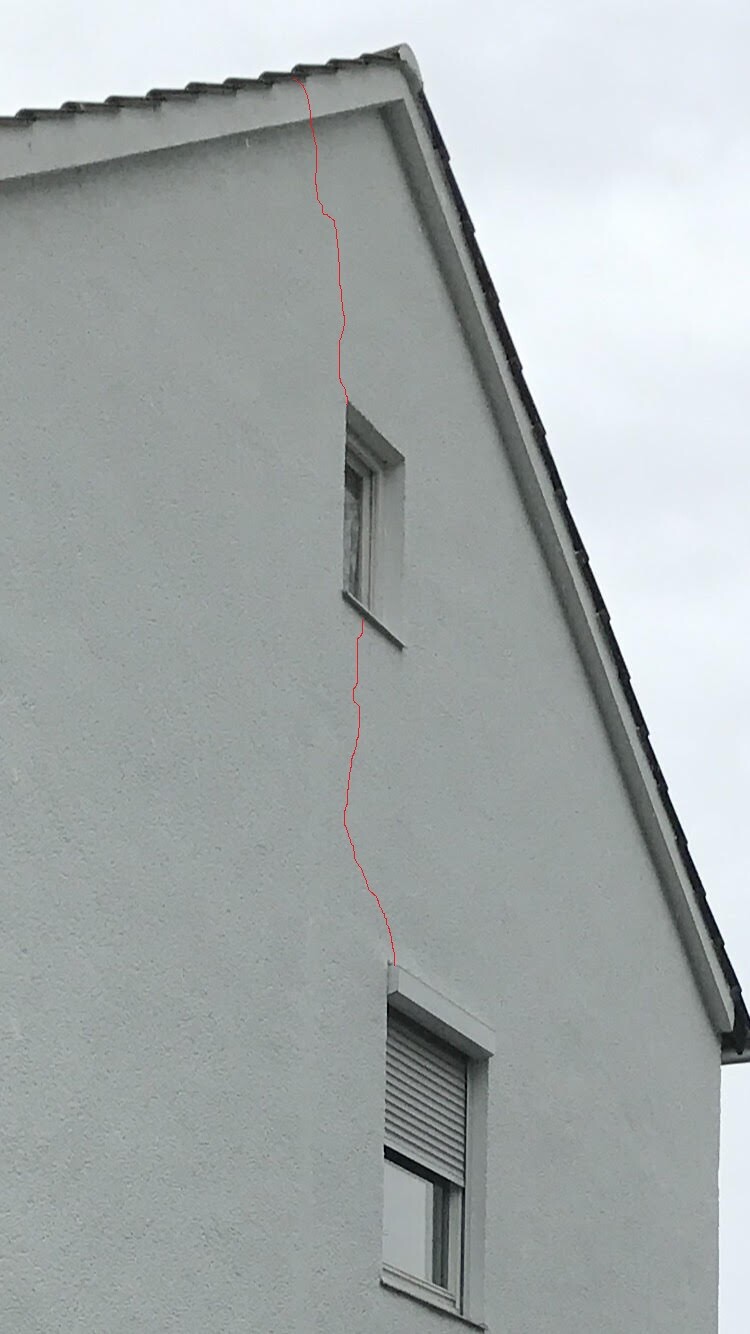
ᐅ Cracks running completely through the masonry of the gable wall, building year 1968.
Created on: 16 Dec 2017 01:06
L
Lukas_Sch
Hello everyone,
My name is Lukas, I’m 27 years old, a heating technician by profession, and I own a fully renovated two-family house, built in 1968, except for the roof.
I hope I’m in the right place with my issue:
Yesterday, we had an extremely strong storm for about 30 minutes. At my coworker’s place in a neighboring town, 250 roof tiles were thrown as far as 50 meters (164 feet) away from the roof.
So today, I wanted to check my attic to see if everything is still okay and if all the tiles are still secure.
I noticed that on both gable walls, there is a crack running all the way through the masonry—from the reinforced concrete floor to the roof, extending to the outside.
I am certain these cracks were not there a month ago.
I believe the gable walls are non-load-bearing because the 10-meter-long (33 feet) purlin is not supported in the middle, and when tapping on the gable walls, they don’t sound like bricks but rather hollow.
Still, I am a bit worried and have already reported the damage to my insurance company.
All other walls show no cracks at all.
Could someone give me an initial assessment of what might have happened here?
Best regards,
Lukas
My name is Lukas, I’m 27 years old, a heating technician by profession, and I own a fully renovated two-family house, built in 1968, except for the roof.
I hope I’m in the right place with my issue:
Yesterday, we had an extremely strong storm for about 30 minutes. At my coworker’s place in a neighboring town, 250 roof tiles were thrown as far as 50 meters (164 feet) away from the roof.
So today, I wanted to check my attic to see if everything is still okay and if all the tiles are still secure.
I noticed that on both gable walls, there is a crack running all the way through the masonry—from the reinforced concrete floor to the roof, extending to the outside.
I am certain these cracks were not there a month ago.
I believe the gable walls are non-load-bearing because the 10-meter-long (33 feet) purlin is not supported in the middle, and when tapping on the gable walls, they don’t sound like bricks but rather hollow.
Still, I am a bit worried and have already reported the damage to my insurance company.
All other walls show no cracks at all.
Could someone give me an initial assessment of what might have happened here?
Best regards,
Lukas
L
Lukas_Sch17 Dec 2017 01:40I have a rafter roof, not a purlin roof.
I also hardly believe that a 10-meter (33 feet) long purlin roof can be built without support beams.
To be honest, my concern was not about the type of roof I have, but rather where the cracks are coming from.
I also hardly believe that a 10-meter (33 feet) long purlin roof can be built without support beams.
To be honest, my concern was not about the type of roof I have, but rather where the cracks are coming from.
 blockhauspower17 Dec 2017 08:37
If it is truly a rafters roof, you will have significant lateral thrust forces on your eave-side exterior walls. Possibly, strong positive and negative wind pressures acted on your roof during the storm, which in turn could have pushed your exterior walls outward; these are interlocked with your gable wall.
Are there also cracks on the gable side at the ground floor?
It is difficult to assess without more information. Hopefully, these points offer some suggestions?
Best regards
Are there also cracks on the gable side at the ground floor?
It is difficult to assess without more information. Hopefully, these points offer some suggestions?
Best regards
A photo would have greatly improved the post. Not all cracks are the same. Are these cracks in the plaster, stepped cracks, or cracks with a larger extent?
In any case, even if you find this post offensive, @Nordlys summarized your question well with comment #4.
A structural engineer is the only person who can assess whether the cause is wind or aging. It cannot be ruled out that the crack may still spread further on the ground floor.
In any case, even if you find this post offensive, @Nordlys summarized your question well with comment #4.
A structural engineer is the only person who can assess whether the cause is wind or aging. It cannot be ruled out that the crack may still spread further on the ground floor.
L
Lukas_Sch17 Dec 2017 16:45Yes, sorry, I was a bit on edge yesterday because of the cracks...
I will take some photos.
There are no cracks at all on the ground floor.
I will take some photos.
There are no cracks at all on the ground floor.
L
Lukas_Sch17 Dec 2017 16:58Here are the photos. I have traced the crack pattern.