
Hello,
I have the following questions.
I am planning to replace the tiles in the covered outdoor area in front of my front door.
When removing the old tiles, I noticed that the screed layer underneath is in very poor condition.
The screed thickness is about 9cm (3.5 inches).
I would like to remove the screed and pour a new one.
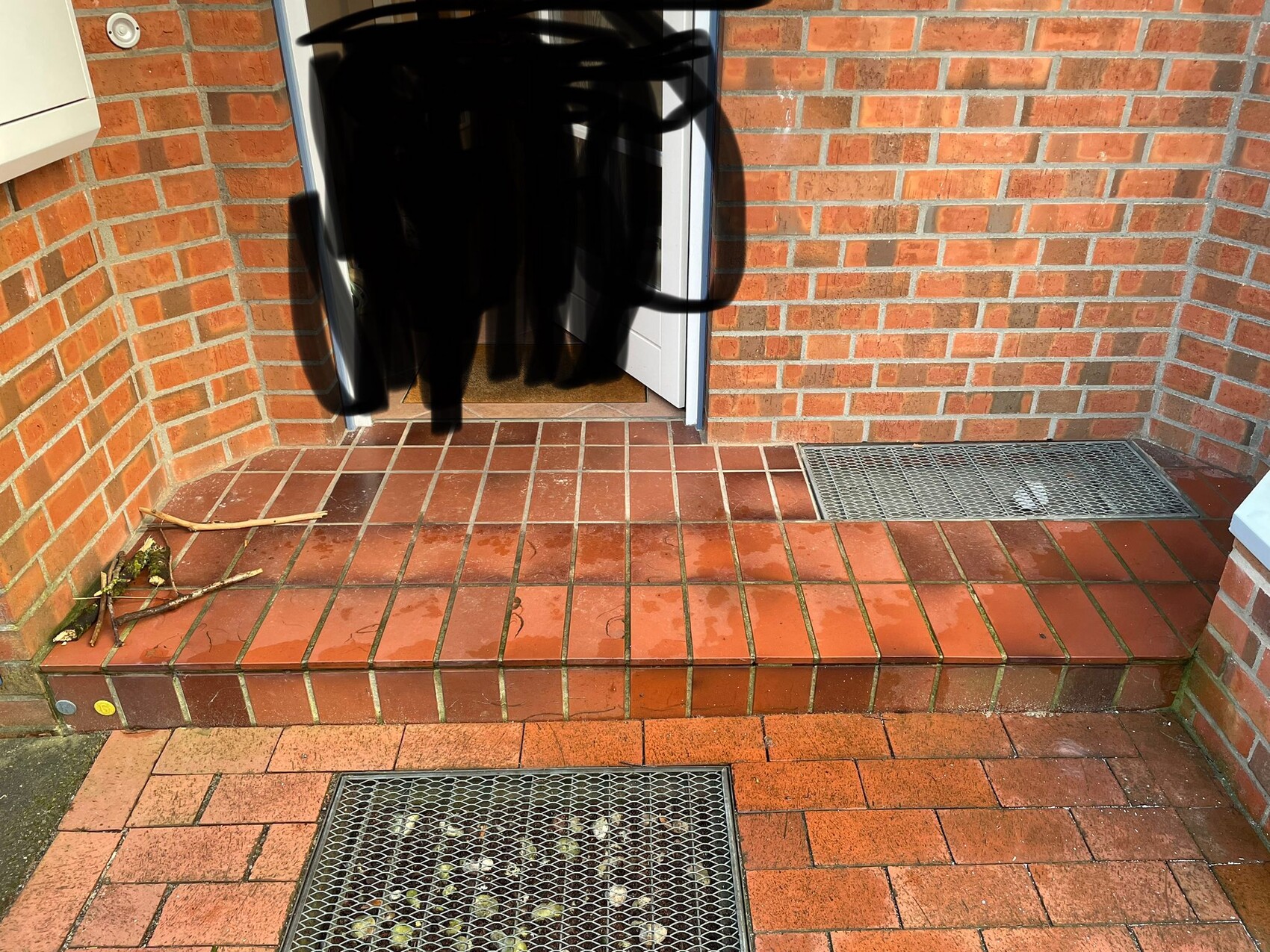
Do I need to use an edge insulation strip and PE foil here? Currently, it is a bonded screed. Since the area is quite small, I am leaning towards using a bonded screed again. Or is it common nowadays to install it as a floating screed, as mentioned above? I am attaching a picture of the entrance area.
Thank you very much
I have the following questions.
I am planning to replace the tiles in the covered outdoor area in front of my front door.
When removing the old tiles, I noticed that the screed layer underneath is in very poor condition.
The screed thickness is about 9cm (3.5 inches).
I would like to remove the screed and pour a new one.
Do I need to use an edge insulation strip and PE foil here? Currently, it is a bonded screed. Since the area is quite small, I am leaning towards using a bonded screed again. Or is it common nowadays to install it as a floating screed, as mentioned above? I am attaching a picture of the entrance area.
Thank you very much

Hello questioner.
Of course, I cannot assess from a distance what you consider a "very poor condition."
However, the area shown in the photo is relatively small, so removing the screed podium should not be a major mistake with unpredictable costs.
Since no impact sound insulation or thermal insulation requirements apply to the podium, a composite construction with the new screed is the right choice.
Edge insulation strips are not necessary in this situation!
For a 90mm (3.5 inches) screed, I would apply it in two layers, as achieving consistent compaction in one pour at this thickness is almost impossible.
Use a cement-based bonding slurry between the screed layers!
Apply the second screed layer the following day (since the small area does not require foot traffic) or later.
If the first layer remains exposed for several weeks, it is advisable to pre-wet the existing screed surface before applying the bonding slurry.
This helps to prevent inevitable drying cracks in the upper layer later on.
Good luck: KlaRa
Of course, I cannot assess from a distance what you consider a "very poor condition."
However, the area shown in the photo is relatively small, so removing the screed podium should not be a major mistake with unpredictable costs.
Since no impact sound insulation or thermal insulation requirements apply to the podium, a composite construction with the new screed is the right choice.
Edge insulation strips are not necessary in this situation!
For a 90mm (3.5 inches) screed, I would apply it in two layers, as achieving consistent compaction in one pour at this thickness is almost impossible.
Use a cement-based bonding slurry between the screed layers!
Apply the second screed layer the following day (since the small area does not require foot traffic) or later.
If the first layer remains exposed for several weeks, it is advisable to pre-wet the existing screed surface before applying the bonding slurry.
This helps to prevent inevitable drying cracks in the upper layer later on.
Good luck: KlaRa
@ "Immo2014":
The use of rapid-setting cement has nothing to do with the compaction of a screed structure when larger cross-sectional thicknesses are planned.
It either sets faster (common definition) or reaches its ready-to-cover stage more quickly due to its material properties (which is illogical since it is intended for outdoor use).
A two-layer construction should definitely be applied, with a bonding layer as I have described.
Reinforcement, if this term is even applicable in screed technology, is not necessary since it is only mentioned (not recommended) in the DIN 18352 "Tiling and Slabbing Works" standard.
Such a reinforced mesh, often called "fear mesh" (Angsteisen) in practice, was removed from the DIN 18365 some years ago. This is because using such mesh tended to cause damage by creating an unintended separating layer and, due to its location near the underside edge of the screed, made no physical sense in terms of building physics.
(This is why in concrete construction spacers are used, so that the "real" twisted steel reinforcement does not just lie directly on the base layer like at a metal burial, without effectively supporting the tension zone of the concrete structure.)
In other words: DO NOT add mesh reinforcement into a screed mortar (the term reinforcement, on the other hand, is generally regulated in the German criminal code within the legal consequences of a criminal offense)!!
--------------------
Best regards and good luck: KlaRa
The use of rapid-setting cement has nothing to do with the compaction of a screed structure when larger cross-sectional thicknesses are planned.
It either sets faster (common definition) or reaches its ready-to-cover stage more quickly due to its material properties (which is illogical since it is intended for outdoor use).
A two-layer construction should definitely be applied, with a bonding layer as I have described.
Reinforcement, if this term is even applicable in screed technology, is not necessary since it is only mentioned (not recommended) in the DIN 18352 "Tiling and Slabbing Works" standard.
Such a reinforced mesh, often called "fear mesh" (Angsteisen) in practice, was removed from the DIN 18365 some years ago. This is because using such mesh tended to cause damage by creating an unintended separating layer and, due to its location near the underside edge of the screed, made no physical sense in terms of building physics.
(This is why in concrete construction spacers are used, so that the "real" twisted steel reinforcement does not just lie directly on the base layer like at a metal burial, without effectively supporting the tension zone of the concrete structure.)
In other words: DO NOT add mesh reinforcement into a screed mortar (the term reinforcement, on the other hand, is generally regulated in the German criminal code within the legal consequences of a criminal offense)!!
--------------------
Best regards and good luck: KlaRa
Similar topics