
Hello everyone,
We are currently planning our house, and according to the soil report, it looks like we will need a well foundation. Initial research shows this could add at least €10,000 (around $11,000) in additional costs.
Has anyone had experience with this? Especially the pricing would be interesting.
We plan for a 120 m² (1,290 sq ft) footprint plus 60 m² (645 sq ft). For the garage, we have a quote of €15,000 (about $16,500) for the related concrete slab and another €15,000 for the garage itself (excluding the door).
According to the report, a slab foundation would be possible if we include a basement. Now I’m considering possibly building a basement to avoid the well foundation.
The idea is, instead of paying €30,000 (around $33,000) for the garage plus at least €10,000 for the well foundation, to invest the money in a basement. I have requested a quote for that and expect it early next week. But I wanted to ask here beforehand if this is a completely dumb idea.
Good luck and thanks in advance!
We are currently planning our house, and according to the soil report, it looks like we will need a well foundation. Initial research shows this could add at least €10,000 (around $11,000) in additional costs.
Has anyone had experience with this? Especially the pricing would be interesting.
We plan for a 120 m² (1,290 sq ft) footprint plus 60 m² (645 sq ft). For the garage, we have a quote of €15,000 (about $16,500) for the related concrete slab and another €15,000 for the garage itself (excluding the door).
According to the report, a slab foundation would be possible if we include a basement. Now I’m considering possibly building a basement to avoid the well foundation.
The idea is, instead of paying €30,000 (around $33,000) for the garage plus at least €10,000 for the well foundation, to invest the money in a basement. I have requested a quote for that and expect it early next week. But I wanted to ask here beforehand if this is a completely dumb idea.
Good luck and thanks in advance!
W
WilderSueden14 Feb 2023 14:06Narnulf1368 schrieb:
I understood from the house builder that the structural calculations and load cases are only done once the building permit / planning permission is granted, to avoid duplicate work. For that, they then require a geotechnical report. From the builder’s point of view, this approach is possible. Any unexpected additional costs are paid by the client, who has no room for negotiation. As the client, your goal should be to exclude extra expenses when difficult soil conditions are known in advance. In other words, provide the companies with the soil report beforehand, and they must commit to specifying any additional costs during the quotation phase. Otherwise, you are buying a pig in a poke. Especially if the budget is tight, I would try to avoid potential extra costs here as much as possible.
N
Narnulf136814 Feb 2023 14:46Cronos86 schrieb:
I had considered the report to be older, as outdated standards were used.
Of course, the report can still be used. I just don’t think it is a good report and believe that an assessment by another expert could possibly provide better recommendations.
What immediately caught my attention:
- Building waterproofing according to standard 18195, which was replaced in 2017 by 18533-1
- Homogeneous zones are missing (these replace soil classes)
- Use of excavated soil without a declaration analysis (no landfill will accept that)
- No description of the foundation, no soil bearing capacities or base resistances, etc. So, it may be that this 2019 report is based on measurements that are older, but I don’t know that. I will consult another expert then.
There really aren’t any true neighbors; the only other house is two plots away. However, that house was built almost 20 years ago, and it was simply heavily backfilled and built with a basement. So, it’s not really comparable at all.
N
Narnulf136816 Feb 2023 09:35I requested a geotechnical survey from another expert and received an offer. The offer includes many items, but not everything is planned.
Now I wanted to ask here whether this is sufficient or if I should better commission additional items.
I would be very grateful for an assessment!
Ps: I hope it is okay that the prices are visible; otherwise, I will remove them.
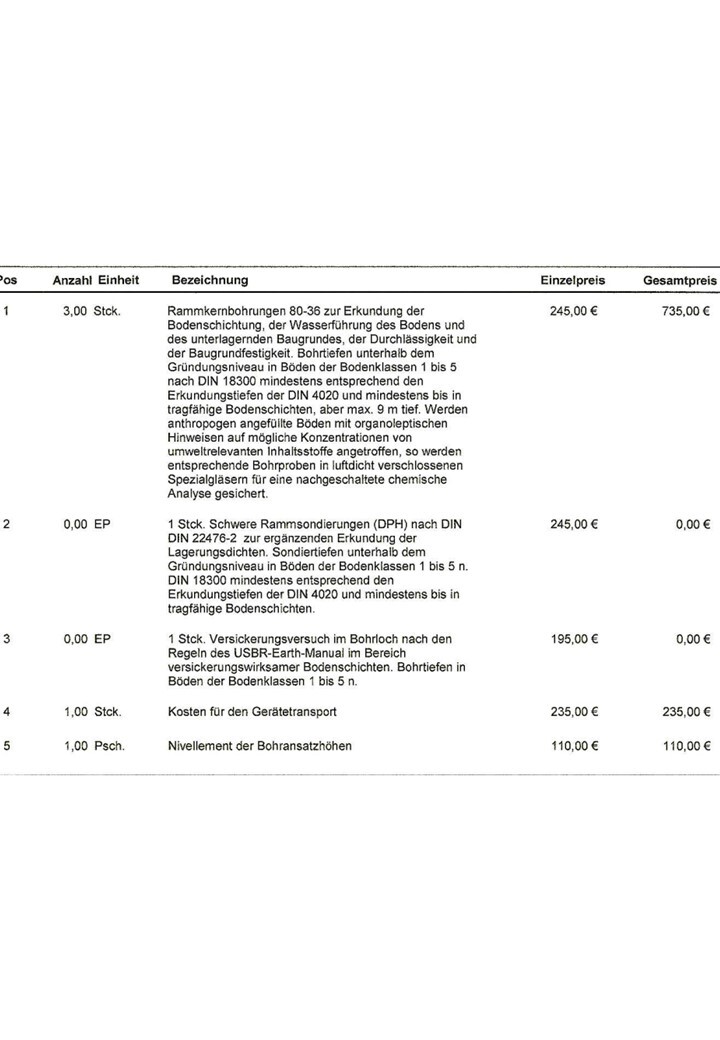
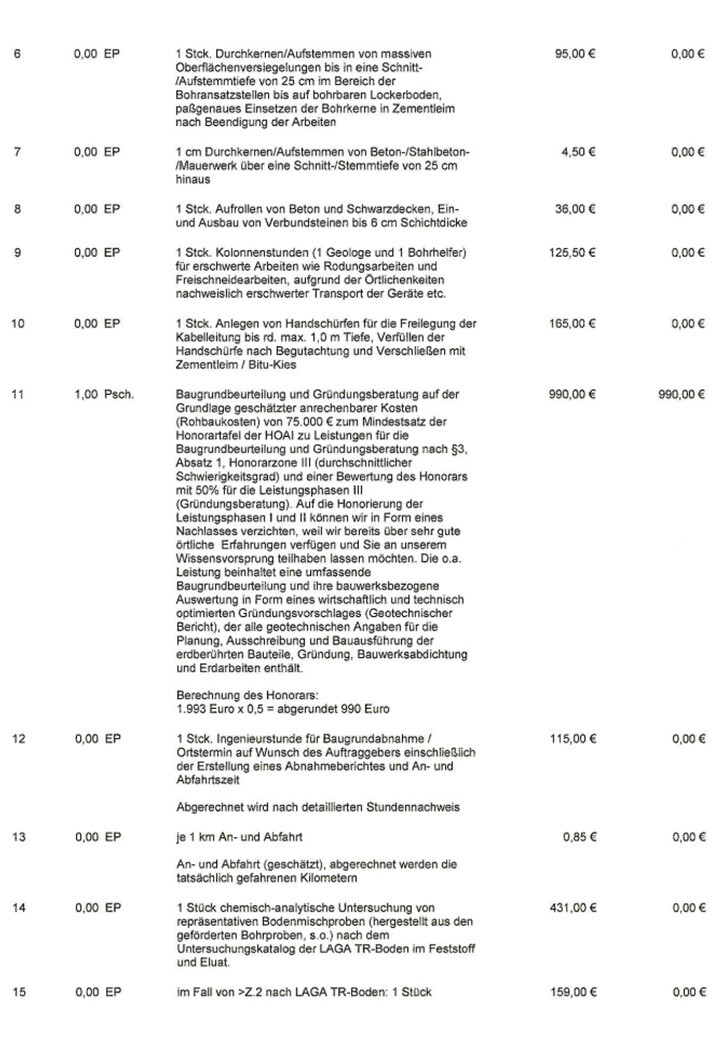
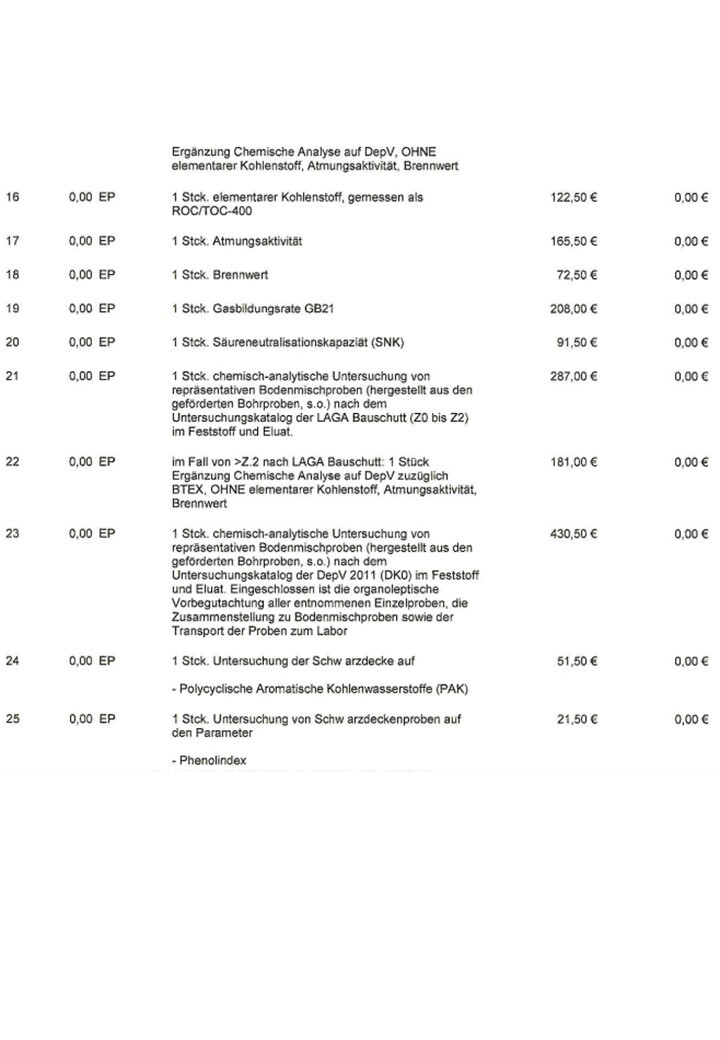
Now I wanted to ask here whether this is sufficient or if I should better commission additional items.
I would be very grateful for an assessment!
Ps: I hope it is okay that the prices are visible; otherwise, I will remove them.
You will need the chemical analyses later for the disposal of the excavated material; otherwise, the landfill will not accept it or they might offer the analysis themselves. However, you don’t need it right now because the analysis for accepting the excavated material must not be too old.
The remaining special provisions seem to be required only for more difficult conditions or if additional work is requested.
The scope looks good for now.
You have to decide on the price yourself; a few years ago, I paid half of that. But what can you do.
The remaining special provisions seem to be required only for more difficult conditions or if additional work is requested.
The scope looks good for now.
You have to decide on the price yourself; a few years ago, I paid half of that. But what can you do.
X
xMisterDx16 Feb 2023 11:46It certainly doesn’t hurt to know in advance what costs to expect for disposal.
If an unpleasant surprise pops up, you can already budget the xxx EUR for it and save that amount elsewhere.
It would be unfortunate if everything is planned and ordered, the excavation contractor arrives, and then the soil test reveals disposal costs of 25,000 EUR, which are not available.
If an unpleasant surprise pops up, you can already budget the xxx EUR for it and save that amount elsewhere.
It would be unfortunate if everything is planned and ordered, the excavation contractor arrives, and then the soil test reveals disposal costs of 25,000 EUR, which are not available.
Hmm... difficult. Unfortunately, I am not really convinced by the offer.
For dynamic core drilling (ram core soundings), billing is always done per linear meter. Costs are usually around €40 (about $45) in total (€25 drilling + €15 relocation). Since you already have an idea of how deep they will go—maximum 4-5 m (13-16 feet)—this method is more cost-effective. The assessor is assuming that after 1.5 m (5 feet), they will reach solid rock (here the weathering zone of chalk), "at least down to load-bearing layers."
The analytical testing prices are far too high. This can easily be done for €100-150 (about $110-165) less. I would also wait with the analytical testing. I don’t know when your project is supposed to start, but the results must not be older than 6 months. Furthermore, the Substitute Building Materials Ordinance (EBV) comes into effect in August, which will change the requirements for the analyses.
The assessors keep soil samples for a certain period and, upon request, even longer. So first, see how the foundation will be built and what kind of soil will actually be excavated that cannot remain on the property. Then check where the soil can be disposed of, as each landfill has different acceptance criteria.
The costs for the reports are also high, but I actually like the billing according to HOAI. The report is the key element of the whole process, and sufficient time and therefore money should be invested here.
I might suggest getting another offer.
For dynamic core drilling (ram core soundings), billing is always done per linear meter. Costs are usually around €40 (about $45) in total (€25 drilling + €15 relocation). Since you already have an idea of how deep they will go—maximum 4-5 m (13-16 feet)—this method is more cost-effective. The assessor is assuming that after 1.5 m (5 feet), they will reach solid rock (here the weathering zone of chalk), "at least down to load-bearing layers."
The analytical testing prices are far too high. This can easily be done for €100-150 (about $110-165) less. I would also wait with the analytical testing. I don’t know when your project is supposed to start, but the results must not be older than 6 months. Furthermore, the Substitute Building Materials Ordinance (EBV) comes into effect in August, which will change the requirements for the analyses.
The assessors keep soil samples for a certain period and, upon request, even longer. So first, see how the foundation will be built and what kind of soil will actually be excavated that cannot remain on the property. Then check where the soil can be disposed of, as each landfill has different acceptance criteria.
The costs for the reports are also high, but I actually like the billing according to HOAI. The report is the key element of the whole process, and sufficient time and therefore money should be invested here.
I might suggest getting another offer.
Similar topics