
ᐅ Converting the attic space of a semi-detached house into a living area
Created on: 26 Dec 2020 13:07
C
ConnileinC
Connilein26 Dec 2020 13:07Hello and happy holidays 🙂
In January, construction will begin on our semi-detached house, and we would like to convert our attic/loft into a hobby/storage room. Now the question is how to approach this best. At the moment, we are gathering information, and our builder pointed out that the wall to the neighbor’s side should be specially insulated with a double stud wall to address temperature differences between the two attics and the space between the semi-detached houses. What is the best way to proceed here?
For the roof itself, we plan to install insulation between the rafters, followed by a vapor barrier. Additionally, we want to add a roof window. Has anyone had experience with this or done something similar and knows what to watch out for, etc.?
Best regards 🙂
In January, construction will begin on our semi-detached house, and we would like to convert our attic/loft into a hobby/storage room. Now the question is how to approach this best. At the moment, we are gathering information, and our builder pointed out that the wall to the neighbor’s side should be specially insulated with a double stud wall to address temperature differences between the two attics and the space between the semi-detached houses. What is the best way to proceed here?
For the roof itself, we plan to install insulation between the rafters, followed by a vapor barrier. Additionally, we want to add a roof window. Has anyone had experience with this or done something similar and knows what to watch out for, etc.?
Best regards 🙂
I can’t contribute anything about the wall. We did the insulation between the rafters ourselves. It’s basically a matter of patience rather than anything complicated. You need insulation material. Cut it with an insulation knife, and build a cutting table on site using plywood and supports on the floor. You can reuse the plywood panel later for something else.
Once the insulation fleece is fitted everywhere, including the corners and any gaps filled well, you install the vapor barrier foil over it. Use a good quality one that allows some moisture to diffuse out—a so-called climate membrane.
Carefully seal all connections with foil tape, tape like Sigacrall, or similar products. Seal the floor and wall connections with sealing compound from a cartridge. Support the foil with boards screwed onto the rafters. If desired, you can install drywall over this afterwards.
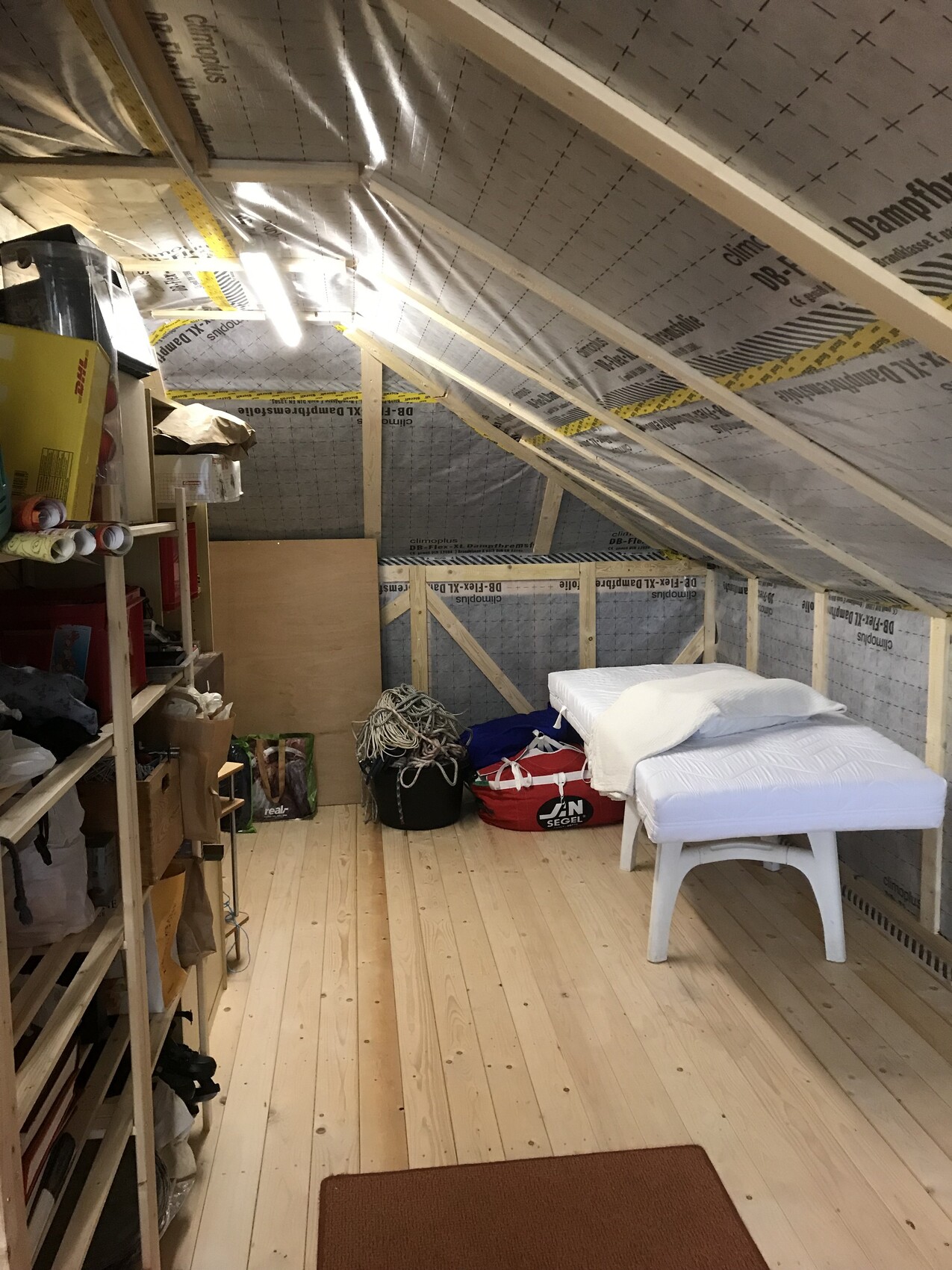
Once the insulation fleece is fitted everywhere, including the corners and any gaps filled well, you install the vapor barrier foil over it. Use a good quality one that allows some moisture to diffuse out—a so-called climate membrane.
Carefully seal all connections with foil tape, tape like Sigacrall, or similar products. Seal the floor and wall connections with sealing compound from a cartridge. Support the foil with boards screwed onto the rafters. If desired, you can install drywall over this afterwards.
K
knalltüte26 Dec 2020 14:23For vapor barrier tape, I can recommend AlfaFlex. It sticks very well and costs significantly less than comparable “brand-name tapes.” Our construction experts have approved it as a good option.
As already mentioned, do the rest carefully and according to the instructions.
If you still have the energy, resources, and budget left, you might consider installing thin OSB or drywall (gypsum board) directly on the counter battens to protect the vapor barrier from being damaged by cartons or shelves if someone is careless. Drywall makes the room brighter, OSB darker. If you choose OSB, I would paint it white to brighten the room.
About 15 years ago, I installed roof windows myself on a more than 100-year-old uneven roof. Personally, I would NEVER do that again. This work should be done by professionals, even on a straight and relatively new roof. The connections between the roof and the reveals are especially important for thermal insulation, waterproofing, etc. Any necessary replacements should also be properly installed by experts.
As already mentioned, do the rest carefully and according to the instructions.
If you still have the energy, resources, and budget left, you might consider installing thin OSB or drywall (gypsum board) directly on the counter battens to protect the vapor barrier from being damaged by cartons or shelves if someone is careless. Drywall makes the room brighter, OSB darker. If you choose OSB, I would paint it white to brighten the room.
About 15 years ago, I installed roof windows myself on a more than 100-year-old uneven roof. Personally, I would NEVER do that again. This work should be done by professionals, even on a straight and relatively new roof. The connections between the roof and the reveals are especially important for thermal insulation, waterproofing, etc. Any necessary replacements should also be properly installed by experts.
Hello,
how should I understand this?
Is the attic open to the neighboring house?
We still have a terraced house, where the gable wall is fully built up, meaning the attic is separated and insulated from the neighbor’s house just like the lower floors.
It should be the same for a semi-detached house, right?
Regards, Olli
how should I understand this?
Is the attic open to the neighboring house?
We still have a terraced house, where the gable wall is fully built up, meaning the attic is separated and insulated from the neighbor’s house just like the lower floors.
It should be the same for a semi-detached house, right?
Regards, Olli
C
Connilein26 Dec 2020 18:59Olli-Ka schrieb:
Hello,
how am I supposed to understand this?
Is the attic open to the neighboring house?
We still have a terraced house, where the gable wall is fully built up, meaning the attic is separated and insulated from the neighbor’s attic just like the lower floors.
It should be the same for a semi-detached house, right?
Regards, Olli Hello,
I’ll try to explain it to you... So, the walls are also fully built up, but it’s about the temperature differences between the two attics of the two halves. Our neighbor isn’t converting her attic, so it will remain cold because the roof itself is not insulated. The insulation for the living space is installed in the ceiling of the top floor. We want to convert our attic, and the argument was raised that we should insulate the wall towards the neighbor with a stud wall (or drywall stud partition) to prevent temperature differences and thus avoid the formation of moisture or condensation. If our room is warm and the neighbor’s attic is cold, there will be a temperature difference where moisture could form. We are now considering how to convert the attic to avoid problems like moisture and so on.
Similar topics