
ᐅ Renovation of a Floor – New Door Installation and Wall Demolition
Created on: 13 Feb 2026 20:20
H
hyperion
Hello,
we are planning to convert 2 rooms into 3:
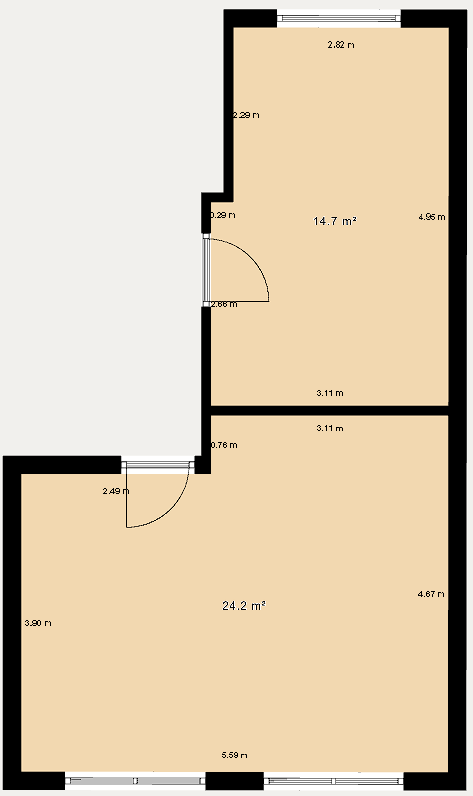
The thick walls around the outside are the exterior walls and are 24 cm (9.5 inches) thick. The thinner walls are made of lightweight concrete blocks and are 13 cm (5 inches) thick. The doors lead into the hallway. The thick wall in the hallway, where the door to the 24.2 m² (260 ft²) room is located, is also 24 cm (9.5 inches) thick and most likely load-bearing. This wall belongs to the stairwell. There is underfloor heating installed in the floor. The large room has two heating circuits – we are not yet sure how these are divided. The upper room has one heating circuit.
We plan to modify it as follows:
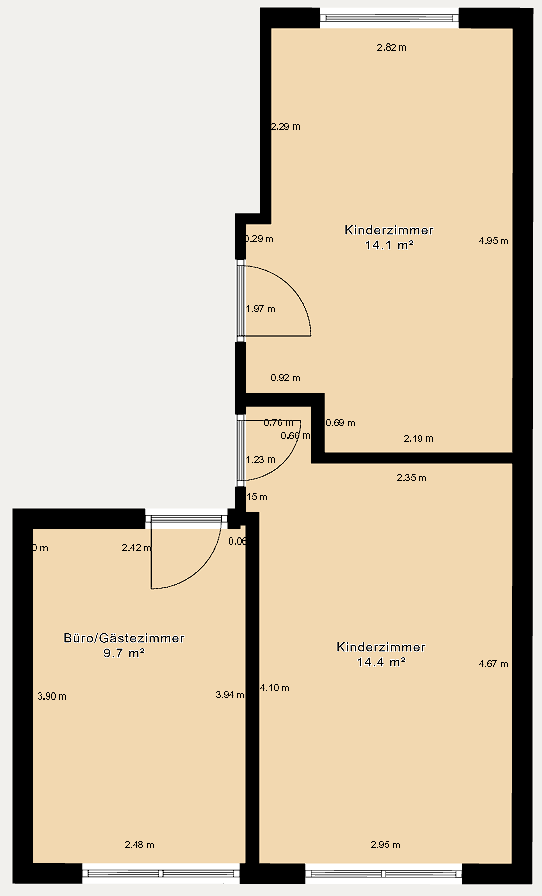
The new walls will be drywall partitions with a thickness of about 16 cm (6.3 inches). The frame for the new door in the middle should be as small as possible since it can be rather impractical.
I’m concerned about the new door. The lintel of the new door shouldn’t overlap with the lintel in the load-bearing wall. Also, cables most likely run in the area where the new door will be installed. This “pillar”
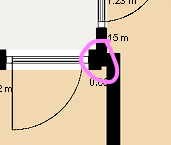
looks like this:
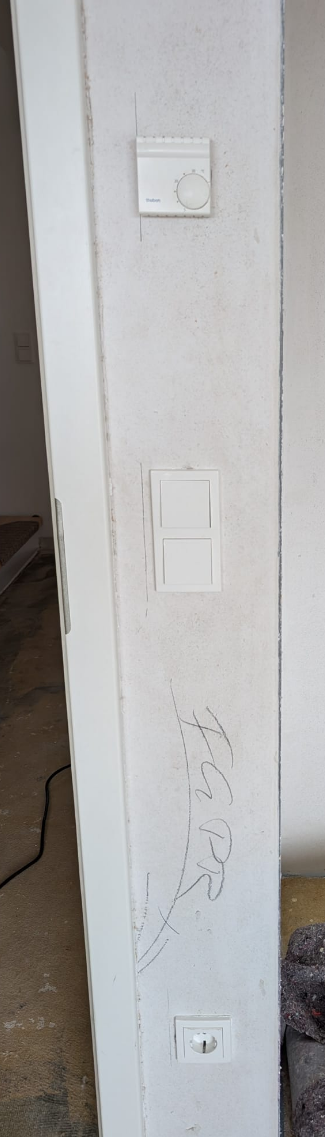
So there is quite a lot going on here. Using a cable detector, I found the following cable routes on this wall:
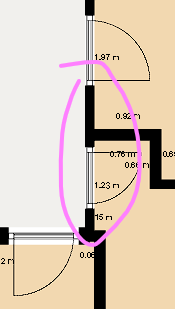
I have already roughly drawn in the new door and the new lintel as an example. You can see that the lintel and the cables interfere with each other.
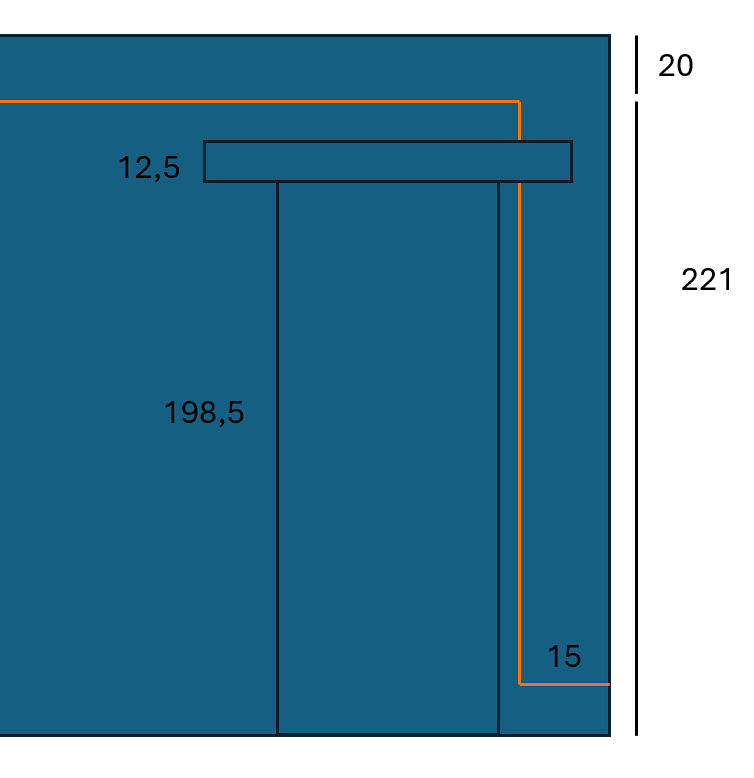
Ideally, I would position the door as far to the right as possible so that the door frame is as small as possible.
How would you approach these issues?
Thanks in advance for your advice.
Best regards
we are planning to convert 2 rooms into 3:
The thick walls around the outside are the exterior walls and are 24 cm (9.5 inches) thick. The thinner walls are made of lightweight concrete blocks and are 13 cm (5 inches) thick. The doors lead into the hallway. The thick wall in the hallway, where the door to the 24.2 m² (260 ft²) room is located, is also 24 cm (9.5 inches) thick and most likely load-bearing. This wall belongs to the stairwell. There is underfloor heating installed in the floor. The large room has two heating circuits – we are not yet sure how these are divided. The upper room has one heating circuit.
We plan to modify it as follows:
The new walls will be drywall partitions with a thickness of about 16 cm (6.3 inches). The frame for the new door in the middle should be as small as possible since it can be rather impractical.
I’m concerned about the new door. The lintel of the new door shouldn’t overlap with the lintel in the load-bearing wall. Also, cables most likely run in the area where the new door will be installed. This “pillar”
looks like this:
So there is quite a lot going on here. Using a cable detector, I found the following cable routes on this wall:
I have already roughly drawn in the new door and the new lintel as an example. You can see that the lintel and the cables interfere with each other.
Ideally, I would position the door as far to the right as possible so that the door frame is as small as possible.
How would you approach these issues?
Thanks in advance for your advice.
Best regards
ypg schrieb:
Simply shift the offset, then everyone will be happy. In fact, in my latest design, I actually expanded the area a bit so that a 1m (3.3 ft) wide wardrobe could fit at the top:
In the upper room, a bed might also fit into the 2.10m (6.9 ft) niche. For that reason, I think the division of 1m (3.3 ft) and 2.10m (6.9 ft) for the upper room works very well.
In the rooms below, there is a balcony door on the interior side and a floor-to-ceiling window right next to it. The bed in the lower left would be a fold-down wall bed. That of course only allows tilt ventilation when the bed is folded down.

hyperion schrieb:
The affected walls do not exist on the floor below or above. In addition, they are only 13 cm (5 inches) thick. The only 24 cm (9.5 inches) thick walls are the exterior walls and the walls around the stairwell. I don’t even see the stairwell represented here. For a meaningful discussion about the structural integrity, it is helpful to be able to visualize the loads and the ceiling/floor sections; in this sense, the comment about walls not being present above or below is significantly incomplete. Unfortunately, we’ve seen before that questioners often try (sometimes quite noticeably) to isolate what they consider to be the only relevant boundary conditions very precisely, while also leaving out crucial details from the original plans in their schematic diagrams. There are smarter ways to approach this, but, as my late grandmother used to say, “Man’s will is his heaven.” Even though it’s not critical here, I find the stated wall thicknesses of “24” and “13” cm (9.5 and 5 inches) confusing: 13 cm (5 inches) would be very thin for lightweight concrete blocks with 11.5 cm (4.5 inches) plus thin plaster, and typical for 10 cm (4 inches) with standard plaster, whereas 24 cm (9.5 inches) is a common raw wall thickness.
What I find lacking in the entire undertaking is the systematic forensic approach of an architect experienced in working with existing buildings, whose involvement I would strongly recommend. You can already see how complex this apparently small project really is.
https://www.instagram.com/11antgmxde/
https://www.linkedin.com/company/bauen-jetzt/
The images so far have been used for space planning and not for structural calculations. Since I do not want to change the hallway, I did not include it in the drawings. Of course, I do not want to withhold any relevant information. However, I do not have a structural plan. I have a building permit / planning permission, but it does not fully match the reality. In other words, after the building permit was issued, the previous owner requested some modifications. I measured the wall thicknesses myself. According to the building permit, the walls should be 11.5 cm (4.5 inches) thick.
The building has a total of 4 floors (mid-terrace house).
Basement / Garden level (on a slope):
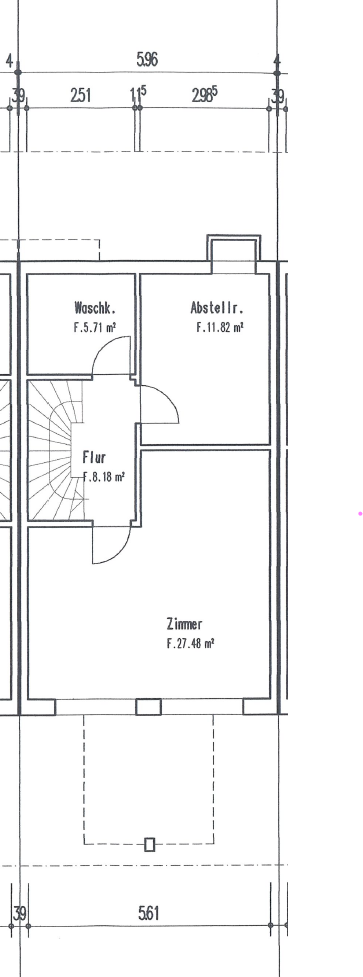
The storage room has a staircase and no light well; otherwise, this is accurate.
The ground floor:
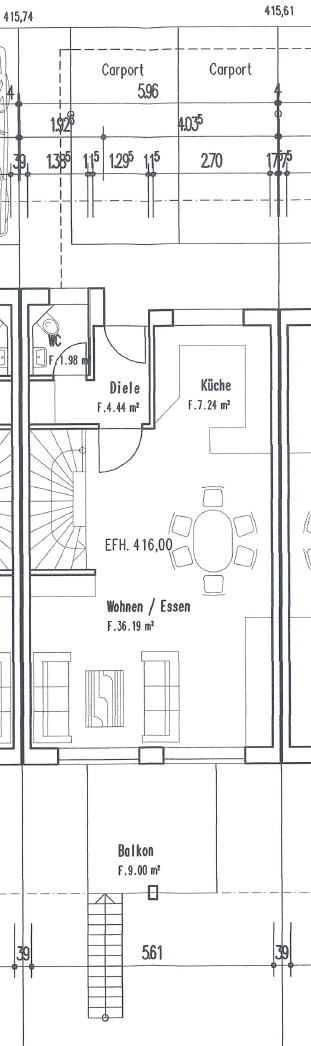
No differences compared to the actual layout.
The first floor (which is to be remodeled):
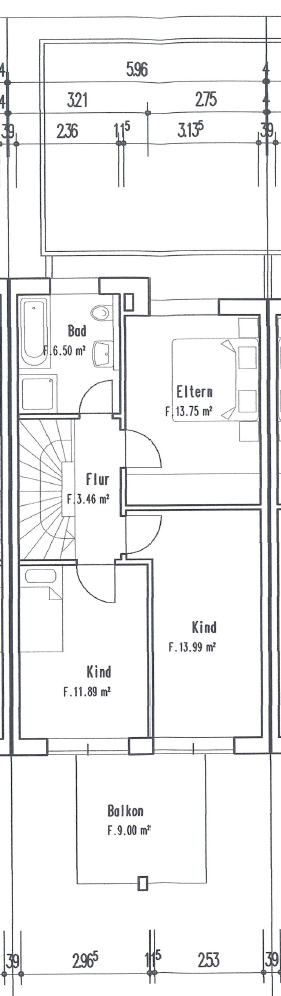
Unlike the building permit, the partition wall between the two children’s rooms does not exist. Additionally, the partition wall between the parents’ room and the child’s room is located lower, so there is no space for a door.
Second floor:
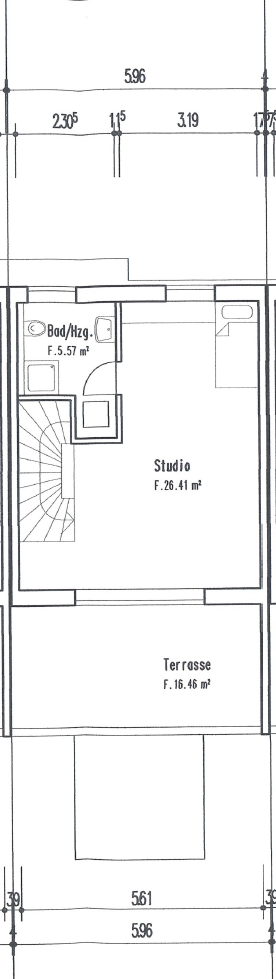
The second floor looks completely different. Several drywall partitions have been added. However, the boxed-in area under the bathroom does not exist; the bathroom is simply rectangular.
The building specification states: reinforced concrete ceilings.
Partition walls between floors: choice of aerated concrete, pumice block masonry, or gypsum wall panels
Party walls: sand-lime brick and reinforced concrete
The building is 10.50 m (34.45 ft) long.
The wall between the upper and lower rooms is definitely made of pumice block. Regarding the wall between the right-side room and the hallway, I cannot say for sure.
Unfortunately, I cannot provide any further information on the structural engineering.
The building has a total of 4 floors (mid-terrace house).
Basement / Garden level (on a slope):
The storage room has a staircase and no light well; otherwise, this is accurate.
The ground floor:
No differences compared to the actual layout.
The first floor (which is to be remodeled):
Unlike the building permit, the partition wall between the two children’s rooms does not exist. Additionally, the partition wall between the parents’ room and the child’s room is located lower, so there is no space for a door.
Second floor:
The second floor looks completely different. Several drywall partitions have been added. However, the boxed-in area under the bathroom does not exist; the bathroom is simply rectangular.
The building specification states: reinforced concrete ceilings.
Partition walls between floors: choice of aerated concrete, pumice block masonry, or gypsum wall panels
Party walls: sand-lime brick and reinforced concrete
The building is 10.50 m (34.45 ft) long.
The wall between the upper and lower rooms is definitely made of pumice block. Regarding the wall between the right-side room and the hallway, I cannot say for sure.
Unfortunately, I cannot provide any further information on the structural engineering.
hyperion schrieb:
Overall, the building has 4 floors (mid-terrace house). Well, initially I wouldn’t have considered a mid-terrace house here, but rather half (one side) of a floor plan in a multi-family building. It’s easy to misunderstand each other.
hyperion schrieb:
The pictures so far were for space planning and not for structural calculations. Since I did not want to redesign the hallway, I did not include it in the drawings. Nothing can be isolated from the whole—and as you can see, even a seemingly simple renovation project touches on a wide range of details at first glance to a non-expert. None of this is rocket science if you consider and coordinate everything in a concerted way—but it can lead to more detours than direct routes if you set aside a methodical approach.
https://www.instagram.com/11antgmxde/
https://www.linkedin.com/company/bauen-jetzt/
hyperion schrieb:
The first floor (which is to be remodeled): By the way, you could just as well have painted over the scan—I don’t understand why amateurs feel the need to keep drawing. Planning requires thinking, not digital doodling. A systematic approach (preferably without giving up professional experts) is important and more effective; the notes can just as well be scribbled on napkins or graph paper if necessary.
https://www.instagram.com/11antgmxde/
https://www.linkedin.com/company/bauen-jetzt/
Similar topics