
ᐅ Controlled residential ventilation – external ventilation ducts – topic: condensation
Created on: 25 Sep 2021 00:35
A
alive&kickingA
alive&kicking25 Sep 2021 00:35Hello everyone,
I’m currently in a bit of a bind and running out of time, which I actually don’t have right now. (I need to specify the sizes of the core drillings, but the execution is not clear yet, as it turns out (radon).)
Normally, I read through forums before posting a question... I did, but clearly not enough.
We have planned a controlled mechanical ventilation system (ComfoAir Q350 TR enthalpy), and at that time, we wanted to install it ourselves. Well, now I would have it installed professionally.
The question I have is: how do I properly drain the condensate that forms in the external ducts?
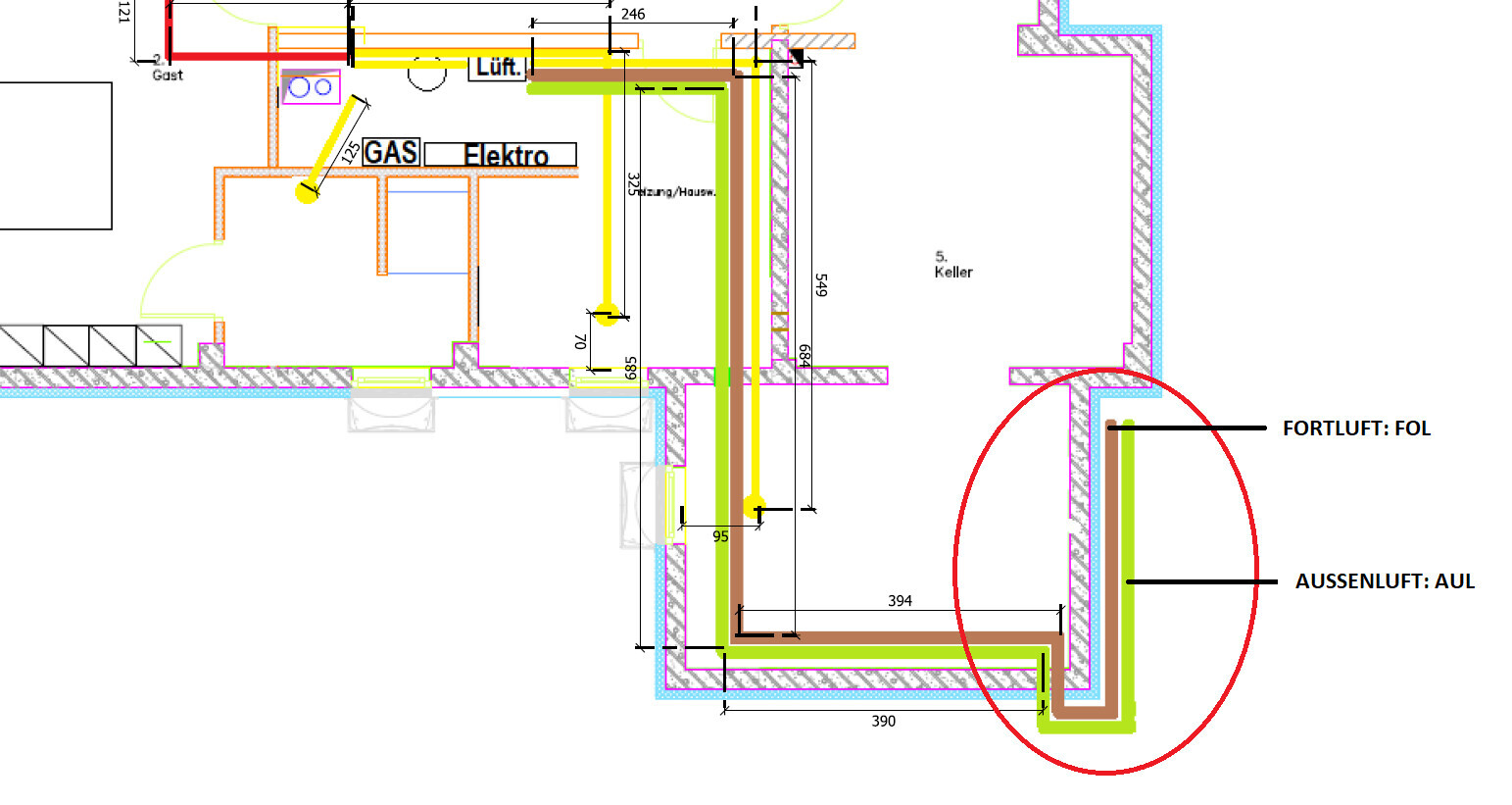
The building situation (Upper Bavaria) is as follows (also visible in the image below). The ventilation unit is in the basement (heated), ductwork runs to the exterior wall in ComfoPipe and spiral ducting, sealed with Doyma seals. Outside there are sewer pipes (KG pipes) DN200 (uninsulated), which are intended to be used as ventilation ducts. These are buried about 50-60 cm (20-24 inches) deep for about 2-3 meters (6.5-9.8 feet), then pass under an existing garage slab and continue over the carport roof. I know the duct length is quite extensive.
Since the radon issue resurfaced, I rejected the suggestion to drain the condensate underground and am now looking for another solution.
My current idea is as follows, but I am very uncertain because I haven’t researched much:
Exhaust air (FOL):
From the ventilation unit, uninsulated spiral ducting to the exterior wall, transition to KG DN160 still inside, Doyma seal, transition to KG DN200 with slope, then somewhere a T-joint with about 20 cm (8 inches) of pipe going down for drainage (with a grate or fleece?), then continuing with an upward slope in KG DN200, insulate the KG pipe above the garage slab, then use a stainless steel ventilation bend DN160 (?).
Supply air (AUL):
Stainless steel intake bend DN160 (?), transition to uninsulated KG DN200, horizontally under the garage slab with slope to the house wall, transition to KG DN160, connection to ComfoPipe DN160, Doyma seal, element with condensate drain (initially into a container), continuing in ComfoPipe to the ventilation unit.
Gently asking, is this a technically sensible option?
Based on my limited knowledge, more condensate forms in the exhaust air duct than in the supply air?
(In parentheses, there is of course also the option to exhaust the FOL through a basement shaft in the utility room, but this is where our garden terrace is, so I’m not sure if that would be an issue. However, in summer we plan to reduce the mechanical ventilation since we will have everything open.)
I would really appreciate any answers and/or alternative suggestions.
Attachment:
Building situation
I’m currently in a bit of a bind and running out of time, which I actually don’t have right now. (I need to specify the sizes of the core drillings, but the execution is not clear yet, as it turns out (radon).)
Normally, I read through forums before posting a question... I did, but clearly not enough.
We have planned a controlled mechanical ventilation system (ComfoAir Q350 TR enthalpy), and at that time, we wanted to install it ourselves. Well, now I would have it installed professionally.
The question I have is: how do I properly drain the condensate that forms in the external ducts?
The building situation (Upper Bavaria) is as follows (also visible in the image below). The ventilation unit is in the basement (heated), ductwork runs to the exterior wall in ComfoPipe and spiral ducting, sealed with Doyma seals. Outside there are sewer pipes (KG pipes) DN200 (uninsulated), which are intended to be used as ventilation ducts. These are buried about 50-60 cm (20-24 inches) deep for about 2-3 meters (6.5-9.8 feet), then pass under an existing garage slab and continue over the carport roof. I know the duct length is quite extensive.
Since the radon issue resurfaced, I rejected the suggestion to drain the condensate underground and am now looking for another solution.
My current idea is as follows, but I am very uncertain because I haven’t researched much:
Exhaust air (FOL):
From the ventilation unit, uninsulated spiral ducting to the exterior wall, transition to KG DN160 still inside, Doyma seal, transition to KG DN200 with slope, then somewhere a T-joint with about 20 cm (8 inches) of pipe going down for drainage (with a grate or fleece?), then continuing with an upward slope in KG DN200, insulate the KG pipe above the garage slab, then use a stainless steel ventilation bend DN160 (?).
Supply air (AUL):
Stainless steel intake bend DN160 (?), transition to uninsulated KG DN200, horizontally under the garage slab with slope to the house wall, transition to KG DN160, connection to ComfoPipe DN160, Doyma seal, element with condensate drain (initially into a container), continuing in ComfoPipe to the ventilation unit.
Gently asking, is this a technically sensible option?
Based on my limited knowledge, more condensate forms in the exhaust air duct than in the supply air?
(In parentheses, there is of course also the option to exhaust the FOL through a basement shaft in the utility room, but this is where our garden terrace is, so I’m not sure if that would be an issue. However, in summer we plan to reduce the mechanical ventilation since we will have everything open.)
I would really appreciate any answers and/or alternative suggestions.
Attachment:
Building situation
A
alive&kicking26 Sep 2021 22:05I’m still stuck ... does no one have any comments on my topic??
D
DennisD8028 Sep 2021 10:51In principle, condensate only forms inside the heat exchanger, where warm, moist air meets a cold surface. In this case, the condensate appears where the warm exhaust air, which contains increased humidity (from the bathroom, kitchen, breath, laundry room), meets the heat exchanger cooled by cold outside air. This effect only occurs at low outdoor temperatures. As long as it is warm outside, no condensation forms. Below the heat exchanger of the ventilation system, a drain is provided to remove the condensate. If any condensate still forms somewhere in the exhaust duct, it should be carried out by the continuous airflow.
D
DennisD8028 Sep 2021 11:01It is possible that condensation could form on the supply air during the summer if it is very humid and the underground duct is sufficiently cold. I find it hard to imagine how much condensation that would actually be. Is there a possibility to install a small drain? I am thinking of something like a funnel with a ball resting on it—the ball should be heavy but still able to float. This way, the ball would lift when it is in water and allow the water to drain, but it would seal the drain and thus solve your radon issue.
A
alive&kicking28 Sep 2021 23:43Thank you for your answers, Dennis.
I have now solved it by allowing the external pipes to "drain" inside the house, using a condensate drain. Since radon is a major concern for us, I keep the pipes sealed on the outside.
I have now solved it by allowing the external pipes to "drain" inside the house, using a condensate drain. Since radon is a major concern for us, I keep the pipes sealed on the outside.
Similar topics