
ᐅ Mechanical Ventilation with Heat Recovery (MVHR) System – Maximum Duct Lengths – What Are the Consequences?
Created on: 11 Feb 2019 10:33
R
Reini1234
I just came back from my construction site and have the feeling that the installation of my mechanical ventilation with heat recovery is going completely off track.
Initial situation:
I actually wanted to subcontract the entire ventilation system without getting too involved. The plumbing subcontractor ordered a Wolf CWL 400 with 50x140cm (20x6 inches) rectangular duct. The company installed the vents for the basement rooms in the precast concrete ceiling during the basement construction and left a few meters of duct hanging up. These ducts were supposed to be routed further through the installation level of the timber frame house up to the attic.
Recently, I was offered to install the remaining ducts myself on a time-and-materials basis, which we accepted.
The unit is mounted in the attic on the gable wall above the bathroom. The two air distributors are located directly in front of it. All supply and exhaust vents in the house are controlled from there. All rectangular ducts are connected, but the exhaust and fresh air ducts to the outside are not yet installed.
The installer came by a few times, briefly checked if everything was okay, and left. I increasingly felt that everything was done roughly by eye and wondered that apparently no guidelines or standards were used. I recently received the ventilation plan, which I have now studied more closely.
It mentions a minimum and maximum duct length of 5–15m (16–49 feet). I have met the minimum of 5m, but the maximum length is clearly exceeded in the basement rooms:
Basement Room Exhaust 12.50m (41 feet)
Basement Room Supply 20.00m (66 feet)
Basement Utility Room Exhaust 17.00m (56 feet)
Basement Hall Supply 15.80m (52 feet)
Basement Supply Exhaust 13.30m (44 feet)
Basement Toilet Exhaust 8.50m (28 feet)
What exactly happens when the duct run is too long? Can the fan no longer handle this? I might be able to reroute the long 20m (66 feet) run via floor routing to save a few meters, but I won’t be able to meet the 15m (49 feet) limit. There are four bends just on this run. Would it help to swap the much shorter exhaust duct with the supply duct?
Other issues I noticed:
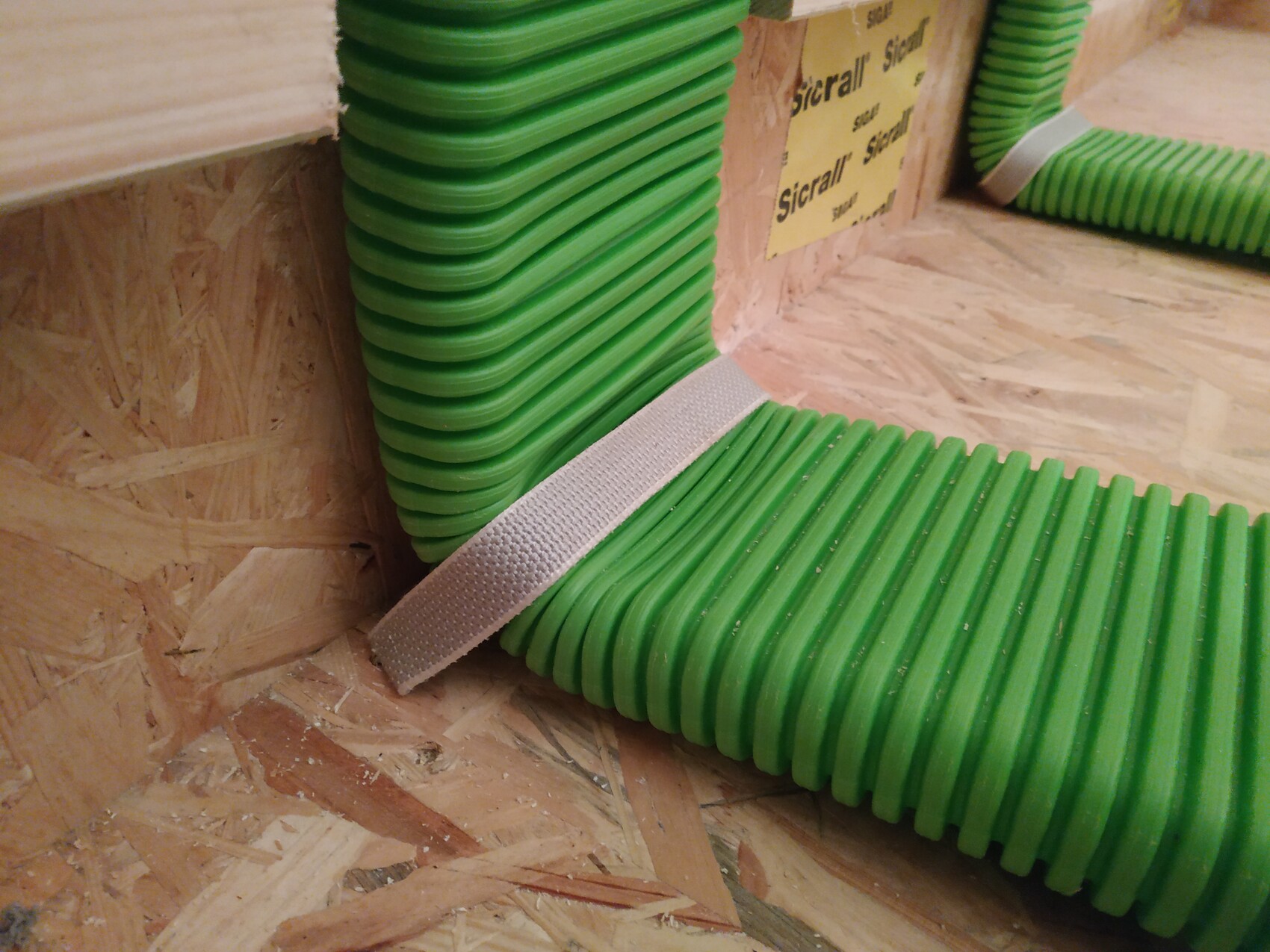
- We were not provided with rigid bends, so we bent everything ourselves. Especially the 90-degree transition from floor to wall looks like in the pictures. Due to the kink, the duct is somewhat pinched—what kind of problems could this cause?
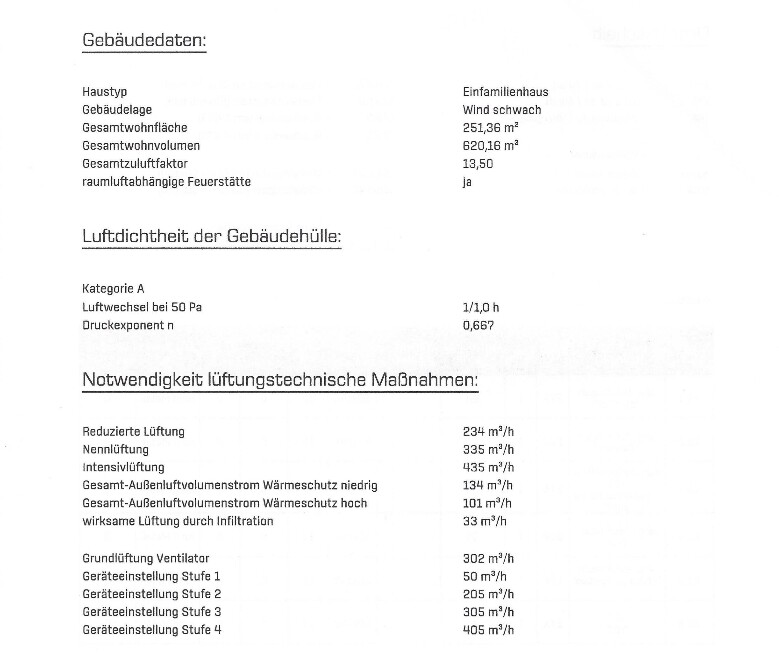
Attached is also my ventilation plan.
Initial situation:
I actually wanted to subcontract the entire ventilation system without getting too involved. The plumbing subcontractor ordered a Wolf CWL 400 with 50x140cm (20x6 inches) rectangular duct. The company installed the vents for the basement rooms in the precast concrete ceiling during the basement construction and left a few meters of duct hanging up. These ducts were supposed to be routed further through the installation level of the timber frame house up to the attic.
Recently, I was offered to install the remaining ducts myself on a time-and-materials basis, which we accepted.
The unit is mounted in the attic on the gable wall above the bathroom. The two air distributors are located directly in front of it. All supply and exhaust vents in the house are controlled from there. All rectangular ducts are connected, but the exhaust and fresh air ducts to the outside are not yet installed.
The installer came by a few times, briefly checked if everything was okay, and left. I increasingly felt that everything was done roughly by eye and wondered that apparently no guidelines or standards were used. I recently received the ventilation plan, which I have now studied more closely.
It mentions a minimum and maximum duct length of 5–15m (16–49 feet). I have met the minimum of 5m, but the maximum length is clearly exceeded in the basement rooms:
Basement Room Exhaust 12.50m (41 feet)
Basement Room Supply 20.00m (66 feet)
Basement Utility Room Exhaust 17.00m (56 feet)
Basement Hall Supply 15.80m (52 feet)
Basement Supply Exhaust 13.30m (44 feet)
Basement Toilet Exhaust 8.50m (28 feet)
What exactly happens when the duct run is too long? Can the fan no longer handle this? I might be able to reroute the long 20m (66 feet) run via floor routing to save a few meters, but I won’t be able to meet the 15m (49 feet) limit. There are four bends just on this run. Would it help to swap the much shorter exhaust duct with the supply duct?
Other issues I noticed:
- We were not provided with rigid bends, so we bent everything ourselves. Especially the 90-degree transition from floor to wall looks like in the pictures. Due to the kink, the duct is somewhat pinched—what kind of problems could this cause?
Attached is also my ventilation plan.
R
Reini123412 Feb 2019 11:21Yes, I have also come across that software. Alternatively, I wanted to try calculating with Helios Easy Plan.
However, the question of the correct air volume still remains...
However, the question of the correct air volume still remains...
The 335s feel acceptable in practice; calculating based on the number of people doesn’t really help if you can’t control the rooms individually or if there are an unusually high number of people living in the house.
A single line up to 10m (33 feet) is fine for simple rooms (like a study or children’s room), but for living rooms or bedrooms, this length is definitely too long. There’s simply not enough supply... If possible, I would recommend fixing this, as the pipes don’t cost much.
A single line up to 10m (33 feet) is fine for simple rooms (like a study or children’s room), but for living rooms or bedrooms, this length is definitely too long. There’s simply not enough supply... If possible, I would recommend fixing this, as the pipes don’t cost much.
R
Reini123412 Feb 2019 12:20The pipes are a major cost factor in the system. Through specialized retailers, they cost 360 EUR for 20m (65 feet), while online they are available for 200 EUR.
What I don’t quite understand is: Why does the manufacturer specify this to me?
What I don’t quite understand is: Why does the manufacturer specify this to me?

R
Reini123412 Feb 2019 14:26The number of pipes to the valve

Reini1234 schrieb:
1. The long ducts would have been mostly resolved except for minor exceedances.There is a significant difference between “approved by the manufacturer” and “ideal for the average homeowner.”
Reini1234 schrieb:
2. Flat ducting was necessary because of the timber frame house with an installation layer.That may be true. I would have at least tried to fit 90mm (3.5 inches) round ducting, but of course, it’s difficult to change such specifications afterwards. My list was not meant as a “criticism,” but simply an overview of your problem areas.
Reini1234 schrieb:
3. These are unavoidable with valves in the ceiling.That may also be true, but they are disruptive for air distribution and should be avoided where possible.
Reini1234 schrieb:
The air distributor should be placed as close to the unit as possible.Who says that? I can’t think of a reason for this...