
ᐅ Mechanical Ventilation with Heat Recovery – Planning the Locations for Supply and Exhaust Air
Created on: 5 May 2021 02:01
M
mwinkelm
Hello everyone,
The planning for our semi-detached house is becoming more concrete. Now we need to determine the positions of the outlets for the central mechanical ventilation system with heat recovery.
I have read quite a bit on the topic and tried to consider the usual best practices. However, it is quite overwhelming at first and leaves some uncertainty. That’s why I would appreciate it if you could take a look based on your experience.
In general, everything is initially planned as ceiling outlets. However, the concept of displacement ventilation also makes sense to me, so wall outlets near the floor for the supply air could also be considered. What are your thoughts on this?
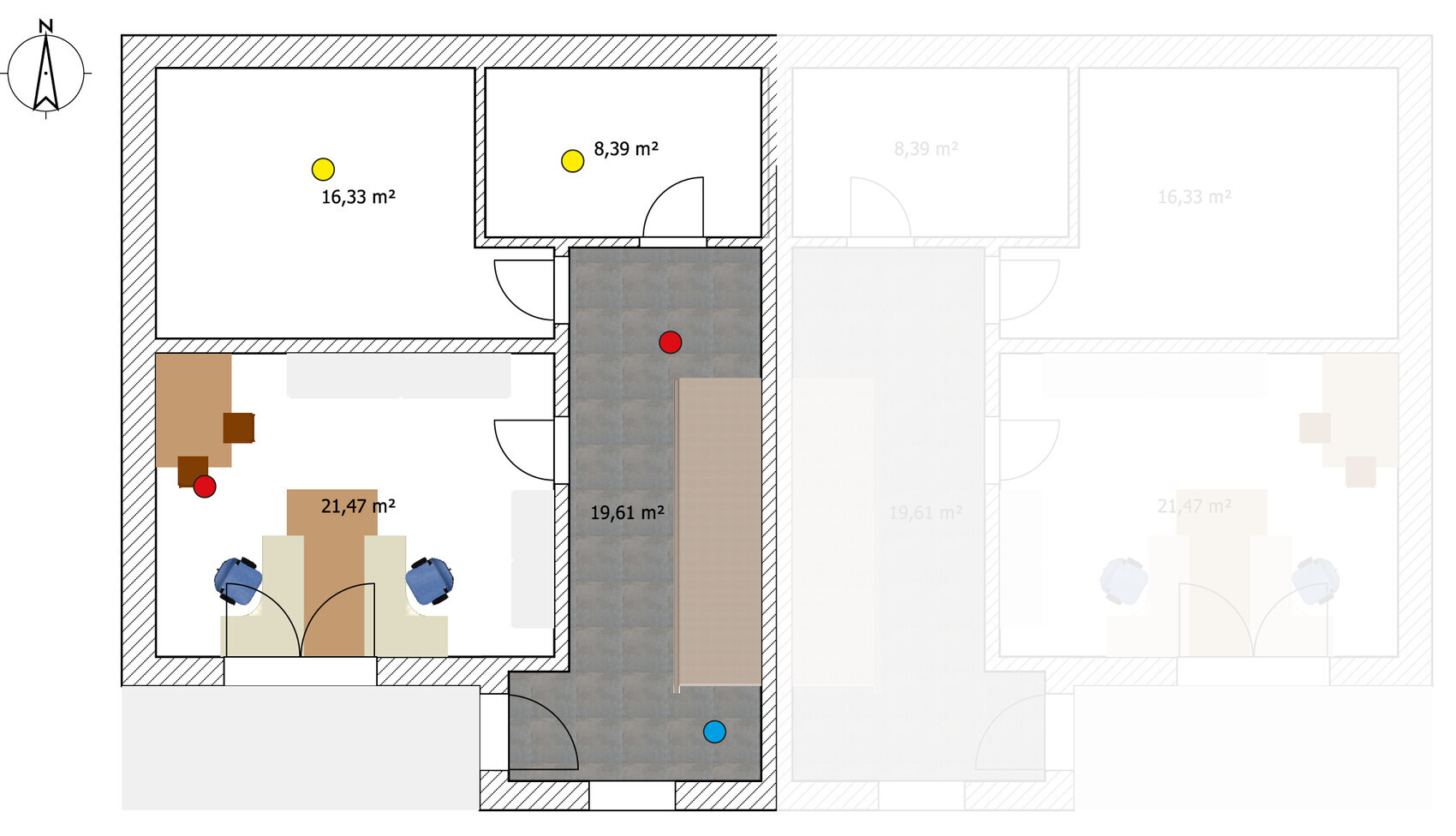
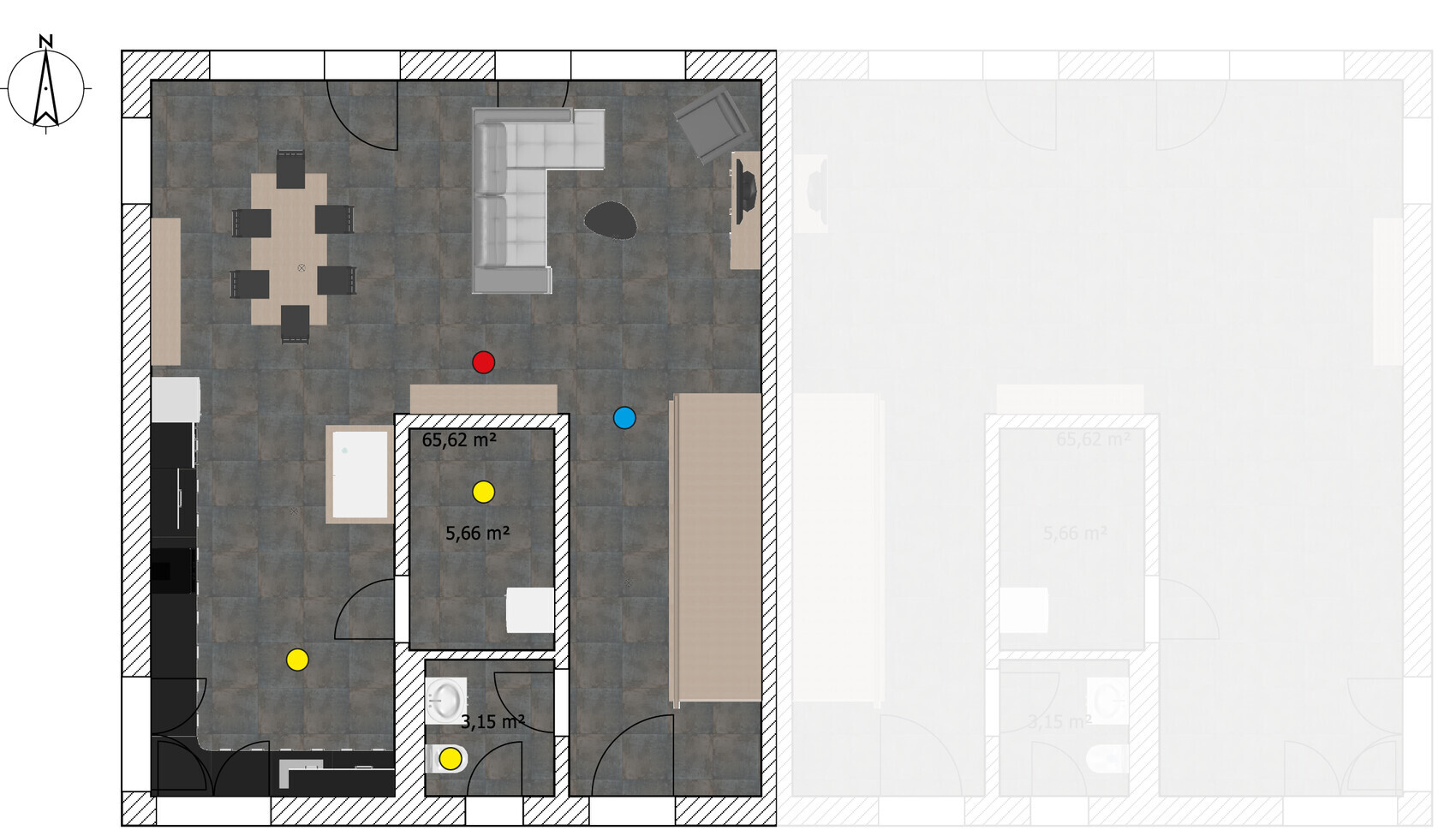
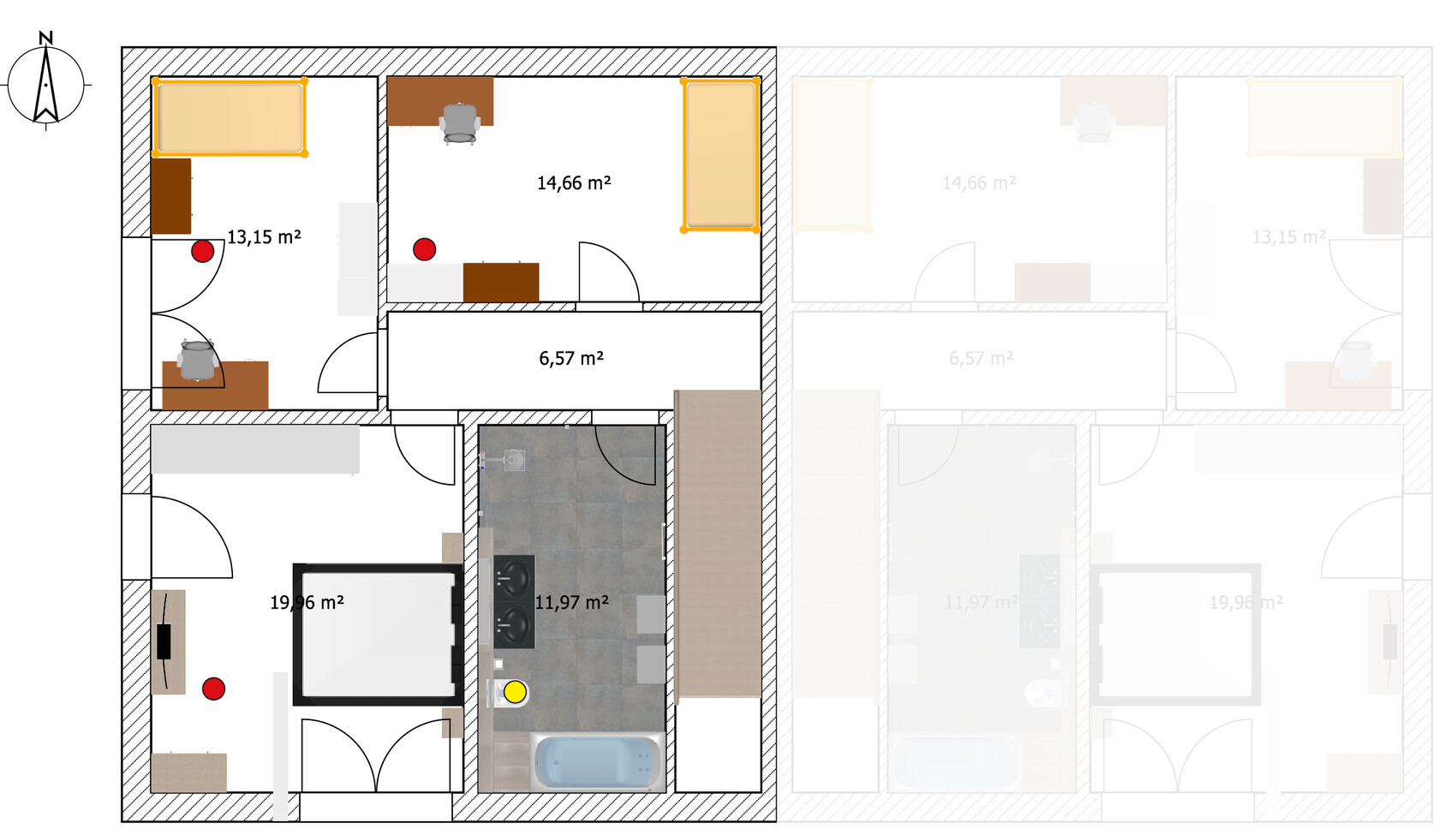
Yellow dots = Extract air
Red dots = Supply air
Blue dots = Alternative supply air (as a possible alternative position for the same room instead of the red dot)
Ground floor:
Upper floor:
Attic floor:
Thank you very much in advance!
Markus
The planning for our semi-detached house is becoming more concrete. Now we need to determine the positions of the outlets for the central mechanical ventilation system with heat recovery.
I have read quite a bit on the topic and tried to consider the usual best practices. However, it is quite overwhelming at first and leaves some uncertainty. That’s why I would appreciate it if you could take a look based on your experience.
In general, everything is initially planned as ceiling outlets. However, the concept of displacement ventilation also makes sense to me, so wall outlets near the floor for the supply air could also be considered. What are your thoughts on this?
Yellow dots = Extract air
Red dots = Supply air
Blue dots = Alternative supply air (as a possible alternative position for the same room instead of the red dot)
Ground floor:
- The additional table indicated in the office will ultimately not be placed there.
- I am unsure whether the supply air in the hallway should preferably be near the front door or not.
Upper floor:
- The alternative supply air position is meant to better cover the hallway area. Or is this not relevant, and is it more important that air is supplied directly into the dining/living area?
- Would it be better to have two outlets in the large living and dining area to minimize noise?
Attic floor:
- The children’s rooms are a bit of a headache because it is very difficult to predict exactly how the furniture will be arranged at this stage.
- In the slightly larger children’s room, I’m also not certain about the door position yet. It might be placed all the way to the left (opposite the bedroom door). In that case, the supply air would need to be located elsewhere.
Thank you very much in advance!
Markus

I'll try to soften it a bit with my own words: It wasn't about the frame vents not fulfilling their primary function or doing so inadequately. They actually do that very well, but as mentioned above, not only air passes through them but also everything that is transported with it: sound as well as odors. 😉 That's why I maintain that these are completely unsuitable when higher sound insulation is required.
K1300S schrieb:
Actually, our door supplier mentioned that with acoustic doors, it’s important to fully foam the gap between the door frame and the wall to prevent any sound bridges from forming.K1300S schrieb:
That’s why I still believe these are completely inappropriate when higher sound insulation is required.I can understand that argument. But you’re referring to interior doors with specific special properties, right? That probably isn’t the model offered by our “standard builder.”K1300S schrieb:
Did you maybe mean outdoor air and exhaust air?Yes, exactly.K1300S schrieb:
I would think that over carefully, otherwise there might be a “short circuit” situation.Hmm... If that were really such a problem, would manufacturers still offer these systems? Our planner doesn’t seem to see any issue at all. The exhaust air is vented downward on these units, while the outdoor air is drawn in straight above.K1300S schrieb:
the usual wind directionOh, I’ll have to check that—I don’t know it yet for the property.T_im_Norden schrieb:
Two outlets per room to keep the air velocity low, while at the same time allowing higher volumes to be supplied.I’ll bring this up again. Thank you very much.mwinkelm schrieb:
I can understand that argument. But this also concerns interior doors with specific special properties, right? That probably won’t be our "standard developer" model. The point is that if sound insulation is important, any air gap is counterproductive. Of course, there are higher-grade soundproof doors, but even a simple model is significantly improved by following the recommendations mentioned above, which doesn’t involve any extra cost. If you then add a drop-down seal underneath (costing about 50 EUR), you’re already well ahead. The ventilation just needs to be planned accordingly; otherwise, you may experience issues with overpressure, noise, etc.
mwinkelm schrieb:
Hmm ... If that were such a big problem, would manufacturers still offer these products? Manufacturers or sellers basically offer everything that doesn’t directly cause problems, and it can work. However, as mentioned, you should consider the wind direction and keep a certain distance. As a builder, I would still critically question such a solution.

Similar topics