
ᐅ Mechanical Ventilation with Heat Recovery – Planning the Locations for Supply and Exhaust Air
Created on: 5 May 2021 02:01
M
mwinkelm
Hello everyone,
The planning for our semi-detached house is becoming more concrete. Now we need to determine the positions of the outlets for the central mechanical ventilation system with heat recovery.
I have read quite a bit on the topic and tried to consider the usual best practices. However, it is quite overwhelming at first and leaves some uncertainty. That’s why I would appreciate it if you could take a look based on your experience.
In general, everything is initially planned as ceiling outlets. However, the concept of displacement ventilation also makes sense to me, so wall outlets near the floor for the supply air could also be considered. What are your thoughts on this?
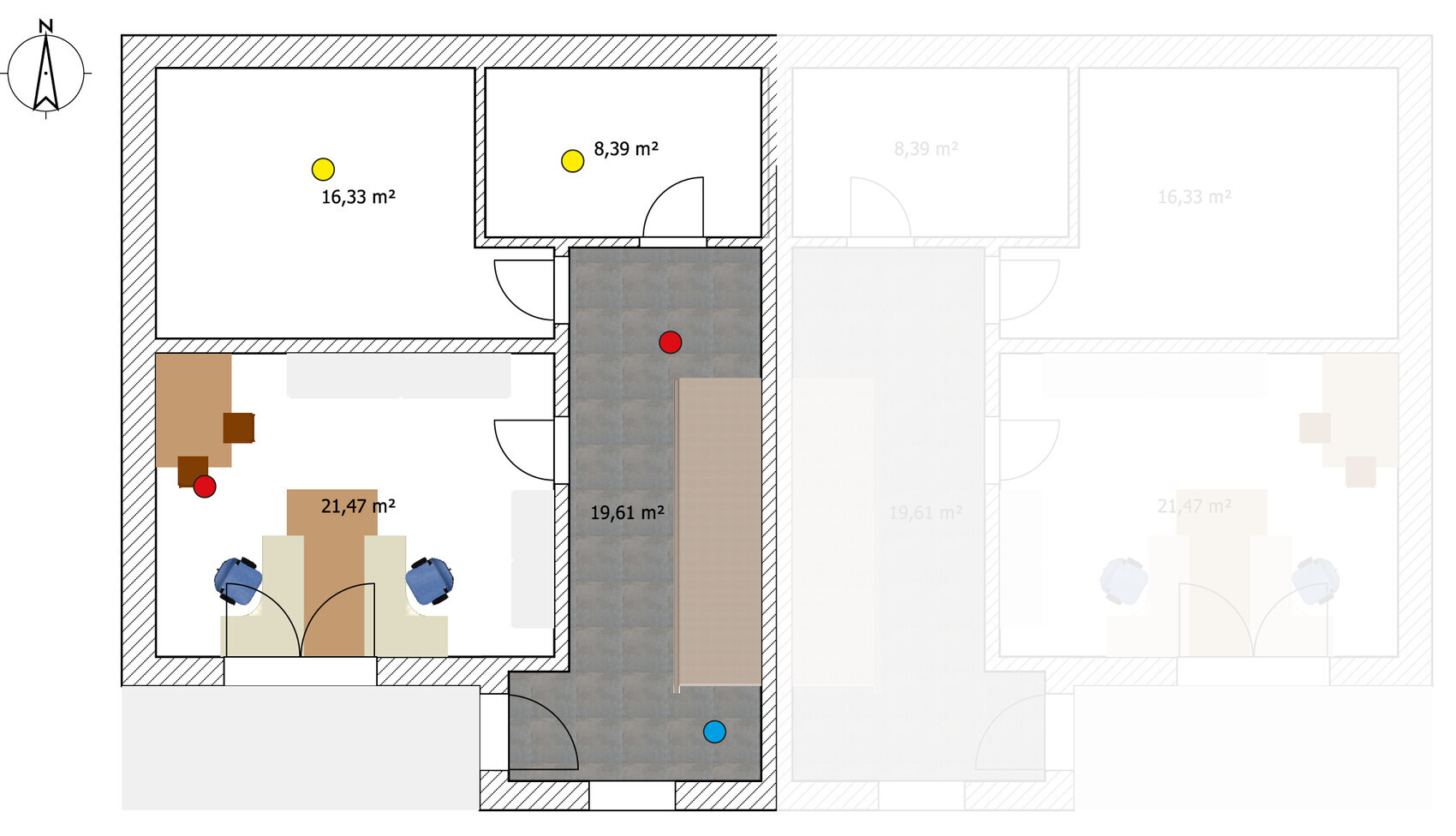
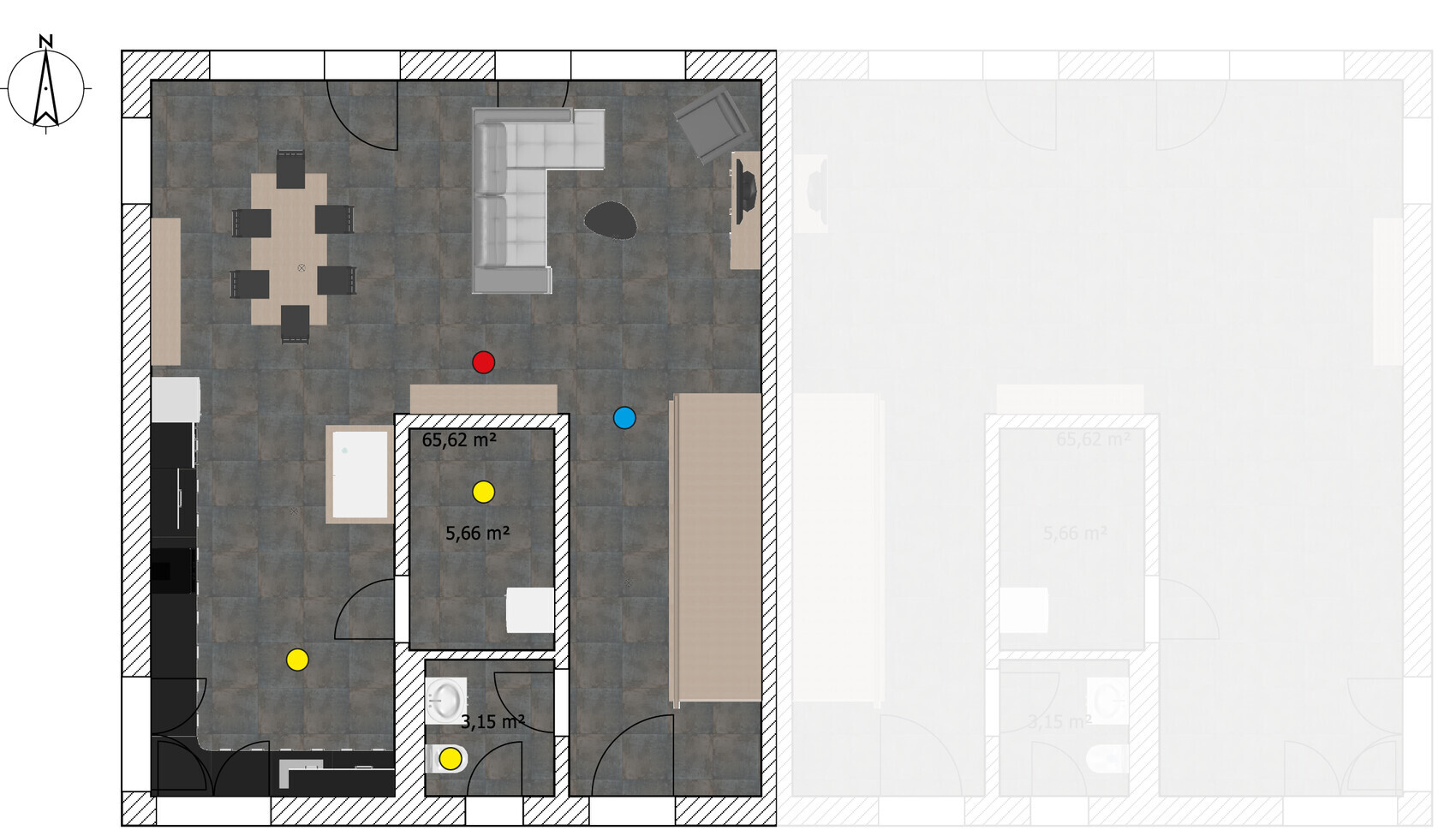
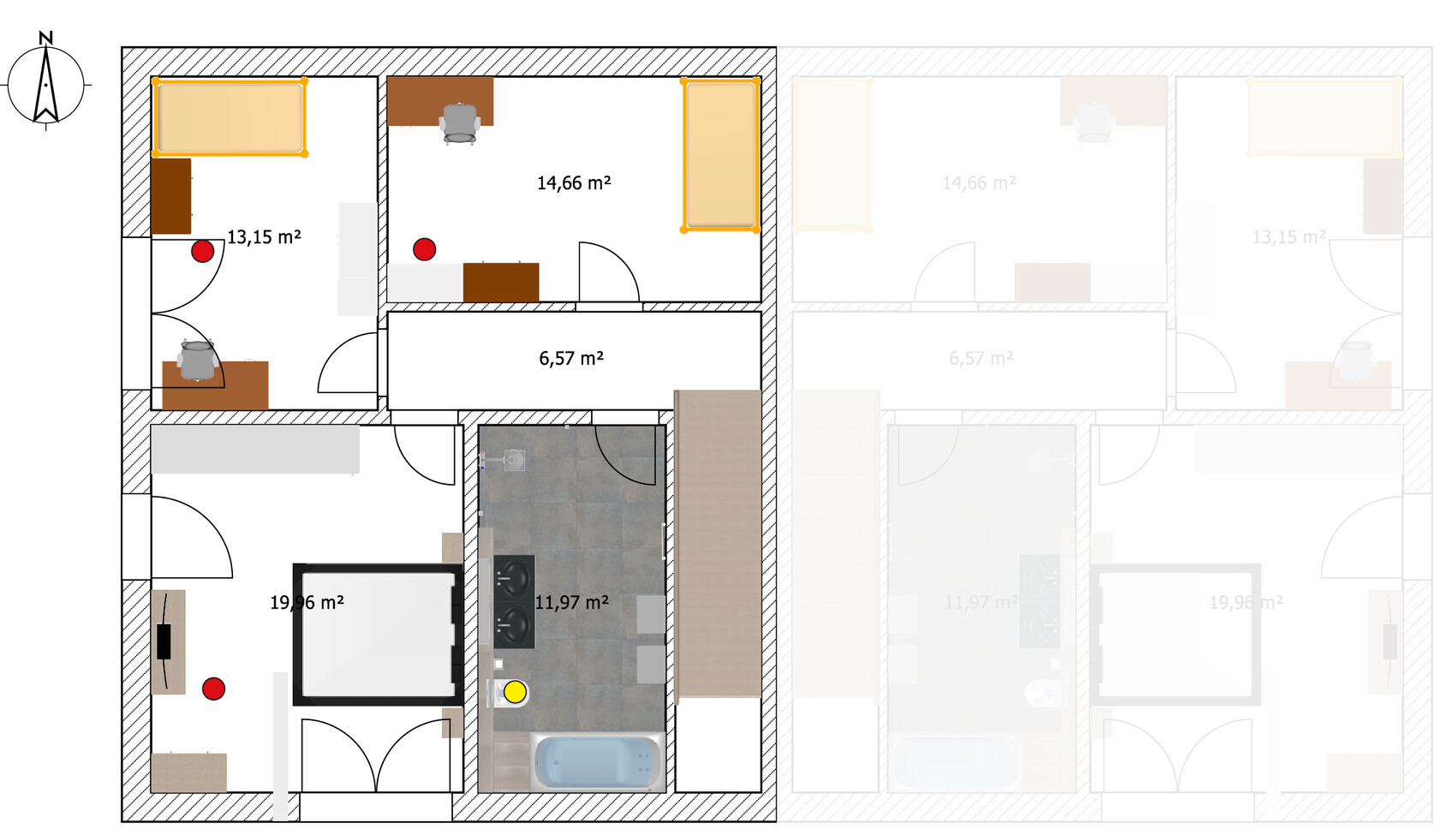
Yellow dots = Extract air
Red dots = Supply air
Blue dots = Alternative supply air (as a possible alternative position for the same room instead of the red dot)
Ground floor:
Upper floor:
Attic floor:
Thank you very much in advance!
Markus
The planning for our semi-detached house is becoming more concrete. Now we need to determine the positions of the outlets for the central mechanical ventilation system with heat recovery.
I have read quite a bit on the topic and tried to consider the usual best practices. However, it is quite overwhelming at first and leaves some uncertainty. That’s why I would appreciate it if you could take a look based on your experience.
In general, everything is initially planned as ceiling outlets. However, the concept of displacement ventilation also makes sense to me, so wall outlets near the floor for the supply air could also be considered. What are your thoughts on this?
Yellow dots = Extract air
Red dots = Supply air
Blue dots = Alternative supply air (as a possible alternative position for the same room instead of the red dot)
Ground floor:
- The additional table indicated in the office will ultimately not be placed there.
- I am unsure whether the supply air in the hallway should preferably be near the front door or not.
Upper floor:
- The alternative supply air position is meant to better cover the hallway area. Or is this not relevant, and is it more important that air is supplied directly into the dining/living area?
- Would it be better to have two outlets in the large living and dining area to minimize noise?
Attic floor:
- The children’s rooms are a bit of a headache because it is very difficult to predict exactly how the furniture will be arranged at this stage.
- In the slightly larger children’s room, I’m also not certain about the door position yet. It might be placed all the way to the left (opposite the bedroom door). In that case, the supply air would need to be located elsewhere.
Thank you very much in advance!
Markus
ypg schrieb:
No, that depends, among other things, on the general contractor / mechanical ventilation system with heat recovery.
This needs to be planned from the very beginning and not just placed "somewhere" where the homeowner thinks it’s right, resulting in a poor job.I completely agree.
Ultimately, though, I believe (with a layperson’s understanding in this area) that a wall outlet is definitely better than one on the floor—whether regarding dust disturbance, furniture placement, or simply aesthetics. I think this is independent of the house itself (at least for standard planned houses) and probably also independent of the mechanical ventilation system. After all, this isn’t really related to a specific model, is it? I simply suspect it’s cheaper for the general contractor to install everything on the floor because then there’s nothing that needs to be routed inside the walls.

Installing ducts within the floor has significant advantages regarding space requirements for the channels. For example, everything can be accommodated in a relatively narrow plane, allowing two floors to be supplied with both exhaust and supply air.
halmi schrieb:It works fine. This is known as overflow area and displacement.
How do you plan to properly remove three times the amount of supply air in the sleeping area compared to one exhaust air duct on the floor?
Mycraft schrieb:
Installing ducts in the floor can have significant advantages regarding space requirements for the channels. For example, everything can be accommodated in a relatively narrow layer, allowing two floors to be supplied with exhaust and fresh air.
Yes, that’s possible. It’s called the overflow area and displacement.Exactly – so the only advantages are the reduced effort for the general contractor or ultimately the trade responsible for installing the ducts?
No, the air distribution is also different. Depending on the design, there can be noise advantages as well. In some cases, very large air diffusers are not necessary, which saves space.
Furthermore, this approach can help avoid excessively long duct lengths, which positively affects airflow and pressure, and ultimately the overall cost.
Fewer wall vents also mean less work for the drywall installer and so on.
So, it is a complex issue with multiple factors.
Furthermore, this approach can help avoid excessively long duct lengths, which positively affects airflow and pressure, and ultimately the overall cost.
Fewer wall vents also mean less work for the drywall installer and so on.
So, it is a complex issue with multiple factors.
Mycraft schrieb:
Installing the ducts in the floor can have significant advantages regarding space requirements. For example, everything can be accommodated in a relatively narrow plane, allowing two floors to be supplied with exhaust and supply air.
Oh, that’s possible. It’s called the overflow area and displacement. In the bedroom, there are probably 40-45 cubic meters, and in the two children’s rooms about 20-25 cubic meters each. In my opinion, an exhaust rate of around 40-50 cubic meters is likely too low. The volume should roughly balance out per floor.