
ᐅ Mechanical Ventilation with Heat Recovery – Planning the Locations for Supply and Exhaust Air
Created on: 5 May 2021 02:01
M
mwinkelm
Hello everyone,
The planning for our semi-detached house is becoming more concrete. Now we need to determine the positions of the outlets for the central mechanical ventilation system with heat recovery.
I have read quite a bit on the topic and tried to consider the usual best practices. However, it is quite overwhelming at first and leaves some uncertainty. That’s why I would appreciate it if you could take a look based on your experience.
In general, everything is initially planned as ceiling outlets. However, the concept of displacement ventilation also makes sense to me, so wall outlets near the floor for the supply air could also be considered. What are your thoughts on this?
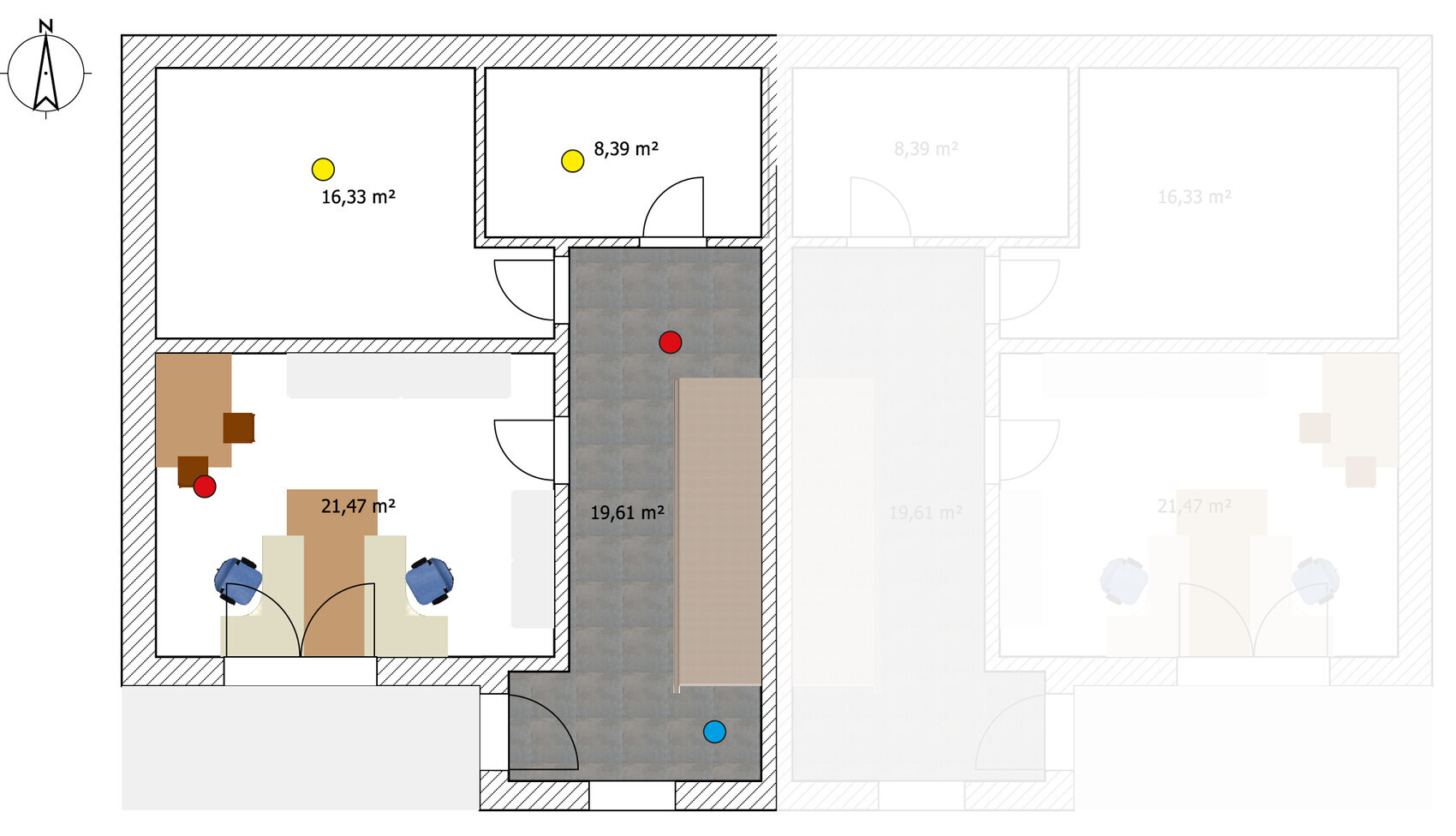
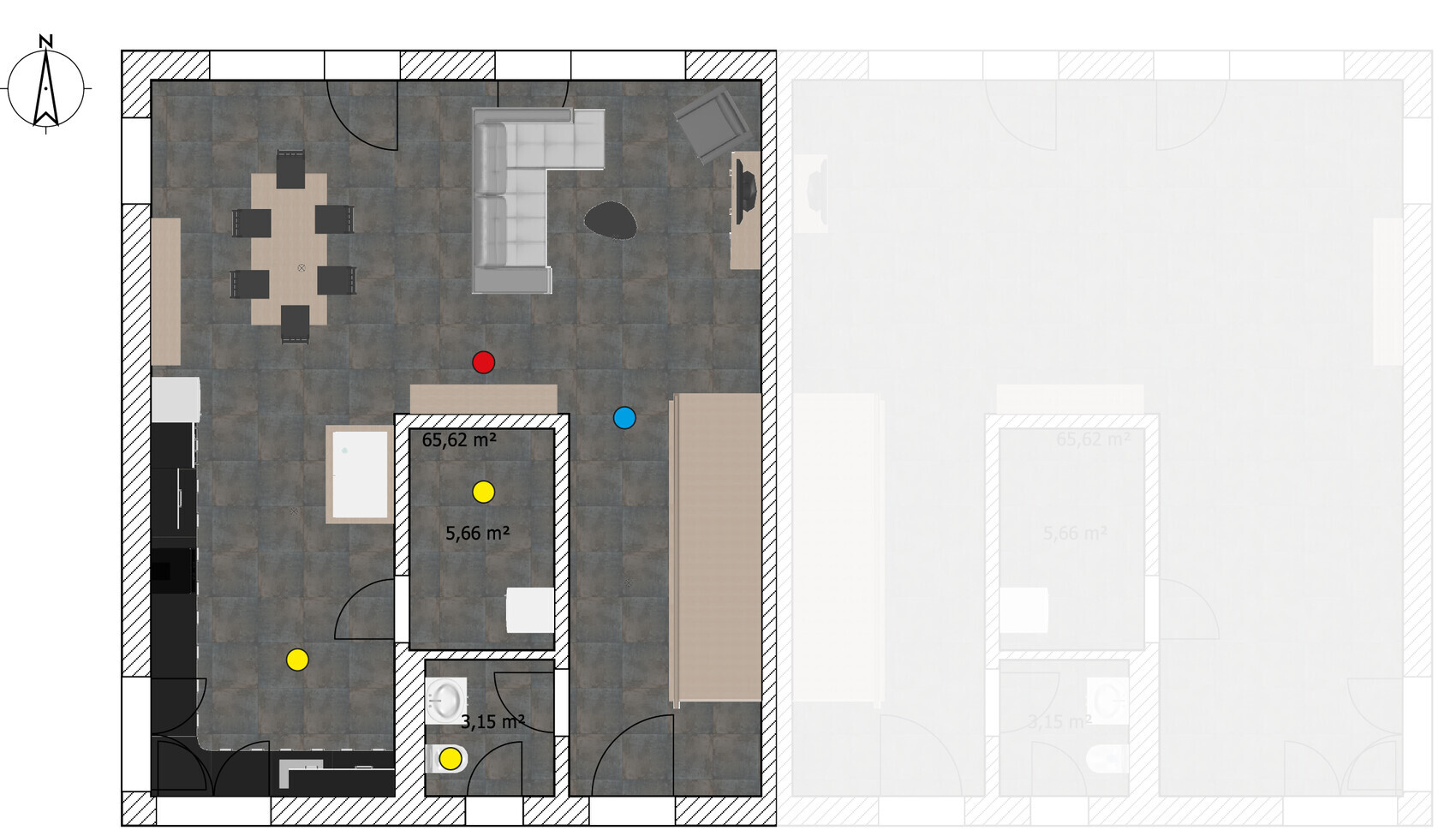
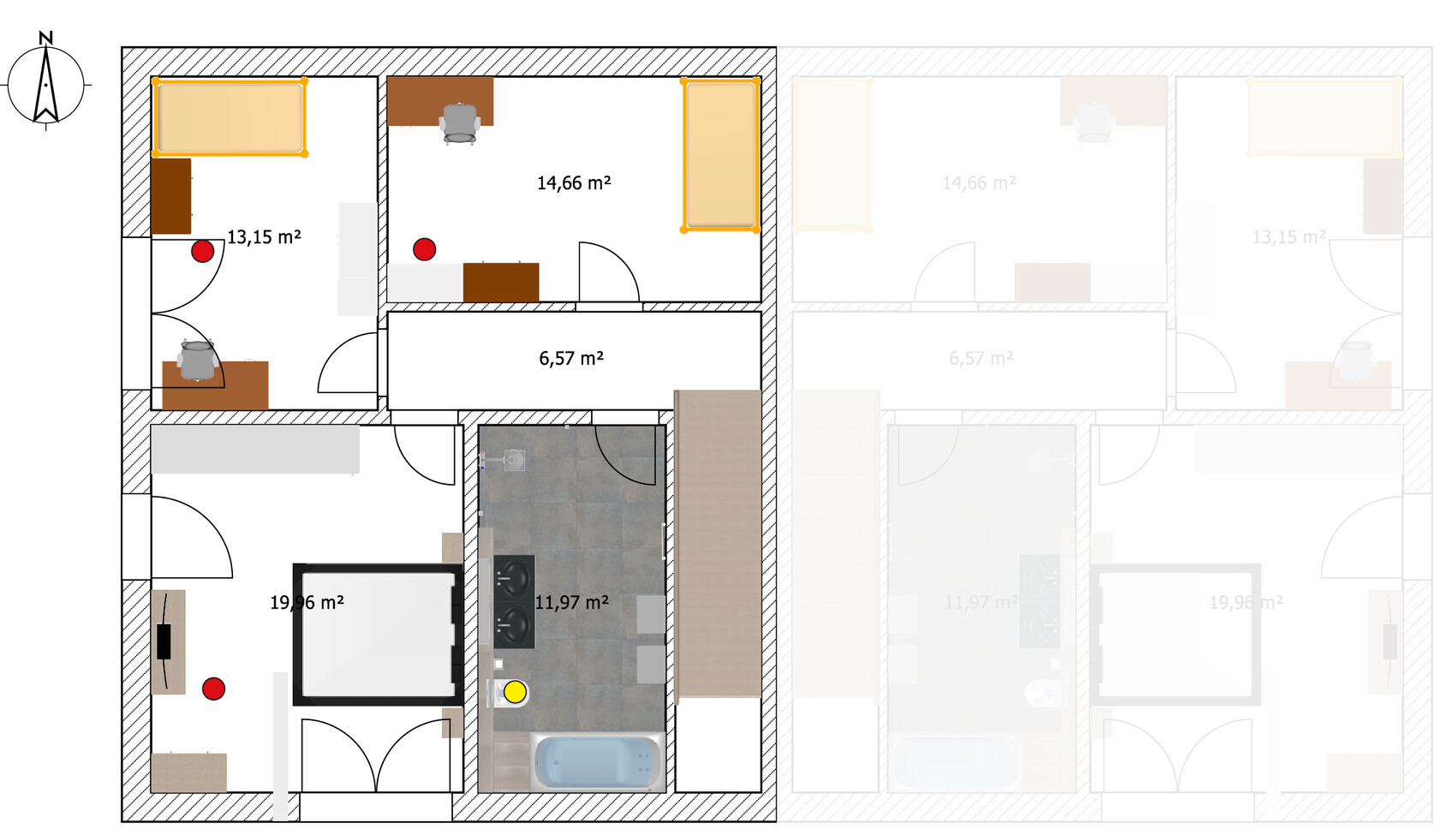
Yellow dots = Extract air
Red dots = Supply air
Blue dots = Alternative supply air (as a possible alternative position for the same room instead of the red dot)
Ground floor:
Upper floor:
Attic floor:
Thank you very much in advance!
Markus
The planning for our semi-detached house is becoming more concrete. Now we need to determine the positions of the outlets for the central mechanical ventilation system with heat recovery.
I have read quite a bit on the topic and tried to consider the usual best practices. However, it is quite overwhelming at first and leaves some uncertainty. That’s why I would appreciate it if you could take a look based on your experience.
In general, everything is initially planned as ceiling outlets. However, the concept of displacement ventilation also makes sense to me, so wall outlets near the floor for the supply air could also be considered. What are your thoughts on this?
Yellow dots = Extract air
Red dots = Supply air
Blue dots = Alternative supply air (as a possible alternative position for the same room instead of the red dot)
Ground floor:
- The additional table indicated in the office will ultimately not be placed there.
- I am unsure whether the supply air in the hallway should preferably be near the front door or not.
Upper floor:
- The alternative supply air position is meant to better cover the hallway area. Or is this not relevant, and is it more important that air is supplied directly into the dining/living area?
- Would it be better to have two outlets in the large living and dining area to minimize noise?
Attic floor:
- The children’s rooms are a bit of a headache because it is very difficult to predict exactly how the furniture will be arranged at this stage.
- In the slightly larger children’s room, I’m also not certain about the door position yet. It might be placed all the way to the left (opposite the bedroom door). In that case, the supply air would need to be located elsewhere.
Thank you very much in advance!
Markus
The general contractor contact has now put me in touch with the manufacturer and provided the detailed planning documents so far. I can now clarify all the technical questions directly with Vallox. The good thing is that today’s conversation was honest and transparent. He said he himself doesn’t have the detailed technical expertise needed to answer my questions. I kind of expected that I would have to get deeply involved myself, since it was already clear before signing the contract that the general contractor rarely installs systems like this.
The question now is how to convince the contact person on the manufacturer’s side that I would like to separate supply and exhaust air. They seem confident that their combined grille works and meets all standards. We’ll see… I will keep you updated.
The question now is how to convince the contact person on the manufacturer’s side that I would like to separate supply and exhaust air. They seem confident that their combined grille works and meets all standards. We’ll see… I will keep you updated.
What should the air exchange rate be in practice? There is this often-cited minimum value of 0.5 air changes per hour for living spaces according to standards. For an office with two people, this would not be sufficient, and the same applies to a combined living/dining area.
What values have you used to design your system or have you experienced in practice (for a good result)?
What values have you used to design your system or have you experienced in practice (for a good result)?

mwinkelm schrieb:
You seem confident that your combined grille works and meets all standards.And you are right. It works.

1 on 1! :p Are there any other opinions on this topic? 😉 I am still interested in real-world experiences from other homeowners.
Seriously though: For a layperson, it is really difficult to decide which option is best and which one will bring the most satisfaction in the end. You can probably overthink it as well.
Seriously though: For a layperson, it is really difficult to decide which option is best and which one will bring the most satisfaction in the end. You can probably overthink it as well.
I have now spoken with a technician from Vallox.
He generally recommends, if possible, locating the outdoor air intake on the north side of the house (due to the temperatures in summer). However, since our terrace is on that side, it’s better to place it on the west side to avoid odors from the grill or occasional smokers entering the house too easily. He also confirmed, as expected, that the combined cover panel works.
Regarding the system sizing and the individual airflow volumes, there have been significant changes compared to the initial calculation. If the system were sized according to the DIN standard, the 270 MV unit would be sufficient, even though it would then typically operate at 60% capacity. Taking all requirements into account (clothes drying, number of people in the home office, etc.), we decided on the next larger model, the 350 MV.
Additionally, the supply air intake from the entrance area (overflow zone) was removed, and the capacity there was increased in the office (sized for 2 people). We designed the system together using specific individual values rather than default values per vent. In the living room, there will now be 2 vents, each connected with its own duct to ensure better air distribution and to avoid overloading a single vent.
For those still in the planning phase, here are my humble recommendations:
He generally recommends, if possible, locating the outdoor air intake on the north side of the house (due to the temperatures in summer). However, since our terrace is on that side, it’s better to place it on the west side to avoid odors from the grill or occasional smokers entering the house too easily. He also confirmed, as expected, that the combined cover panel works.
Regarding the system sizing and the individual airflow volumes, there have been significant changes compared to the initial calculation. If the system were sized according to the DIN standard, the 270 MV unit would be sufficient, even though it would then typically operate at 60% capacity. Taking all requirements into account (clothes drying, number of people in the home office, etc.), we decided on the next larger model, the 350 MV.
Additionally, the supply air intake from the entrance area (overflow zone) was removed, and the capacity there was increased in the office (sized for 2 people). We designed the system together using specific individual values rather than default values per vent. In the living room, there will now be 2 vents, each connected with its own duct to ensure better air distribution and to avoid overloading a single vent.
For those still in the planning phase, here are my humble recommendations:
- Decide for or against a central controlled ventilation system before the first floor plan draft is made—this allows you to allocate space for ducts intelligently and unobtrusively in the layout.
- Get informed about the basic technical aspects of such a controlled ventilation system beforehand, so you can critically review the plans and avoid simply accepting them blindly.
- Oversize the system slightly beyond what the DIN standard requires so it can run more quietly. However, it should not be too large for economic reasons, as this could mean unnecessarily higher electricity consumption.
- Insist on an individual design based on the planned use of each room.
Similar topics