
ᐅ Controlled ventilation system in a bungalow: Is it necessary to lower the ceiling?
Created on: 5 Jul 2019 18:51
R
Reluctance
Hello everyone,
We are currently finalizing the building permit / planning permission application for our construction project (a bungalow with 135 sqm (1453 sq ft)). We would like to have a ventilation system installed in our bungalow. In this context, our general contractor (GC) recently approached us and said that the ceiling would need to be lowered to install the ventilation system. This means we would have to increase the room height, and this must be taken into account in the building permit / planning application.
There are several issues with this whole process:
So: Has anyone installed a ventilation system in a bungalow without lowering the ceiling?
We are currently finalizing the building permit / planning permission application for our construction project (a bungalow with 135 sqm (1453 sq ft)). We would like to have a ventilation system installed in our bungalow. In this context, our general contractor (GC) recently approached us and said that the ceiling would need to be lowered to install the ventilation system. This means we would have to increase the room height, and this must be taken into account in the building permit / planning application.
There are several issues with this whole process:
- The GC’s subcontractor installs only Zewotherm systems; the cost estimate is 18,000 euros. On top of that, there would be additional costs for increasing the room height. From what I read here, in other forums, and hear from acquaintances, the cost for a ventilation system (e.g., Zehnder or Vaillant) including installation is more around 12k. (We originally thought we would have to build a one-and-a-half-story house; in that case, the Zewotherm system was even offered to us for 23k.)
- We do not want a Zewotherm system but prefer Zehnder (Vaillant would also be possible) – so now we have to find a suitable contractor ourselves who installs Zehnder systems.
- We don’t understand why the ceiling must be lowered to install a ventilation system in a bungalow. Has anyone had experience with this? Is it always necessary to lower the ceiling? What if the system is installed in the floor? Would the floor then need to be raised? I’m afraid our GC simply doesn’t really know much about ventilation systems... but maybe I’m wrong.
So: Has anyone installed a ventilation system in a bungalow without lowering the ceiling?
B
boxandroof13 Jul 2019 18:27Mycraft schrieb:
Insulate the roof and install all the piping and the system in the atticWe did the same, and it works. However, I would still recommend installing as much as possible within the heated area. In our mechanical ventilation with heat recovery system, we monitored temperatures at four different points and clearly saw how the heat recovery efficiency drops significantly in the deep winter because the ventilation unit, manifold, and silencer are located in the unheated but insulated area. Adding insulation afterward is tricky. Honestly, without the measurements, I wouldn’t have noticed.We are also building a bungalow with a controlled ventilation system (Zehnder ComfoAir).
In our case, the ducts for the supply air will be installed below the screed.
The pipes for the exhaust air (bathroom, kitchen, toilet) will probably have to be visibly routed along the ceiling and then covered with drywall.
I’m not very happy with this solution either and don’t understand why these cannot be installed invisibly within the ceiling.
In our case, the ducts for the supply air will be installed below the screed.
The pipes for the exhaust air (bathroom, kitchen, toilet) will probably have to be visibly routed along the ceiling and then covered with drywall.
I’m not very happy with this solution either and don’t understand why these cannot be installed invisibly within the ceiling.

M
Mottenhausen5 Aug 2019 14:42The suspended ceiling also has its advantages. For example, using the flat oval ducts from the Viessmann controlled ventilation system adds roughly 5–7cm (2–3 inches) in height for routing the pipes under the ceiling.
Advantages I see: The ducts don’t run through the unheated attic space (even if insulated, it’s still colder than the living area).
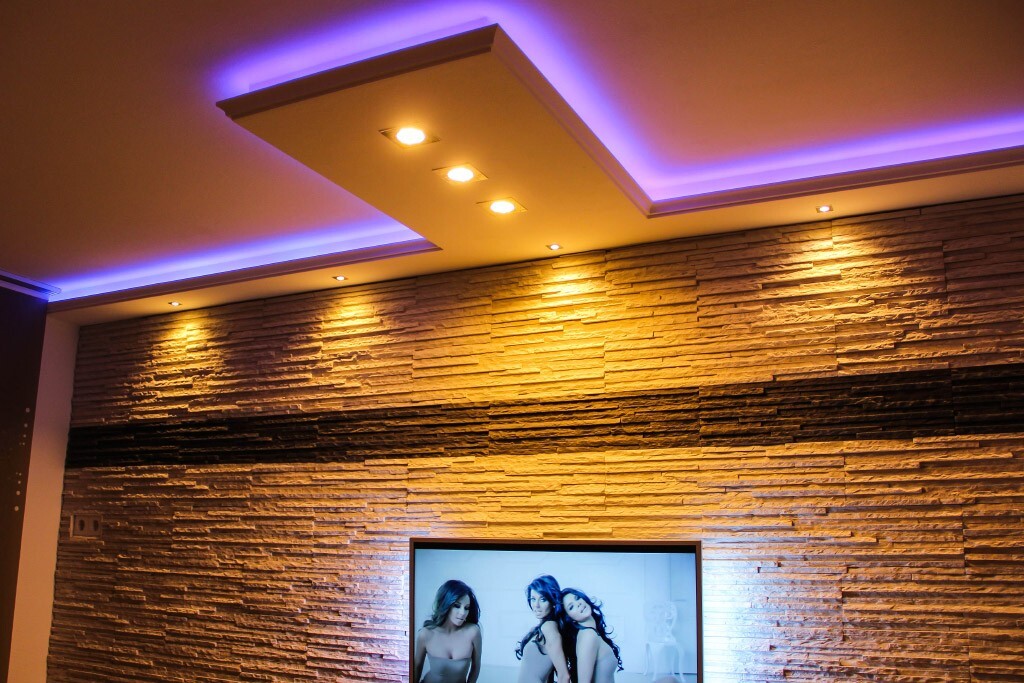
You can also choose to suspend the ceiling only around the edges, creating clean surfaces with recessed spotlights and LED backlighting on the ceiling. Attached is a random Google image of such a ceiling, which practically invites moving the ventilation system into the soffits:
Advantages I see: The ducts don’t run through the unheated attic space (even if insulated, it’s still colder than the living area).
You can also choose to suspend the ceiling only around the edges, creating clean surfaces with recessed spotlights and LED backlighting on the ceiling. Attached is a random Google image of such a ceiling, which practically invites moving the ventilation system into the soffits:
How has the original poster decided now?
Lowering the ceiling probably doesn't make much difference. See the scope of work description for a Pluggit Avent C 200.
Due to the required minimum clear suspension height of the drywall cladding for installing the duct system, the clear room height in all rooms (except the utility room) is reduced by 3 to 4 cm (1 to 1.5 inches).
In the utility room on the ground floor, unlike § 12 in the building and scope of work description "Insulation and drywall cladding," an OSB board is installed directly below the vapor barrier.
On this substructure, the air duct system including distribution boxes and silencers is mounted and covered by a suspended ceiling structure with double-layer drywall cladding.
The clear room height in the utility room is reduced by about 30 cm (12 inches).
However, I don’t understand why the entire utility room is being lowered. The mechanical ventilation system doesn’t need to be completely concealed, does it?
Lowering the ceiling probably doesn't make much difference. See the scope of work description for a Pluggit Avent C 200.
Due to the required minimum clear suspension height of the drywall cladding for installing the duct system, the clear room height in all rooms (except the utility room) is reduced by 3 to 4 cm (1 to 1.5 inches).
In the utility room on the ground floor, unlike § 12 in the building and scope of work description "Insulation and drywall cladding," an OSB board is installed directly below the vapor barrier.
On this substructure, the air duct system including distribution boxes and silencers is mounted and covered by a suspended ceiling structure with double-layer drywall cladding.
The clear room height in the utility room is reduced by about 30 cm (12 inches).
However, I don’t understand why the entire utility room is being lowered. The mechanical ventilation system doesn’t need to be completely concealed, does it?
Similar topics