
ᐅ Mechanical ventilation with heat recovery + earth tube ventilation + exhaust hood ventilation and independent chimney
Created on: 11 Feb 2021 23:10
S
Stephan—
Hello professionals,
I would like to gather some different opinions on the following project (see title). I have researched various forums and websites on the topics mentioned and here is the solution I am considering.
Mechanical ventilation with heat recovery (DIY installation of flexible ducts, devices, distributors, etc., excluding commissioning and balancing)
- Flexible round ducts, 75mm (3 inches) outer diameter with 61 or 63mm (2.4 or 2.5 inches) inner diameter
- For the ground floor on a raw concrete slab within insulation beneath the underfloor heating
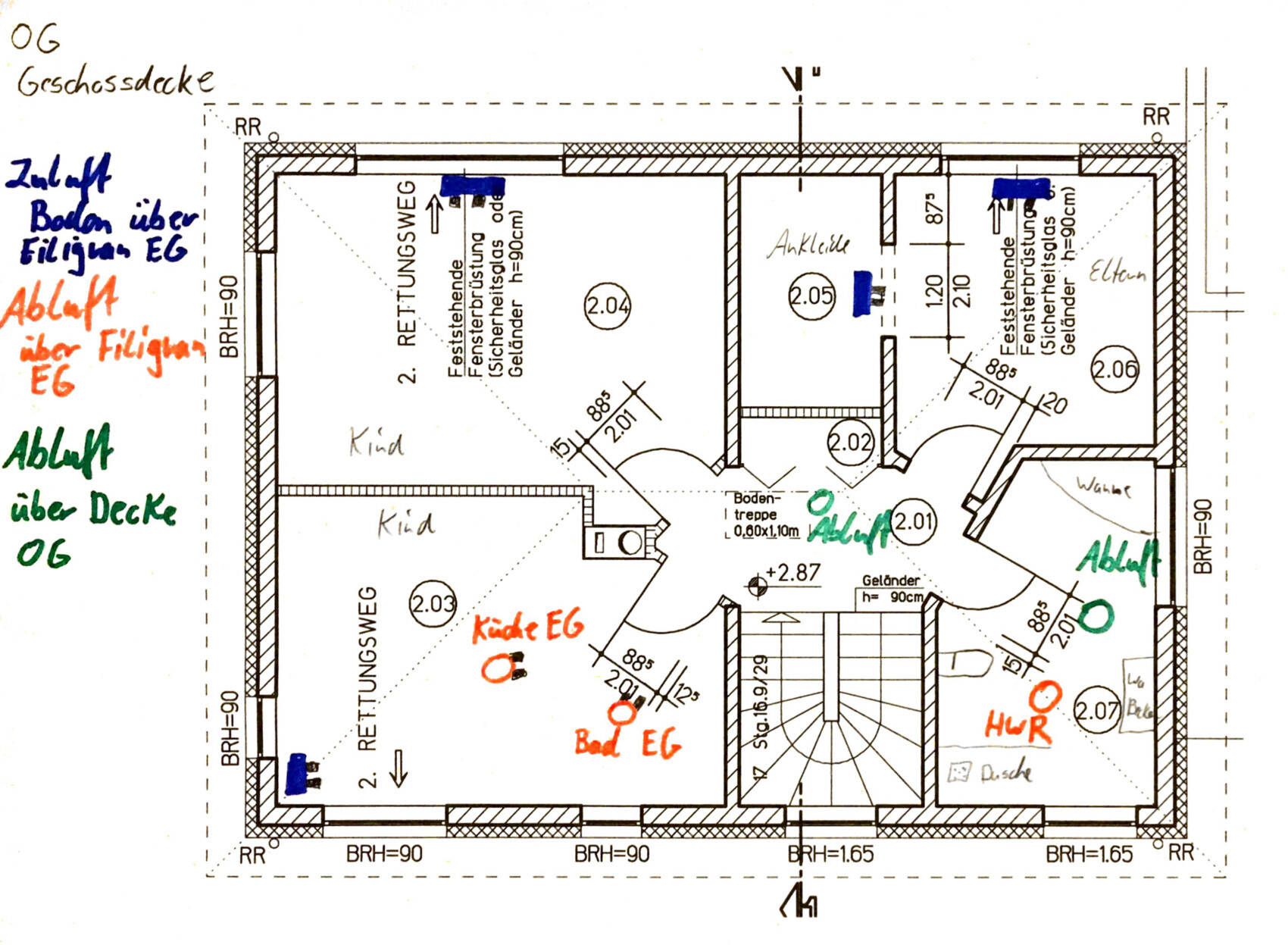
- For the upper floor above the precast ceiling, to be embedded in cast-in-place concrete (including valves) and approved by the structural engineer
- Exhaust air from bathroom and hallway on the upper floor routed through the attic (cold roof)
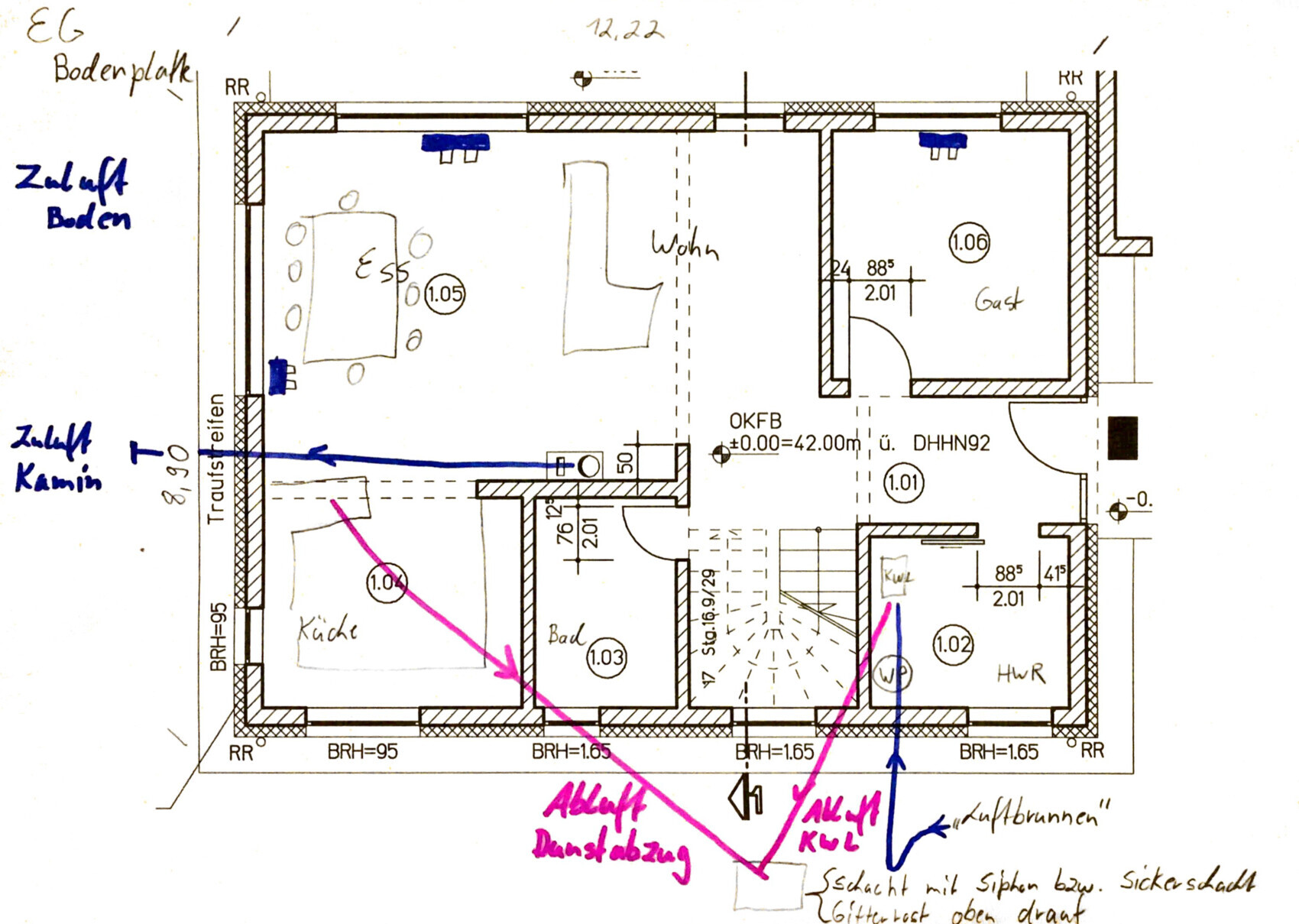
- All supply air valves via floor inlets (including 2 connections for flexible ducts)
- All exhaust air valves via ceiling vents 125mm (5 inches) (including 2 connections for flexible ducts)
Supply air for the mechanical ventilation with heat recovery through a 200mm (8 inches) duct passing through the foundation slab from outside via an earth air tunnel (just search online for inspiration)
Exhaust air 200mm (8 inches) duct through the foundation slab to the outside into a shaft (with slope for condensate drainage and permeable) and a ground-level grid cover
Provision for exhaust fumes below the foundation slab using a 150mm (6 inches) sewer pipe, also to be vented into the above-mentioned shaft
Chimney supplied with fresh air via a 200mm (8 inches) sewer pipe under the foundation slab, with a condensate drainage connected to the wastewater system
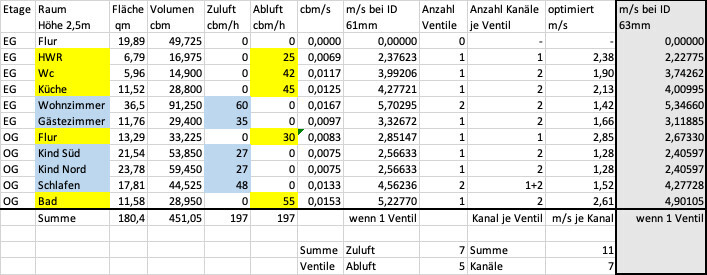
I have calculated the mechanical ventilation system using various tools (Helios, Wolf, Selfio (for calculation), Vallox, Maico) and come up with the following idea (pressure loss not taken into account):
Maximum air velocity in quiet rooms such as bedrooms about 2m/s (6.6 ft/s), in other rooms up to 3m/s (9.8 ft/s)
Motto: better to install one more duct than to have "noise problems" later
PS:
Proper supply air needs to be provided if mechanical ventilation is stopped when the exhaust hood is on.
I am considering installing a Maico system and saving energy with enthalpy and earth or brine heat exchangers via the earth air tunnel.
Looking forward to lively feedback, whether positive or negative.
Good idea or have I lost the plot?! 🙂
I would like to gather some different opinions on the following project (see title). I have researched various forums and websites on the topics mentioned and here is the solution I am considering.
Mechanical ventilation with heat recovery (DIY installation of flexible ducts, devices, distributors, etc., excluding commissioning and balancing)
- Flexible round ducts, 75mm (3 inches) outer diameter with 61 or 63mm (2.4 or 2.5 inches) inner diameter
- For the ground floor on a raw concrete slab within insulation beneath the underfloor heating
- For the upper floor above the precast ceiling, to be embedded in cast-in-place concrete (including valves) and approved by the structural engineer
- Exhaust air from bathroom and hallway on the upper floor routed through the attic (cold roof)
- All supply air valves via floor inlets (including 2 connections for flexible ducts)
- All exhaust air valves via ceiling vents 125mm (5 inches) (including 2 connections for flexible ducts)
Supply air for the mechanical ventilation with heat recovery through a 200mm (8 inches) duct passing through the foundation slab from outside via an earth air tunnel (just search online for inspiration)
Exhaust air 200mm (8 inches) duct through the foundation slab to the outside into a shaft (with slope for condensate drainage and permeable) and a ground-level grid cover
Provision for exhaust fumes below the foundation slab using a 150mm (6 inches) sewer pipe, also to be vented into the above-mentioned shaft
Chimney supplied with fresh air via a 200mm (8 inches) sewer pipe under the foundation slab, with a condensate drainage connected to the wastewater system
I have calculated the mechanical ventilation system using various tools (Helios, Wolf, Selfio (for calculation), Vallox, Maico) and come up with the following idea (pressure loss not taken into account):
Maximum air velocity in quiet rooms such as bedrooms about 2m/s (6.6 ft/s), in other rooms up to 3m/s (9.8 ft/s)
Motto: better to install one more duct than to have "noise problems" later
PS:
Proper supply air needs to be provided if mechanical ventilation is stopped when the exhaust hood is on.
I am considering installing a Maico system and saving energy with enthalpy and earth or brine heat exchangers via the earth air tunnel.
Looking forward to lively feedback, whether positive or negative.
Good idea or have I lost the plot?! 🙂

Yes, discuss this with him. I assume he simplified it, and it should be 100-110mm (4-4.3 inches) of thermal insulation (thermal conductivity 0.035 W/mK or better) and 30mm (1.2 inches) of tack system insulation (thermal conductivity 0.045 W/mK).
Make sure to specifically address the issue of missing insulation beneath the pipes and the potential for condensation.
Make sure to specifically address the issue of missing insulation beneath the pipes and the potential for condensation.
This will become a topic of discussion, especially since the energy consultant has declared KfW55 as the minimum standard.
- 10cm (4 inches) insulation with a thermal conductivity of 0.035 W/(m·K) + 4cm (1.5 inches) impact sound insulation with a thermal conductivity of 0.040 W/(m·K) + 25cm (10 inches) reinforced concrete slab
T
T_im_Norden12 Feb 2021 15:33Ceiling because then you can freely position the valves and will never block them with anything.
If placed in the floor slab, you weaken the insulation at a point where there is continuous ground contact.
In the precast concrete ceiling, only the insulation towards the rooms below is reduced.
If placed in the floor slab, you weaken the insulation at a point where there is continuous ground contact.
In the precast concrete ceiling, only the insulation towards the rooms below is reduced.
Similar topics