
We have a mold problem on one wall in our temporary accommodation.
The issue has been ongoing for some time. Last autumn, we tried treating it with a mold removal kit that I had good experience with before, but unfortunately, it didn’t achieve the desired result. The likely cause is that the wall keeps getting wet at that spot.
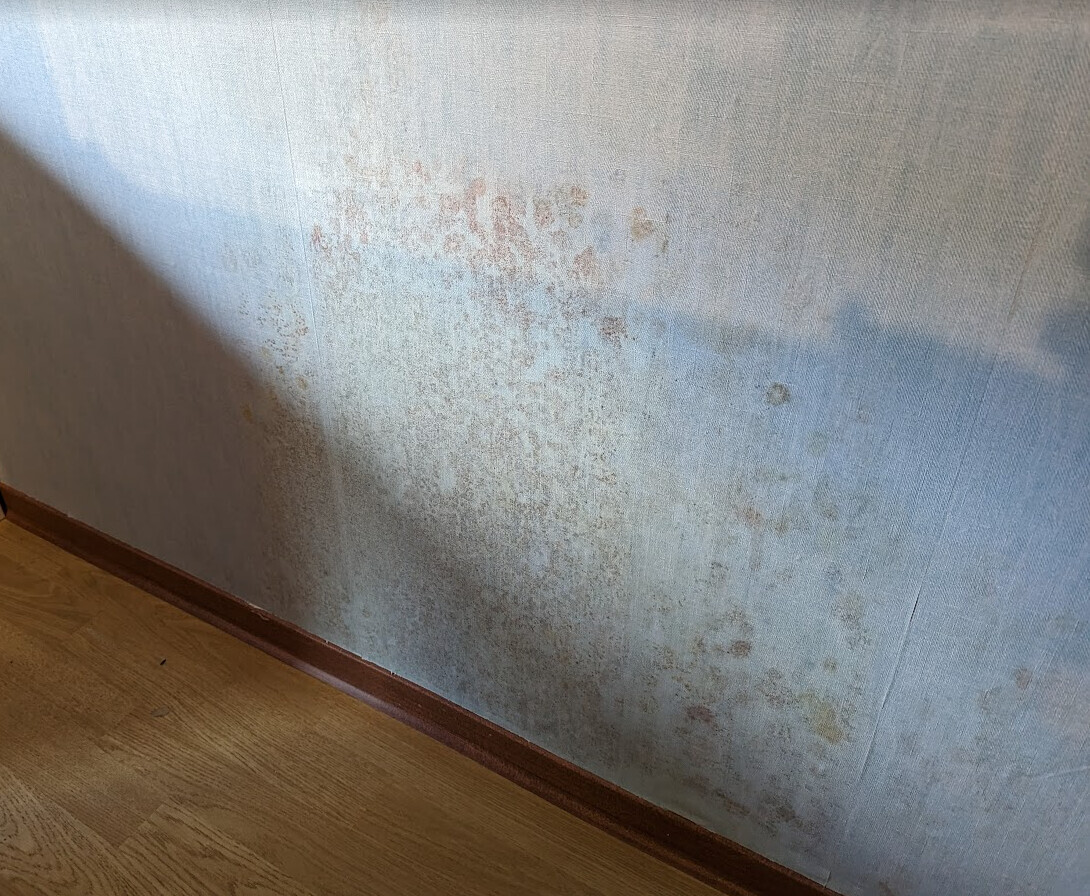
The stains are limited to about 1m² (11 sq ft) of wall surface. Within this area, the problem is steadily getting worse, but it is not spreading beyond that. On the opposite side of the wall is the shower in the bathroom. We suspect that something is leaking there, which causes the wall to become damp and mold to develop. For context, the wall was freshly wallpapered in July 2022. When we moved in, there was no visible issue. However, we are the first ones to really use this shower, since my uncle who previously lived here rarely used it. 🙄
To my great frustration, the affected wall is in our son’s nursery. So far, we had controlled the problem by placing a changing table in front of the wall. The changing pad on top ensured he couldn’t reach behind it, and the table was always kept about 20cm (8 inches) away from the wall.
Now we have to move the changing pad because baby number two is on the way. We’re wondering what to do with the wall. We have to stay here for about another 3 to 4 months until we can move out.
If I remove the changing pad, the table would be close to the moldy wall. That wouldn’t be too bad; I would probably just get rid of the table anyway rather than risk bringing mold into the new house over a $100 piece of furniture. That thought makes me shudder. :/
Still, I’m worried that the mold might get worse if a piece of furniture is placed directly against the wall. It would be especially bad if the mold started spreading sideways.
In the bathroom, we temporarily fixed black mold spots on the plasterboard ceiling by covering them with vinyl foil. It’s not pretty, but it at least provides a barrier between us and whatever is living in the ceiling. The advantage there is that we have shut off that bathroom (which was causing the ceiling to get wet). So while the ceiling is stained, it is now dry.
We can’t do the same for the children’s room wall. The shower next door is the only one in the house still in use.
Would taping plastic foil over the affected area work if the wall keeps getting wet? Or would it be better to push the table close to the wall without any foil?
Does anyone have a completely different, clever idea on how to solve this?
The issue has been ongoing for some time. Last autumn, we tried treating it with a mold removal kit that I had good experience with before, but unfortunately, it didn’t achieve the desired result. The likely cause is that the wall keeps getting wet at that spot.
The stains are limited to about 1m² (11 sq ft) of wall surface. Within this area, the problem is steadily getting worse, but it is not spreading beyond that. On the opposite side of the wall is the shower in the bathroom. We suspect that something is leaking there, which causes the wall to become damp and mold to develop. For context, the wall was freshly wallpapered in July 2022. When we moved in, there was no visible issue. However, we are the first ones to really use this shower, since my uncle who previously lived here rarely used it. 🙄
To my great frustration, the affected wall is in our son’s nursery. So far, we had controlled the problem by placing a changing table in front of the wall. The changing pad on top ensured he couldn’t reach behind it, and the table was always kept about 20cm (8 inches) away from the wall.
Now we have to move the changing pad because baby number two is on the way. We’re wondering what to do with the wall. We have to stay here for about another 3 to 4 months until we can move out.
If I remove the changing pad, the table would be close to the moldy wall. That wouldn’t be too bad; I would probably just get rid of the table anyway rather than risk bringing mold into the new house over a $100 piece of furniture. That thought makes me shudder. :/
Still, I’m worried that the mold might get worse if a piece of furniture is placed directly against the wall. It would be especially bad if the mold started spreading sideways.
In the bathroom, we temporarily fixed black mold spots on the plasterboard ceiling by covering them with vinyl foil. It’s not pretty, but it at least provides a barrier between us and whatever is living in the ceiling. The advantage there is that we have shut off that bathroom (which was causing the ceiling to get wet). So while the ceiling is stained, it is now dry.
We can’t do the same for the children’s room wall. The shower next door is the only one in the house still in use.
Would taping plastic foil over the affected area work if the wall keeps getting wet? Or would it be better to push the table close to the wall without any foil?
Does anyone have a completely different, clever idea on how to solve this?

Schorsch_baut schrieb:
Why can’t your husband do that? My poor husband is currently doing absolutely everything, from fully taking care of our firstborn, to managing the household, and also earning money. Asking him to do that now—potentially just hours before the birth—would be a bit much. Besides, we don’t even have the materials or paint ready for it. I’ve been pretty useless for a few weeks now. Due to some pre-existing health issues, the last weeks of my pregnancy are mostly spent resting.
But once labor starts, the little one will stay with grandma for the time being, and after that, I think we can involve family to quickly fix the wall problem. That way, my husband won’t have to do it alone. After all, that’s one of the reasons we moved here—to finally have family nearby. 😉
I’m not taking this lightly; the kids already have a higher risk of allergies, as it runs in both sides of the family...
Nida35a schrieb:
Then technically, I wish you a good slide 🙄 Thanks, I wish the same for myself. I fought for two weeks against an induction because I was worried about a “bad slide,” though you never really know in advance.
Jurassic135 schrieb:
I wouldn’t even take the baby in there. We aren’t either; the baby sleeps in our room anyway. We’ll take care of the affected room as soon as possible. Otherwise, it’s really fine. If we hadn’t even moved the dresser, we wouldn’t have noticed anything. Everything else in that room—the corners, window reveals—is completely fine, with no spots at all. The room is also regularly aired and cleaned; the issue is really concentrated on the wall adjoining the shower.
And believe me—the last thing I ever wanted was to come home from the hospital with my newborn and then unlock the door to this temporary “fixer-upper.” But life is what happens while you’re making other plans. And apparently, you’re never more fertile than when you’re not even trying. 😀
When the sale of our old house was finalized and we knew we were moving, we decided we wanted a second child. So we deliberately “planned” for it, expecting that at my age it might take some time. Well, it took about two weeks. 😀
For quite a while, we even hoped the house would be finished before the baby arrived—but even with our relatively smooth construction progress, delays were inevitable. So now we’re just taking it as it comes. The little one will still take her first steps on the hardwood floor in the new living room. And we always have a great story to tell when we look back on the last year or two. =)
X
xMisterDx4 Mar 2023 12:14Schorsch_baut schrieb:
I strongly advise against that. My nephew is seven years old now and developed asthma and a severe allergy to mold spores as a baby after his parents missed a water damage issue and mold behind the bedroom wardrobe. Mold spores are not only toxic but also powerful allergens. I wouldn’t let any child sleep or play in a room with mold. It can even lead to fungal infections of the respiratory tract.
Remove the wallpaper and paint the walls with lime paint—real lime paint! Mold cannot grow on that. And don’t put anything against the wall! I don’t understand how parents can take that risk with their child. It’s widely known that it’s not harmless.
Also, mold removers are not exactly healthy when they are effective. I lived for 22 years in an apartment in a block built in the 1970s... flat roof, end unit, so almost only exterior walls... there was black mold in almost every room in a corner, it was impossible to keep up.
The roof was constantly leaking, the windows draughty, and so on.
I don’t have asthma or allergies, and neither does my brother, who lived there for 25 years. There may be very sensitive immune systems that can be harmed, but that is not the general rule... genetics play a major role in asthma and allergies.
What we see in the pictures is mold in an early stage. Remove the wallpaper, treat the wall with alcohol, and that’s fine.
By the way, excessive hygiene, especially in early years, can also lead to asthma and allergies. When everything a baby touches is disinfected and boiled twice beforehand... bacteria, viruses, mold spores are part of the environment, just like water and air to breathe. That’s why we have an immune system that has adapted over tens of thousands of years.
Also consider that a lot of this is hereditary. My partner and I generally have strong immune systems apart from allergies, and our first child inherited this as well. Compared to friends and acquaintances, our child rarely got sick. This changed for all of us during the pandemic. That makes sense, though. When you wear a mask in public for two years straight, your immune system misses out on regular “updates” from changing pathogens. After mask mandates were lifted more and more, all three of us seemed to catch infections “constantly,” especially when our little one started attending daycare again. We’re certainly not alone in this; there’s a lot of illness going around in daycare at the moment (there’s always a notice on the door).
Before COVID, I could honestly say, “I almost never get sick.” I’m confident that once the virus becomes endemic for a year or two, things will settle down and our immune systems will return to their usual strength.
Masks are an example of “too much hygiene,” even though they were necessary during the pandemic. I approach this similarly with children. With our first child, we even bought a sterilizer. For very young infants, you do need to be a bit careful—without going overboard. But as soon as the baby reached crawling age—which happens quickly—we completely stopped boiling everything. The baby crawls on the floor, and we have two cats walking around... so there’s no point sterilizing bottles anymore. 😀
Before COVID, I could honestly say, “I almost never get sick.” I’m confident that once the virus becomes endemic for a year or two, things will settle down and our immune systems will return to their usual strength.
Masks are an example of “too much hygiene,” even though they were necessary during the pandemic. I approach this similarly with children. With our first child, we even bought a sterilizer. For very young infants, you do need to be a bit careful—without going overboard. But as soon as the baby reached crawling age—which happens quickly—we completely stopped boiling everything. The baby crawls on the floor, and we have two cats walking around... so there’s no point sterilizing bottles anymore. 😀
S
Schorsch_baut5 Mar 2023 11:34xMisterDx schrieb:
I lived for 22 years in an apartment in a block of flats built in the 1970s... flat roof, end unit, so almost only exterior walls... there was black mold in a corner of almost every room, it was hard to keep up with removing it. The roof was constantly leaking, the windows were drafty, and so on.
I don’t have asthma or allergies, and neither does my brother, who lived there for 25 years. There may be very sensitive immune systems that are affected, but this is not the norm... genetic predisposition plays a very important role in asthma and allergies.Arguments based on personal historical anecdotes usually do not provide meaningful insights and only show that someone is not truly interested in the subject but rather wants to demonstrate how ridiculous something supposedly is. In the past, we used to sit unrestrained in the backseat as children and used the parcel shelf (rear deck) as a play area. Nobody would do that today either. Instead of dismissing such risks out of ignorance as trivial or laughable, it is better to consult reliable sources to understand what mold can trigger. For example, a brief article is available from pediatricians online under the title “Mold in Living Spaces Increases the Risk of Asthma for Children.” ateliersiegel5 Mar 2023 15:03
It may have been said already, but I want to emphasize from personal experience:
Mold should not be underestimated!
Panic doesn’t help, but one possible consequence of mold exposure is asthma. Not something to take lightly and apparently lifelong. 🙄
Mold should not be underestimated!
Panic doesn’t help, but one possible consequence of mold exposure is asthma. Not something to take lightly and apparently lifelong. 🙄

Unfortunately, we have also had experience with mold.
We had a family member who was seriously ill with a lung condition, and the doctors suspected mold in the house. Since the person involved strongly denied it, her daughter conducted an indoor air mold spore test, which showed high levels on every indicator.
In our rental apartment, mold once appeared behind the wardrobe. When we moved the wardrobe aside, the wall was a terrible sight. At the time, our daughter was just a few months old, so out of concern, we also did an indoor air spore test. The lab reported a "non-health-threatening amount." Apparently, you can be lucky if the mold is still relatively "fresh."
We then treated the wall together with the landlord and repainted it. Both the treatment and the paint claimed effectiveness for about 4 years. This turned out to be accurate. Four years after moving in, we had mold appear for the first time, and now, after another 4 years, unfortunately it has returned.
Long story short: I wouldn’t feel comfortable with a small child either. I would probably remove the wallpaper, treat everything with alcohol, and, just to be sure, have a spore test done 🙂
We had a family member who was seriously ill with a lung condition, and the doctors suspected mold in the house. Since the person involved strongly denied it, her daughter conducted an indoor air mold spore test, which showed high levels on every indicator.
In our rental apartment, mold once appeared behind the wardrobe. When we moved the wardrobe aside, the wall was a terrible sight. At the time, our daughter was just a few months old, so out of concern, we also did an indoor air spore test. The lab reported a "non-health-threatening amount." Apparently, you can be lucky if the mold is still relatively "fresh."
We then treated the wall together with the landlord and repainted it. Both the treatment and the paint claimed effectiveness for about 4 years. This turned out to be accurate. Four years after moving in, we had mold appear for the first time, and now, after another 4 years, unfortunately it has returned.
Long story short: I wouldn’t feel comfortable with a small child either. I would probably remove the wallpaper, treat everything with alcohol, and, just to be sure, have a spore test done 🙂
Similar topics