
ᐅ Construction Road for a Rear Parcel – Should Utilities Be Installed in Advance?
Created on: 2 Feb 2021 21:36
F
Fapone88
Hello, I have a question regarding the construction access road and another about the utility installation.
Since a building is planned on a rear lot I own, I need to create the access road on my right of way (3m wide). During the construction phase, the owner of the front lot kindly provides me with 4m, so I can build the access road for construction vehicles up to 40 tons on this.
Is the following recycled concrete layer with a thickness of 30cm (12 inches) sufficient? RC base layer 0-45, B2 (150 MN/m²)
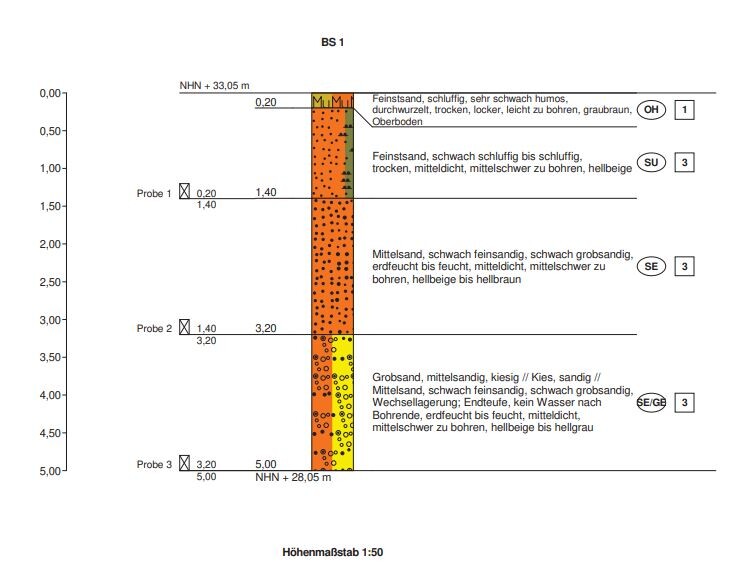
I am attaching an excerpt from the soil report. Of course, I would remove the 30cm (12 inches) of topsoil first. The question is whether the existing sand is adequate as a sub-base under the recycled concrete?
Another question:
I assume it makes the most sense to install the pipes or conduits (potable water, wastewater, electricity, telecom, and 1-2 empty conduits or corrugated pipes for private use) in the ground before building the access road, right? That way, I can use the access road later as the base for my permanent driveway.
I also need to install a wastewater manhole and a chamber for the water meter.
Would it be better to install these two chambers only after the heavy vehicles have driven over the access road, or could they be installed at the same time? Installing them now would mean only digging up the driveway locally where the chambers are located later, instead of reopening the entire access road for utility installation.
Or is this generally not recommended?
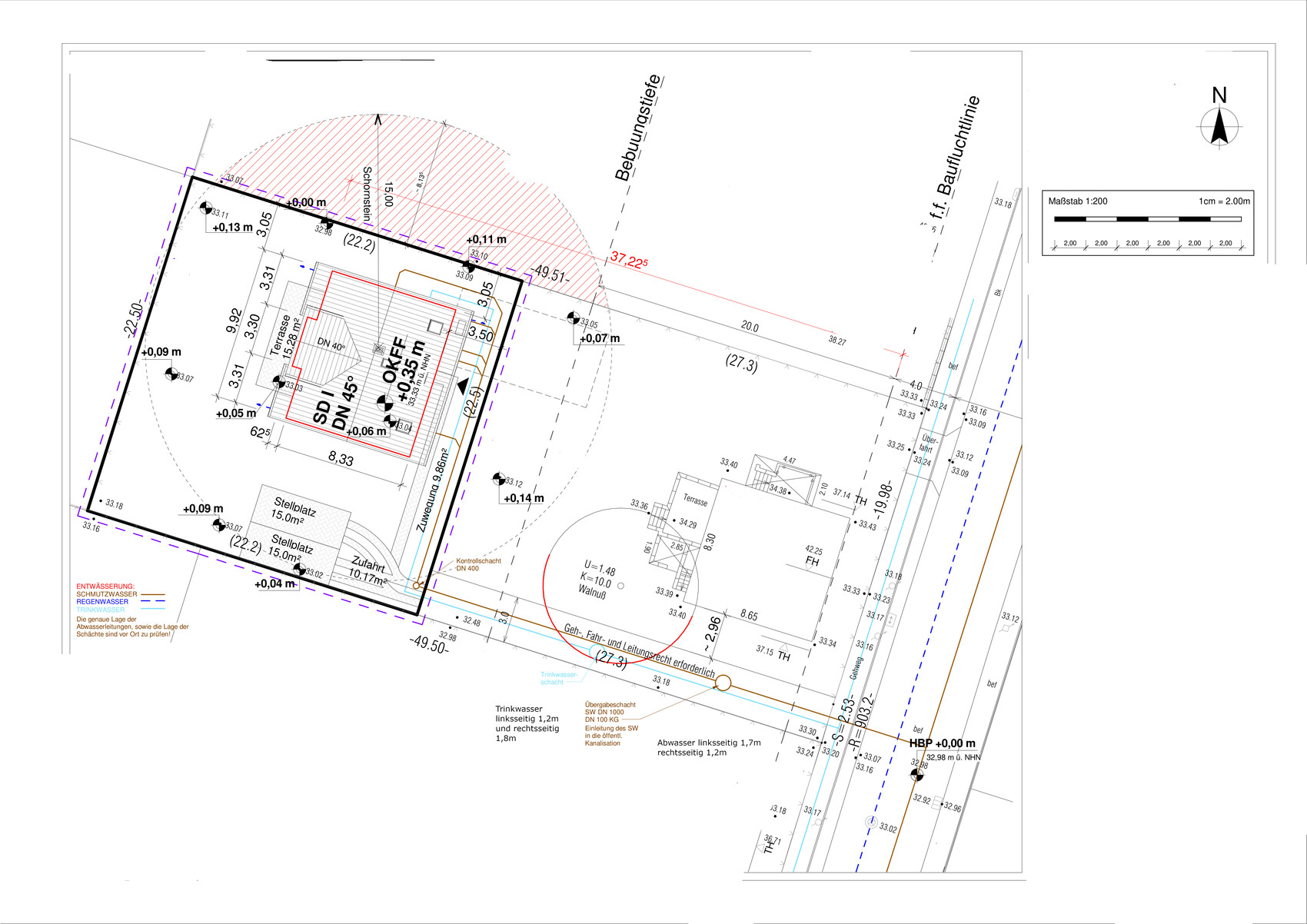
The proposed pipe routes are marked on the attached site plan. They are planned so that they do not run directly under the wheel tracks.
Where would you place the electricity and telecom lines?
For the potable water and water meter chamber, I would use a telescopic chamber from EWE or Plasson.
Are there similar products for wastewater, or are large concrete chambers typically used for this?
The wastewater manhole should be as close as possible to the street, about 1.5m (5 feet) from the road edge.
The water chamber’s position is flexible since I can lay empty conduits for the connection there.
Can I use the access road with 30cm (12 inches) thickness as a base later without problems, or would it be worn down too much? It’s clear that I will have to open the sides later to set the curbs. Especially since I will have to reduce the width back from 4m to 3m for the right of way.
Since I do not yet know the exact final elevation of my driveway, I would initially leave the access road about 10cm (4 inches) below the road level so that I can later raise it with gravel and paving to the same level. If necessary, I could add more recycled concrete fill later and end up with, for example, 33-34cm (13-13.5 inches) of base layer instead of 30cm (12 inches), right?
I think this is better than finishing the road and then having to remove material later, because removing would leave only 20-25cm (8-10 inches) of base layer, which would be too little, correct?
Also, I can easily adjust the chambers’ heights by a few centimeters later to match the final paving level, either shortening or extending them, right?
Thank you very much.

Since a building is planned on a rear lot I own, I need to create the access road on my right of way (3m wide). During the construction phase, the owner of the front lot kindly provides me with 4m, so I can build the access road for construction vehicles up to 40 tons on this.
Is the following recycled concrete layer with a thickness of 30cm (12 inches) sufficient? RC base layer 0-45, B2 (150 MN/m²)
I am attaching an excerpt from the soil report. Of course, I would remove the 30cm (12 inches) of topsoil first. The question is whether the existing sand is adequate as a sub-base under the recycled concrete?
Another question:
I assume it makes the most sense to install the pipes or conduits (potable water, wastewater, electricity, telecom, and 1-2 empty conduits or corrugated pipes for private use) in the ground before building the access road, right? That way, I can use the access road later as the base for my permanent driveway.
I also need to install a wastewater manhole and a chamber for the water meter.
Would it be better to install these two chambers only after the heavy vehicles have driven over the access road, or could they be installed at the same time? Installing them now would mean only digging up the driveway locally where the chambers are located later, instead of reopening the entire access road for utility installation.
Or is this generally not recommended?
The proposed pipe routes are marked on the attached site plan. They are planned so that they do not run directly under the wheel tracks.
Where would you place the electricity and telecom lines?
For the potable water and water meter chamber, I would use a telescopic chamber from EWE or Plasson.
Are there similar products for wastewater, or are large concrete chambers typically used for this?
The wastewater manhole should be as close as possible to the street, about 1.5m (5 feet) from the road edge.
The water chamber’s position is flexible since I can lay empty conduits for the connection there.
Can I use the access road with 30cm (12 inches) thickness as a base later without problems, or would it be worn down too much? It’s clear that I will have to open the sides later to set the curbs. Especially since I will have to reduce the width back from 4m to 3m for the right of way.
Since I do not yet know the exact final elevation of my driveway, I would initially leave the access road about 10cm (4 inches) below the road level so that I can later raise it with gravel and paving to the same level. If necessary, I could add more recycled concrete fill later and end up with, for example, 33-34cm (13-13.5 inches) of base layer instead of 30cm (12 inches), right?
I think this is better than finishing the road and then having to remove material later, because removing would leave only 20-25cm (8-10 inches) of base layer, which would be too little, correct?
Also, I can easily adjust the chambers’ heights by a few centimeters later to match the final paving level, either shortening or extending them, right?
Thank you very much.
All these pipes were installed more or less staggered on top of each other in the 50cm (20 inches) wide trench?
You have potable water, wastewater, 380V electrical supply, and telephone lines.
And you also installed a conduit for data cables and electrical supply for your own use?
Are the 220V cables for the pathway lighting installed inside the conduit or buried directly in the ground?
Had you already installed the sewage inspection chamber? Just at a deeper level? And then construction vehicles drove over it and afterwards you raised it to the paving level?
You have potable water, wastewater, 380V electrical supply, and telephone lines.
And you also installed a conduit for data cables and electrical supply for your own use?
Are the 220V cables for the pathway lighting installed inside the conduit or buried directly in the ground?
Had you already installed the sewage inspection chamber? Just at a deeper level? And then construction vehicles drove over it and afterwards you raised it to the paving level?

Similar topics