
R
Reini12343 Feb 2021 16:57Hello everyone,
We have a basement ceiling that also serves as the slab for our carport. Due to the sloped site, the ceiling is "open" on three sides. We planned to use paving stones as the surface, extending continuously to the left up to the main entrance of the house.
For the construction, I was initially thinking of welding roofing felt, then a gravel bed, and finally laying the paving stones. At the open edges, I planned to install drip edges to direct water away. On the house side, a metal sealing has already been applied.
My question is whether this construction method makes sense or if there are alternative solutions? Also, I will probably need special drip edges that channel water downward while containing the gravel bed from above.
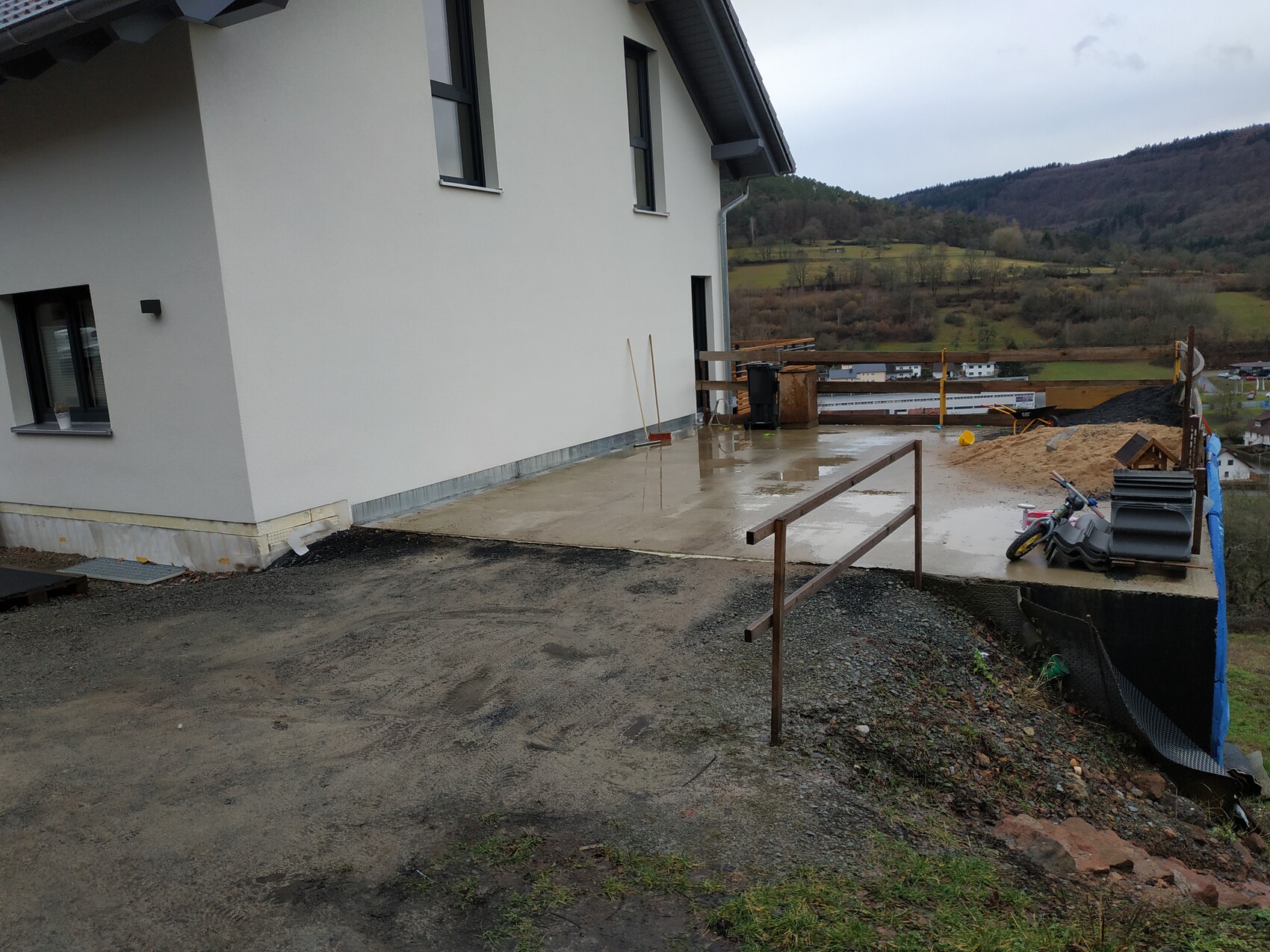
We have a basement ceiling that also serves as the slab for our carport. Due to the sloped site, the ceiling is "open" on three sides. We planned to use paving stones as the surface, extending continuously to the left up to the main entrance of the house.
For the construction, I was initially thinking of welding roofing felt, then a gravel bed, and finally laying the paving stones. At the open edges, I planned to install drip edges to direct water away. On the house side, a metal sealing has already been applied.
My question is whether this construction method makes sense or if there are alternative solutions? Also, I will probably need special drip edges that channel water downward while containing the gravel bed from above.

Hello,
first, a basic question: what was planned? A gravel bed and paving add considerable weight—was this adequately accounted for in the ceiling structure?
How much height can you afford for the floor construction? The drip edge on the house doesn’t look very high; 20 cm (8 inches) of gravel plus 8 cm (3 inches) of paving won’t cover that.
The key question is how thick the gravel layer needs to be here. It’s definitely worth consulting a professional about this.
Could the paving possibly be “glued” like a tile?
Best regards,
Andreas
first, a basic question: what was planned? A gravel bed and paving add considerable weight—was this adequately accounted for in the ceiling structure?
How much height can you afford for the floor construction? The drip edge on the house doesn’t look very high; 20 cm (8 inches) of gravel plus 8 cm (3 inches) of paving won’t cover that.
The key question is how thick the gravel layer needs to be here. It’s definitely worth consulting a professional about this.
Could the paving possibly be “glued” like a tile?
Best regards,
Andreas
R
Reini12344 Feb 2021 13:48The original plan was actually for a garage. I have now checked the structural calculations. For the concrete ceiling, a load of 6.25 kN/m² was assumed for the ceiling itself, plus an additional 1.50 kN/m² for the covering. Assuming 153 kg/m² per kN/m², that would be just under 6,400 kg on the surface area (non-professional opinion).
The drip edge is 17 cm (7 inches) high.
If I now add the 28 cm (11 inches) height mentioned by @andimann above the concrete ceiling, it will become more difficult from the driveway side again...
The drip edge is 17 cm (7 inches) high.
If I now add the 28 cm (11 inches) height mentioned by @andimann above the concrete ceiling, it will become more difficult from the driveway side again...
R
Reini12347 Feb 2021 13:17Do I really need a 20cm (8 inch) base layer for the paving? Wouldn’t the bedding layer be sufficient? Since the carport is built on top, there shouldn’t be much water involved.
Similar topics