
ᐅ Construction of a Terrace and Installation of Ceramic Tiles in Outdoor Areas
Created on: 18 Sep 2025 07:57
N
nils123Hello everyone,
We are planning our new terrace. The base is a concrete slab with a slope away from the house. On top of the concrete, we want to install ceramic tiles that are 2cm (about 0.8 inches) thick. Below the tiles, there is about 5cm (2 inches) of space for screed. The dimensions of the terrace are 4.6m (15 feet) by 9.5m (31 feet). A terrace roof covering of 3m (10 feet) by 9.5m (31 feet) covers most of the area.
We want to fix the tiles firmly in place; only a strip of 1.6m (5 feet) by 9.5m (31 feet) will be exposed to weather.
I have two small questions and would appreciate any suggestions:
1.) Do I need to lay the outdoor tiles with a water-permeable joint fresh in fresh on a trass-cement and gravel mix, or can I simply apply a layer of "regular" screed, let it dry, and then glue the tiles on as you would indoors? Only one-third of the area is affected by rain, the rest is covered. Naturally, I want a long-lasting terrace without cracked tiles or joints.
2.) Do I need to plan an expansion joint for the 9.5m (31 feet) width? I would prefer to avoid it for aesthetic reasons but understand it might be necessary. Does anyone recommend a plastic profile for 2cm (0.8 inch) ceramic, or is it better to use an elastic joint?
3.) What kind of material should I install between the tiles and the house wall to allow for expansion? I will need to finish it with silicone, as there will be no baseboards.
4.) What is the minimum joint width I can use for this project?
If anyone knows of a thread or article covering this topic, I would appreciate a reference.
Best regards,
nils123
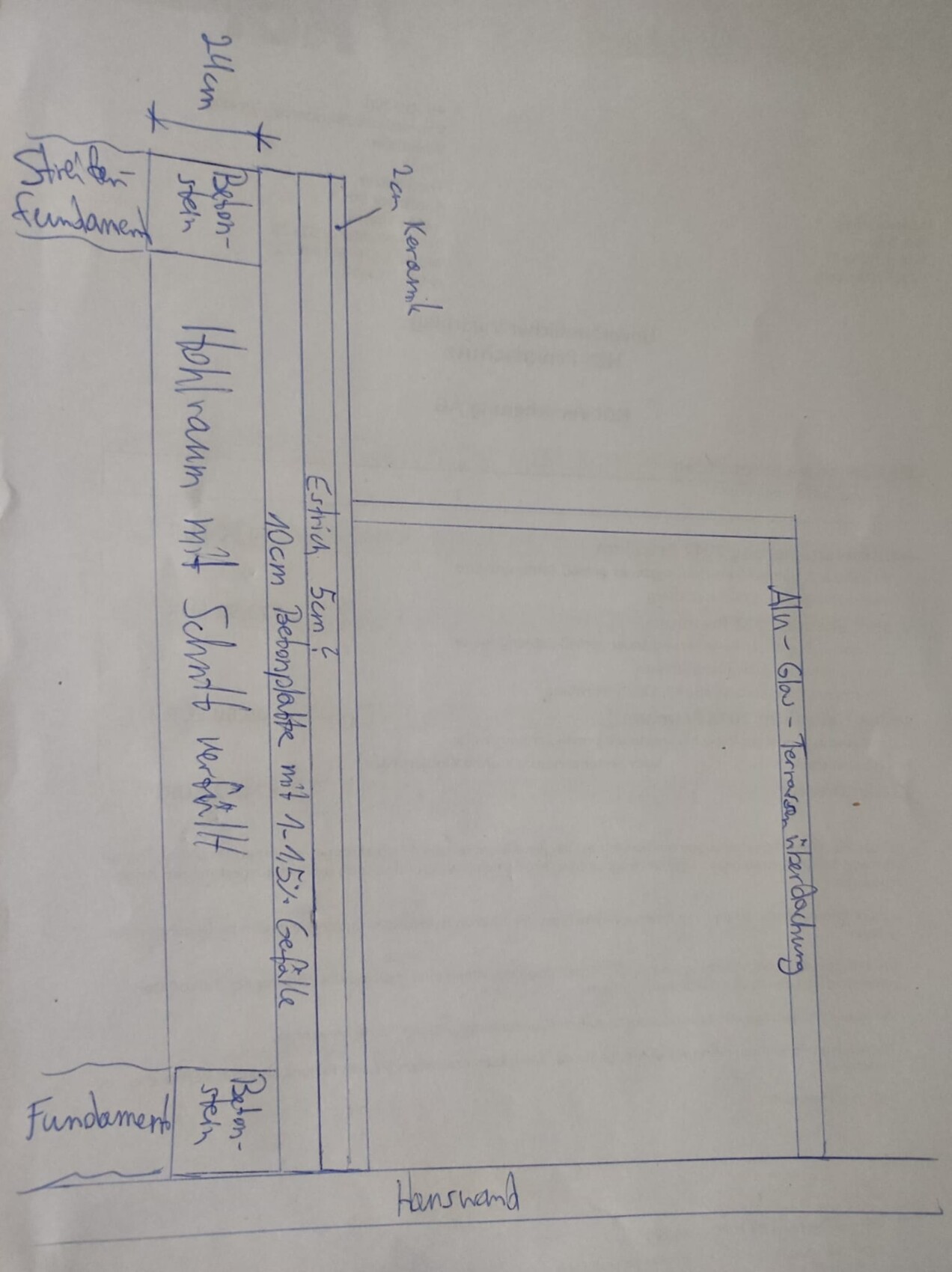
We are planning our new terrace. The base is a concrete slab with a slope away from the house. On top of the concrete, we want to install ceramic tiles that are 2cm (about 0.8 inches) thick. Below the tiles, there is about 5cm (2 inches) of space for screed. The dimensions of the terrace are 4.6m (15 feet) by 9.5m (31 feet). A terrace roof covering of 3m (10 feet) by 9.5m (31 feet) covers most of the area.
We want to fix the tiles firmly in place; only a strip of 1.6m (5 feet) by 9.5m (31 feet) will be exposed to weather.
I have two small questions and would appreciate any suggestions:
1.) Do I need to lay the outdoor tiles with a water-permeable joint fresh in fresh on a trass-cement and gravel mix, or can I simply apply a layer of "regular" screed, let it dry, and then glue the tiles on as you would indoors? Only one-third of the area is affected by rain, the rest is covered. Naturally, I want a long-lasting terrace without cracked tiles or joints.
2.) Do I need to plan an expansion joint for the 9.5m (31 feet) width? I would prefer to avoid it for aesthetic reasons but understand it might be necessary. Does anyone recommend a plastic profile for 2cm (0.8 inch) ceramic, or is it better to use an elastic joint?
3.) What kind of material should I install between the tiles and the house wall to allow for expansion? I will need to finish it with silicone, as there will be no baseboards.
4.) What is the minimum joint width I can use for this project?
If anyone knows of a thread or article covering this topic, I would appreciate a reference.
Best regards,
nils123
Hi Nils,
regarding your first question: For exterior areas, the substructure and screed must be vapor-permeable and crack-bridging – conventional interior screed is generally not suitable for this. A trass-cement and gravel mixture or another frost-resistant, permeable construction is essential to allow water drainage and prevent frost damage. This is the only way to avoid moisture buildup behind the tiles.
About the expansion joint: For a length of 9.5 m (31 feet), I strongly recommend including an expansion joint. Even if it might not look perfect, it provides the necessary stress relief for temperature and humidity changes. Alternatively, you might cleverly disguise the joint with a transition strip or design element. Keep in mind that missing expansion joints can lead to cracks or spalling in the tiles or screed – especially at this size.
One question for you: How do you plan to create or compensate for the slope, considering the uneven concrete base? This can be critical for water drainage and the durability of the tiles.
Good luck!
regarding your first question: For exterior areas, the substructure and screed must be vapor-permeable and crack-bridging – conventional interior screed is generally not suitable for this. A trass-cement and gravel mixture or another frost-resistant, permeable construction is essential to allow water drainage and prevent frost damage. This is the only way to avoid moisture buildup behind the tiles.
About the expansion joint: For a length of 9.5 m (31 feet), I strongly recommend including an expansion joint. Even if it might not look perfect, it provides the necessary stress relief for temperature and humidity changes. Alternatively, you might cleverly disguise the joint with a transition strip or design element. Keep in mind that missing expansion joints can lead to cracks or spalling in the tiles or screed – especially at this size.
One question for you: How do you plan to create or compensate for the slope, considering the uneven concrete base? This can be critical for water drainage and the durability of the tiles.
Good luck!
Hello Nauer,
by uneven I mean that the surface is not smooth but somewhat rough. If I find an area that doesn’t have enough slope or a depression, I would level it with a smoothing compound and establish the bond to the concrete slab with a bonding agent.
It’s a pity, I wanted to avoid wet-on-wet application. But it has to be that way then.
Thanks for the advice!
by uneven I mean that the surface is not smooth but somewhat rough. If I find an area that doesn’t have enough slope or a depression, I would level it with a smoothing compound and establish the bond to the concrete slab with a bonding agent.
It’s a pity, I wanted to avoid wet-on-wet application. But it has to be that way then.
Thanks for the advice!
Similar topics