
ᐅ Flush-mounted wall box – What types of connections are these?
Created on: 10 Oct 2019 12:41
A
ashley
Hello everyone,
In a house built in 1992, there are the connections shown in the picture. Can someone tell me what kind of connections these are? I guessed they might be LAN. The cable fits, but it doesn't seem to work. Thanks and best regards, Ash
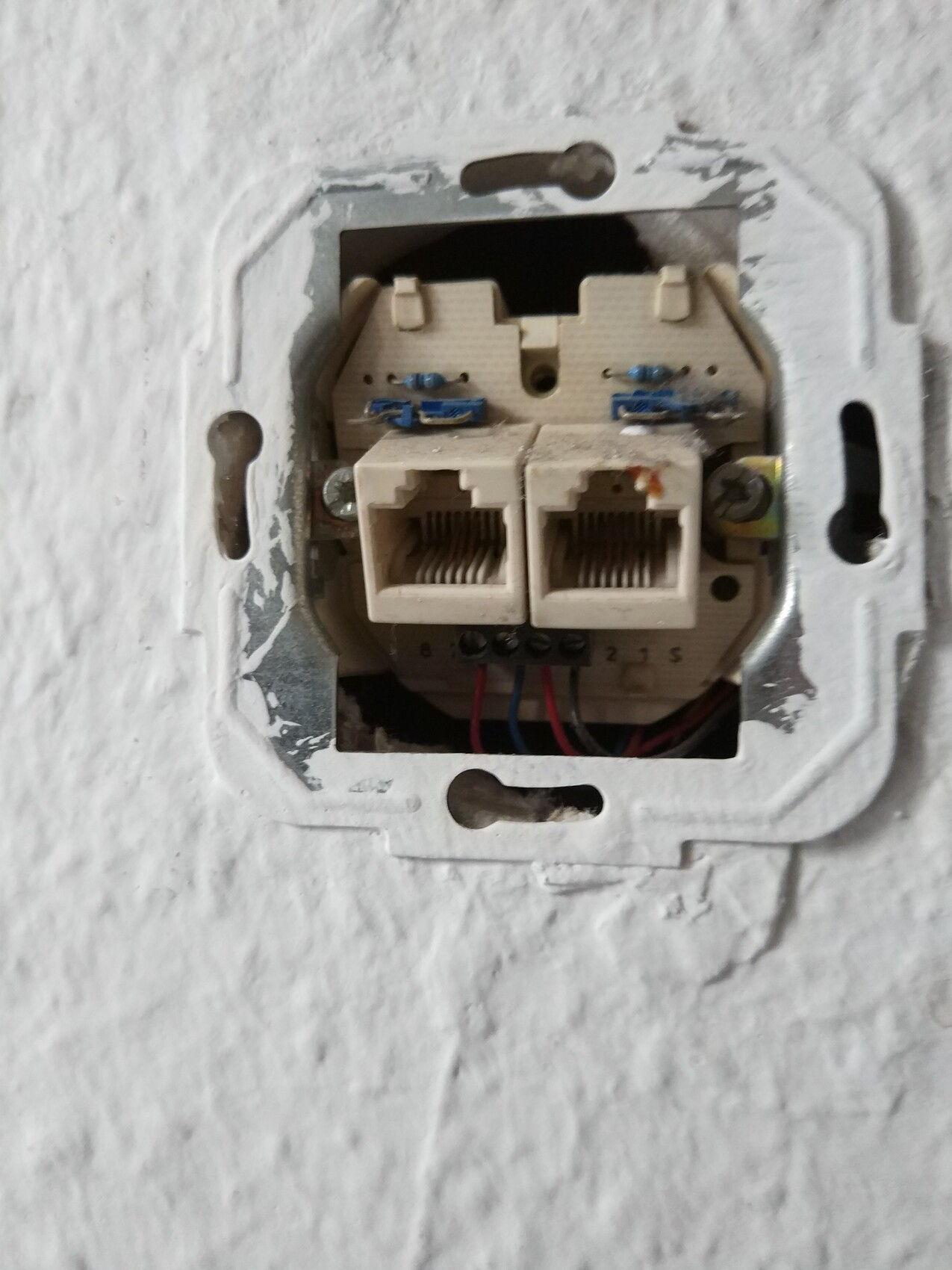
In a house built in 1992, there are the connections shown in the picture. Can someone tell me what kind of connections these are? I guessed they might be LAN. The cable fits, but it doesn't seem to work. Thanks and best regards, Ash
Ok, good idea. Result shown in the picture. Two gray cables are coming in here. From one, a black and a red cable go to the socket. Next to it, there are also an unused yellow and white cable. From the other, a blue and a red cable go to the socket. Additionally, there are unused cables: five white, and one each of brown, black, blue, yellow, and green. Can these be used for anything? Best regards
G
Grantlhaua10 Oct 2019 14:32Shame on me, you are right...
M
Mottenhausen10 Oct 2019 15:01ashley schrieb:
Is this useful for anything?No, these appear to be communication cables typical from about 30 years ago. While it might be possible to connect four twisted pairs to RJ45 sockets here, the crucial feature of a CAT network cable is missing: the special shielding of the twisted pairs and the overall cable. What you would end up with is a network wiring limited to 10 Mbit, which is practically unusable since current routers and PCs will reject any connections below 100 Mbit.
Mottenhausen schrieb:
NoYes, if there are empty conduits. Then you can use the existing cables as a pull line guide for the new CAT cables.
Oh dear. This was done by a hobby installer. You can’t get “internet coming out” here because it first has to somehow enter your home network, and then because of the socket wiring. These are ISDN sockets, which you can also tell by the terminal strip that only has 4/5 and 3/6, meaning 1/2 and 7/8 are missing. For Ethernet, you need 1/2 and 3/6 (or all four pairs for Gigabit Ethernet). Forget the talk about shielding being the reason it doesn’t work—I work professionally in this field and in practice, I have seen much better-functioning internet connections over doorbell wires than most well-informed IT readers would believe.
You can still use the socket insert if you want to connect analog phones because those are far from obsolete—unlike ISDN. What you see in terms of cables are two different types, and someone must have had a reason for using both because actually only the “smaller” one would have been necessary here. It would be worthwhile to investigate where they come from (and the route(s) taken to get there).
One of the cables is a classic telephone cable, of which only the first pair (red/black) is used, and the other is a 6DA cable, also telephone cabling (or for moderate demands, even internal telephone wiring). You can keep the first one as a spare behind the socket, and you can use the larger cable (for Gigabit Ethernet, only for one socket). The pairs go together as follows: red/blue, white/yellow, white/green, white/brown, white/black, and white/blue, see for example tocker (de). Together, there are six twisted pairs, but you only need four for a socket. Mixing them with the other cable would also be possible, but that wouldn’t be my first choice.
https://www.instagram.com/11antgmxde/
https://www.linkedin.com/company/bauen-jetzt/
You can still use the socket insert if you want to connect analog phones because those are far from obsolete—unlike ISDN. What you see in terms of cables are two different types, and someone must have had a reason for using both because actually only the “smaller” one would have been necessary here. It would be worthwhile to investigate where they come from (and the route(s) taken to get there).
One of the cables is a classic telephone cable, of which only the first pair (red/black) is used, and the other is a 6DA cable, also telephone cabling (or for moderate demands, even internal telephone wiring). You can keep the first one as a spare behind the socket, and you can use the larger cable (for Gigabit Ethernet, only for one socket). The pairs go together as follows: red/blue, white/yellow, white/green, white/brown, white/black, and white/blue, see for example tocker (de). Together, there are six twisted pairs, but you only need four for a socket. Mixing them with the other cable would also be possible, but that wouldn’t be my first choice.
https://www.instagram.com/11antgmxde/
https://www.linkedin.com/company/bauen-jetzt/
Similar topics