
ᐅ Connecting an LED ceiling light – multiple wires hanging from the ceiling
Created on: 5 May 2021 15:42
H
Handwerkerin
Hello
I need some help again.
After decades without a ceiling light, I have now bought an LED ceiling fixture (metal and plastic).
This can be turned on and off or dimmed using a remote control.
The original light switch is probably no longer needed.
But now my question.
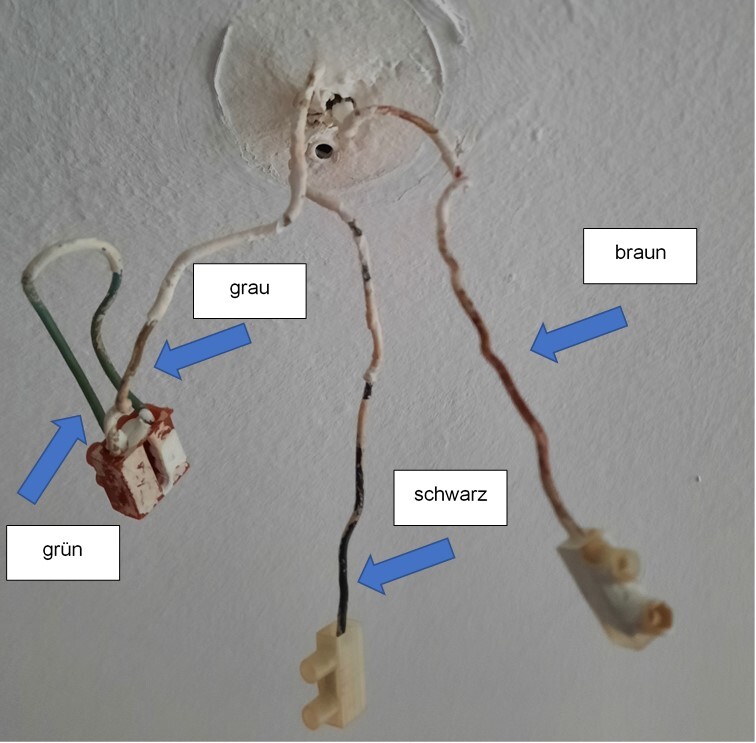
The building was constructed in 1963. Several cables are hanging from the ceiling. 😳 I don’t know which ones need to be connected to the fixture.
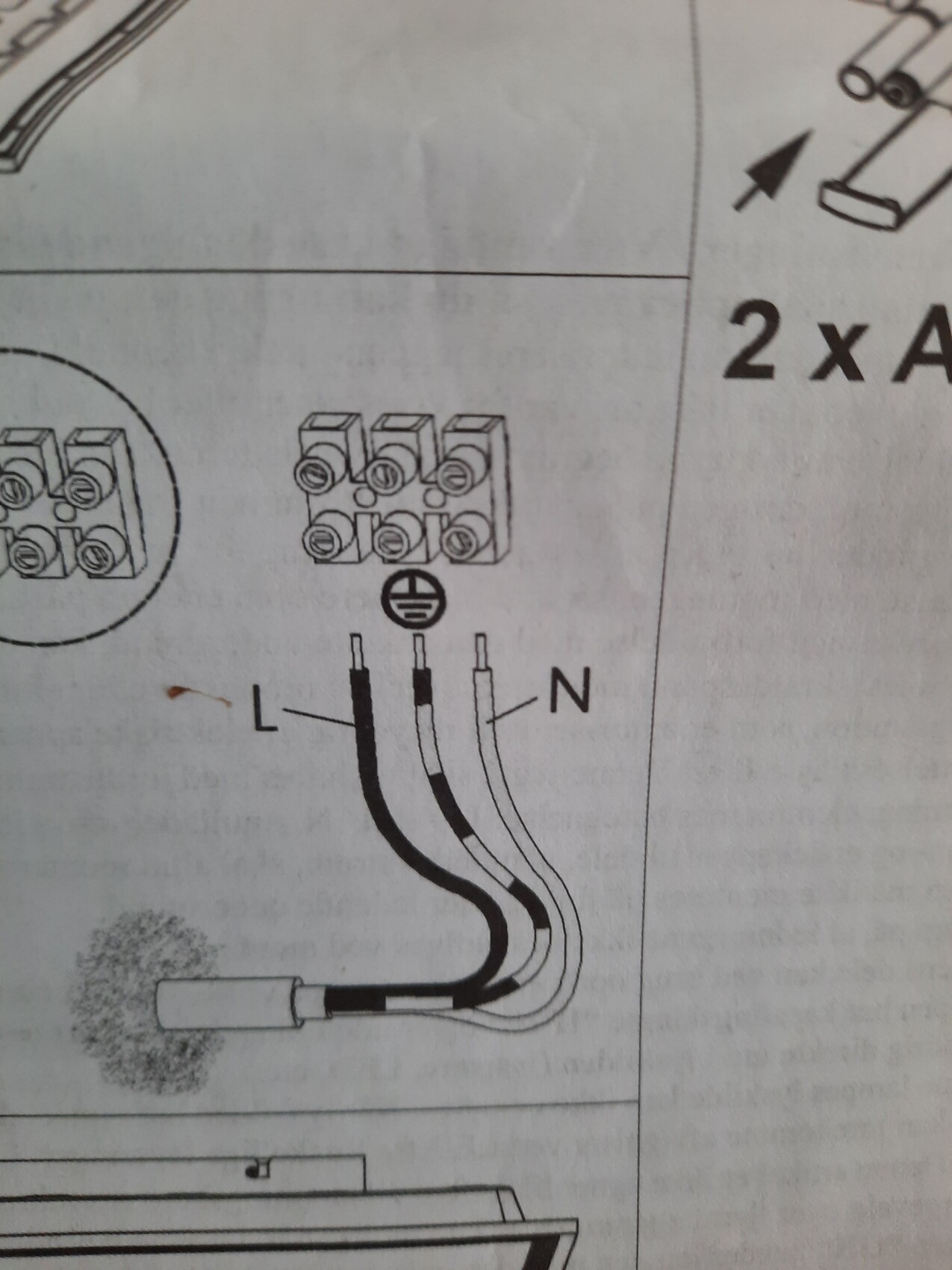
I’m attaching two photos for clarification.
Thank you in advance for any helpful answers.
Best regards
PS: Of course, I will switch off the circuit breaker beforehand 🙂
I need some help again.
After decades without a ceiling light, I have now bought an LED ceiling fixture (metal and plastic).
This can be turned on and off or dimmed using a remote control.
The original light switch is probably no longer needed.
But now my question.
The building was constructed in 1963. Several cables are hanging from the ceiling. 😳 I don’t know which ones need to be connected to the fixture.
I’m attaching two photos for clarification.
Thank you in advance for any helpful answers.
Best regards
PS: Of course, I will switch off the circuit breaker beforehand 🙂
5 pages just to hang a lamp?
@Handwerkerin, don’t you know anyone who has some basic electrical knowledge and maybe even owns a testing device? Neighbors, colleagues, relatives, friends, a colleague’s brother-in-law, etc.
It’s not rocket science. There are 3 wires whose functions need to be identified. Since a lamp was already installed here before, it’s safe to assume the wiring should already be functional.
Here’s what I would do:
- If someone has a voltage tester (non-contact or multimeter): test for live/line wire -> Perfect, first wire = live/line identified.
- If no voltage tester is available: locate the corresponding wall switch and see which wire color is switched -> That will most likely not be the grounding wire ;-) So it will be live/line or, if it was done poorly, neutral.
- If a tester is available and an RCD (residual current device) is installed: measure live against the 2 unknown wires and see if the RCD trips. If the RCD trips on one wire -> Perfect, second wire = ground identified.
- If no tester or no RCD is installed: use an ohmmeter to check resistance from each of the 2 unknown wires to a known earth/ground (radiator, water pipe, etc.). Low resistance reading -> Perfect, second wire = ground identified.
- The remaining wire will be neutral.
=> Connect the lamp and switch it on. If the lamp lights up, verify with a suitable tester that the fixture is not energized. If it is safe -> mission accomplished.
Remember, ohmic measurements must only be done with the circuit breaker turned off and by following the 5 safety rules.
@Handwerkerin, don’t you know anyone who has some basic electrical knowledge and maybe even owns a testing device? Neighbors, colleagues, relatives, friends, a colleague’s brother-in-law, etc.
It’s not rocket science. There are 3 wires whose functions need to be identified. Since a lamp was already installed here before, it’s safe to assume the wiring should already be functional.
Here’s what I would do:
- If someone has a voltage tester (non-contact or multimeter): test for live/line wire -> Perfect, first wire = live/line identified.
- If no voltage tester is available: locate the corresponding wall switch and see which wire color is switched -> That will most likely not be the grounding wire ;-) So it will be live/line or, if it was done poorly, neutral.
- If a tester is available and an RCD (residual current device) is installed: measure live against the 2 unknown wires and see if the RCD trips. If the RCD trips on one wire -> Perfect, second wire = ground identified.
- If no tester or no RCD is installed: use an ohmmeter to check resistance from each of the 2 unknown wires to a known earth/ground (radiator, water pipe, etc.). Low resistance reading -> Perfect, second wire = ground identified.
- The remaining wire will be neutral.
=> Connect the lamp and switch it on. If the lamp lights up, verify with a suitable tester that the fixture is not energized. If it is safe -> mission accomplished.
Remember, ohmic measurements must only be done with the circuit breaker turned off and by following the 5 safety rules.
H
Handwerkerin8 May 2021 12:53Hello
please don’t argue on my behalf. I’m now having it done by someone who knows what they’re doing.
Thanks again for all the replies and warnings.
Best regards
please don’t argue on my behalf. I’m now having it done by someone who knows what they’re doing.
Thanks again for all the replies and warnings.
Best regards
H
Handwerkerin8 May 2021 12:54Spoony80 schrieb:
5 pages just about hanging a lamp?
@ Handwerkerin, don’t you know anyone with some electrical knowledge who might even have a measuring device? Neighbors, coworkers, relatives, friends, a colleague’s brother-in-law, etc.
Hello
Thank you very much for your response and advice. I will now have someone who knows about this do it.
Best regards