
Hello everyone, I already asked this question in another forum but haven’t received any answers yet. Maybe someone here knows more?!
The interior plaster (lime plaster) was applied three weeks ago, and the screed is scheduled to be installed in two weeks. Currently, the humidity on site is around 80-90% at an indoor temperature of about 5-10°C (41-50°F). We will use construction dryers and heating as soon as the screed is ready.
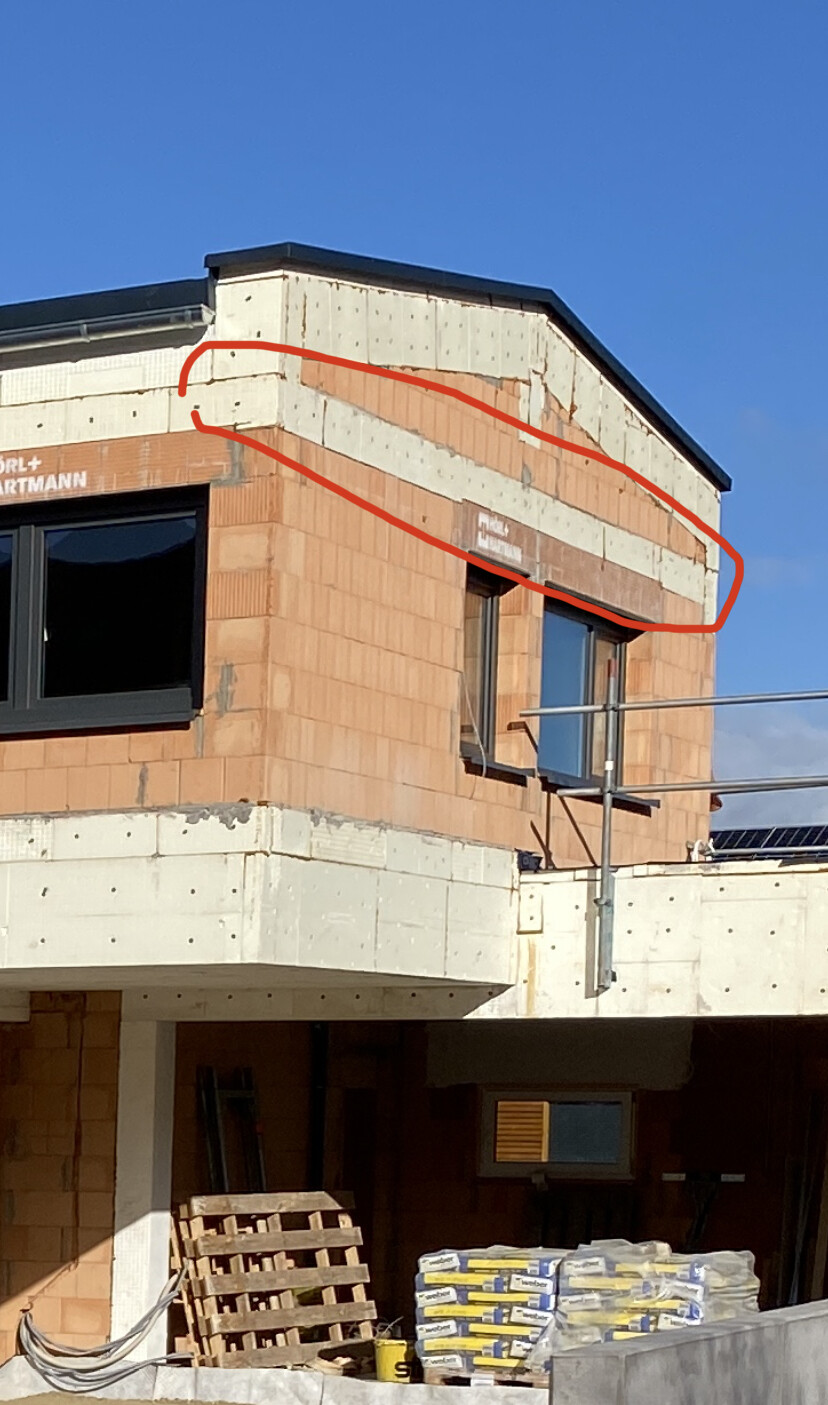
What concerns me a bit is that the walls around the ring beam are extremely wet (you can clearly see the area from the inside). Is this normal? The ring beam is insulated on the outside with 100mm (4 inches) and on the inside with 20mm (0.8 inches) insulation (see picture). The U-value of the ring beam is worse than that of the brickwork. Could this be the problem, or are we dealing with something else here?
Thanks a lot!
Best regards,
Hannes
The interior plaster (lime plaster) was applied three weeks ago, and the screed is scheduled to be installed in two weeks. Currently, the humidity on site is around 80-90% at an indoor temperature of about 5-10°C (41-50°F). We will use construction dryers and heating as soon as the screed is ready.
What concerns me a bit is that the walls around the ring beam are extremely wet (you can clearly see the area from the inside). Is this normal? The ring beam is insulated on the outside with 100mm (4 inches) and on the inside with 20mm (0.8 inches) insulation (see picture). The U-value of the ring beam is worse than that of the brickwork. Could this be the problem, or are we dealing with something else here?
Thanks a lot!
Best regards,
Hannes
Good morning,
This is completely normal and has the following background:
The plaster contains a very high amount of water, which it needs to release while curing. In the areas you built, the water can escape toward the interior and also toward the wall, since the Poroton block can absorb some water and transport it outward. The same would apply, for example, to sand-lime bricks and even more so to aerated concrete blocks.
Your ring beam is cast concrete, and concrete is significantly denser and less absorbent of water compared to the other materials. Therefore, the water can only dry toward the interior side, causing the plaster to remain noticeably wetter. This often results in visible moisture appearing on the surface.
The current weather conditions are also quite unfavorable for drying, as there is generally high humidity and the cold temperature means the air can absorb very little moisture.
So initially, this has nothing to do with a dew point being crossed that would cause condensation.
I hope this helps.
Best regards,
Jann
This is completely normal and has the following background:
The plaster contains a very high amount of water, which it needs to release while curing. In the areas you built, the water can escape toward the interior and also toward the wall, since the Poroton block can absorb some water and transport it outward. The same would apply, for example, to sand-lime bricks and even more so to aerated concrete blocks.
Your ring beam is cast concrete, and concrete is significantly denser and less absorbent of water compared to the other materials. Therefore, the water can only dry toward the interior side, causing the plaster to remain noticeably wetter. This often results in visible moisture appearing on the surface.
The current weather conditions are also quite unfavorable for drying, as there is generally high humidity and the cold temperature means the air can absorb very little moisture.
So initially, this has nothing to do with a dew point being crossed that would cause condensation.
I hope this helps.
Best regards,
Jann
Similar topics