
ᐅ Condensation on the back side of the external venetian blind box
Created on: 18 Nov 2025 11:36
D
DiabloMilesD
DiabloMiles18 Nov 2025 11:36Hello everyone,
I need some help thinking this through, as I might have made a planning or execution mistake.
I am currently renovating our two-family house. The building envelope (excluding the front door) and one apartment are finished. We are now working on the attic conversion and its substructure. The interior plaster in the second apartment is 6 weeks old.
Since it is getting cold, I noticed condensation forming above the window and on the window sills next to the shutter guide rails.
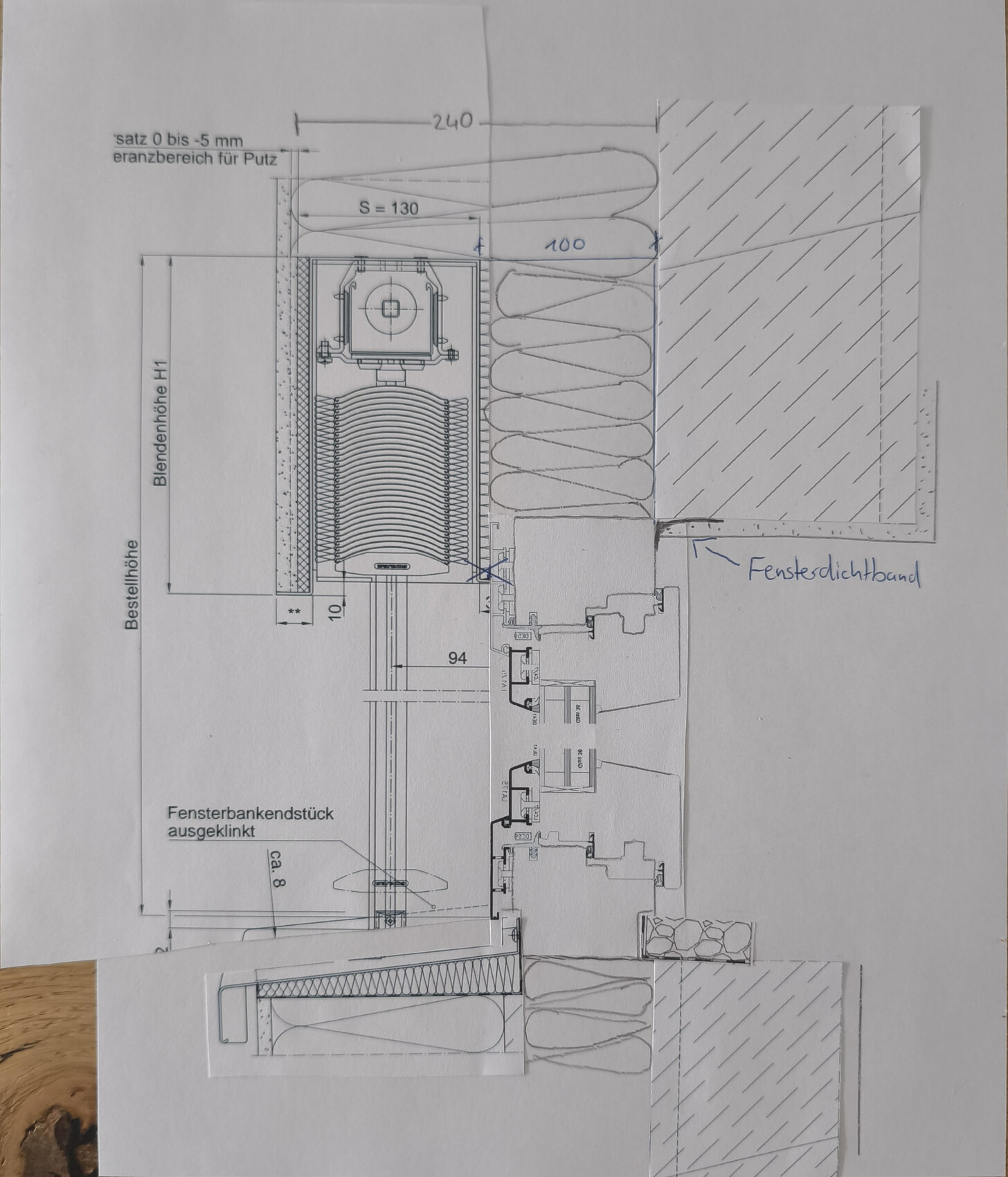
I made a cross-section sketch by hand, which should be attached. The structure is a wood-aluminum window with a 90mm (3.5 inches) frame and 0.5mm (0.02 inches) glazing, installed in front of the masonry in a pre-wall mounting. We have mounted a Warema window system shutter (FSR) onto the aluminum casing using compressible sealing tape.
Behind the shutter box, 100mm (4 inches) EPS insulation is glued. The façade is wrapped with 240mm (9.5 inches) EPS (thermal conductivity 0.031) insulation. The window sills used are Gutmann GS40 with sliding end caps. As a second sealing layer, Delta drainage modules are installed on the left and right with a membrane in between. No water escapes here; it must run back onto the window sill behind the shutter rails. The amount of moisture currently is about 2-3 droplets per hour.
At one window, I drilled a 10mm (0.4 inches) hole in the bent edge of the shutter box (between the aluminum casing and shutter box) and found moisture/condensation there.
Now I am asking myself where this water is coming from. Inside, the window frames are sealed on all four sides with sealing tapes bonded to the masonry. I installed and thoroughly checked all of this again before plastering.
My second thought is that air might flow through the window seals behind the aluminum casing and then condense at the shutter box. However, the aluminum casing would need to be damp for this, which I have not found.
The third speculation is whether the moisture could be coming from construction moisture in the masonry that is drying out now.
Explanation of the cross-section: I found moisture at the intersection marked with a cross. The shutter rails are continuous up to the aluminum casing, not as shown in the drawing.
I hope you can help me identify the cause. If I forgot any information, please let me know, and I will provide it.
Additional information:
The problem seems strongest in the attic. The first floor shows only minimal moisture, and I could not detect any moisture on the window sills on the ground floor.
On the ground floor (120m² / 1,292ft²), a Maico WS470 ventilation system operates at a constant 100m³/h (3,530 ft³/h). It has an enthalpy heat exchanger installed and currently reports 52% relative humidity, averaging around 55%. The roof ventilation duct is still open and not connected.
Temperatures are about 22°C (72°F) on the ground floor, cooling to 20.5°C (69°F) by morning (heat pump currently runs only during the day). It is 18°C (64°F) on the first floor and 16°C (61°F) in the attic. The roof has only the vapor retarder installed so far. Blowing insulation will be done next week. Currently, only 60mm (2.4 inches) of insulation is installed on the roof deck, which explains the temperature gradient. The outside temperature at 11:30 am is 1.6°C (35°F).
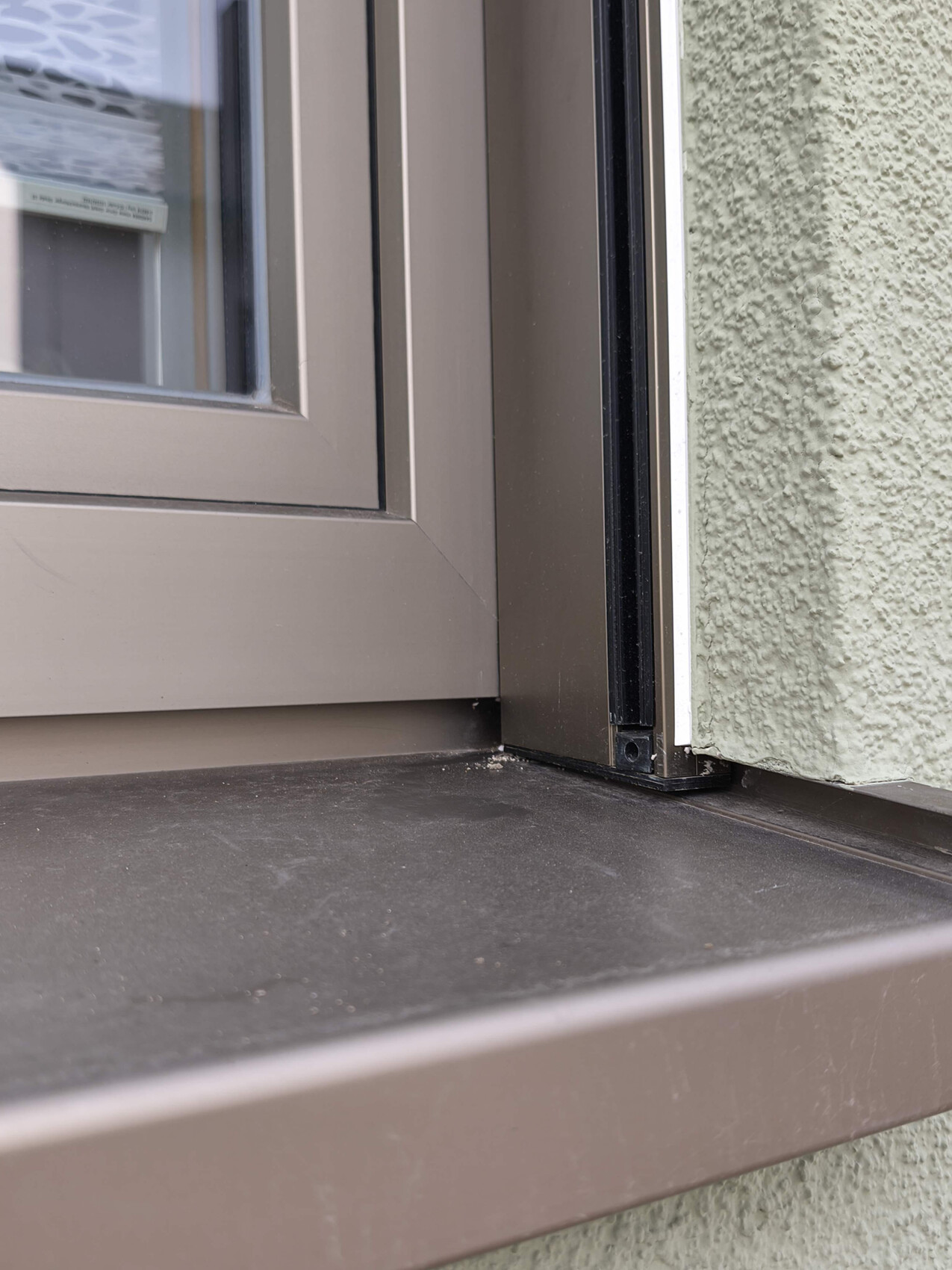
The attachment shows an example of where the water exits—behind the shutter rail on the window sill near the window frame. This window currently shows no visible water. I recall that last winter we had icicles on the window sills (end pieces) on the ground floor.
Thanks and regards,
Timo
I need some help thinking this through, as I might have made a planning or execution mistake.
I am currently renovating our two-family house. The building envelope (excluding the front door) and one apartment are finished. We are now working on the attic conversion and its substructure. The interior plaster in the second apartment is 6 weeks old.
Since it is getting cold, I noticed condensation forming above the window and on the window sills next to the shutter guide rails.
I made a cross-section sketch by hand, which should be attached. The structure is a wood-aluminum window with a 90mm (3.5 inches) frame and 0.5mm (0.02 inches) glazing, installed in front of the masonry in a pre-wall mounting. We have mounted a Warema window system shutter (FSR) onto the aluminum casing using compressible sealing tape.
Behind the shutter box, 100mm (4 inches) EPS insulation is glued. The façade is wrapped with 240mm (9.5 inches) EPS (thermal conductivity 0.031) insulation. The window sills used are Gutmann GS40 with sliding end caps. As a second sealing layer, Delta drainage modules are installed on the left and right with a membrane in between. No water escapes here; it must run back onto the window sill behind the shutter rails. The amount of moisture currently is about 2-3 droplets per hour.
At one window, I drilled a 10mm (0.4 inches) hole in the bent edge of the shutter box (between the aluminum casing and shutter box) and found moisture/condensation there.
Now I am asking myself where this water is coming from. Inside, the window frames are sealed on all four sides with sealing tapes bonded to the masonry. I installed and thoroughly checked all of this again before plastering.
My second thought is that air might flow through the window seals behind the aluminum casing and then condense at the shutter box. However, the aluminum casing would need to be damp for this, which I have not found.
The third speculation is whether the moisture could be coming from construction moisture in the masonry that is drying out now.
Explanation of the cross-section: I found moisture at the intersection marked with a cross. The shutter rails are continuous up to the aluminum casing, not as shown in the drawing.
I hope you can help me identify the cause. If I forgot any information, please let me know, and I will provide it.
Additional information:
The problem seems strongest in the attic. The first floor shows only minimal moisture, and I could not detect any moisture on the window sills on the ground floor.
On the ground floor (120m² / 1,292ft²), a Maico WS470 ventilation system operates at a constant 100m³/h (3,530 ft³/h). It has an enthalpy heat exchanger installed and currently reports 52% relative humidity, averaging around 55%. The roof ventilation duct is still open and not connected.
Temperatures are about 22°C (72°F) on the ground floor, cooling to 20.5°C (69°F) by morning (heat pump currently runs only during the day). It is 18°C (64°F) on the first floor and 16°C (61°F) in the attic. The roof has only the vapor retarder installed so far. Blowing insulation will be done next week. Currently, only 60mm (2.4 inches) of insulation is installed on the roof deck, which explains the temperature gradient. The outside temperature at 11:30 am is 1.6°C (35°F).
The attachment shows an example of where the water exits—behind the shutter rail on the window sill near the window frame. This window currently shows no visible water. I recall that last winter we had icicles on the window sills (end pieces) on the ground floor.
Thanks and regards,
Timo
Hi Timo,
The construction setup you describe is generally plausible, but at the interface between the window frame, aluminum cladding, and shutter box, there are often some building physics effects that only become apparent when it gets cold outside and the residual moisture inside the building is still high. Finding condensation at the top of the window and on the side window sills is almost a classic issue with fresh interior plaster, but your observation behind the folded edge of the shutter box doesn’t fully match with just indoor moisture. That area is usually not warm enough for enough moist air from the interior to “creep in” there.
You mentioned that air might be flowing behind the aluminum cladding via the sash seals. This is actually one of the most common causes, even if no moisture is visible on the aluminum surface. The aluminum skin cools down very quickly, and condensation tends to form in the sheltered cavity behind the box rather than on exposed areas. Another point is the ventilation behind the aluminum cladding itself. Some systems have slight openings and react sensitively if the compressible sealing tape on the shutter rails is either pressed too hard or not firmly enough over time. This can create tiny leaks where convective moisture is pulled in. May I ask if you used the same installation kit for all the windows and whether the sealing tapes were installed correctly within the recommended swelling time frame?
The building moisture hypothesis cannot be ruled out. Six-week-old interior plaster in a space that is not yet fully heated or ventilated releases more moisture than one might expect, and this moisture tends to accumulate on cold metal areas. If the reveal insulation or the transition to the shutter box was not completely sealed, even the smallest air movements can be enough. The small occurrence of 2 to 3 drops per hour can in some cases really correspond to the drying-out phase. Observe whether the amount of droplets stabilizes or changes after a few days if you consistently increase the heating and reduce the indoor humidity.
I would strongly recommend checking the transition from the shutter rail to the aluminum cladding again very carefully. There are often two temperature zones and a small capillary edge there due to the system design, where exactly what you are seeing now can form. Have you already checked at the affected window whether the sliding seal of the GS40 is truly free of tension? A slightly strained seal can sometimes create a microscopically small groove through which cold air can flow in without you noticing from the outside.
Good luck!
The construction setup you describe is generally plausible, but at the interface between the window frame, aluminum cladding, and shutter box, there are often some building physics effects that only become apparent when it gets cold outside and the residual moisture inside the building is still high. Finding condensation at the top of the window and on the side window sills is almost a classic issue with fresh interior plaster, but your observation behind the folded edge of the shutter box doesn’t fully match with just indoor moisture. That area is usually not warm enough for enough moist air from the interior to “creep in” there.
You mentioned that air might be flowing behind the aluminum cladding via the sash seals. This is actually one of the most common causes, even if no moisture is visible on the aluminum surface. The aluminum skin cools down very quickly, and condensation tends to form in the sheltered cavity behind the box rather than on exposed areas. Another point is the ventilation behind the aluminum cladding itself. Some systems have slight openings and react sensitively if the compressible sealing tape on the shutter rails is either pressed too hard or not firmly enough over time. This can create tiny leaks where convective moisture is pulled in. May I ask if you used the same installation kit for all the windows and whether the sealing tapes were installed correctly within the recommended swelling time frame?
The building moisture hypothesis cannot be ruled out. Six-week-old interior plaster in a space that is not yet fully heated or ventilated releases more moisture than one might expect, and this moisture tends to accumulate on cold metal areas. If the reveal insulation or the transition to the shutter box was not completely sealed, even the smallest air movements can be enough. The small occurrence of 2 to 3 drops per hour can in some cases really correspond to the drying-out phase. Observe whether the amount of droplets stabilizes or changes after a few days if you consistently increase the heating and reduce the indoor humidity.
I would strongly recommend checking the transition from the shutter rail to the aluminum cladding again very carefully. There are often two temperature zones and a small capillary edge there due to the system design, where exactly what you are seeing now can form. Have you already checked at the affected window whether the sliding seal of the GS40 is truly free of tension? A slightly strained seal can sometimes create a microscopically small groove through which cold air can flow in without you noticing from the outside.
Good luck!
Similar topics