
ᐅ Concrete patio slabs on a layer of crushed stone, with or without edge restraint
Created on: 22 Jul 2020 09:55
W
world-e
Hello everyone,
How did you install or have your concrete patio slabs installed? With or without edge restraints such as curbing, edging strips, etc.? Our patio slabs will have a thickness of 42mm (1.65 inches). I imagine it would be difficult to install them without edge restraints and then secure the outer row with concrete or create a concrete wedge. There would only be about 20mm (0.8 inches) of space if the concrete wedge is intended to be slightly covered with topsoil later. Grass would probably have a hard time growing there. However, this approach could save the effort of installing the edging stones. In theory, you can position the edging stones so that the slabs fit in without needing to cut them. But I am not sure how well that works in practice.
What are your opinions or experiences? Possibly even with photos showing patios without edge restraints.
Thank you very much
How did you install or have your concrete patio slabs installed? With or without edge restraints such as curbing, edging strips, etc.? Our patio slabs will have a thickness of 42mm (1.65 inches). I imagine it would be difficult to install them without edge restraints and then secure the outer row with concrete or create a concrete wedge. There would only be about 20mm (0.8 inches) of space if the concrete wedge is intended to be slightly covered with topsoil later. Grass would probably have a hard time growing there. However, this approach could save the effort of installing the edging stones. In theory, you can position the edging stones so that the slabs fit in without needing to cut them. But I am not sure how well that works in practice.
What are your opinions or experiences? Possibly even with photos showing patios without edge restraints.
Thank you very much
Hello,
we installed 5cm (2 inch) thick concrete slabs on a gravel-sand mixture, dug a bit deeper around the edges, and created a concrete wedge that extends about 1.5cm (0.6 inch) up along the edge of the slab. On top of that, we placed soil and turf. We've had this setup for three years, and the slabs have not shifted; the grass grows perfectly fine there as well, despite there being only about 3.5cm (1.4 inch) of soil/turf above the wedge.
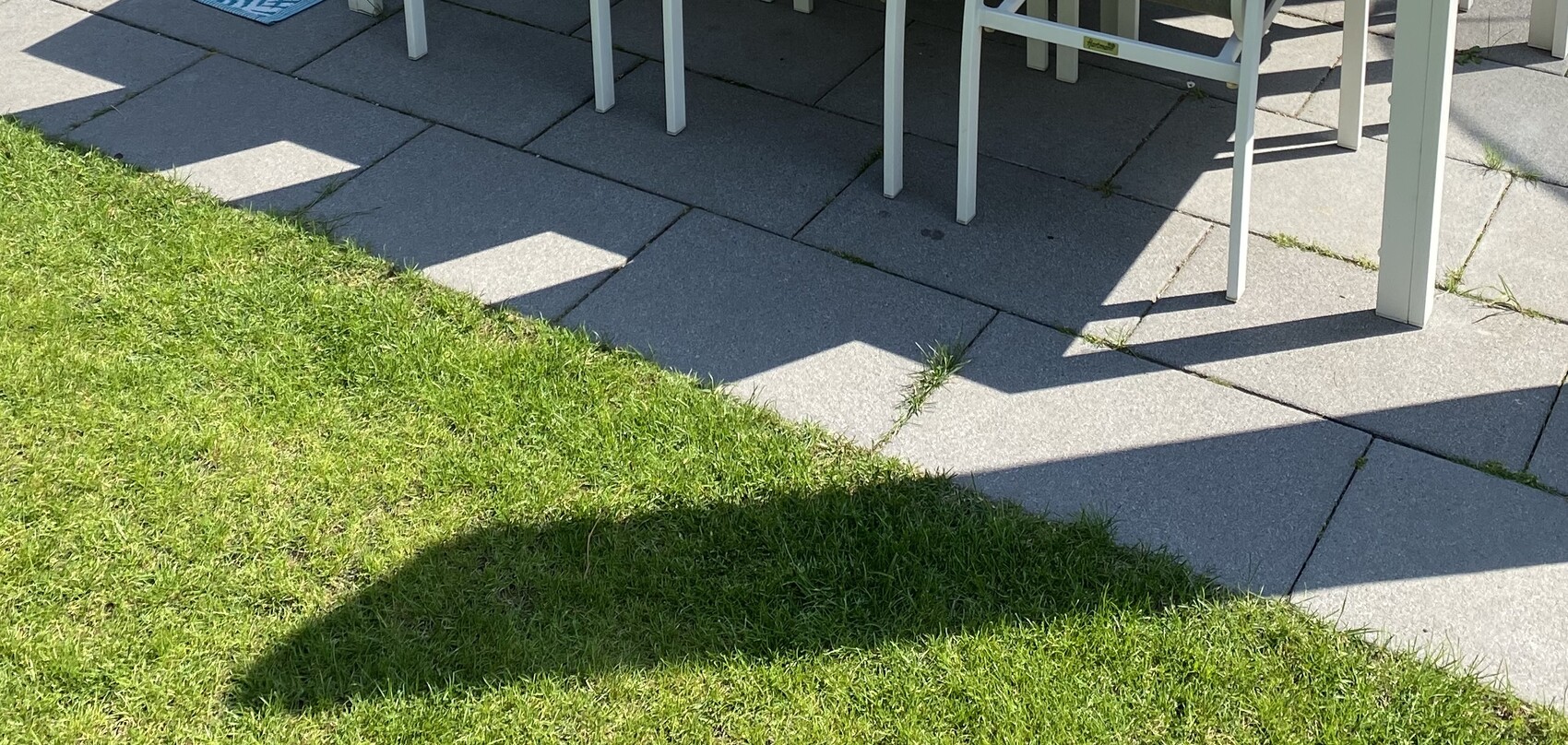
(and before anyone says it: Yes, I need to clean the joints again )
we installed 5cm (2 inch) thick concrete slabs on a gravel-sand mixture, dug a bit deeper around the edges, and created a concrete wedge that extends about 1.5cm (0.6 inch) up along the edge of the slab. On top of that, we placed soil and turf. We've had this setup for three years, and the slabs have not shifted; the grass grows perfectly fine there as well, despite there being only about 3.5cm (1.4 inch) of soil/turf above the wedge.
(and before anyone says it: Yes, I need to clean the joints again )
Are 6-piece curbstones 20cm (8 inches) high? We made sure that we still had 5cm (2 inches) of soil coverage above the concrete wedge.
Our landscaping guy, who wasn’t the best either, once suggested using regular rectangular paving stones with a concrete wedge as an edging alternative to the 20cm (8 inches) curb stone. But I didn’t really trust that idea because I couldn’t imagine how you’d make a proper concrete wedge for an 8cm (3 inches) or 10cm (4 inches) thick paving stone that still leaves enough soil coverage for grass to grow.
Our landscaping guy, who wasn’t the best either, once suggested using regular rectangular paving stones with a concrete wedge as an edging alternative to the 20cm (8 inches) curb stone. But I didn’t really trust that idea because I couldn’t imagine how you’d make a proper concrete wedge for an 8cm (3 inches) or 10cm (4 inches) thick paving stone that still leaves enough soil coverage for grass to grow.
Similar topics