
Hello everyone,
While searching for a suitable canopy for our entrance area, I keep coming across canopies made of concrete. For a new build, this can be integrated without much effort, but we are not building new; we have an existing building. Now, I am wondering if it is still possible to add this later on.
To illustrate exactly what I have in mind, I have attached an example image.
Regarding the dimensions: the entrance area is 1.40 meters (55 inches) wide. Ideally, the canopy should be the same width. For the length, I was thinking about 1.5 to 2.0 meters (59 to 79 inches).
I am not a professional or skilled tradesperson, but I am reasonably handy, so I don’t necessarily need a specialist company—just advice on how to implement it so that it holds up and doesn’t collapse under severe weather or snow load. I live in the Saarland region, so snow is not heavy or frequent during our "winter."
My idea was to build the vertical support from concrete formwork blocks with reinforced steel bars to create a secure connection to the ground. The base is a basement extension, meaning a concrete basement ceiling. The concrete formwork blocks can be plastered later and, with a suitable coating or plaster technique, probably achieve a concrete look. (Alternatives are also welcome.) I considered whether I could possibly build the formwork myself on this scale but am unsure if it would withstand the pressure from the concrete. Again, ideas or instructions on how to do this are appreciated.
To ensure the "lid" of the whole structure holds and is firmly connected to the house, I thought I might cut slots into the wall along the length of the roof every 50 centimeters (20 inches) and insert steel beams into the wall to support the weight. Then, I would reinforce everything with rebar, install formwork underneath with proper support, and pour the concrete lid. The wall joint would be sealed with an appropriate sealant and designed with a slope for water drainage.
That is my plan.
Now I am hoping for your input and ideas on whether this is feasible and how best to carry it out. It would also be helpful to know how thick the slab should or must be, which beams should or must be installed to ensure stability. I do not have a structural engineer available to calculate this in advance.
Thank you in advance for your help.
Best regards
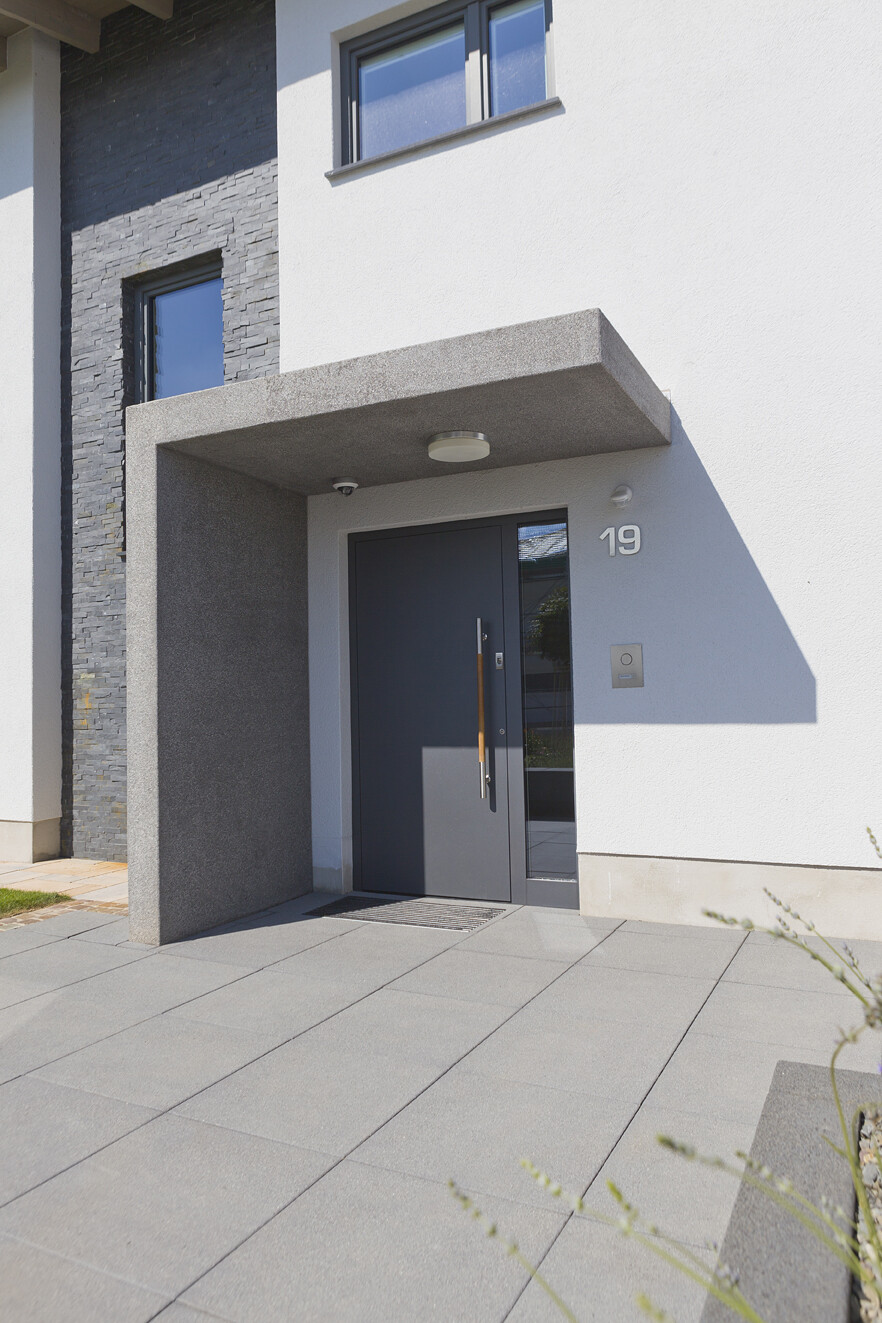
While searching for a suitable canopy for our entrance area, I keep coming across canopies made of concrete. For a new build, this can be integrated without much effort, but we are not building new; we have an existing building. Now, I am wondering if it is still possible to add this later on.
To illustrate exactly what I have in mind, I have attached an example image.
Regarding the dimensions: the entrance area is 1.40 meters (55 inches) wide. Ideally, the canopy should be the same width. For the length, I was thinking about 1.5 to 2.0 meters (59 to 79 inches).
I am not a professional or skilled tradesperson, but I am reasonably handy, so I don’t necessarily need a specialist company—just advice on how to implement it so that it holds up and doesn’t collapse under severe weather or snow load. I live in the Saarland region, so snow is not heavy or frequent during our "winter."
My idea was to build the vertical support from concrete formwork blocks with reinforced steel bars to create a secure connection to the ground. The base is a basement extension, meaning a concrete basement ceiling. The concrete formwork blocks can be plastered later and, with a suitable coating or plaster technique, probably achieve a concrete look. (Alternatives are also welcome.) I considered whether I could possibly build the formwork myself on this scale but am unsure if it would withstand the pressure from the concrete. Again, ideas or instructions on how to do this are appreciated.
To ensure the "lid" of the whole structure holds and is firmly connected to the house, I thought I might cut slots into the wall along the length of the roof every 50 centimeters (20 inches) and insert steel beams into the wall to support the weight. Then, I would reinforce everything with rebar, install formwork underneath with proper support, and pour the concrete lid. The wall joint would be sealed with an appropriate sealant and designed with a slope for water drainage.
That is my plan.
Now I am hoping for your input and ideas on whether this is feasible and how best to carry it out. It would also be helpful to know how thick the slab should or must be, which beams should or must be installed to ensure stability. I do not have a structural engineer available to calculate this in advance.
Thank you in advance for your help.
Best regards

H
hampshire27 Sep 2019 22:33In addition to snow load, wind load also plays a significant role in a structure like the one shown. This can of course be managed with appropriately strong anchors in the wall. I would consult a structural engineer on site to discuss the sizing and construction. Especially if the design is meant to be elegant and delicate, it is important to inspect, consider, and calculate everything on site.
Does it need to be solid, or is a concrete look or surface finish sufficient for you?
Does it need to be solid, or is a concrete look or surface finish sufficient for you?
I have attached two older photos to help better visualize the conditions. The exterior of the house has been newly plastered and painted, except for the base, but that does not affect the construction project. The base itself is planned to be replastered and repainted next spring. Inside the house, at this location, is the stairwell, which is still in the shell stage. This means structural modifications could be made here as well, such as openings through the wall for anchors or other purposes.
In general, the question remains whether it is possible to properly construct something like this and, if so, with which material.
For your information... the "nice" railing will of course be removed as well.
@hampshire
It does not necessarily have to be solid concrete; the appearance and construction method are basically what matter to me.
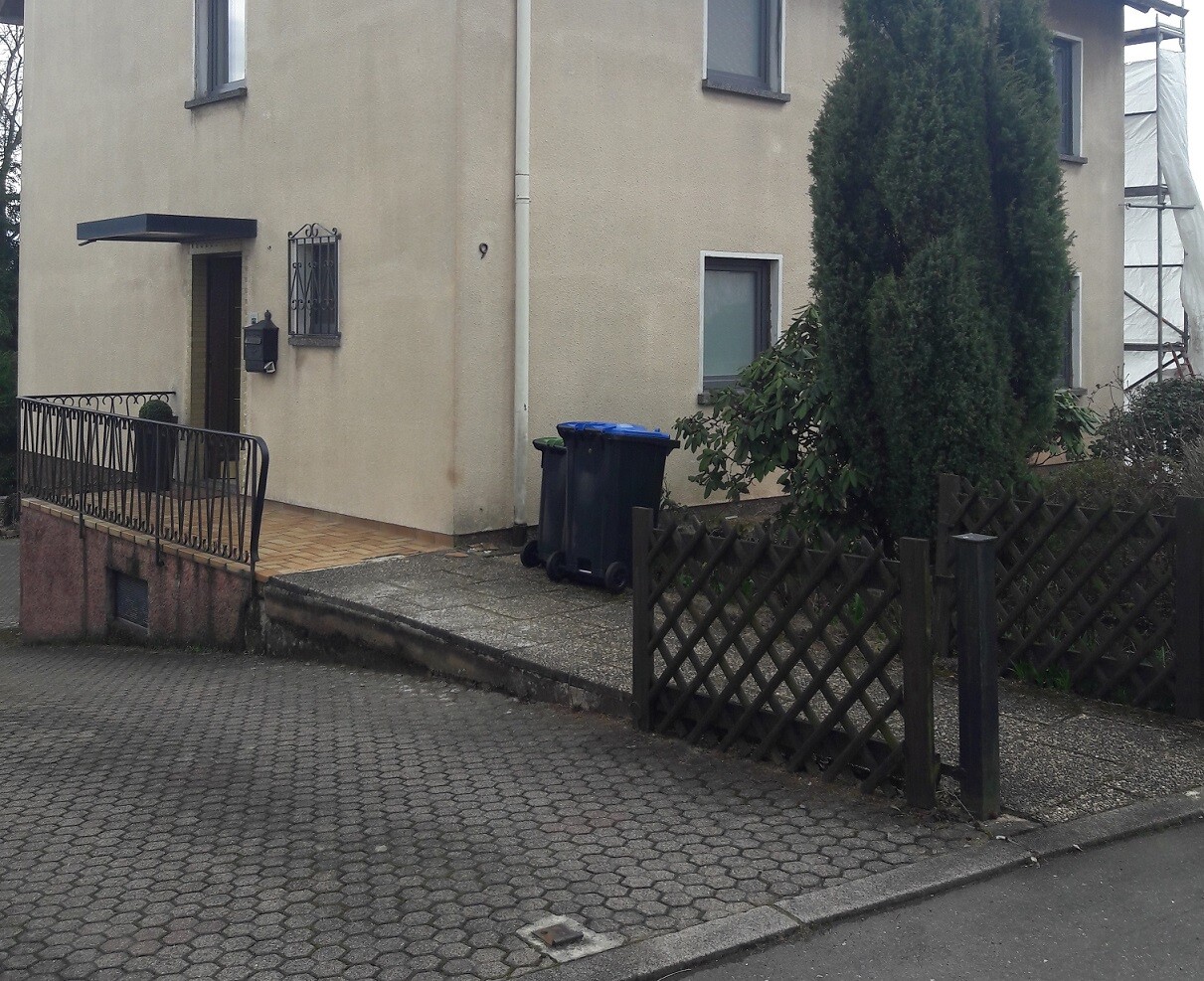
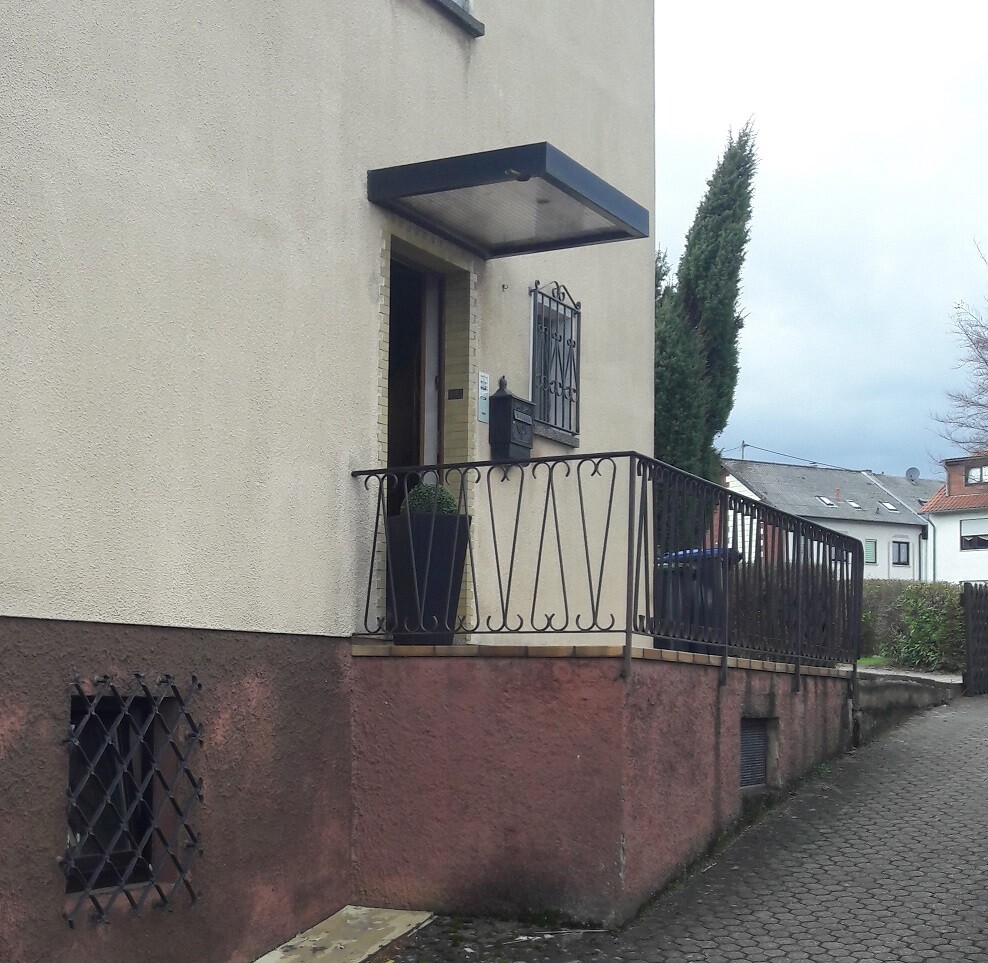
In general, the question remains whether it is possible to properly construct something like this and, if so, with which material.
For your information... the "nice" railing will of course be removed as well.
@hampshire
It does not necessarily have to be solid concrete; the appearance and construction method are basically what matter to me.
So, I have now explored different options and also consulted a structural engineer. Constructing the entire structure from concrete would be possible, but the cost-benefit ratio doesn’t justify it. The basic framework will now be made of wood and later clad and plastered to achieve a concrete look.
The roof will be installed later and securely anchored to the wall; this has already been planned and calculated. However, I do not want the vertical support to be made of wood but rather masonry. For this, I plan to use 17.5cm (7 inches) formwork blocks, reinforce them with rebar, and fill them with concrete.
To connect this to the base (which is a concrete wall in this case), my idea is to drill holes from above at this point, embed the vertical connection reinforcement in concrete, and then place the blocks on top, so they have a firm connection with the base and do not tip over.
Now my question is whether this approach is practical or if it would lack stability if I only connect four vertical 10mm (0.4 inch) reinforcement bars to the base? Can I simply place this on the existing base (I would of course remove the tiles, as they will be removed anyway), or should there be a layer of bitumen or something similar between the base and the first block?
Or do I need to approach this differently to achieve structural strength?
Attached is a diagram marked in red showing how the wall will be built. It is free-standing without connection to the house wall. The top part will later be connected to the side part and will rest on top.
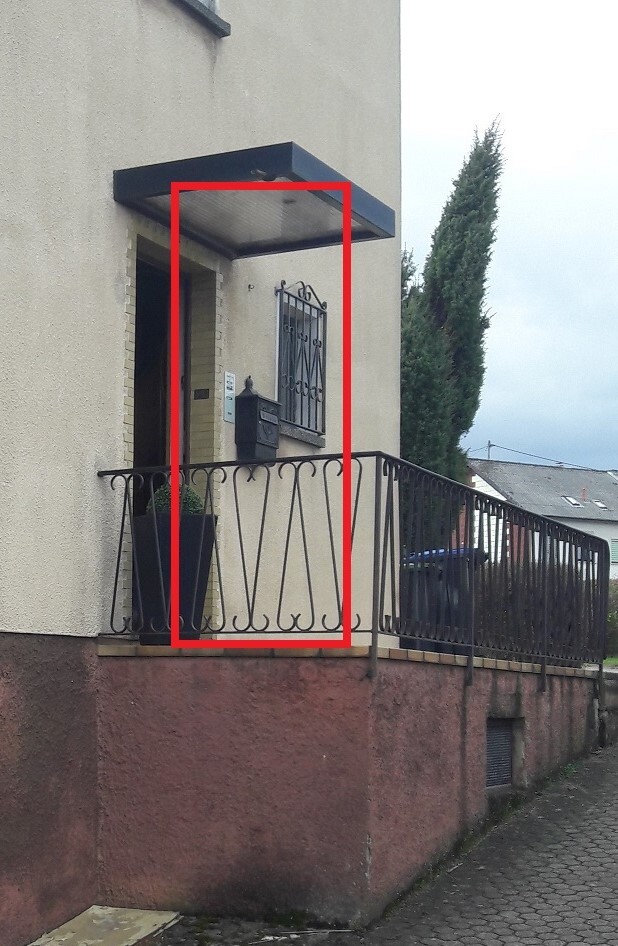
The roof will be installed later and securely anchored to the wall; this has already been planned and calculated. However, I do not want the vertical support to be made of wood but rather masonry. For this, I plan to use 17.5cm (7 inches) formwork blocks, reinforce them with rebar, and fill them with concrete.
To connect this to the base (which is a concrete wall in this case), my idea is to drill holes from above at this point, embed the vertical connection reinforcement in concrete, and then place the blocks on top, so they have a firm connection with the base and do not tip over.
Now my question is whether this approach is practical or if it would lack stability if I only connect four vertical 10mm (0.4 inch) reinforcement bars to the base? Can I simply place this on the existing base (I would of course remove the tiles, as they will be removed anyway), or should there be a layer of bitumen or something similar between the base and the first block?
Or do I need to approach this differently to achieve structural strength?
Attached is a diagram marked in red showing how the wall will be built. It is free-standing without connection to the house wall. The top part will later be connected to the side part and will rest on top.
Why are you so focused on concrete? Have you considered steel?
Just as an idea, the roof as drawn there is actually much too small. Even the slightest wind will let rain get everywhere underneath.
What about a steel structure over the entire tiled area? Glass on top would keep it nice and bright, and it could be combined with the railing for a coherent look. The side could be closed off with glass or steel (powder-coated or stainless).
Those concrete brackets you see on some new houses, in my opinion, only really work on square cube-shaped buildings with flat roofs.
Just a few thoughts to consider—you have to like it yourself, after all.
Just as an idea, the roof as drawn there is actually much too small. Even the slightest wind will let rain get everywhere underneath.
What about a steel structure over the entire tiled area? Glass on top would keep it nice and bright, and it could be combined with the railing for a coherent look. The side could be closed off with glass or steel (powder-coated or stainless).
Those concrete brackets you see on some new houses, in my opinion, only really work on square cube-shaped buildings with flat roofs.
Just a few thoughts to consider—you have to like it yourself, after all.
Similar topics