
ᐅ Clarification question: Gable roof – load-bearing walls – floor plan
Created on: 10 Jan 2025 18:31
H
HausmitGarten
Dear Forum,
I would like to thank you in advance for the many suggestions I have received from reading the numerous posts in this forum over the past period. Now things are becoming more concrete for us: we have been able to purchase a plot of land and are planning to build a single-family house on it.
We are currently at the beginning of the planning stage and are carefully considering possible floor plan layouts. In this context, the question arose as to which structural conditions we need to take into account: specifically, how "free" we are when positioning the walls.
I will first describe our building project:
Our questions:
To illustrate our questions more clearly, I am attaching two sketches of possible floor plans for the ground floor and upper floor. I am not looking to start the discussion about the optimal floor plan at this point, although I am already looking forward to your suggestions on this topic!
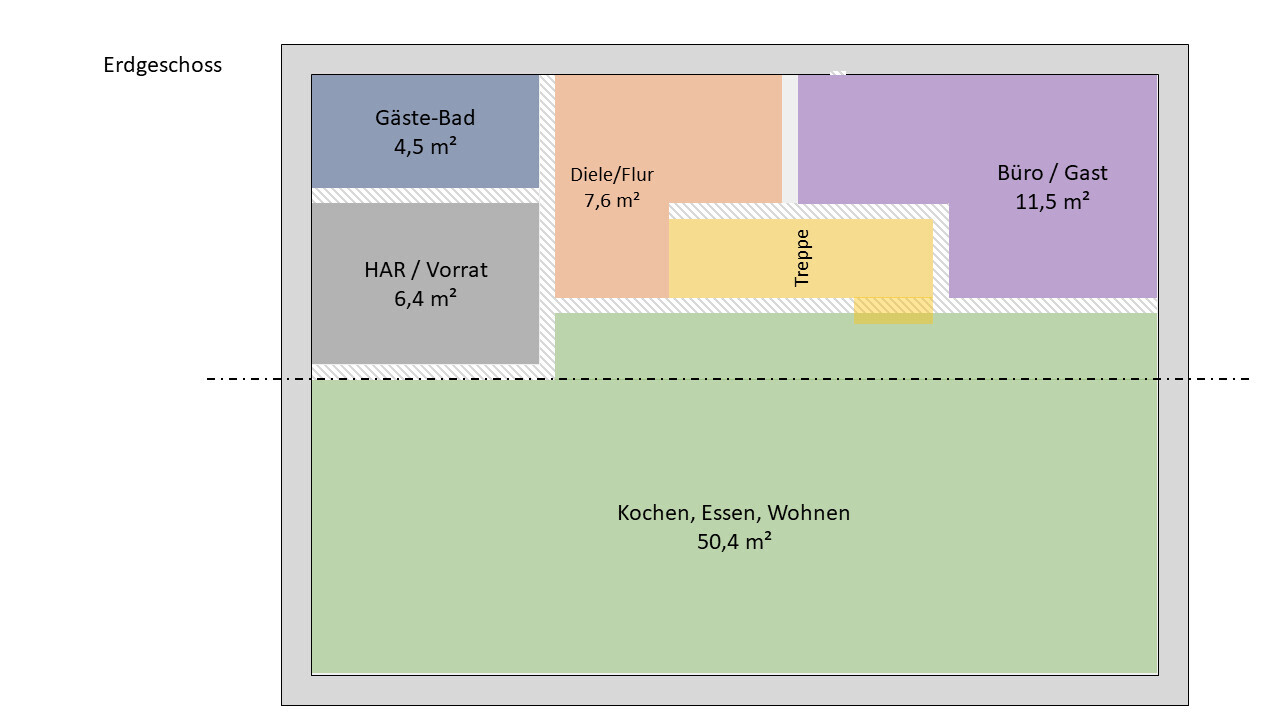
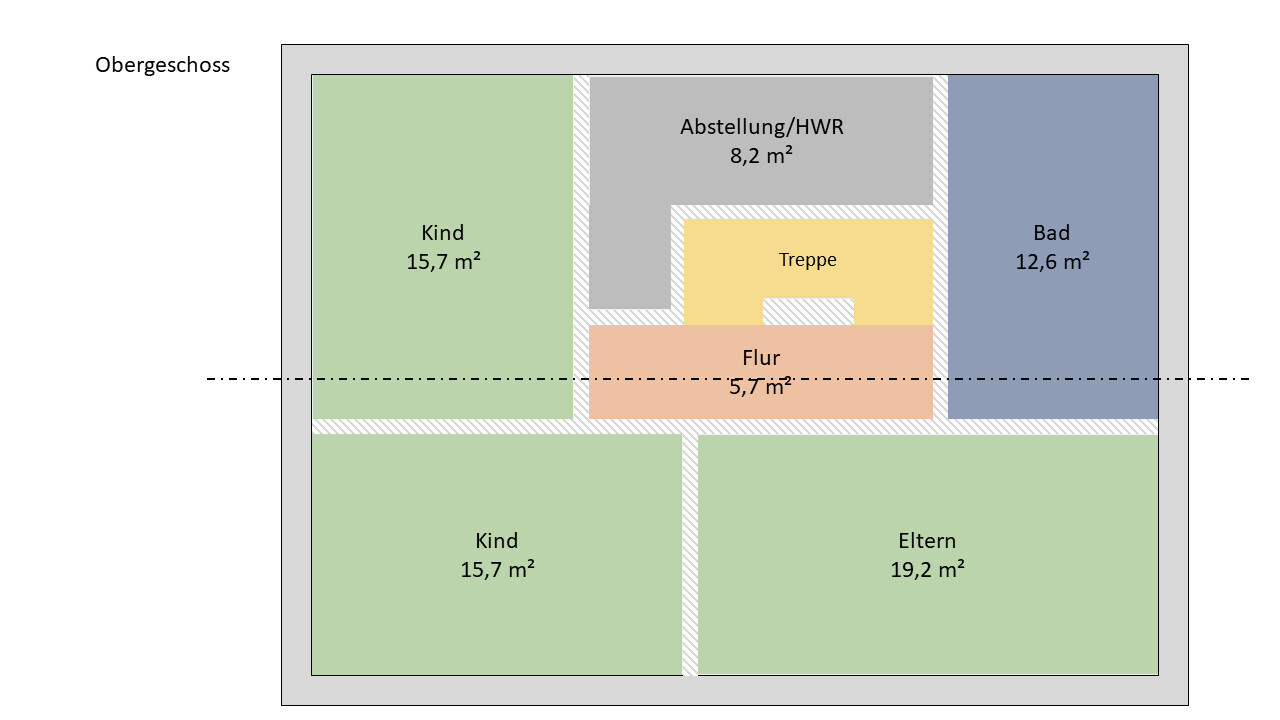
We understand that our plans will be reviewed and approved by a structural engineer in due course. However, on the way there, we would like to align ourselves as closely as possible with the structural framework conditions and hope for your input! This will help us discard floor plan variants early on that might cause major issues later.
Thank you very much and best regards!
I would like to thank you in advance for the many suggestions I have received from reading the numerous posts in this forum over the past period. Now things are becoming more concrete for us: we have been able to purchase a plot of land and are planning to build a single-family house on it.
We are currently at the beginning of the planning stage and are carefully considering possible floor plan layouts. In this context, the question arose as to which structural conditions we need to take into account: specifically, how "free" we are when positioning the walls.
I will first describe our building project:
- We are building on a footprint of about 105 m² (12.0 x 8.75 m (39.4 x 28.7 ft) external dimensions).
- We will construct 2 full stories and an attic as a partial story. No basement will be built.
- The attic is planned as a gable roof without dormers, with a roof pitch of approximately 30 - 35 degrees.
- We prefer to build a "timber house," i.e., timber frame or timber panel construction or similar. However, we are not fixed on this and it could also be a masonry house.
Our questions:
- Which construction type is most suitable for the gable roof? A rafter roof seems to be the most economical option and possibly does not require supports – is this feasible given our building depth (8.75 m (28.7 ft))? Or would another construction type (e.g., purlin roof) be more appropriate, and if so, why?
- Do (possibly) load-bearing walls on the ground floor and upper floor need to be "aligned," or what degree of overlap or spatial proximity should we initially consider to avoid (possibly very costly) special structural solutions later?
- Are there dependencies related to the (central) ridge beam – i.e., should load-bearing walls in the ground and upper floors ideally be arranged near the center as well?
To illustrate our questions more clearly, I am attaching two sketches of possible floor plans for the ground floor and upper floor. I am not looking to start the discussion about the optimal floor plan at this point, although I am already looking forward to your suggestions on this topic!
We understand that our plans will be reviewed and approved by a structural engineer in due course. However, on the way there, we would like to align ourselves as closely as possible with the structural framework conditions and hope for your input! This will help us discard floor plan variants early on that might cause major issues later.
Thank you very much and best regards!
W
wiltshire11 Jan 2025 01:2011ant schrieb:
The "antiserum afterwards" tastes bitter/expensive.If you want everything you see right away, it naturally becomes difficult. A certain ability to abstract is definitely helpful there, you are right.H
HausmitGarten11 Jan 2025 18:44wiltshire schrieb:
You can basically design any room layout you want. Structural challenges like long-span beams or offset load-bearing walls increase material use and costs. Offset load-bearing walls are not suitable for budget-conscious building.11ant schrieb:
Load-bearing walls are indeed best aligned directly above or rather directly below each other. For more information, search (externally, including the quotation marks) for "The upper floor takes priority," "Plan change: From a concrete ceiling to a timber ceiling," and "Lightweight walls in solid construction houses?"
Sort of, not all load transfer needs to be rigidly aligned under the ridge beam. In the layout shown, even if the upper floor were an attic floor, I don’t see any issues.Thanks, that already helps us a lot with the question.11ant schrieb:
No, if used as a storage room, a dry truss roof is probably the most cost-effective option—essentially a free span that also forms the highest floor ceiling; this also allows more flexibility in the upper floor layout.The initial idea was to leave the attic unfinished for now and use it as a cellar replacement. If we want to develop it later, a dry truss roof would be a rather unfavorable solution. In that case, we would prefer a purlin or rafter roof because they offer greater flexibility in room usage. What do you think?
11ant schrieb:
What do the plot and the development plan say about this? Have you considered the 11ant cellar rule ("With or without a cellar: a rule as a decision-making tool")?The plot is 526 m² (5653 sq ft), and the development plan specifies a building level II/2—two full storeys plus an attic considered a non-full storey. The floor space ratio is 0.2, and the plot ratio is 0.4. The city planning office indicated a possible exception regarding the floor space ratio for attic development (e.g., comparing neighboring plots) and therefore suggests planning the rooms as habitable spaces. We have read the 11ant cellar rule—the plot is almost flat. The existing building, which has no cellar, will be demolished.ypg schrieb:
Not from my perspective. That won’t happen. It won’t be your plans submitted to the structural engineer but those of the planner or architect, meaning the professional.Of course, that’s what we meant—we just like calling it "our" project ;-)wiltshire schrieb:
Aside from that, your first draft raises quite different questions:
1. What modern technology is supposed to fit into a utility room of this size?
2. Why does the staircase have a different layout upstairs compared to downstairs?
3. How do you plan to arrange the large living area without creating a big circulation space? (Or do you want space to dance anytime without moving furniture?)
4. How do you efficiently use such a narrow storage room?
5. What size restrictions for furniture arise from the narrow staircase/hallway on the first upper floor?
6. Where are the doors? Where does natural light come from?Thank you for the questions—they help us reconsider our own ideas! I was actually planning to discuss the floor plan in the relevant subforum and provide more input as it develops, but I’m happy to address the topics here first:
- The idea in the floor plan shown is to split the contents of a "classic" utility/technical room on the ground floor into a utility room plus storage on the ground floor, and a laundry room plus storage on the upper floor. Based on typical utility room sizes of about 10–12 m² (108–129 sq ft), the initial thought was to divide that area. Please give us feedback if you think this won’t work. Currently, the goal is at least 8 m² (86 sq ft) on the ground floor. The building services will be typical for a new build—we plan to install a ground-source or air-to-water heat pump, most likely without a buffer tank. We want to place the photovoltaic system’s components in the attic.
- We shaped the staircase based on circulation paths—on the ground floor, separating entrance and living area access to the upper floor—and upstairs tried to be even more space-saving (hence two quarter turns). Does that cause significant extra costs?
- Regarding the "large circulation area," the current plan is to arrange the kitchen on the right side, the dining area in the center, and the living area on the left side. The room faces roughly southeast. Perhaps the room is just planned too large?
- We want to equip the upper floor storage room with wall shelves/cabinets and a washing machine plus dryer. But the narrow width has already been noted negatively—we want to address that.
- The hallway is planned at 1.25 m (49 inches) wide, the staircase has a tread width of 1.0 m (39 inches). We thought these were common dimensions?
- Doors and windows are not yet drawn in—we planned to open the floor plan discussion later.

HausmitGarten schrieb:
The initial idea was and still is not to further develop the attic and to use it as a basement substitute. If an expansion is desired in the future,... then one would realistically need to win the lottery. Unless fertility treatments unexpectedly result in quadruplets, I would primarily consider that mysterious multipurpose space reserves are never given for free. So, use the attic as a basement replacement in moderation, and in case of a significant family size increase, consider moving to a different property. Keeping extra space just for show is a waste of money.https://www.instagram.com/11antgmxde/
https://www.linkedin.com/company/bauen-jetzt/
H
HausmitGarten11 Jan 2025 19:2011ant schrieb:
... you would realistically need to win the lottery. Unless a fertility treatment unexpectedly leads to quadruplets, I would mainly consider that those so-called multi-purpose storage spaces are never really free. So, a basement replacement should be kept moderate, and in case of a sudden increase in family members, relocating might be necessary. Space kept just for show is a waste of money. Our assessment is that, beyond the ground floor and first floor, we will still need storage space, estimating around 20 m² (215 sq ft). The attic initially seems suitable for this. What would be your conclusion in this specific case, apart from the option of attic trusses (which we are not yet convinced about)? Should we reduce the house’s footprint and fully convert the attic? Keep the footprint but choose a flat roof or another roof style, possibly forego the second full floor and work with a high knee wall to minimize the attic space?
HausmitGarten schrieb:
Our assessment is that beyond the ground floor and the upper floor, we still need storage space, estimating about 20 m² (215 sq ft). The attic initially seems suitable for this. What would be your conclusion in this specific case, apart from the option of using attic trusses? I am not drawing any conclusions, Watson. It’s not really reasonable just to squeeze in a picky 20 m² (215 sq ft) of storage space. I mentioned attic trusses only as an economical possibility (since the question was about the cheapest option).
HausmitGarten schrieb:
(Which we are still not convinced about? Reduce the footprint of the house and directly develop the attic? Keep the footprint but choose a flat roof or another roof style, possibly forego the second full floor and work with a high knee wall to minimize the attic space? Don’t design the house underneath the roof yet—this would be putting the cart before the horse. It’s still far too early for such sprint decisions. Before proceeding, you first need to start (with “Module A”). This will produce the requirements specification, into which building form features should not yet be incorporated as headings. Don’t try to acquire qualifications to train the architect.
https://www.instagram.com/11antgmxde/
https://www.linkedin.com/company/bauen-jetzt/
W
wiltshire12 Jan 2025 09:43HausmitGarten schrieb:
What do you mean by "large circulation area"? The current plan is to place the kitchen on the right side, the dining area in the center, and the living area on the left side. Try sketching this out on graph paper and cut out some scale-accurate pieces to represent the furniture and kitchen. Move these around the space to get a feel for the layout. You’ll notice that a lot of space will be left unused, serving only as circulation area—from one zone to another. That’s what I mean by "circulation area." It’s not necessarily a bad thing, but if you consider how much a 1m (3.3 ft) enclosed space costs, you can imagine how expensive inefficient use of space can be—especially if you later find the overall area might be a bit too small.
Similar topics