
ᐅ Complete Renovation of a Single-Family Home from the 1950s
Created on: 28 Dec 2024 10:23
H
Handwerk_82H
Handwerk_8228 Dec 2024 10:23Hello everyone,
I’ve been following this forum for a while and appreciate the input shared here. A few weeks ago, we purchased an old house built in the early 1950s that now requires a complete renovation. I wanted to share some information with you to exchange ideas.
Here are some basic facts:
Year built: 1952
Living area: 115 sqm (1,238 sq ft)
Ground floor: spacious entrance area plus kitchen, dining room, and living room (door from living room to extension)
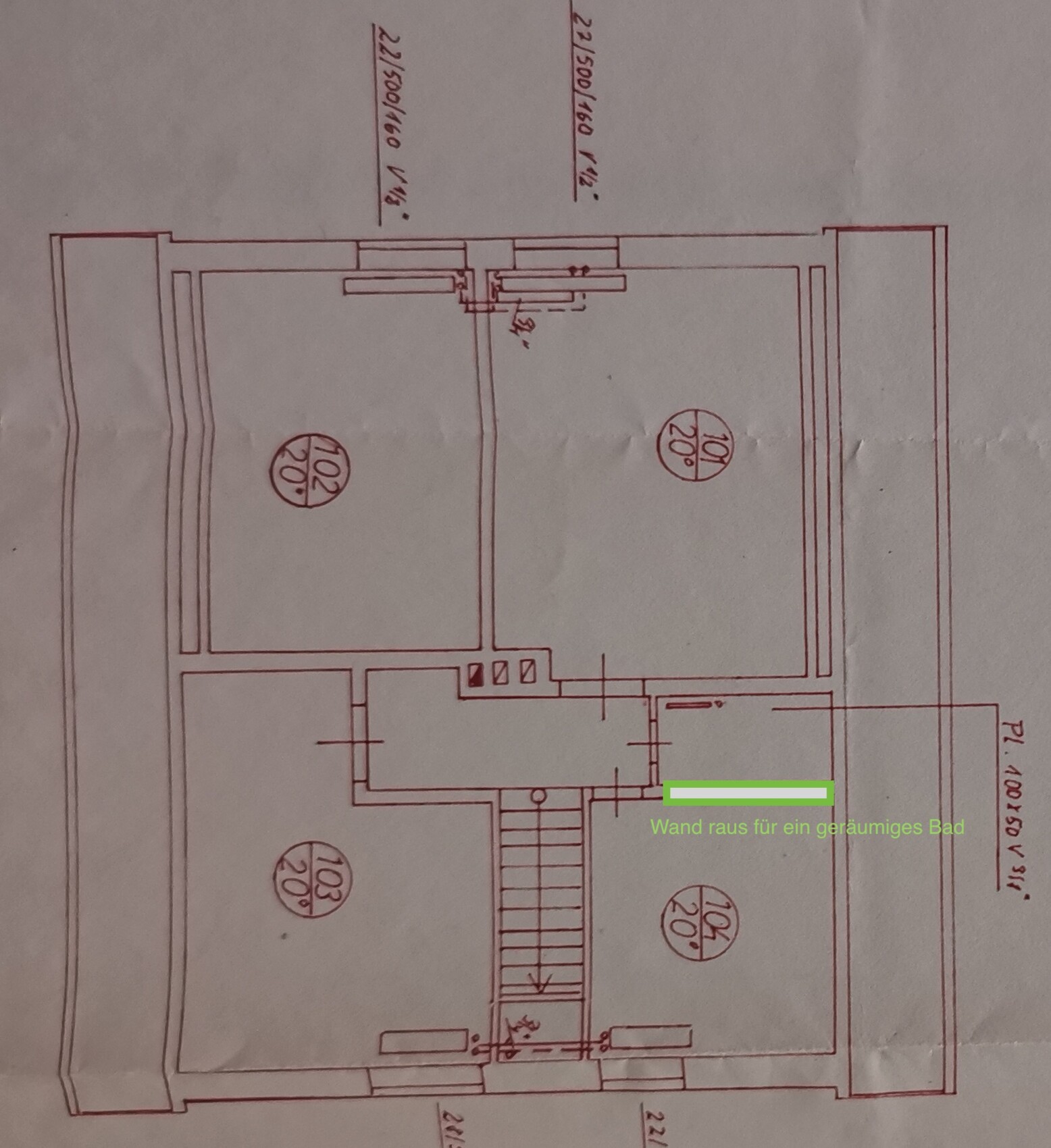
Upper floor: 3 bedrooms + bathroom (currently 4 rooms + small WC)
Fully basemented
Plot size: just over 700 sqm (7,535 sq ft)
Extension: The house has an extension accessible directly from the living room and from the garden (see photo below). The extension offers about 60 sqm (645 sq ft) of usable space. Of this, 25 sqm (270 sq ft) has a flat roof and 35 sqm (375 sq ft) additional space under a pitched roof, which could also be converted. My idea is to convert the extension into living space later on. For cost reasons, we plan to focus on the main house first and deal with the extension afterwards.
What we plan to do:
Floor plan
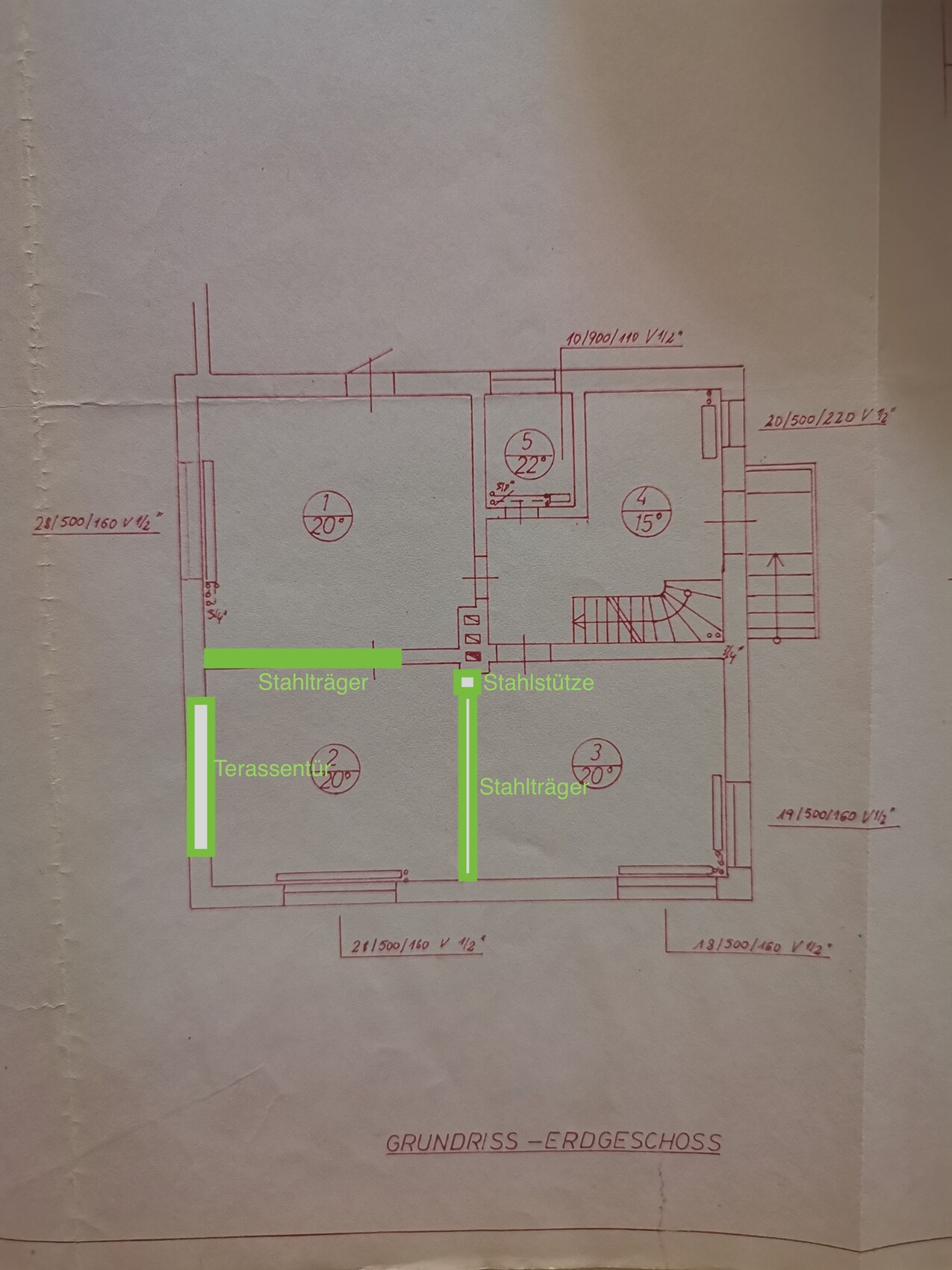
- We want to create an open plan on the ground floor by removing two load-bearing walls. This will require installing two steel beams and one steel column.
- We want to create direct access from the house to the garden, as access currently is only possible via an outside gate or through the extension: For this, part of the wall in the future dining room will be removed and a steel beam installed, including a 2m (6.6 ft) wide patio door.
- Combine the small WC and office on the upper floor into a spacious bathroom. Since it’s not a load-bearing wall, it can be removed. However, due to the room’s awkward shape (see photo), fitting all necessary elements will be a challenge, so we will consult a bathroom designer.
Heating
- Replace the old oil heating system with a heat pump.
- Install underfloor heating on the ground floor and in the upper floor bathroom. Replace the other heating elements upstairs to make them efficient for use with a heat pump.
- The ceiling height on the ground floor is about 265 cm (104 inches). I have already removed the floorboards in three rooms, which gained us about 9.5 cm (3.7 inches); there is now bare concrete.
- We are considering buying the BOSCH air source heat pump model CS787 AW 7 OR-S. According to the energy consultant, the smaller model should be sufficient. The extra cost is negligible, and we do not plan to implement all measures from the energy advisor. As far as I understand, there is no disadvantage if the device runs at lower capacity. Possibly, we would not need a second heat pump when we start work on the extension in a few years.
Plumbing
- Replace all pipes throughout the house. We will take care of the demolition ourselves.
- So far, the house has been supplied independently by a well. We will now connect to the municipal water supply for drinking water, showering, and laundry. However, the well will still be used for the garden.
- Both bathrooms need a complete refurbishment. The guest WC downstairs is about 3 sqm (32 sq ft) and previously had a bathtub, which we have removed. We want to make it a small guest WC only. The bathroom upstairs will be more challenging.
Insulation
- Blown-in insulation: We have about 8.5 cm (3.3 inches) space between the interior wall and brickwork, so we plan to apply blown-in insulation. We have not yet decided on the material.
- Insulation of the top floor ceiling: We will insulate the top floor ceiling from the inside. We can install about 12 cm (4.7 inches) of insulation between the joists (+/- 1 cm / 0.4 inches, as not all beams are the same width). We are considering whether to add battens to extend the thickness of the insulation by 5-6 cm (2-2.4 inches), or whether to use the current space for the between-joist insulation and additionally install a 4-5 cm (1.6-2 inches) PIR/PUR board below the joists, using both together.
Electrical
- Recently renewed, but unfortunately without documentation. We will check whether a full rewiring is necessary or only partial work is required. A good electrician friend inspected it and said it looks fine and he wouldn’t redo it. However, we are uncertain, especially because we are renovating the entire house and might want the electrical system redone. Also, the main electrical panel is currently in the extension. We are considering relocating it to the basement of the main house.
Windows and front door
- We want to replace all windows in the house (except the basement) and the front door. All windows should be triple-glazed. We have had several discussions already about whether double or triple glazing is better in a house with this level of insulation to prevent moisture buildup and mold in the walls. Currently, our plan is to install triple-glazed windows. What are your opinions on double vs. triple glazing?
Roof
- Does not need to be replaced.
I look forward to your input and am happy to provide more information. So far, we have cleared out the house (which was full of furniture etc.) and done part of the gutting. We will handle the entire gutting and removal of the water pipes ourselves. We h

I’ve been following this forum for a while and appreciate the input shared here. A few weeks ago, we purchased an old house built in the early 1950s that now requires a complete renovation. I wanted to share some information with you to exchange ideas.
Here are some basic facts:
Year built: 1952
Living area: 115 sqm (1,238 sq ft)
Ground floor: spacious entrance area plus kitchen, dining room, and living room (door from living room to extension)
Upper floor: 3 bedrooms + bathroom (currently 4 rooms + small WC)
Fully basemented
Plot size: just over 700 sqm (7,535 sq ft)
Extension: The house has an extension accessible directly from the living room and from the garden (see photo below). The extension offers about 60 sqm (645 sq ft) of usable space. Of this, 25 sqm (270 sq ft) has a flat roof and 35 sqm (375 sq ft) additional space under a pitched roof, which could also be converted. My idea is to convert the extension into living space later on. For cost reasons, we plan to focus on the main house first and deal with the extension afterwards.
What we plan to do:
Floor plan
- We want to create an open plan on the ground floor by removing two load-bearing walls. This will require installing two steel beams and one steel column.
- We want to create direct access from the house to the garden, as access currently is only possible via an outside gate or through the extension: For this, part of the wall in the future dining room will be removed and a steel beam installed, including a 2m (6.6 ft) wide patio door.
- Combine the small WC and office on the upper floor into a spacious bathroom. Since it’s not a load-bearing wall, it can be removed. However, due to the room’s awkward shape (see photo), fitting all necessary elements will be a challenge, so we will consult a bathroom designer.
Heating
- Replace the old oil heating system with a heat pump.
- Install underfloor heating on the ground floor and in the upper floor bathroom. Replace the other heating elements upstairs to make them efficient for use with a heat pump.
- The ceiling height on the ground floor is about 265 cm (104 inches). I have already removed the floorboards in three rooms, which gained us about 9.5 cm (3.7 inches); there is now bare concrete.
- We are considering buying the BOSCH air source heat pump model CS787 AW 7 OR-S. According to the energy consultant, the smaller model should be sufficient. The extra cost is negligible, and we do not plan to implement all measures from the energy advisor. As far as I understand, there is no disadvantage if the device runs at lower capacity. Possibly, we would not need a second heat pump when we start work on the extension in a few years.
Plumbing
- Replace all pipes throughout the house. We will take care of the demolition ourselves.
- So far, the house has been supplied independently by a well. We will now connect to the municipal water supply for drinking water, showering, and laundry. However, the well will still be used for the garden.
- Both bathrooms need a complete refurbishment. The guest WC downstairs is about 3 sqm (32 sq ft) and previously had a bathtub, which we have removed. We want to make it a small guest WC only. The bathroom upstairs will be more challenging.
Insulation
- Blown-in insulation: We have about 8.5 cm (3.3 inches) space between the interior wall and brickwork, so we plan to apply blown-in insulation. We have not yet decided on the material.
- Insulation of the top floor ceiling: We will insulate the top floor ceiling from the inside. We can install about 12 cm (4.7 inches) of insulation between the joists (+/- 1 cm / 0.4 inches, as not all beams are the same width). We are considering whether to add battens to extend the thickness of the insulation by 5-6 cm (2-2.4 inches), or whether to use the current space for the between-joist insulation and additionally install a 4-5 cm (1.6-2 inches) PIR/PUR board below the joists, using both together.
Electrical
- Recently renewed, but unfortunately without documentation. We will check whether a full rewiring is necessary or only partial work is required. A good electrician friend inspected it and said it looks fine and he wouldn’t redo it. However, we are uncertain, especially because we are renovating the entire house and might want the electrical system redone. Also, the main electrical panel is currently in the extension. We are considering relocating it to the basement of the main house.
Windows and front door
- We want to replace all windows in the house (except the basement) and the front door. All windows should be triple-glazed. We have had several discussions already about whether double or triple glazing is better in a house with this level of insulation to prevent moisture buildup and mold in the walls. Currently, our plan is to install triple-glazed windows. What are your opinions on double vs. triple glazing?
Roof
- Does not need to be replaced.
I look forward to your input and am happy to provide more information. So far, we have cleared out the house (which was full of furniture etc.) and done part of the gutting. We will handle the entire gutting and removal of the water pipes ourselves. We h
Similar topics