
ᐅ Add wood gasification boilers, hydronic fireplaces, and solar systems to gas heating.
Created on: 20 Jan 2024 13:08
J
Jansepp
Dear forum community,
I would like to ask for advice regarding the upgrade of our heating system. I am quite skilled in some areas of DIY, but not when it comes to heating. Please excuse me if my questions seem amateurish. Ultimately, a professional will carry out the work, but I would like to better understand the topic myself in order to be able to assess everything.
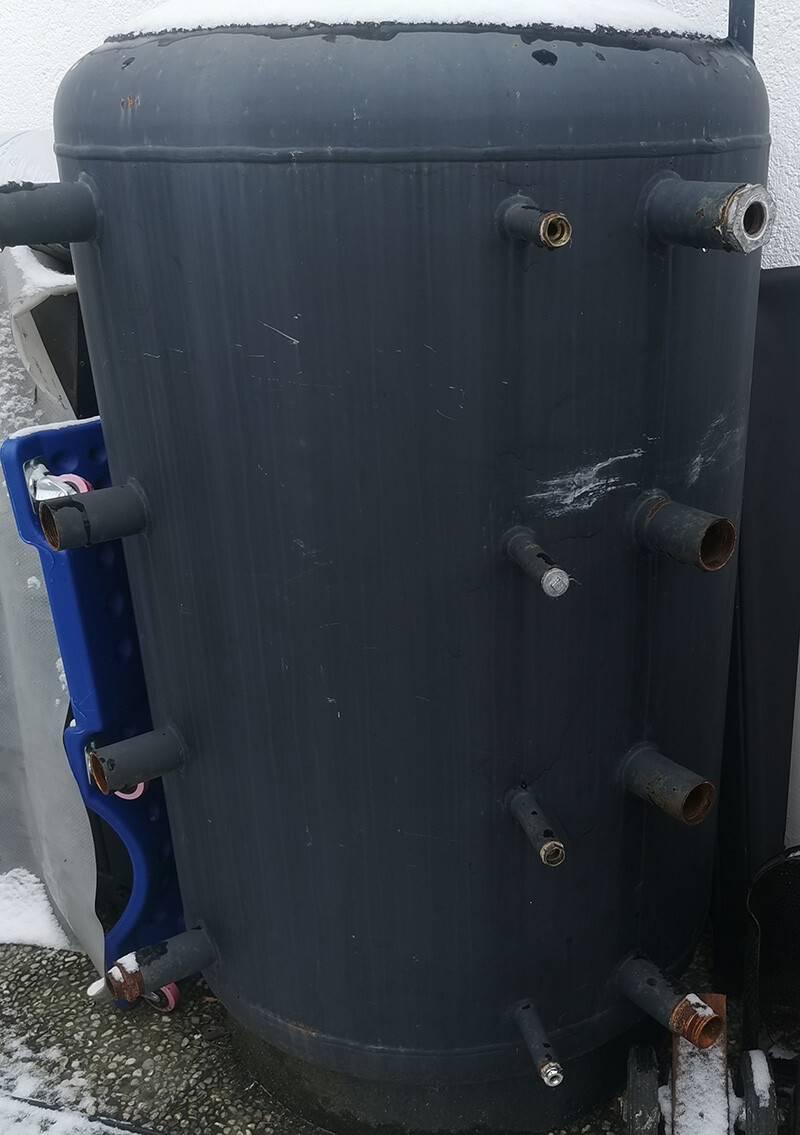
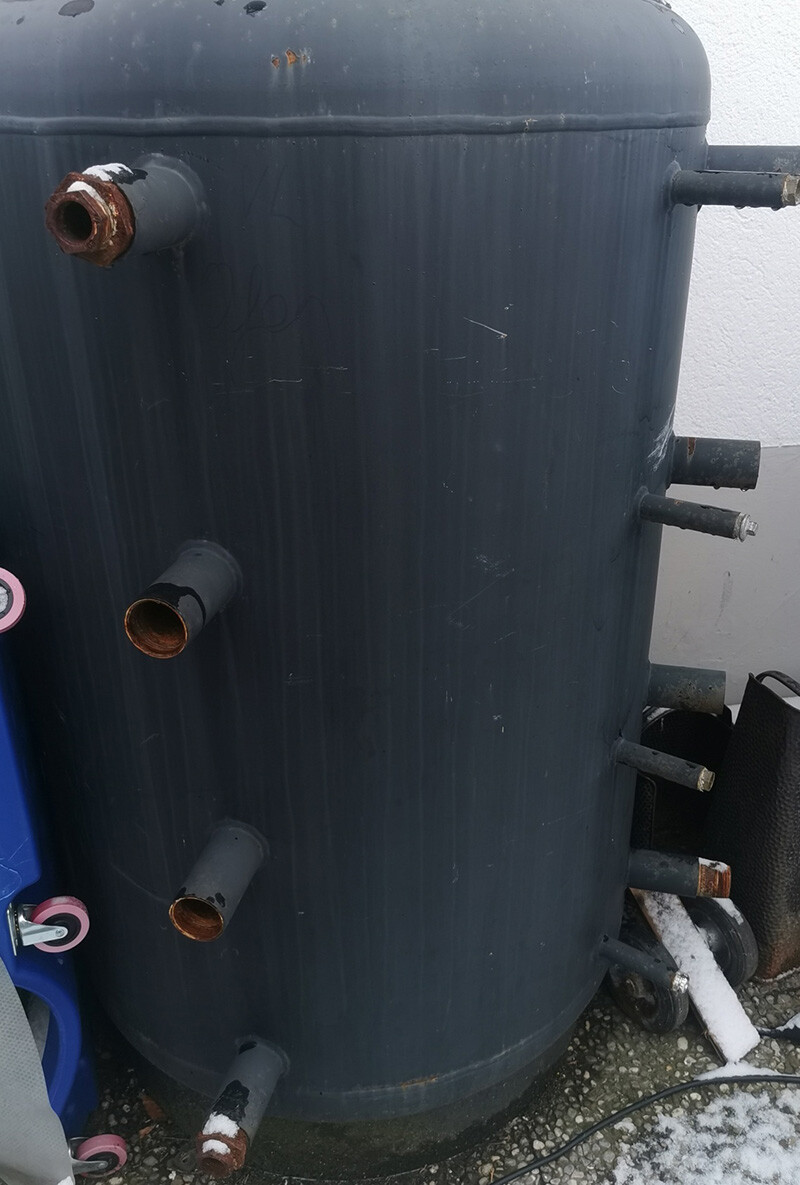
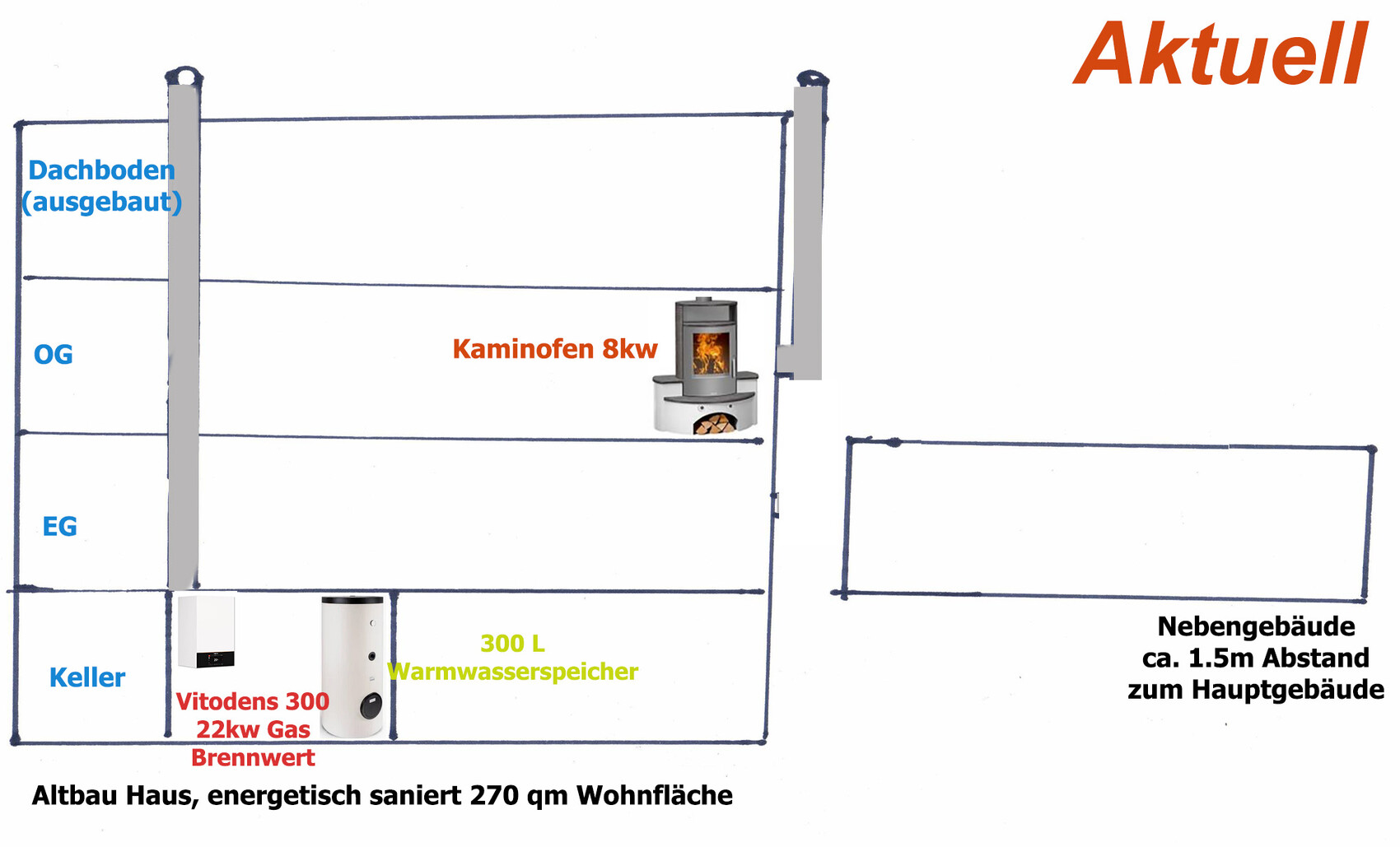
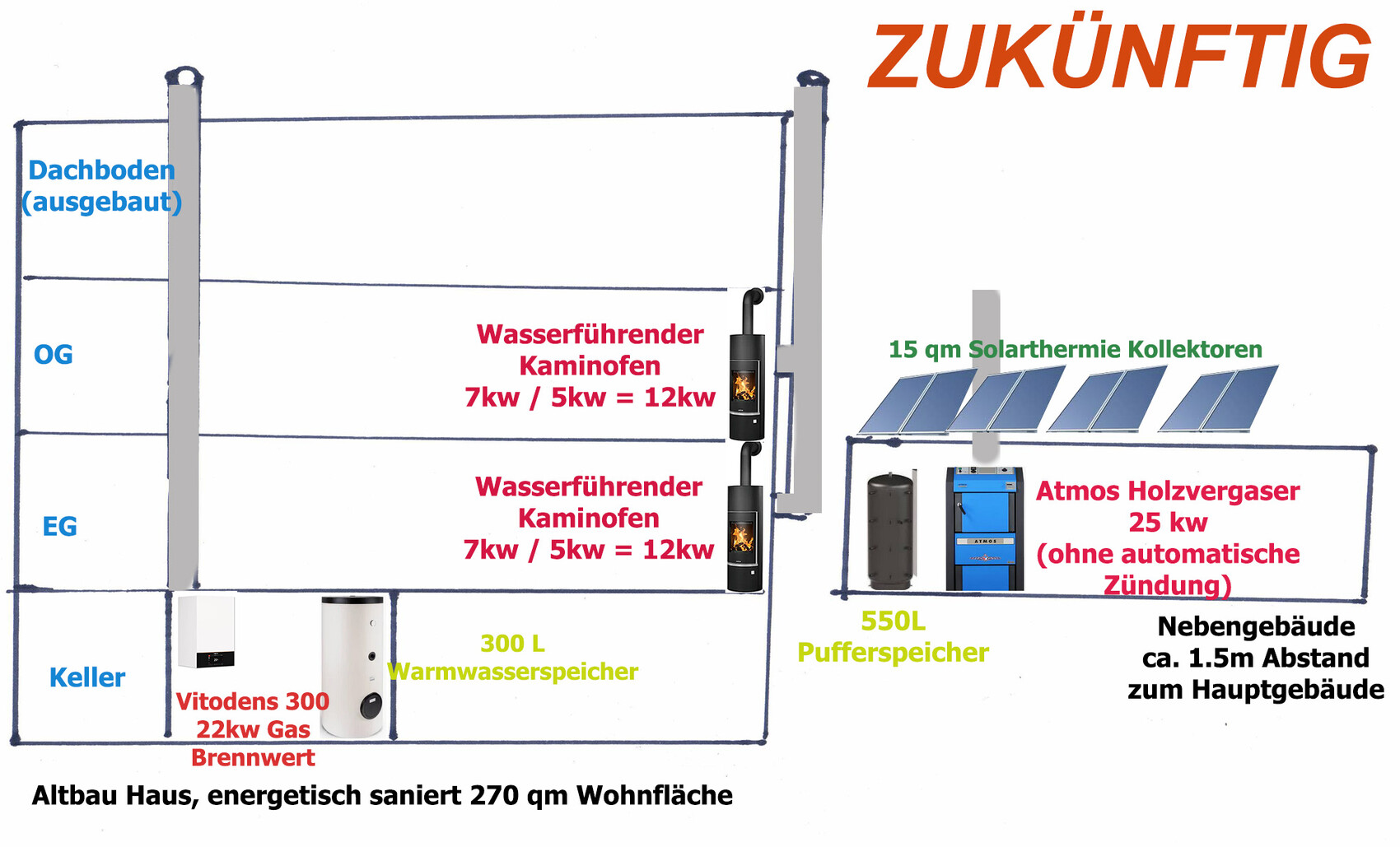
I am attaching sketches of the current and planned setups, as well as pictures of the buffer storage tank.
Currently, we heat our house (an old building from 1930 with an extension from the 1970s) with a Viessmann Vitodens 300 condensing boiler connected to a simple 300 L (79 gallons) domestic hot water tank. Additionally, there is a wood stove with an external chimney.
The house is now being energy renovated, and to avoid dependence on gas, the primary energy source is intended to be wood combined with solar thermal energy.
This means:
- Installation of an Atmos wood gasifier with 25 kW output
- Installation of two water-jacketed wood stoves, each with 12 kW output (7 kW room air, 5 kW water jacket)
- Installation of a 550 L (145 gallons) buffer storage tank
- Installation of a 15 m² (161 sq ft) solar thermal system
The two stoves will be regularly fired during the day and evening.
We basically have free access to wood.
So far, so good, but I still have the following issues / questions:
- I would like not to have to reload the wood gasifier constantly but rather bring the buffer tank up to temperature once a day. Are 550 L buffer tanks sufficient for 270 m² (2,906 sq ft) of living space? If not, how many liters would be recommended?
- Is the buffer tank suitable for this setup in terms of connections? Unfortunately, I have no data on this. It came together with one of the water-jacketed stoves. The flange still has three inlets and outlets. For example, I do not know if it is suitable for domestic hot water production (it of course has insulation, which is not shown in the photos). I would also appreciate alternative purchase recommendations.
- I assume that the current 300 L (79 gallons) tank can be removed completely, as it will no longer be needed? Or will I need a tank for domestic hot water in the future, with the buffer tank only used for heating water?
- Is it advisable to place the buffer tank in the outbuilding or would it be better located in the basement next to the gas boiler? Or does the location not matter?
- How / by which device (controller?) can the system be set up so that the gas boiler starts automatically when the temperature in the buffer tank drops too low? The gas boiler should remain as a backup in case the stoves, wood gasifier, and solar thermal system fail to provide sufficient heat for any reason.
- What share of the energy supply can the solar thermal system roughly be expected to contribute?
- Now a difficult question: approximately how high might the costs be for the connection work / piping?
Thank you very much and best regards,
Josef

I would like to ask for advice regarding the upgrade of our heating system. I am quite skilled in some areas of DIY, but not when it comes to heating. Please excuse me if my questions seem amateurish. Ultimately, a professional will carry out the work, but I would like to better understand the topic myself in order to be able to assess everything.
I am attaching sketches of the current and planned setups, as well as pictures of the buffer storage tank.
Currently, we heat our house (an old building from 1930 with an extension from the 1970s) with a Viessmann Vitodens 300 condensing boiler connected to a simple 300 L (79 gallons) domestic hot water tank. Additionally, there is a wood stove with an external chimney.
The house is now being energy renovated, and to avoid dependence on gas, the primary energy source is intended to be wood combined with solar thermal energy.
This means:
- Installation of an Atmos wood gasifier with 25 kW output
- Installation of two water-jacketed wood stoves, each with 12 kW output (7 kW room air, 5 kW water jacket)
- Installation of a 550 L (145 gallons) buffer storage tank
- Installation of a 15 m² (161 sq ft) solar thermal system
The two stoves will be regularly fired during the day and evening.
We basically have free access to wood.
So far, so good, but I still have the following issues / questions:
- I would like not to have to reload the wood gasifier constantly but rather bring the buffer tank up to temperature once a day. Are 550 L buffer tanks sufficient for 270 m² (2,906 sq ft) of living space? If not, how many liters would be recommended?
- Is the buffer tank suitable for this setup in terms of connections? Unfortunately, I have no data on this. It came together with one of the water-jacketed stoves. The flange still has three inlets and outlets. For example, I do not know if it is suitable for domestic hot water production (it of course has insulation, which is not shown in the photos). I would also appreciate alternative purchase recommendations.
- I assume that the current 300 L (79 gallons) tank can be removed completely, as it will no longer be needed? Or will I need a tank for domestic hot water in the future, with the buffer tank only used for heating water?
- Is it advisable to place the buffer tank in the outbuilding or would it be better located in the basement next to the gas boiler? Or does the location not matter?
- How / by which device (controller?) can the system be set up so that the gas boiler starts automatically when the temperature in the buffer tank drops too low? The gas boiler should remain as a backup in case the stoves, wood gasifier, and solar thermal system fail to provide sufficient heat for any reason.
- What share of the energy supply can the solar thermal system roughly be expected to contribute?
- Now a difficult question: approximately how high might the costs be for the connection work / piping?
Thank you very much and best regards,
Josef
Jansepp schrieb:
I brought the wood into the house, but it has stayed cold.Pellet heating? A wood stove that can also provide hot water… everything is possibleDomestic and heating water systems are always separate. The buffer tank should be significantly larger, at least 1500 liters (400 gallons), or if you have space, even double that.
Solar panels provide enough energy for domestic hot water in summer; 4-6 m² (43-65 sq ft) is sufficient, but in winter they provide almost nothing. A 25 kW + 2x5 kW setup seems excessive to me. I would choose two standard wood-burning stoves instead, which are much cheaper.
If you can program a control system yourself, you might try combining it with the gas heating. If not, I would go for the best control system available—as your right hand—and operate it manually.
Solar panels provide enough energy for domestic hot water in summer; 4-6 m² (43-65 sq ft) is sufficient, but in winter they provide almost nothing. A 25 kW + 2x5 kW setup seems excessive to me. I would choose two standard wood-burning stoves instead, which are much cheaper.
If you can program a control system yourself, you might try combining it with the gas heating. If not, I would go for the best control system available—as your right hand—and operate it manually.
 Winniefred23 Jan 2024 16:31
Grundaus schrieb:
Domestic hot water and heating water are always kept separate. The buffer tank should be significantly larger, at least 1500 liters (400 gallons), or double that if you have the space.
Solar thermal provides enough energy for domestic hot water in summer; 4–6 m² (43–65 sq ft) is sufficient, but in winter it provides almost nothing. A 25 kW + 2x5 kW system seems very large to me. I would choose two standard wood-burning stoves instead, as they are much cheaper. If you can program a control system yourself, you could try combining this with the gas heating. If not, I would take the best control system available—your right hand—and operate it manually. You can't say it like that. Our solar thermal system has delivered over 60°C (140°F) even at deep subzero temperatures (we use it for both water and heating support). Of course, output is low in the darkest winter months, but it’s not zero. Friends of ours have had solar thermal for six years and with five people in the household, they don’t need any gas between May and September/October and significantly less during transitional seasons than before installing solar thermal.
For a 25kW wood gasification boiler, a minimum of 2000 liters (530 gallons) buffer tank plus a separate hot water tank (fed from the buffer) is recommended.
If you only want to run the gasification boiler once a day, choose a different model. The Attack SLX Lambda (for example) has a buffer volume twice as large and features excellent controls. For Atmos boilers, it depends on the model—are there any with automatic regulation by now?
I wouldn’t combine it with gas; instead, use a heat pump. The heat pump should feed directly into the supply line, not through the buffer tank. Set the heat pump with a lower heating curve than the control for the gasification boiler. This way, the heat pump will automatically switch off as soon as the storage tank provides sufficient temperature and turn back on when it cools down.
If you only want to run the gasification boiler once a day, choose a different model. The Attack SLX Lambda (for example) has a buffer volume twice as large and features excellent controls. For Atmos boilers, it depends on the model—are there any with automatic regulation by now?
I wouldn’t combine it with gas; instead, use a heat pump. The heat pump should feed directly into the supply line, not through the buffer tank. Set the heat pump with a lower heating curve than the control for the gasification boiler. This way, the heat pump will automatically switch off as soon as the storage tank provides sufficient temperature and turn back on when it cools down.
Winniefred schrieb:
You can't really say it like that. Our solar thermal system provided over 60 degrees Celsius (140°F) even at deep subzero temperatures (we use it for water heating and heating support). Of course, during the darkest winter months it's less, but not zero. Friends of ours have had a solar thermal system for six years and with five people, they don't need any gas between May and September/October, and significantly less gas during the transition seasons compared to before installing solar thermal. Are you actually aware of the cost of heating domestic hot water with gas? I need 20 cubic meters (706 cubic feet) per month; a large family might use three times that...
You could heat domestic hot water with gas for many years before a solar thermal system pays for itself^^
A 1500-liter (396-gallon) buffer tank?!?! For what purpose?
Similar topics