
ᐅ Comparison Tests of Various Centralized Mechanical Ventilation Systems with Heat Recovery + Additional Questions
Created on: 1 Nov 2017 17:46
4
4MotionHello dear forum community,
I have a few questions about controlled residential ventilation systems that my own research online and in this forum haven’t helped me with. If you don’t want to read everything, feel free to jump straight to the questions.
First, about our situation: Two builders independently advised us against controlled residential ventilation. The first said it’s not necessary. He prefers to build with clay bricks (Poroton), which are vapor-permeable and allow excess moisture to move outside. He also applies hydraulic lime plaster to the walls, which can quickly absorb and release a lot of moisture and also absorb pollutants. Both the plaster and Poroton do not provide a breeding ground for mold or bacteria. Just occasional manual ventilation (opening windows briefly) is sufficient. He is also critical of the cleaning of duct systems. Well, that’s his opinion for now.
The other builder builds entirely with wood but argues similarly. He told us about customers who installed a controlled residential ventilation system just for safety but have now completely turned it off because they didn’t need it.
So initially, we were against controlled residential ventilation. After my research, however, I still want to have one. Personally, I’m somewhat negligent when it comes to ventilation. My wife, on the other hand, is a ventilation fanatic and always needs a lot of fresh air. She also always finds the air in prefabricated house showrooms very stuffy, which made us even more opposed to controlled residential ventilation. She actually prefers to ventilate manually all the time. Some windows in our home are even left slightly open for longer periods.
1. I am still a bit skeptical. Is there a statistic on what percentage of new builds have a controlled residential ventilation system?
2. To me as a layperson, all systems sound the same. Are there any comparison tests between different brands? Since controlled residential ventilation systems are so widespread, there should be tests similar to those for vacuum cleaners or kitchen appliances.
3. Who are the market leaders and which brands are rather niche players? So I can compare the top 5 myself.
4. Is it better to use round ducts with wide radii instead of flat ducts that sometimes bend sharply at 90°, to allow better cleaning? Or have you not considered that important?
I have a few questions about controlled residential ventilation systems that my own research online and in this forum haven’t helped me with. If you don’t want to read everything, feel free to jump straight to the questions.
First, about our situation: Two builders independently advised us against controlled residential ventilation. The first said it’s not necessary. He prefers to build with clay bricks (Poroton), which are vapor-permeable and allow excess moisture to move outside. He also applies hydraulic lime plaster to the walls, which can quickly absorb and release a lot of moisture and also absorb pollutants. Both the plaster and Poroton do not provide a breeding ground for mold or bacteria. Just occasional manual ventilation (opening windows briefly) is sufficient. He is also critical of the cleaning of duct systems. Well, that’s his opinion for now.
The other builder builds entirely with wood but argues similarly. He told us about customers who installed a controlled residential ventilation system just for safety but have now completely turned it off because they didn’t need it.
So initially, we were against controlled residential ventilation. After my research, however, I still want to have one. Personally, I’m somewhat negligent when it comes to ventilation. My wife, on the other hand, is a ventilation fanatic and always needs a lot of fresh air. She also always finds the air in prefabricated house showrooms very stuffy, which made us even more opposed to controlled residential ventilation. She actually prefers to ventilate manually all the time. Some windows in our home are even left slightly open for longer periods.
1. I am still a bit skeptical. Is there a statistic on what percentage of new builds have a controlled residential ventilation system?
2. To me as a layperson, all systems sound the same. Are there any comparison tests between different brands? Since controlled residential ventilation systems are so widespread, there should be tests similar to those for vacuum cleaners or kitchen appliances.
3. Who are the market leaders and which brands are rather niche players? So I can compare the top 5 myself.
4. Is it better to use round ducts with wide radii instead of flat ducts that sometimes bend sharply at 90°, to allow better cleaning? Or have you not considered that important?

4Motion schrieb:
He prefers to build with bricks (Poroton), which are vapor-permeable and allow excess moisture to escape to the outside.Hmm, someone must have skipped physics class...
4Motion schrieb:
Just ventilate briefly a few times a day, and that’s enough.If only it were that simple...
4Motion schrieb:
He is also skeptical about the cleaning of the duct systems.Commercial buildings are a completely different matter, so what exactly is different about the ducts in single-family homes?
4Motion schrieb:
He told us about clients who installed a mechanical ventilation system with heat recovery for safety but completely turned it off because they didn’t need it.Sure, he knows someone who knows someone...
4Motion schrieb:
From my research, I still want to have one.Good decision, provided you are building a typical house according to energy-saving regulations (building permit / planning permission) or a better standard. And you are not at home all the time to maintain ventilation intervals manually.
4Motion schrieb:
She also finds the air in the prefab house showrooms very stuffy,That makes sense, as these usually do not have mechanical ventilation systems installed. They aren’t necessary there… almost no moisture is generated since nobody is showering or cooking there—let alone living in them.
1) Slightly older data, but the trend is clear
2) There are really only 3-4 main manufacturers; the others just put their name on the products… What exactly do you want to know? The technical specifications are usually available on manufacturer websites, and the systems are about 90% the same regardless of brand—the main differences are usually the controls and type/cost of filters.
3) Helios, Brink, Zehnder, Pluggit, to name a few.
But as I said, most of the systems are basically identical. Wolf, Stiebel Eltron, and a few smaller brands all supply Brink equipment.
4) There is no one-size-fits-all solution… often only one option is offered anyway.
4Motion schrieb:
He prefers to build with bricks (Poroton), which are vapor-permeable and allow excess moisture to escape to the outside. He also applies red lime plaster to the walls, which can absorb and release a large amount of moisture very quickly and also absorb pollutants. Both (the plaster and Poroton) do not provide a breeding ground for mold and bacteria. Just ventilate briefly from time to time, and that’s sufficient.With a bit of thought, anyone should realize that this is nonsense. But anyway... the question was whether there are any tests. I only know of the Passive House Institute’s database.
And if you believe it, the individual units differ quite significantly in terms of energy efficiency and noise levels.
4Motion schrieb:
1. I am still a bit skeptical. Is there any statistic on what percentage of new builds have a controlled residential ventilation system?
2. To me as a layperson, all systems sound the same. Are there comparison tests between the different brands? Since controlled residential ventilation systems are so widespread, there should be tests similar to those for vacuum cleaners or kitchen appliances.
3. Which are the market leaders and which ones have a rather niche presence? So I can compare the Big 5 myself.
4. Is it better to use round ducts with wide radii instead of flat ducts that sometimes bend sharply at 90°, to make cleaning easier, or did you not pay attention to that?1. I can’t say much about that. We deliberately chose a controlled residential ventilation system because we simply cannot ventilate constantly ourselves. Alternatively, the developer offered us a decentralized solution without heat recovery... but that was never an option for us.
2+3. We will use a Vallox MV-350; presumably, other manufacturers are quite similar. However, Vallox offers everything from the smallest to the largest systems themselves. What convinced me was the ability to upgrade with various heating coils and an enthalpy heat exchanger for moisture recovery.
4. We installed round ducts. That was the decision of the ventilation planner. Maybe it will be easier to access them later for cleaning? All pipes for the ground floor are installed in the ceiling slab.
Does anyone know if these systems need to be cleaned and how?
S
stefanc843 Nov 2017 08:16munger71 schrieb:
Does anyone know if these need to be cleaned and how?Dust tends to build up quite quickly inside the exhaust ducts, especially those with internal ridges. I don't see this as a major issue since it's air going outside. The fresh air ducts get much less dirty.
You can clean them using a rotating duct brush and a vacuum cleaner at the duct outlet.
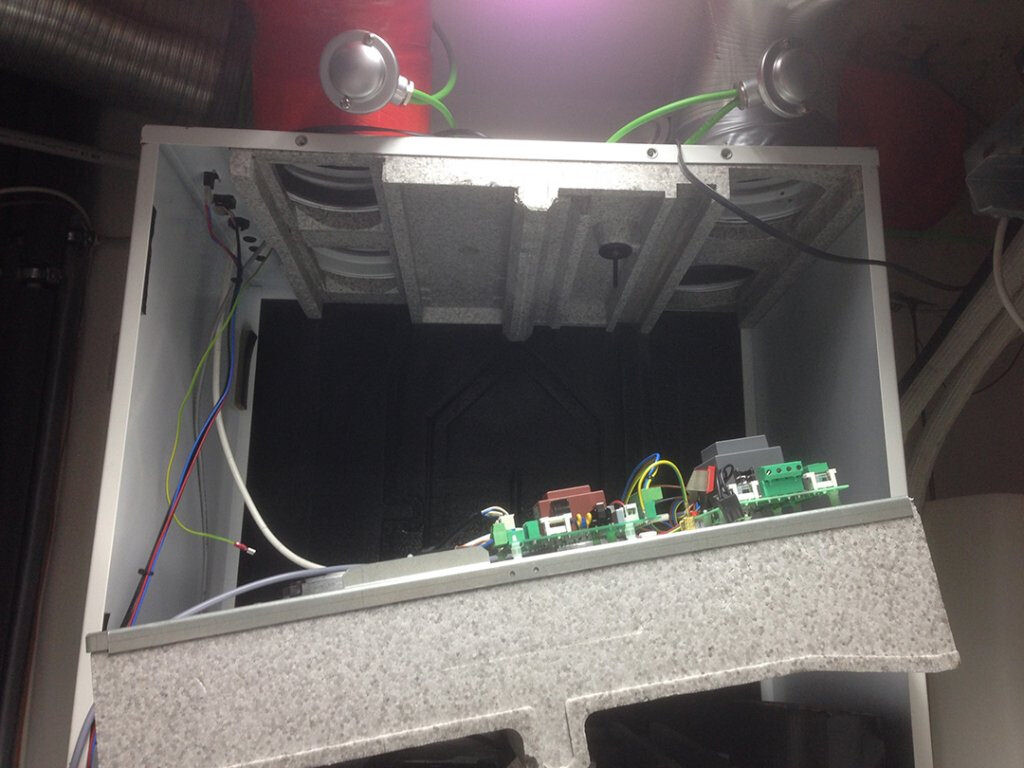
I once posted pictures showing what a system and its pipes look like from the inside after 3 years of continuous operation... I need to find them again...
Here is a picture from the inside:
And here one of the impellers:
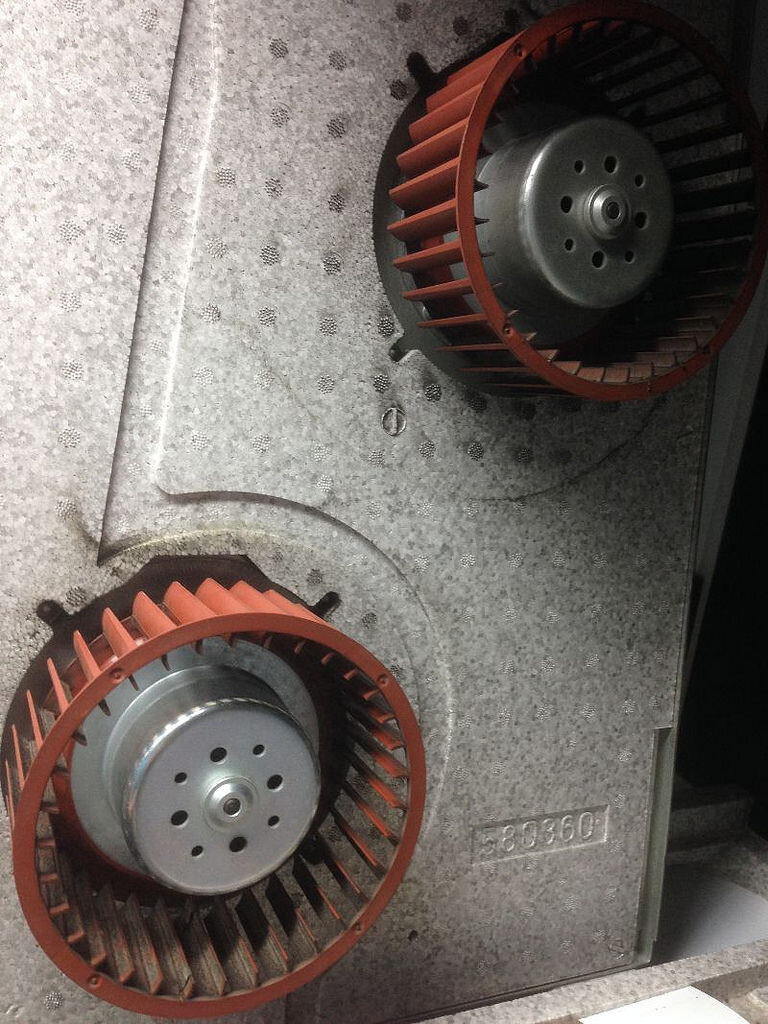
As you can see, it’s not very dirty... I expect the first thorough cleaning to be necessary no earlier than after 10 years of continuous operation... although by then, one or both motors will likely fail and need replacement.
Here is a picture from the inside:
And here one of the impellers:
As you can see, it’s not very dirty... I expect the first thorough cleaning to be necessary no earlier than after 10 years of continuous operation... although by then, one or both motors will likely fail and need replacement.
Similar topics