
On the right side of this terrace, about 80cm (31 inches) down to the lawn, a small staircase with 4 steps is needed.
It will be built from granite slabs and will be quite a solid block, likely only movable as a whole.
A gravel layer will be used as the base.
Based on my long experience observing construction sites, this layer should be compacted.
For that, a vibratory plate compactor is usually the best choice.
However, since this house is on a slope, and this is an ongoing issue, there is no simple way to get a 50-kilogram (110-pound) machine behind the house. Carrying it down the concrete steps and back up again would be quite a challenge.
The alternative would be a hand tamper — a rod with a flat plate at the bottom — which I would have to borrow somehow, but such a tool does not provide nearly the level of compaction that would be ideal.
I assume there is no solution to this problem and I simply can’t think of one, but maybe I am overlooking something?

KarstenausNRW schrieb:
There are many options.The very simple and traditionally common method was to turn a spade upside down and use the handle to firmly tamp down gravel, sand, etc. Houses were built this way that are still standing today, or maybe not 😉
B
Buchsbaum27 Nov 2023 16:34KarstenausNRW schrieb:
Well, construction existed before 1950 as well – but there were no vibratory plates yet.Wacker produced the first electric vibratory plates and tampers in 1930. Just a little piece of information.
B
Buchsbaum27 Nov 2023 16:38A small tip from me: If you have an electric demolition hammer, there is an attachment with a small plate at the bottom.
So, instead of the chisel, of course.
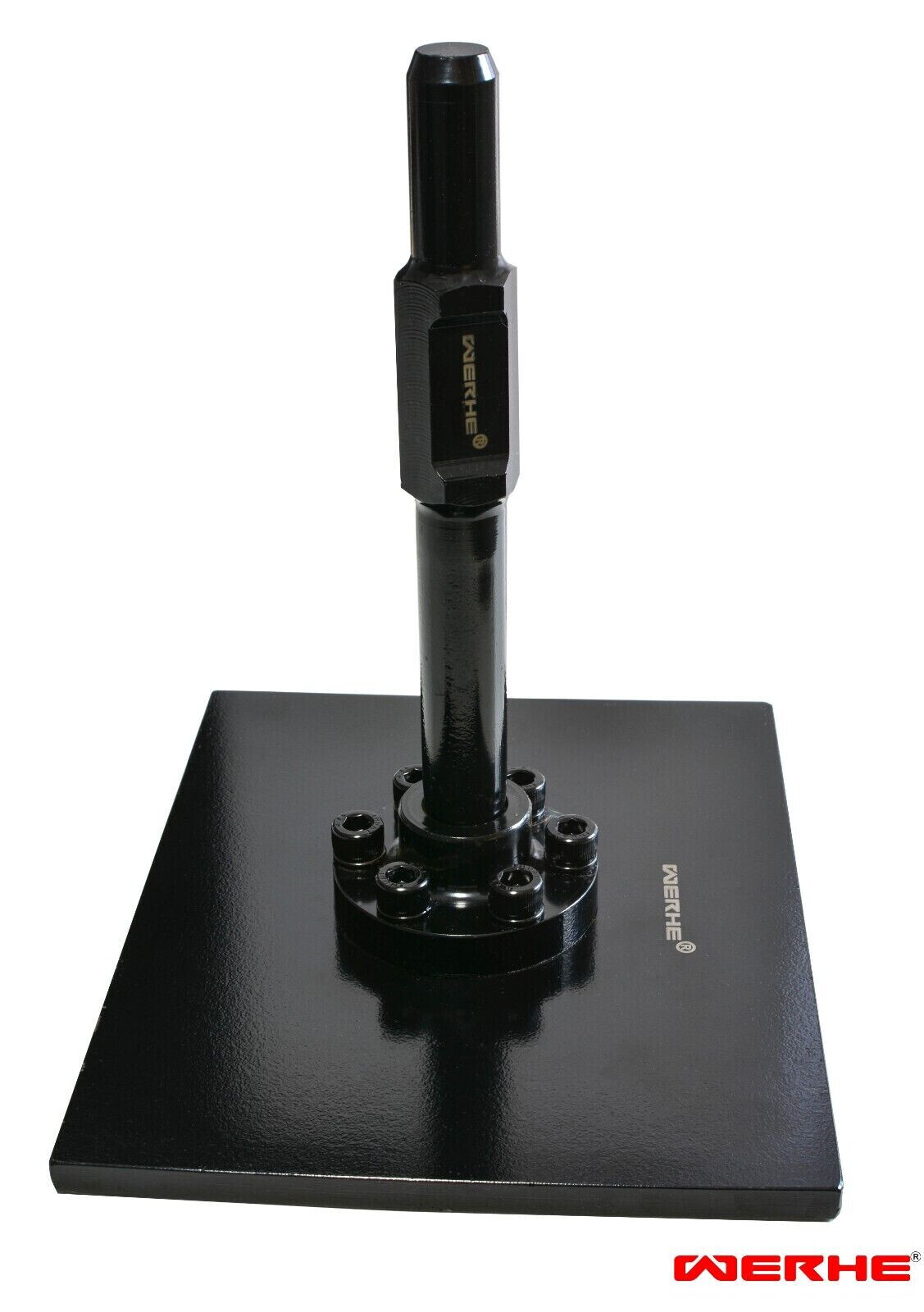
Just plug it in and you’re good to go. It costs around one hundred euros on eBay.
So, instead of the chisel, of course.
Just plug it in and you’re good to go. It costs around one hundred euros on eBay.
W
WilderSueden27 Nov 2023 16:41ateliersiegel schrieb:
On the right side of this terrace, about 80cm (31 inches) down to the lawn, a small staircase with 4 steps is needed.
It will be built from granite blocks and will be quite massive, likely only moveable as a whole.
A layer of gravel will be used as the base underneath. Back to the main issue... are we talking about the trenches for the retaining wall posts? For those, even the small plate compactors are usually too large, so only a trench compactor or manual tamper will work.
K
KarstenausNRW27 Nov 2023 17:01Buchsbaum schrieb:
Wacker produced the first electric vibratory plates and tampers in 1930. Just a little info.I love smart alecks... Yes, it was invented by Wacker. But that doesn’t mean it was standard in 1930, 1935, or 1940. The vibratory plate only became common with the use of an internal combustion engine in the early 1950s.
That also doesn’t mean that heat pump heating was common in the 1950s. The 19th-century 1850s—that’s when it was invented. Or the electric ground source heat pump from the early 1900s.
Between 1930 and 1950, building was still very conventional—that is, old-fashioned.
 ateliersiegel27 Nov 2023 17:23
Are we talking about the trenches for the palisades here? Palisades?
A small staircase with 4 steps.
It will be made from granite pillars and become quite a massive block...
A gravel layer will be placed underneath as the base. I want to use gravel—about 10 centimeters deep (4 inches)—as the bottom layer under the entire block. Ideally, it should be arranged so that any water collecting there drains forward—that is, away from the terrace—or seeps away.
Trenches 80 centimeters (31.5 inches) deep to protect against frost are too much work for me. It won’t be a disaster if the structure shifts a few centimeters over the years... and I don’t expect more than that (who knows? 🤨)
I appreciate all your thoughts on this, as they help me organize my own ideas.