
Hello everyone,
We have a very simple two-stringer staircase over three floors in our new build (two upper floors instead of a basement), similar to the one shown in the picture:
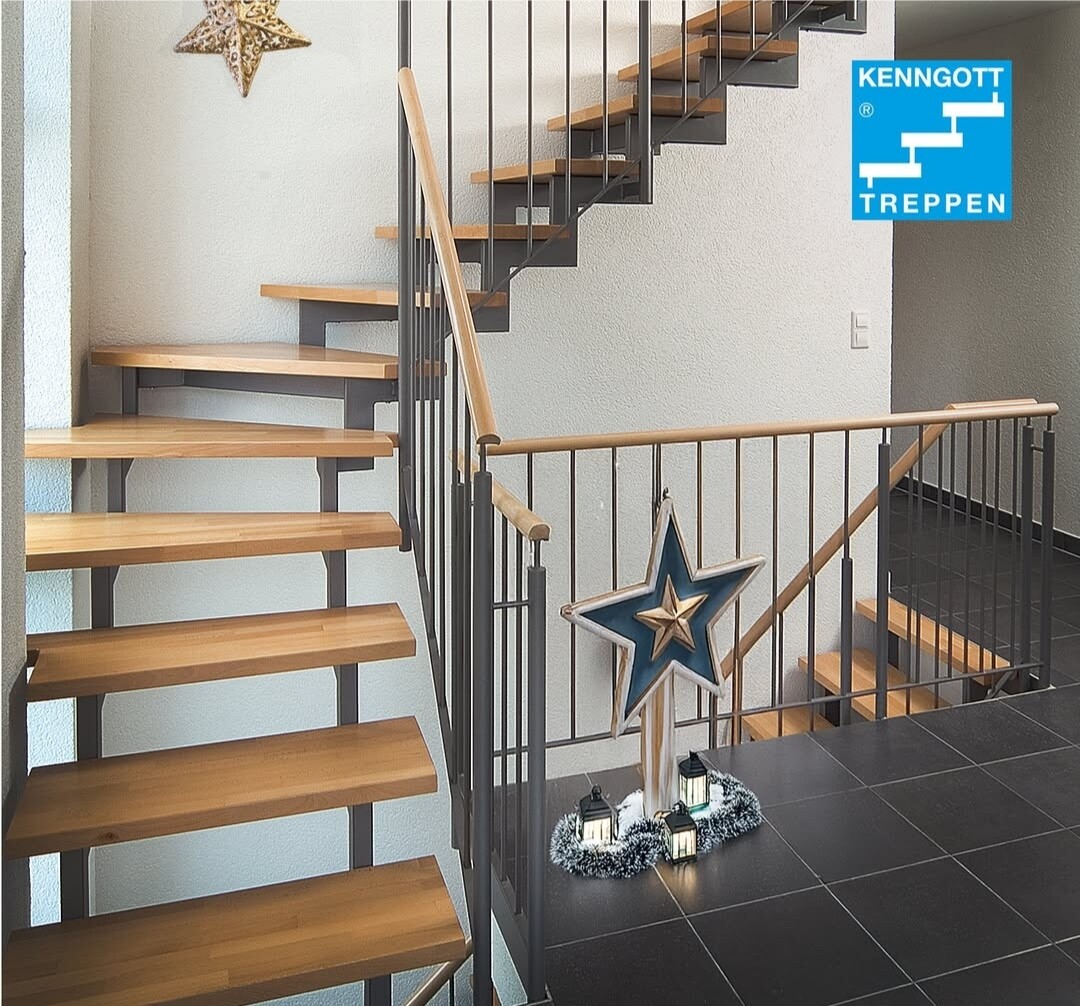
Our floor is oak parquet and the stair treads are also oak. Now we need to choose the color for painting the staircase. Since we have white window frames, initially white walls, and also white doors, we want to go for a gray/black shade to introduce some contrast, independent of furniture or artwork. Nowadays, you often see "anthracite," which is also the color of our front door. However, the door is white on the inside, and you have to enter the living area first to reach the staircase. My husband wants to choose anthracite (RAL 7016), but I’m a bit worried it might be too dark. In the color catalog, there is also graphite gray (RAL 7024), which seems slightly lighter. However, there are many gray tones, and with just a small color sample, it’s easy to be misled and end up with an unexpected brown, green, blue tint, or something else.
Who has experience with this? Do most people simply choose anthracite, or has anyone dared to go for something different? By the way, I find it perfectly fine for something so long-term to be a bit boring.
Many greetings
We have a very simple two-stringer staircase over three floors in our new build (two upper floors instead of a basement), similar to the one shown in the picture:
Our floor is oak parquet and the stair treads are also oak. Now we need to choose the color for painting the staircase. Since we have white window frames, initially white walls, and also white doors, we want to go for a gray/black shade to introduce some contrast, independent of furniture or artwork. Nowadays, you often see "anthracite," which is also the color of our front door. However, the door is white on the inside, and you have to enter the living area first to reach the staircase. My husband wants to choose anthracite (RAL 7016), but I’m a bit worried it might be too dark. In the color catalog, there is also graphite gray (RAL 7024), which seems slightly lighter. However, there are many gray tones, and with just a small color sample, it’s easy to be misled and end up with an unexpected brown, green, blue tint, or something else.
Who has experience with this? Do most people simply choose anthracite, or has anyone dared to go for something different? By the way, I find it perfectly fine for something so long-term to be a bit boring.
Many greetings
D
derdietmar8 Feb 2025 21:00Hello,
it looks like corrosion protection paint. In that case, the only option left is to paint it, unfortunately it’s too late for the raw metal look...
Instead of RAL 7016, I would rather lean towards DB 703, RAL 7013, or RAL 7022 to get rid of that bluish tint.
Best regards
it looks like corrosion protection paint. In that case, the only option left is to paint it, unfortunately it’s too late for the raw metal look...
Instead of RAL 7016, I would rather lean towards DB 703, RAL 7013, or RAL 7022 to get rid of that bluish tint.
Best regards
We also have a similar staircase in the living area, but with dark brown steps (black or black oak was not offered at the time).
For interior colors, I don’t follow RAL colors strictly; instead, I deliberately choose from tonal scales, complementary colors, or simply whatever I like.
I don’t focus on white (windows, walls, ceiling). The white shade neutralizes and supports the look. We chose a gray tone with about 75% black density.
If I hadn’t liked it, I wouldn’t have minded spending another two hours repainting. Now, after 11 years, black and gray are disappearing from our space and are used only as accents. Gray and black will become white and beige. The staircase will be updated soon. Copper, blush... we’ll see what the market offers next year.
So: do what feels right to you. If it doesn’t work out, you can always change it.
For interior colors, I don’t follow RAL colors strictly; instead, I deliberately choose from tonal scales, complementary colors, or simply whatever I like.
I don’t focus on white (windows, walls, ceiling). The white shade neutralizes and supports the look. We chose a gray tone with about 75% black density.
If I hadn’t liked it, I wouldn’t have minded spending another two hours repainting. Now, after 11 years, black and gray are disappearing from our space and are used only as accents. Gray and black will become white and beige. The staircase will be updated soon. Copper, blush... we’ll see what the market offers next year.
So: do what feels right to you. If it doesn’t work out, you can always change it.
B
Bertram1009 Feb 2025 07:44I would choose a color. A muted, grayish green or red. If you prefer something less striking, then painting it white would be better. Anthracite or black combined with white does not create a very appealing contrast where there isn’t enough space and light. It ends up looking like “we didn’t dare to try anything and just did what everyone else has done so far.”
I would choose anything except anthracite or black.
I would choose anything except anthracite or black.
W
wiltshire9 Feb 2025 07:58If you want the staircase to be visually striking, choose the dark color. If you prefer it to appear lighter and more discreet, choose white.
wiltshire schrieb:
If you want the staircase to be visually prominent, choose the dark color. If you prefer it to look lighter and more discreet, go with white.Actually, I initially wanted white and the wall beige. However, by the time we get around to painting the three-story stairwell, we might as well repaint the staircase too.
derdietmar schrieb:
Hello,
it looks like an anti-corrosion primer. Painting is the only option left; unfortunately, it’s too late to keep the raw look...
Instead of RAL7016, I would probably lean more towards DB703, RAL7013, or RAL7022 to get rid of that bluish tint.
Best regardsDB tones are not available as options. On my color chart, RAL7013 and RAL7022 have a more noticeable brownish tint compared to anthracite’s bluish tint. I need some time to think this over.
Similar topics