
Hello,
attached is a photo of our current construction phase. We have installed a glass roof on the house for a future cold conservatory. Also, a side panel has already been added on the left side to the L-shaped blocks.
The right (front post) has a DN50 rainwater drain at the lower end, which currently ends just above the gravel surface. The gravel layer is about 2m (6.5 feet) thick.
The house is a prefabricated home from the brand Schwörerhaus.
We plan to later install glass sliding elements on the front and right side to complete the cold conservatory. The builder of the roof told me that a foundation is needed for these sliding elements (30cm (12 inches) deep, 20cm (8 inches) wide).
The terrace is meant to be 2m (6.5 feet) larger on each side than the conservatory, and I frankly don’t know what would be more sensible or practical to use—composite wood decking (WPC)/wooden planks or paving slabs.
With decking, I need as much free air circulation as possible to keep it dry. However, in my opinion, this also leads to rather quick cooling in autumn and spring. Or can a wooden terrace be made airtight enough for outdoor use? A stone terrace would have corresponding advantages. What is the forum’s opinion on this? Should the slope start under the glass roof in this case or only at the edge outside the shaded area?
How would you handle drainage at the corner post? The builder suggested simply creating a soakaway pit with gravel there and letting the water flow directly beside the post.
What is your opinion on the foundation for the glass sliding elements? If it is to be 20cm (8 inches) wide, then I will always have a 20cm (8 inches) wide concrete wall visible on my terrace. How have you covered or cladded this?
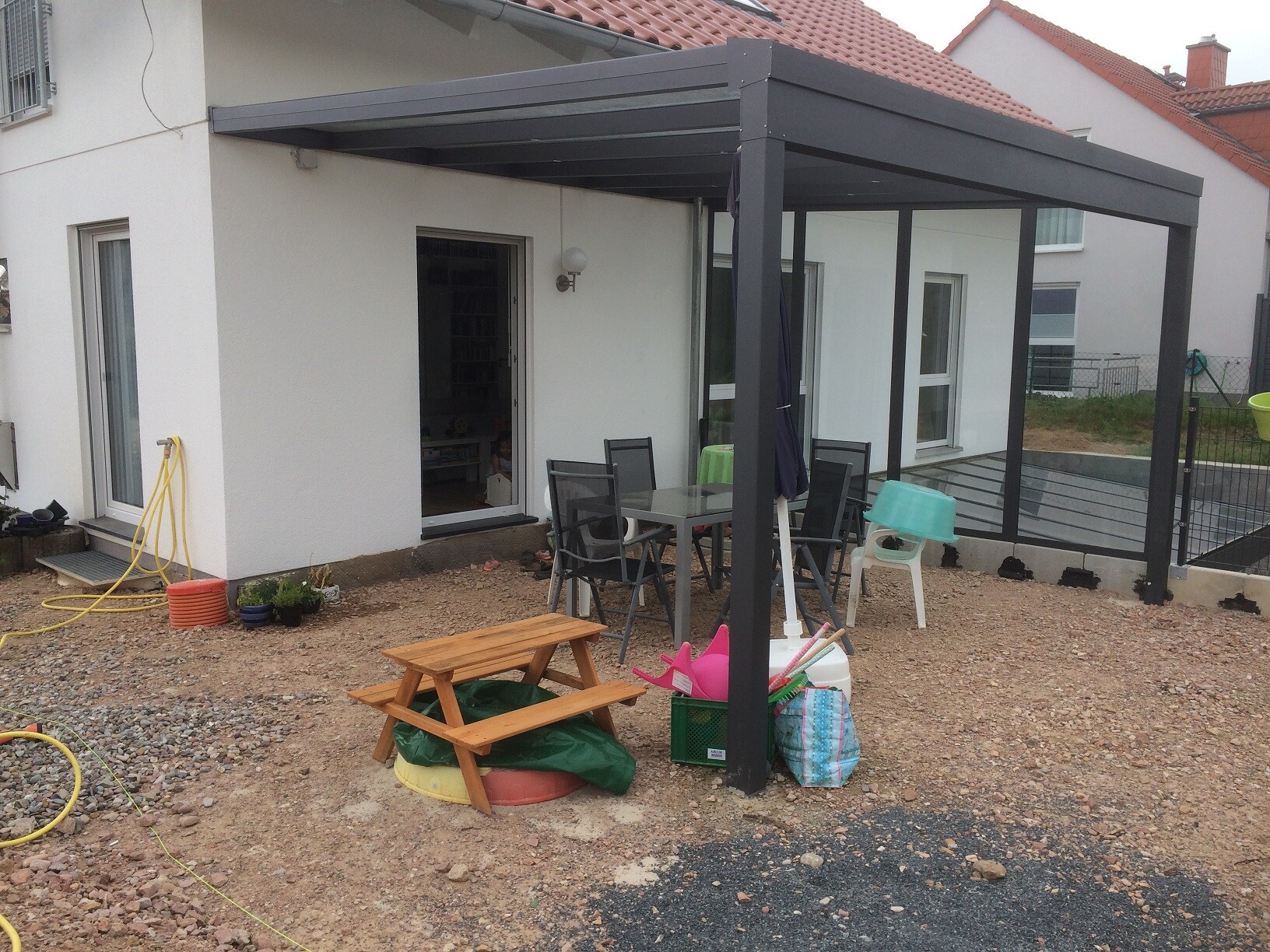
attached is a photo of our current construction phase. We have installed a glass roof on the house for a future cold conservatory. Also, a side panel has already been added on the left side to the L-shaped blocks.
The right (front post) has a DN50 rainwater drain at the lower end, which currently ends just above the gravel surface. The gravel layer is about 2m (6.5 feet) thick.
The house is a prefabricated home from the brand Schwörerhaus.
We plan to later install glass sliding elements on the front and right side to complete the cold conservatory. The builder of the roof told me that a foundation is needed for these sliding elements (30cm (12 inches) deep, 20cm (8 inches) wide).
The terrace is meant to be 2m (6.5 feet) larger on each side than the conservatory, and I frankly don’t know what would be more sensible or practical to use—composite wood decking (WPC)/wooden planks or paving slabs.
With decking, I need as much free air circulation as possible to keep it dry. However, in my opinion, this also leads to rather quick cooling in autumn and spring. Or can a wooden terrace be made airtight enough for outdoor use? A stone terrace would have corresponding advantages. What is the forum’s opinion on this? Should the slope start under the glass roof in this case or only at the edge outside the shaded area?
How would you handle drainage at the corner post? The builder suggested simply creating a soakaway pit with gravel there and letting the water flow directly beside the post.
What is your opinion on the foundation for the glass sliding elements? If it is to be 20cm (8 inches) wide, then I will always have a 20cm (8 inches) wide concrete wall visible on my terrace. How have you covered or cladded this?

How is the situation with the adjacent winter garden on the basement level handled?
https://www.instagram.com/11antgmxde/
https://www.linkedin.com/company/bauen-jetzt/
https://www.instagram.com/11antgmxde/
https://www.linkedin.com/company/bauen-jetzt/
D
daniels8728 May 2018 15:36There are aluminum crossbars that are screwed between the posts, on which the sliding door rails are then mounted. These could also be set into a lean concrete bed (with compacted gravel underneath). A direct strip foundation would be unnecessarily complicated, as it would have to be perfectly level.
Additionally, we glazed the wedge sections on the sides.
For the surface, we laid porcelain stoneware patio slabs in drainage concrete, with permeable joints.
I am currently building an adjacent pergola next to the existing patio, also made of aluminum, with one side having a wall of wooden rhombus slats. It has no roof, as the pergola is intended to be covered with climbing plants. For this, I will use wooden decking boards. I wouldn’t do this in a conservatory, partly because of crawling insects and so on.
This way, there is a cold conservatory for cooler days and the pergola for the high summer. Aluminum is simply a brilliant material. It doesn’t weather and is very lightweight. I built the pergola (5.2 x 3.5 m) entirely on my own. The beams are easy to lift overhead.
Additionally, we glazed the wedge sections on the sides.
For the surface, we laid porcelain stoneware patio slabs in drainage concrete, with permeable joints.
I am currently building an adjacent pergola next to the existing patio, also made of aluminum, with one side having a wall of wooden rhombus slats. It has no roof, as the pergola is intended to be covered with climbing plants. For this, I will use wooden decking boards. I wouldn’t do this in a conservatory, partly because of crawling insects and so on.
This way, there is a cold conservatory for cooler days and the pergola for the high summer. Aluminum is simply a brilliant material. It doesn’t weather and is very lightweight. I built the pergola (5.2 x 3.5 m) entirely on my own. The beams are easy to lift overhead.

D
daniels8729 May 2018 08:18The entire terrace area is currently a construction site :-/
At least the lawn has grown well; I only sowed it two weeks ago.
The climbing plants are large-leaved morning glories. The soil would probably be too heavy and damp for grapevines. On the back side of the wooden wall (west side), I’m trying mini kiwis.
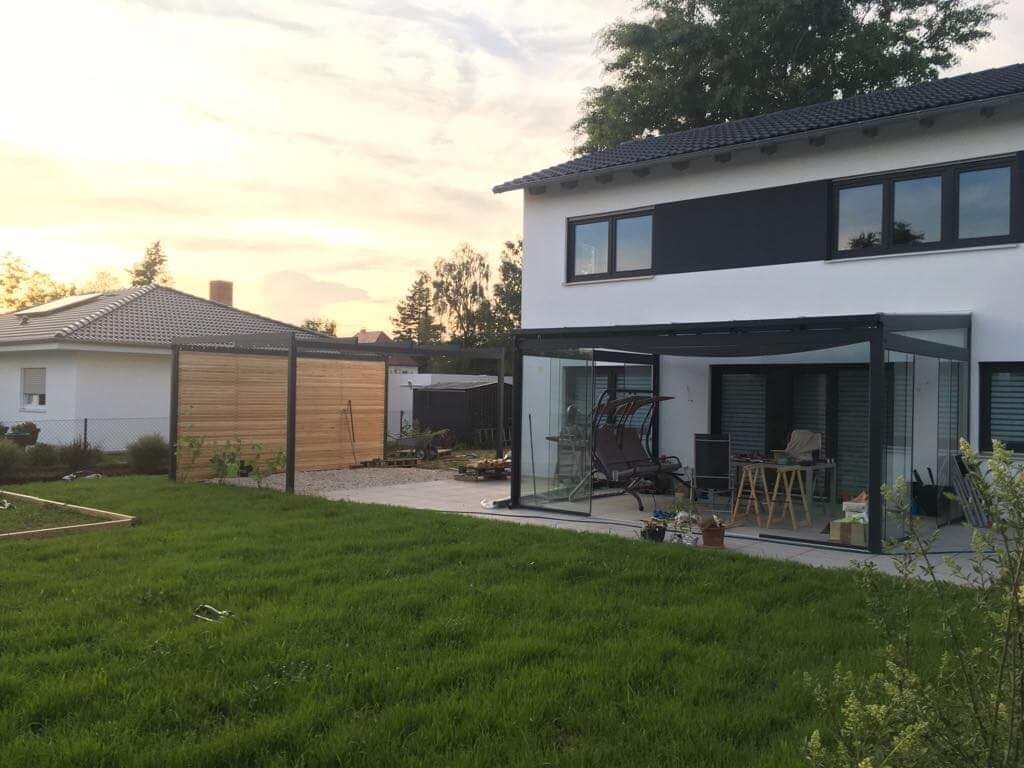
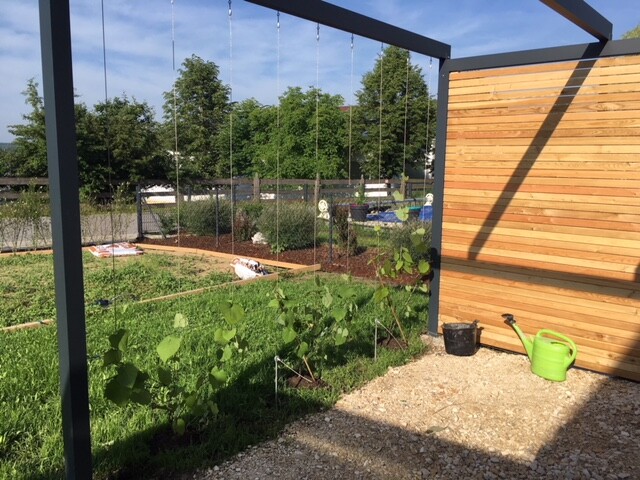
At least the lawn has grown well; I only sowed it two weeks ago.
The climbing plants are large-leaved morning glories. The soil would probably be too heavy and damp for grapevines. On the back side of the wooden wall (west side), I’m trying mini kiwis.
Similar topics