
ᐅ Close the airspace in the roof above the partition walls
Created on: 21 Dec 2025 22:16
T
tenspoplin5sT
tenspoplin5s21 Dec 2025 22:16Hi,
our roof is finally on, and the house will be completed before the end of the year – I’m relieved.
Here is our current situation:
single-story building, all interior walls made of 17.5cm (7 inches) calcium silicate bricks, with a reinforced concrete ring beam on top. The flat roof rests on the ring beam – warm roof construction with solid wood rafters, 25mm (1 inch) OSB3 sheathing, followed by 14cm (5.5 inches) PIR insulation, then an EPDM full-surface membrane, and finally a green roof.
All rooms will have a suspended drywall ceiling roughly aligned with the middle of the ring beam, see the line in the picture below.
This creates a shared airspace/cavity above all the rooms. I want to acoustically decouple the rooms from each other and am looking for a practical solution. My first idea: cut 22mm (7/8 inch) OSB3 panels and close off the walls between the rooms in the red marked area in the picture. I would leave a minimal gap (3-5mm / 0.1-0.2 inches) to the roof sheathing, which I would then seal with a permanently elastic foam (there are several flexible foams on the market) or MS polymer. This way, the rooms would be airtight from each other while still allowing the roof to move without damaging the seal. Using 22mm OSB on both sides of the wall would be overkill based on thorough research, since the main goal is to interrupt the cavity with an airtight layer – a single 22mm OSB panel should suffice for that.
Second idea: to reduce excitation of the drywall ceiling, I could use sound-isolating hangers. Also, I could attach 40-60mm (1.5-2.4 inches) mineral wool insulation on both sides of the OSB sheathing I install as a wall. This should reduce the OSB panel’s tendency to vibrate. Then, we would mostly be dealing with structure-borne sound through the rafters/roof sheathing into the ring beam and calcium silicate walls, correct?
My question to the experts: what is necessary, what is overkill?
My goal: “normal sound insulation in the living area” – when I close the solid wood doors later, conversations should not be overheard from room to room. If loud music is played in one room, it’s okay that it’s still audible outside.
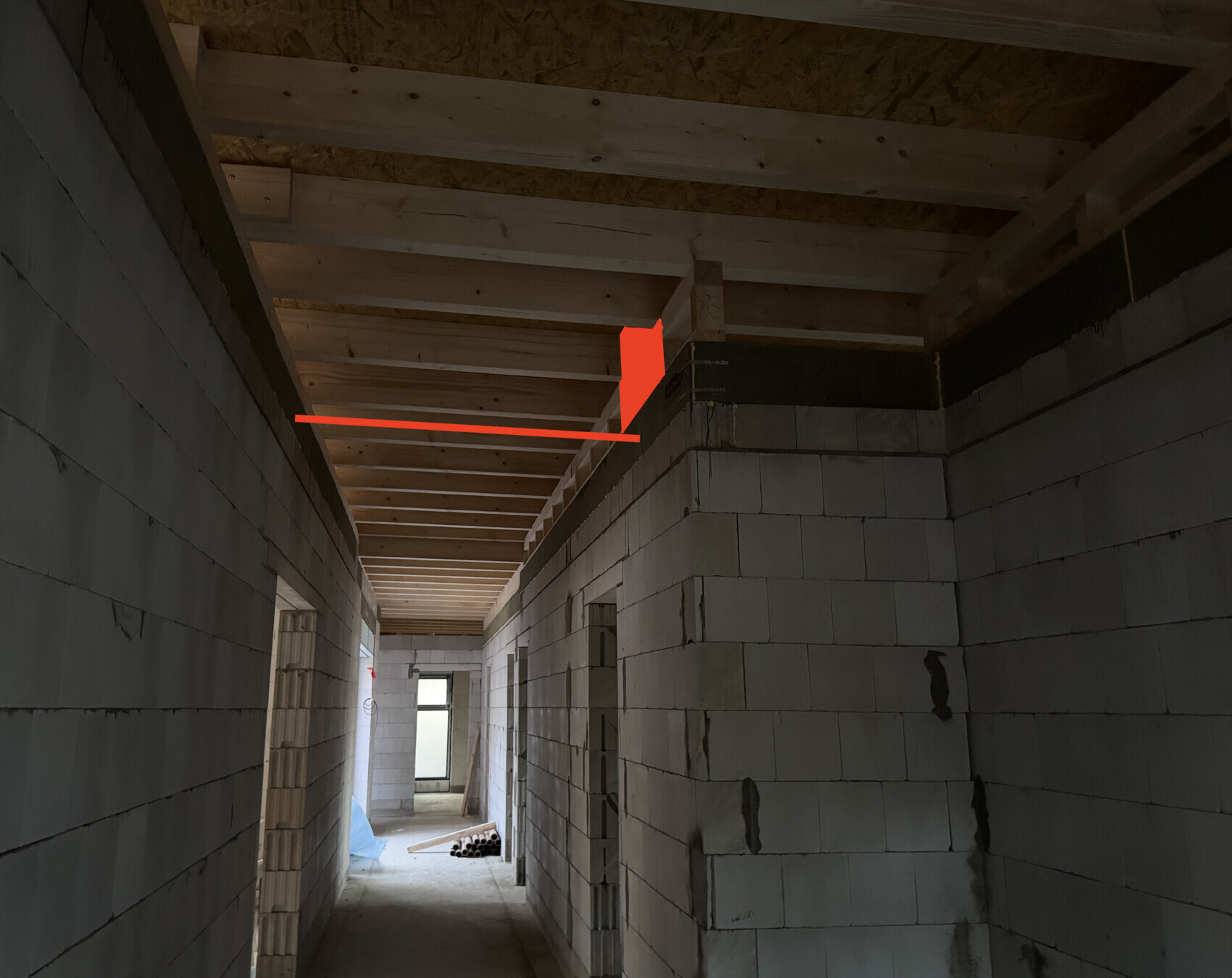
For the exterior, OSB3 sheathing was also used – here 25mm (1 inch) thickness – as you can see from the light gaps in the picture, which still need to be sealed airtight:

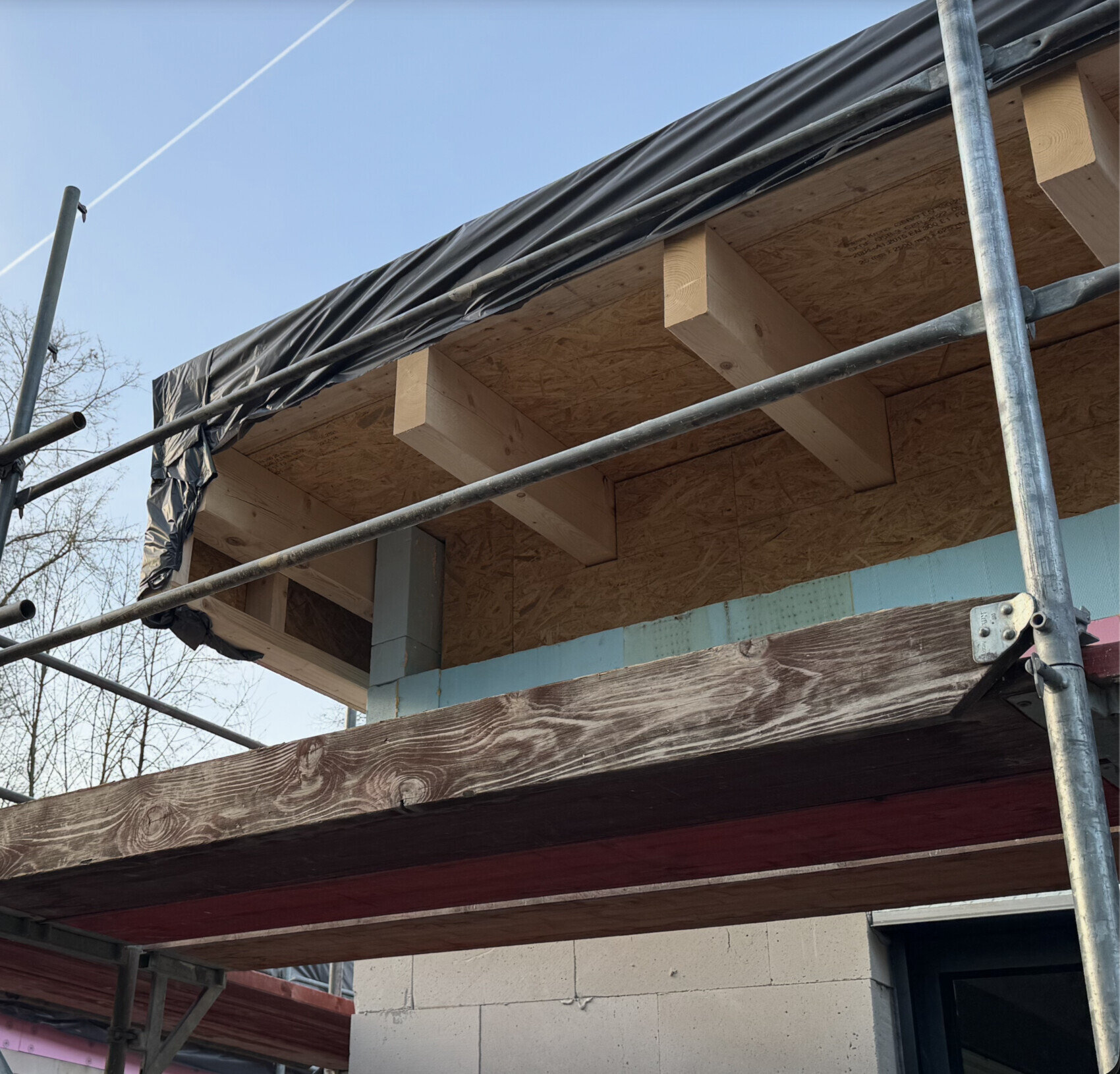
Here is the exterior view, where a 14cm (5.5 inches) EPS or XPS insulation will be added, as already visible on the left. In the upper area between the ring beam and roof, the 25mm OSB3 currently serves as the “wall sheathing.” On the inside, I would also install a 22mm OSB panel in front of it, similar to the interior walls as planned, as described above.
our roof is finally on, and the house will be completed before the end of the year – I’m relieved.
Here is our current situation:
single-story building, all interior walls made of 17.5cm (7 inches) calcium silicate bricks, with a reinforced concrete ring beam on top. The flat roof rests on the ring beam – warm roof construction with solid wood rafters, 25mm (1 inch) OSB3 sheathing, followed by 14cm (5.5 inches) PIR insulation, then an EPDM full-surface membrane, and finally a green roof.
All rooms will have a suspended drywall ceiling roughly aligned with the middle of the ring beam, see the line in the picture below.
This creates a shared airspace/cavity above all the rooms. I want to acoustically decouple the rooms from each other and am looking for a practical solution. My first idea: cut 22mm (7/8 inch) OSB3 panels and close off the walls between the rooms in the red marked area in the picture. I would leave a minimal gap (3-5mm / 0.1-0.2 inches) to the roof sheathing, which I would then seal with a permanently elastic foam (there are several flexible foams on the market) or MS polymer. This way, the rooms would be airtight from each other while still allowing the roof to move without damaging the seal. Using 22mm OSB on both sides of the wall would be overkill based on thorough research, since the main goal is to interrupt the cavity with an airtight layer – a single 22mm OSB panel should suffice for that.
Second idea: to reduce excitation of the drywall ceiling, I could use sound-isolating hangers. Also, I could attach 40-60mm (1.5-2.4 inches) mineral wool insulation on both sides of the OSB sheathing I install as a wall. This should reduce the OSB panel’s tendency to vibrate. Then, we would mostly be dealing with structure-borne sound through the rafters/roof sheathing into the ring beam and calcium silicate walls, correct?
My question to the experts: what is necessary, what is overkill?
My goal: “normal sound insulation in the living area” – when I close the solid wood doors later, conversations should not be overheard from room to room. If loud music is played in one room, it’s okay that it’s still audible outside.
For the exterior, OSB3 sheathing was also used – here 25mm (1 inch) thickness – as you can see from the light gaps in the picture, which still need to be sealed airtight:
Here is the exterior view, where a 14cm (5.5 inches) EPS or XPS insulation will be added, as already visible on the left. In the upper area between the ring beam and roof, the 25mm OSB3 currently serves as the “wall sheathing.” On the inside, I would also install a 22mm OSB panel in front of it, similar to the interior walls as planned, as described above.
Similar topics