
Hello,
We had water damage that has now been repaired and dried. I want to close the wall again – see photo. By the way, the water damage was at the bottom left. All the open areas on the right were opened up during the search for the source.
My problem is that the pipes were previously embedded in a material I am not familiar with. The cavity around the pipes was filled with something that looks like a mounting foam made of small polystyrene beads. It is soft, can be pressed in with a finger, and rubs off very easily. Afterwards, everything is covered with these small, strange beads. Above the horizontal drain pipe, you can still see an area like that. It might be a type of Tiroplan slot plaster. I have no idea where to get it...
I would prefer to close the wall “like before.” So, put the insulation back in, plaster, tile it, and that’s it. It should not be a poor fix (just throwing in concrete or spray foam), but also not a major renovation (going all out with stainless steel, etc.)... 🙂
If I want to close it with a lime-cement plaster, I probably have quite some work ahead. The DN50 (2-inch) drain pipe is currently not insulated. But I can’t easily fit an insulation sleeve around it because everything is quite tight. The copper pipes are insulated, but there is a branch where the copper is currently bare. What is wrapped in duct tape there would need to be covered with something proper.
I appreciate any advice!
Best regards,
André
PS: The last plumber on site told me to just fill it up with mortar...
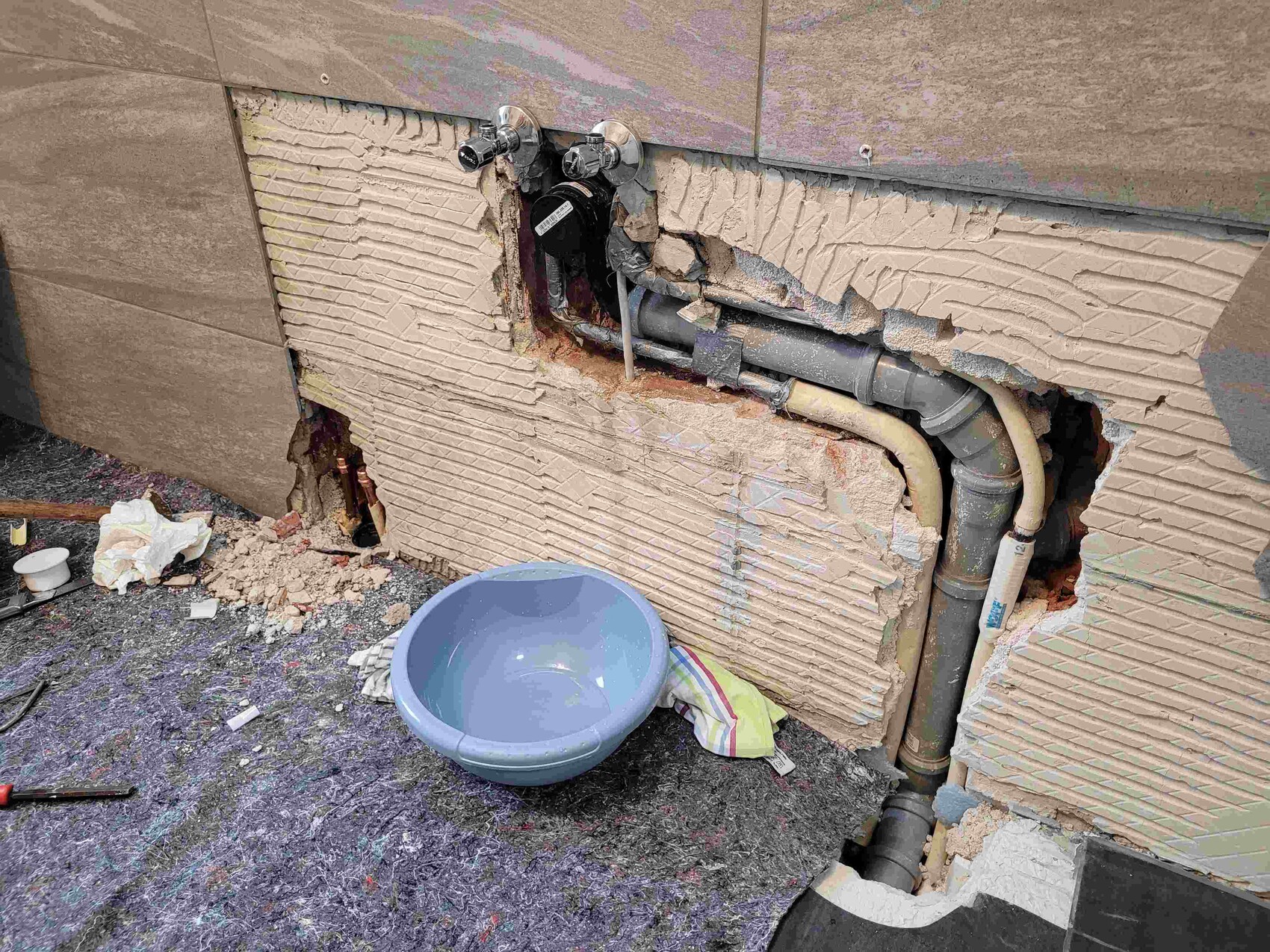
We had water damage that has now been repaired and dried. I want to close the wall again – see photo. By the way, the water damage was at the bottom left. All the open areas on the right were opened up during the search for the source.
My problem is that the pipes were previously embedded in a material I am not familiar with. The cavity around the pipes was filled with something that looks like a mounting foam made of small polystyrene beads. It is soft, can be pressed in with a finger, and rubs off very easily. Afterwards, everything is covered with these small, strange beads. Above the horizontal drain pipe, you can still see an area like that. It might be a type of Tiroplan slot plaster. I have no idea where to get it...
I would prefer to close the wall “like before.” So, put the insulation back in, plaster, tile it, and that’s it. It should not be a poor fix (just throwing in concrete or spray foam), but also not a major renovation (going all out with stainless steel, etc.)... 🙂
If I want to close it with a lime-cement plaster, I probably have quite some work ahead. The DN50 (2-inch) drain pipe is currently not insulated. But I can’t easily fit an insulation sleeve around it because everything is quite tight. The copper pipes are insulated, but there is a branch where the copper is currently bare. What is wrapped in duct tape there would need to be covered with something proper.
I appreciate any advice!
Best regards,
André
PS: The last plumber on site told me to just fill it up with mortar...
Hi Andre,
EPS granulate or loose fill insulation crumbles like snow dust and was designed specifically for these kinds of pipe areas. You can easily reinstall it as is, it provides good thermal and sound insulation. Off to the hardware store 😉
I would cover the bare copper section with a thin pipe insulation sleeve; that’s all you need. You don’t necessarily have to fully wrap the DN50 (2 inch) pipe, as long as it’s properly embedded.
Good luck!
EPS granulate or loose fill insulation crumbles like snow dust and was designed specifically for these kinds of pipe areas. You can easily reinstall it as is, it provides good thermal and sound insulation. Off to the hardware store 😉
I would cover the bare copper section with a thin pipe insulation sleeve; that’s all you need. You don’t necessarily have to fully wrap the DN50 (2 inch) pipe, as long as it’s properly embedded.
Good luck!
Thank you for the quick reply!
Unfortunately, I’m having trouble finding something suitable. I like to check online first before visiting our local hardware stores.
When it comes to slot filling, I always end up on Hornbach.at and other Austrian websites. This Tiroplan product also doesn’t seem to be common here.
I found something about EPS granulate on the German Hornbach site (Thermozell eco 400 ready mix). Would that be the right product? It appears to contain cement as well. I need something that I can mix into a kind of mortar and then fill into the slot. I don’t think a loose fill would stay in the wall until I plaster it ;-)
Unfortunately, I’m having trouble finding something suitable. I like to check online first before visiting our local hardware stores.
When it comes to slot filling, I always end up on Hornbach.at and other Austrian websites. This Tiroplan product also doesn’t seem to be common here.
I found something about EPS granulate on the German Hornbach site (Thermozell eco 400 ready mix). Would that be the right product? It appears to contain cement as well. I need something that I can mix into a kind of mortar and then fill into the slot. I don’t think a loose fill would stay in the wall until I plaster it ;-)
Hi André,
the eco-400 works but is quite light. I would recommend a slightly denser thermal insulation mixture, which can be compacted more tightly and stays reliably in the slot. It is important to mix it semi-wet and compact it well. Loose filling would really not be a good idea here.
the eco-400 works but is quite light. I would recommend a slightly denser thermal insulation mixture, which can be compacted more tightly and stays reliably in the slot. It is important to mix it semi-wet and compact it well. Loose filling would really not be a good idea here.
What would be a denser thermal insulation mixture? At our hardware store, I can get the 400 and 250 types. But as far as I understand, the 250 is still "lighter."
And as a small bonus question: If I fill the cavities with the mixture, I would probably need to plaster over it again, right? I still have some lime-cement plaster – would that be suitable on the thermal insulation? After that, only tile adhesive and tiles will be applied.
And as a small bonus question: If I fill the cavities with the mixture, I would probably need to plaster over it again, right? I still have some lime-cement plaster – would that be suitable on the thermal insulation? After that, only tile adhesive and tiles will be applied.
Use the 400 grit; it is absolutely sufficient for your purpose and can be compressed more compactly if mixed rather dry – make sure to fill the gaps thoroughly to prevent odors.
Lime-cement plaster adheres well to it; roughen the surface slightly beforehand. A thin layer is entirely enough, especially since tiles will be installed on top. Insulate the bare copper spot carefully to reduce operational noise.
Lime-cement plaster adheres well to it; roughen the surface slightly beforehand. A thin layer is entirely enough, especially since tiles will be installed on top. Insulate the bare copper spot carefully to reduce operational noise.
Similar topics