
Hello,
I have covered the space between the house and the garage.
Now I am looking for a way to fully enclose this area.
How would you approach this?
I was thinking of installing a roller shutter door.
Also, I need a recommendation for the roof. There are currently plastic corrugated panels that are cloudy and very brittle. I want to use transparent panels again because I need light there. Which panels would you recommend?
Attached is a picture to show what I mean.
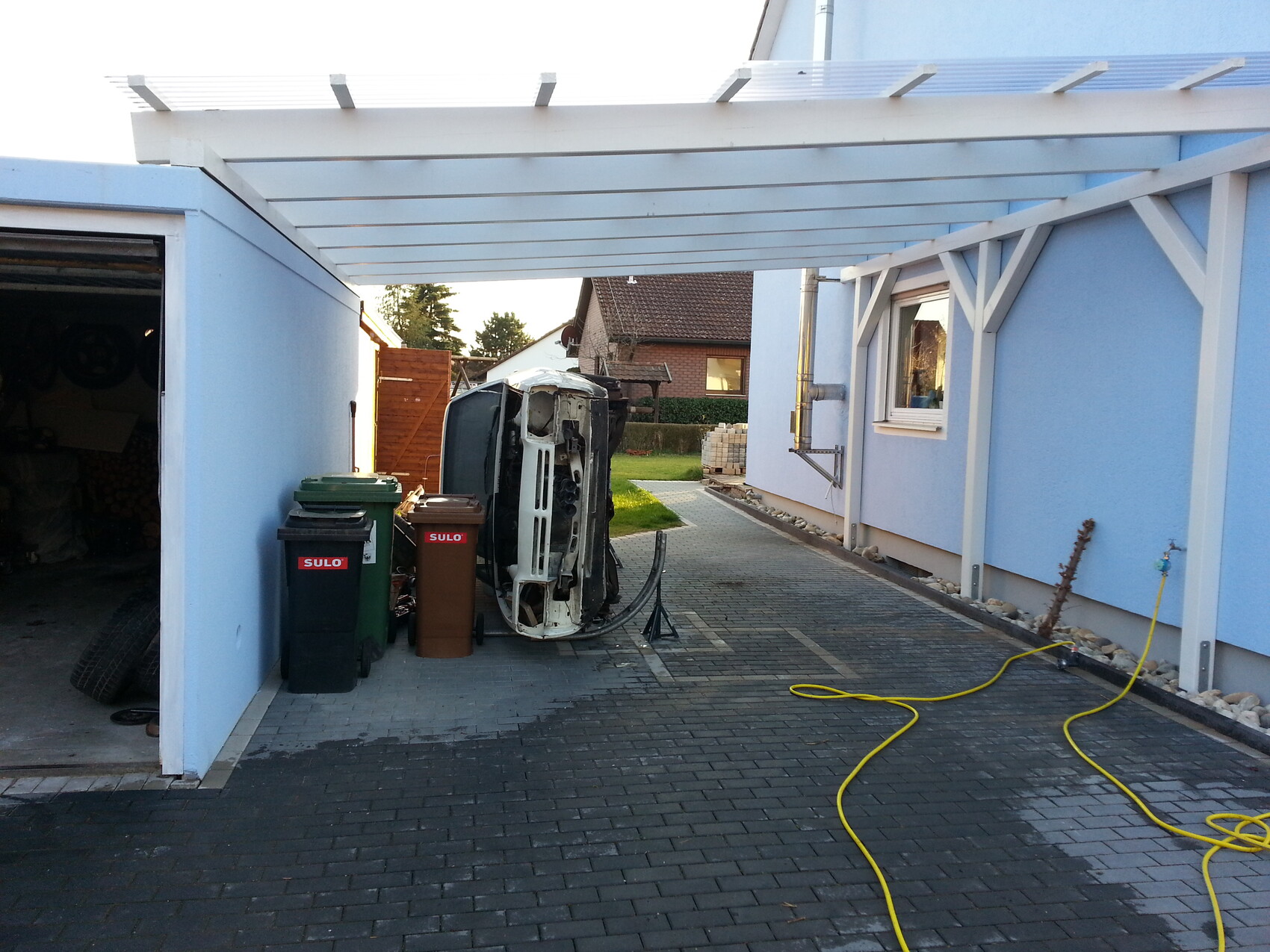
I have covered the space between the house and the garage.
Now I am looking for a way to fully enclose this area.
How would you approach this?
I was thinking of installing a roller shutter door.
Also, I need a recommendation for the roof. There are currently plastic corrugated panels that are cloudy and very brittle. I want to use transparent panels again because I need light there. Which panels would you recommend?
Attached is a picture to show what I mean.
D
Dieter111110 Mar 2020 15:56That’s exactly how I imagined it.
But I would need precise ideas about which materials I can use for that.
In particular, which cladding to apply and how to anchor the supports into the ground…..
P.S. I dismantled the manta because I needed parts for my other one.
But I would need precise ideas about which materials I can use for that.
In particular, which cladding to apply and how to anchor the supports into the ground…..
P.S. I dismantled the manta because I needed parts for my other one.
 Birkenfelder10 Mar 2020 16:22
Here are my suggestions:
- Top anchoring: Support placed in front of the beam, connection plate attached to the support with holes for Spax screws
- Bottom anchoring: Open the paving around the supports, small individual foundation 250mm (10 inches) deep with a thickness of 500mm (20 inches)
Personally, I would build the supports from galvanized steel. This way, the structure can initially remain unfinished without starting to rust. Since there is hardly any wind load and only short support spans, HEA 100 to HEA 120 sections will be entirely sufficient in that area.
For the walls, you could use sandwich panels (whether installed horizontally or vertically). The advantage is that you get some insulation, although combined with PVC roof light panels, the effect is somewhat limited. Alternatively, single-layer trapezoidal metal sheets are an option. However, depending on the building permit / planning permission, such walls may not be allowed everywhere.
At least one piece of scrap metal made it onto the street!
- Top anchoring: Support placed in front of the beam, connection plate attached to the support with holes for Spax screws
- Bottom anchoring: Open the paving around the supports, small individual foundation 250mm (10 inches) deep with a thickness of 500mm (20 inches)
Personally, I would build the supports from galvanized steel. This way, the structure can initially remain unfinished without starting to rust. Since there is hardly any wind load and only short support spans, HEA 100 to HEA 120 sections will be entirely sufficient in that area.
For the walls, you could use sandwich panels (whether installed horizontally or vertically). The advantage is that you get some insulation, although combined with PVC roof light panels, the effect is somewhat limited. Alternatively, single-layer trapezoidal metal sheets are an option. However, depending on the building permit / planning permission, such walls may not be allowed everywhere.
Dieter1111 schrieb:
p.s. den manta habe ich geschlachtet da ich teile für meinen anderen brauchte.
At least one piece of scrap metal made it onto the street!
D
Dieter111115 Mar 2020 18:08There is still plenty of scrap metal lying around here.
Thank you for your tips.
Thank you for your tips.